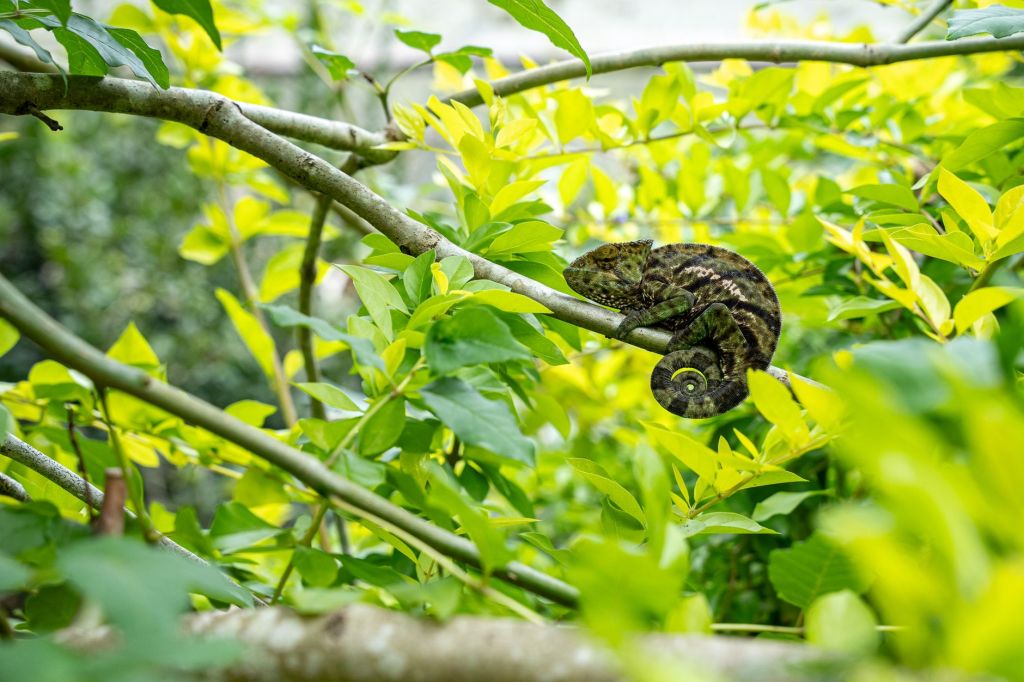
This is the third in a series of posts that demonstrate plants performing phenomena that hint at intelligent behaviour. These posts provide evidence to support the book’s draft chapter 6 The intelligent plant(?). Previous examples of plants behaving cleverly have provided nods in the direction of arithmetic, with ‘multiplication’ (colour-change of sexual apparatus), and addition (Venus flytrap). Now, it’s appropriate for a bit of ‘subtraction’ (but not as we necessarily know it in the mathematical sense*****).
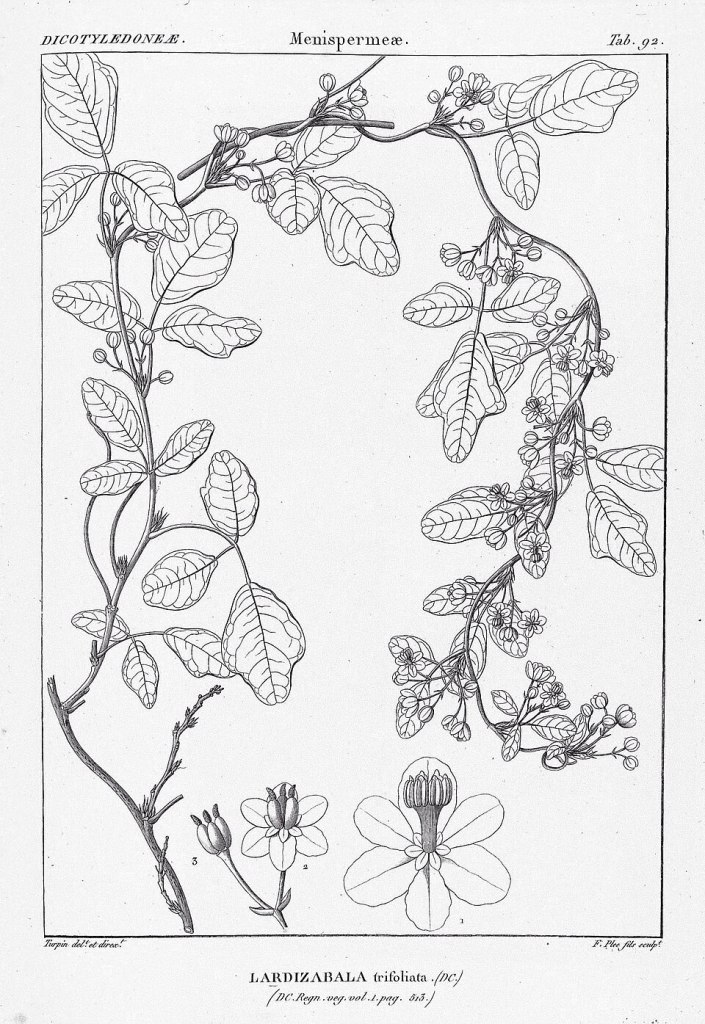
This image, entitled “Boquila trifoliata” by “Turpin, P. J. F. (Pierre Jean François), 1775-1840”, has been released into the public domain by its author, Missouri Botanical Garden. This applies worldwide.
In the early part of the 21st century, Ernesto Gianoli & Fernando Carrasco-Urra (2014) announced the discovery of a plant with the ability to alter its own leaf shape to match that of the plant over which it was growing.
The leaf-mimicking plant in question was Boquila trifoliata. A member of the flowering plant family known as the Lardizabalaceae (Maarten Christenhusz, 2012), it is a vine that gains height and exposure to more sunlight by scrambling over the self-supporting upright stems of other plants – especially trees.
Leaves of the ‘normal’ plant of B. trifoliata* have three leaflets (which is what the specific epithet ‘trifoliata’ means; think of the trefoil leaf of a clover in English), as shown in the picture above. However, leaves of parts of the vine that are next to other species have characteristics that are typical of the leaves of that other species. In other words, those of Gianoli & Carrasco-Urra (2014), it “mimics the leaves of its supporting trees in terms of size, shape, color, orientation, petiole length, and/or tip spininess”. As impressive as that feat is, there’s more. B. trifoliata not only has the ability to mimic leaves of one other species, it can also mimic leaves of more than one other species that may support the length of its twiny, viny stem. This phenomenon is known as sequential leaf mimicry, and can involve at least three other species with different leaf characteristics.
Having identified this behaviour, one naturally wants to understand what its purpose may be. By reference to the title of their report, Gianoli & Carrasco-Urra (2014) were clearly of the view that this “Leaf Mimicry in a Climbing Plant Protects against Herbivory”.
In support of that assertion they provided three pieces of evidence. First, the degree of herbivory did not differ between climbing vines and the supporting host trees – as would be expected on the basis that “indistinguishable phenotypes [i.e., leaves that looked similar] should lead to similar levels of leaf damage” (Gianoli & Carrasco-Urra, 2014). In other words, mimicked leaves were treated by herbivores as if they were those of the host. Second, leaf herbivory was significantly higher in creeping, unsupported Boquila individuals than in those climbing on trees. Which indicates that the vine gains some protection against herbivory by being raised above the forest floor – where it would attract the feeding attention of ground herbivores. And, third, leaf herbivory on vine individuals climbing onto leafless supports—on which there is no leaf model to mimic—was higher than leaf herbivory on unsupported individuals. This later implies that the vine’s ‘normal’ trifoliate leaf type is particularly prone to herbivore attack, which provides further support for leaf-mimicking being a behaviour that helps to reduce herbivory.
[Ed. – on the basis of the first piece of evidence, it appears that mimicked leaves suffer the same degree of herbivory as the plant whose leaves are mimicked. That would be advantageous to the vine if it mimics leaves of species that have some defence against herbivory. However, should it mimic leaves of a species that is particularly prone to herbivory, it would presumably suffer more herbivory than if it was not mimicking those leaves. In which situation the ability of the vine to discriminate between herbivory-prone and herbivory-resistant species would be a bonus. Can the vine do this? Does it tend to favour herbivore-defended species when selecting a support to scramble over? Some interesting questions about plant behaviour are suggested here. It would also be of interest to know if the chemistry of mimicked leaves differs from that of ‘normal’ vine leaves. And whether the chemistry of each different mimicked leaf is different from other mimicked leaves, and whether it is similar to that of the species whose leaves it is mimicking…]
Having a phenomenon, and a plausible interpretation of its survival value for the plant, the next obvious question is: How does it happen? What is the mechanism that brings this leaf-morphing behaviour about? Although candid (i.e., honest) enough to state that “We currently lack a mechanistic explanation for this unique phenomenon”, Gianoli & Carrasco-Urra (2014), do suggest two possible explanations for the fact that “leaf mimicry is observed even when the model [presumably the non-B. trifoliata plant whose leaves are ‘modelled’ by B. trifoliata] is not directly in contact with the vine”.
Their first named possibility involves ‘host plant volatiles’. Drawing upon reports that volatile organic compounds [VOCs (Verónica Couto Antelo; Francesco Loreto et al., 2014; Gianna Vivaldo et al., 2017; A Corina Vlot & Maaria Rosenkranz, 2022; Qurban Ali et al., 2026)] have been shown to elicit specific responses in neighbouring plants [see their article for examples they cite], Gianoli & Carrasco-Urra wondered if such chemicals might be released from the ‘model’ plants, detected by B. trifoliata and these may – somehow – give rise to the observed changes in leaf morphology. Maybe. But, as the authors state, “research on airborne plant-plant signaling has not reported specific morphological changes in leaves, and nothing is known about the involvement of volatiles of the model in leaf mimicry via induced reprogramming of genes in the mimic”. Any involvement of VOCs is neither proven nor disproven, but it is a hypothesis (Asghar Ghasemi et al., 2025) that can be examined further.
Their second suggestion – which Gianoli & Carrasco-Urra acknowledge is “perhaps less plausible” than VOCs – is horizontal gene transfer [HGT] (Graham Boorse, 2025) [Ed. – HGT is also known as lateral gene transfer (Carl Robinson, 2025)]. HGT is the name given to the transfer of genes between individuals – of the same or different species (Patrick Keeling & Jeffrey Palmer, 2008; Shannon Soucy et al., 2015; Carl Robinson, 2025).
[Ed. – seeing ‘horizontal’ specified, you’re probably wondering if there is such a thing as ‘vertical’ gene transfer [VGT]. There is, it’s what takes place in reproduction where a parent gives rise to offspring that therefore inherit parental genes. VGT is arguably the gene-transfer mechanism most of us are more familiar with…]
[Ed. – HGT lies at the heart of the spread and persistence of antibiotic resistance within and between bacteria (Alita Burmeister, 2015), HGT is also the phenomenon that underlies the creation of GM plants with the Agrobacterium-mediated transformation technique (Stanton Gelvin, 2003).]
Recognising that “mimicry is observed with respect to the foliage to which the vine is nearest, irrespective of whether this foliage belongs to the host tree that the vine has climbed”, Gianoli & Carrasco-Urra (2014) envisage that HGT here “might be mediated by airborne microorganisms” (presumably ferrying genes between the ‘nearest species’ and B. trifoliata). As for the VOC suggestion, at the time of publication of the leaf-mimicry observation, there was no evidence for HGT either. And, since Gianoli & Carrasco-Urra (2014) considered that HGT might operate on “an ecological timescale” it is difficult to imagine how this mechanism might explain the leaf mimicry taking place within the growing time of a few weeks of a single vine. But, and leaving the door open to further research on this phenomenon, Gianoli & Carrasco-Urra (2014) end their report with “Further research on leaf mimicry by B. trifoliata might lead to the identification of the host tree volatiles or vector-mediated gene transfers that trigger differential gene expression in this singular climbing plant”.
Follow-up work…
By way of providing some sort of support for a HGT explanation, Ernesto Gianoli et al. (2021) examined the bacterial communities within leaves of B. trifoliata and a tree whose leaves it was mimicking, Rhaphithamnus spinosus. Whereas leaves of a non-mimicking B. trifoliata and R. spinosus* showed no overlap in their internal bacterial communities, leaves of mimicking B. trifoliata and R. spinosus did show an overlap in those microbial populations. Although that finding is still a long way away from demonstrating any involvement of HGT in the leaf mimicry behaviour, it does permit the conclusion that “The role of bacteria in this unique case of leaf mimicry should be studied further” (Gianoli et al., 2021).
Things get much more interesting when František Baluška & Stefano Mancuso (2016), dismissing attempts to explain the Boquila leaf-mimicry by VOC communication between the vine and host trees, or via HGT, as “quite implausible”, proposed involvement of ocelli in this phenomenon. Ocelli are a concept attributed to esteemed Austrian botanist Gottlieb Haberlandt, who proposed it for the “leaf epidermis in which the upper epidermal cells resemble convex or planoconvex lens, converging light rays on the light-sensitive subepidermal cells” (Felipe Yamashita & František Baluška 2023). And, in the case of Boquila leaf-mimicry, it was suggested that epidermal cells were appropriately positioned to “gather information about their environmental setting through vision-based inputs” (Baluška & Mancuso, 2016).
A suggestion needs to be tested before it can be verified to have any validity or veracity. Appropriately enough, a follow-up investigation into B. trifoliata‘s leaf-mimicry was conducted by Jacob White & Felipe Yamashita (2022). Keen to avoid any complications from VOCs or HGT, they examined the ability of B. trifoliata to mimic the leaves of a non-living plant model, crafted from plastic. In that way they could concentrate on “a rare opportunity to test plant vision in more detail”. And what did they find out? White & Yamashita (2022) found that “by placing an artificial vine model above the living plants has shown that these will attempt to mimic the artificial leaves. The experiment has been carried out with multiple plants, and each plant has shown attempts at mimicry. It was observed that mimic leaves showed altered leaf areas, perimeters, lengths, and widths compared to non-mimic leaves”. This conclusion led the pair to propose that some sort of ‘plant vision’ – presumably using ‘ocelli’ – is a plausible hypothesis for the ability of B. trifoliata to mimic leaves of other plants**.
In a follow-up article, Felipe Yamashita & František Baluška (2023) referred to White & Yamashita (2022)’s work saying that “This is very strong support for the proposal that plant-specific vision based on leaf ocelli is behind the mimicking responses of Boquila plants”. Although they did also say that “Future experimental research is needed to understand how all this can be accomplished”.
But, White & Yamashita (2022)’s experimental design – and therefore the conclusions that can legitimately be made from the work – have been criticised (e.g., here; Linda Chalker-Scott, 2022; Benji Jones, 2023; Martin Bourdev, 2025)****. Perhaps the best we can conclude is that ‘the jury is still out’ (Gary Martin) on this chameleon vine’s leaf-mimicking behaviour. Nevertheless, the ability of B. trifoliata to alter its leaf appearance to match that of other plants is quite remarkable. In that respect you may even consider the ‘chameleon vine’ to be quite clever (although, and as exciting as all of this work sounds, it is worth noting this cold statement from the chameleon vine’s Wikipedia page, “However, in the decade following the original study describing the species mimicry capabilities in 2014, no independent research groups have verified the field observations” (quoted from here…).
For more on this leaf-mimicry phenomenon, see here; here; Nsikan Akpan, 2014; John Pannell, 2014; Ed Yong, 2014; Robert Krulwich, 2016; Umair Hussaini, 2020; Christie Wilcox, 2022; Quinn Eberhard, 2023; Benji Jones, 2023; Denyse O’Leary, 2024; Antonio García, 2025; Felipe Yamashita, 2025; and James Felton, 2026. For a video presentation about this plant and its mimicking ability, see Hank Green.
For more on plant ocelli, see here; Harold Wager, 1909; Miranda Hitchens, 2023.
And, for a little more on the concept of mimicry by plants more generally, see here; here; and John Pannell & Edward Farmer, 2016.
* Reducing the plant’s generic name to just the initial italicised single upper-case letter and a full-stop (Yateendra Joshi, 2026) is permissible when using the full name on each mention may be burdensome for the writer (and the reader…), and where it won’t be confused with another abbreviated species whose generic name also begins with the same letter.
** Interestingly, Ernesto Gianoli (2016) questioned the plant vision assertion of František Baluška & Stefano Mancuso (2016) saying that “the idea of vision in higher plants not only is unsupported by facts, but also, and more importantly, is not necessary”. In reply to that article, Mancuso & Baluška ‘stick to their guns’ (Alan Clark; Cari Mayhew), remaining “convinced that the concept of plant ocelli is more convincing than are the alternative explanations [VOCs and/or HGT], particularly given that it is supported by experimental results*** and is the only realistic explanation of Boquila trifoliata mimicry”(Mancuso & Baluška, 2016).
*** Mr Cuttings would like to know what experimental results Mancuso & Baluška (2016) had in mind. The only experimental study that looks at that notion specifically appears to be White & Yamashita’s from 2022, which post-dates Mancuso & Baluška’s 2016 article…
**** Those concerns aside, the research was awarded the 2024 Botany Prize at the 34th First Annual Ig Nobel Prize ceremony in 2024 for “finding evidence that some real plants imitate the shapes of neighboring artificial plastic plants”. For readers who’ve not heard of ‘the Igs’, they recognise “achievements that first make people LAUGH
then make them THINK”. In so doing “The prizes are intended to celebrate the unusual, honor the imaginative — and spur people’s interest in science, medicine, and technology” (quoted from here).
***** OK, we’ve read the post, where does ‘subtraction’ come into this phenomenon? In the way that the leaf-mimicking behaviour ‘subtracts’ the vine from view in the environment by – quite literally – hiding in plain sight, which helps it to avoid detection by would-be herbivores. [Ed. – well, Mr P Cuttings did say that it was ‘subtraction’ but not as we might know it in the mathematical sense…]
REFERENCES
Qurban Ali et al., 2026. Volatile organic compound-mediated conversation in soil. Commun Earth Environ 7: 495; https://doi.org/10.1038/s43247-026-03685-8
František Baluška & Stefano Mancuso, 2016. Vision in plants via plant-specific ocelli? Trends in Plant Science 21(9): 727-730; https://doi.org/10.1016/j.tplants.2016.07.008
Alita R Burmeister, 2015. Horizontal gene transfer. Evolution, Medicine, and Public Health 2015(1): 193–194; https://doi.org/10.1093/emph/eov018
Maarten JM Christenhusz, 2012. An overview of Lardizabalaceae. Curtis’s Botanical Magazine 29: 235-276; https://doi.org/10.1111/j.1467-8748.2012.01790.x
Stanton B Gelvin, 2003. Agrobacterium-mediated plant transformation: the biology behind the “gene-jockeying” tool. Microbiol Mol Biol Rev 67(1): 16–37; https://doi.org/10.1128/mmbr.67.1.16-37.2003
Asghar Ghasemi et al., 2025. Research hypothesis: A brief history, central role in scientific inquiry, and characteristics. Addiction & Health 17(1): 1-13; doi: 10.34172/ahj.1623
Ernesto Gianoli, 2016. Eyes in the chameleon vine? Trends in Plant Science 22(1): 4-5; https://doi.org/10.1016/j.tplants.2016.11.001
Ernesto Gianoli & Fernando Carrasco-Urra, 2014. Leaf mimicry in a climbing plant protects against herbivory. Current Biology 24(9): 984-987; https://doi.org/10.1016/j.cub.2014.03.010
Ernesto Gianoli et al., 2021. Endophytic bacterial communities are associated with leaf mimicry in the vine Boquila trifoliata. Sci Rep 11: 22673; https://doi.org/10.1038/s41598-021-02229-8
Patrick J Keeling & Jeffrey D Palmer, 2008. Horizontal gene transfer in eukaryotic evolution. Nat Rev Genet 9: 605–618; https://doi.org/10.1038/nrg2386
Francesco Loreto et al., 2014. Plant volatiles and the environment. Plant Cell Environ 37(8): 1905-1908; https://doi.org/10.1111/pce.12369
Stefano Mancuso & František Baluška, 2016. Plant ocelli for visually guided plant behavior. Trends in Plant Science 22(1): 5-6; https://doi.org/10.1016/j.tplants.2016.11.009
John R Pannell, 2014. Leaf mimicry: Chameleon-like leaves in a Patagonian vine. Current Biology 24(9): R357-R359; https://doi.org/10.1016/j.cub.2014.03.066
John Pannell & Edward Farmer, 2016. Mimicry in plants. Current Biology 26(17): R784-R785; https://doi.org/10.1016/j.cub.2016.04.005
Shannon Soucy et al., 2015. Horizontal gene transfer: building the web of life. Nat Rev Genet 16: 472–482; https://doi.org/10.1038/nrg3962
Gianna Vivaldo et al., 2017. The network of plants volatile organic compounds. Sci Rep 7: 11050; https://doi.org/10.1038/s41598-017-10975-x
A Corina Vlot & Maaria Rosenkranz, 2022. Volatile compounds—the language of all kingdoms? Journal of Experimental Botany 73(2): 445–448; https://doi.org/10.1093/jxb/erab528
Harold Wager, 1909. The perception of light in plants. Annals of Botany 23(3) [Old Series]: 459–490; https://doi.org/10.1093/oxfordjournals.aob.a089231
Jacob White & Felipe Yamashita, 2022. Boquila trifoliata mimics leaves of an artificial plastic host plant. Plant Signaling & Behavior 17(1): e1977530; https://doi.org/10.1080/15592324.2021.1977530
Felipe Yamashita & František Baluška, 2023. Algal ocelloids and plant ocelli. Plants 12(1): 61; https://doi.org/10.3390/plants12010061


Leave a Reply