
This is the second in a series of posts that demonstrate plants performing phenomena that hint at intelligent behaviour. These posts provide evidence to support the book’s draft chapter 6 The intelligent plant(?).
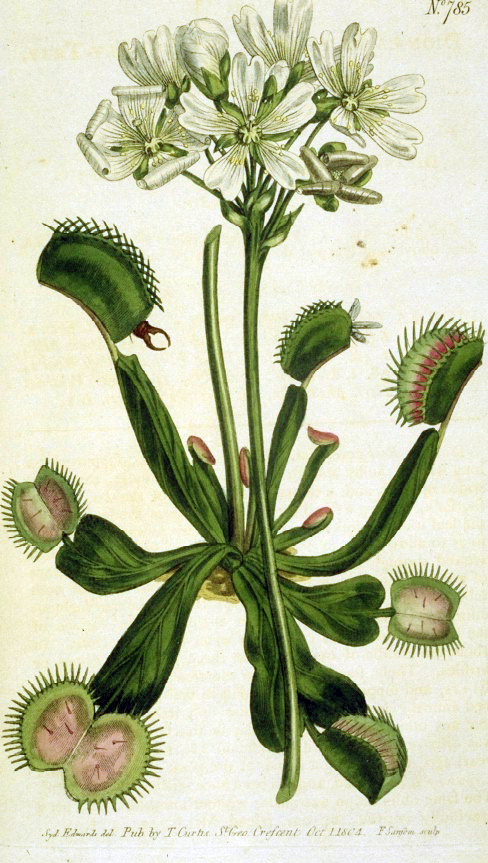
This image of an illustration of a flowering Venus flytrap by William Curtis is provided by the National Agricultural Library of the United States Department of Agriculture‘s Agricultural Research Service. As a work of a U.S. federal government the image is in the public domain in the United States. See the NAL copyright statement for details.
Probably the most well-known example of counting in the botanical world occurs in the Venus flytrap* (Dionaea muscipula (Lisa Friend)), a carnivorous plant (Kerry Lotzof; Abi Saeed). Although it has photosynthetic leaves and is thus an autotroph (Joseph Dewey, 2020; Hilary Costa et al.) – like a regular plant, it has the additional ability to trap and digest the bodies of small animals**. In that way it supplements its mineral requirements – of nitrogen in particular (Lukas Fasbender et al., 2017) – which tend to be in shorter-than-needed supply in the habitats where the plant is found (Kat O’Melia, 2023).
Capturing the insects is performed by the highly-modified ends of the plant’s leaves, which are known as ‘snap traps’. Although one could describe the traps in words, a picture is so much more useful for this purpose. Accordingly, this is what the insect-trapping terminal portions of the blade look like:
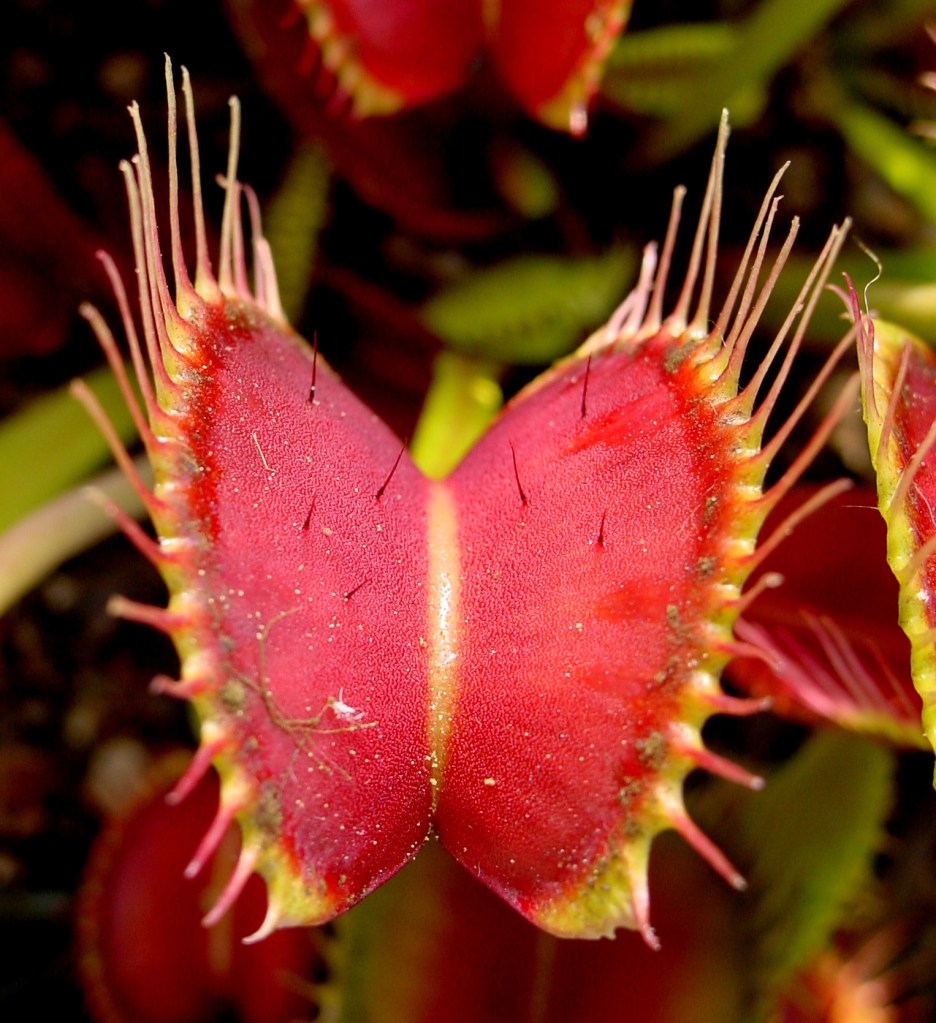
This image, entitled “The trap of a Venus fly trap, showing trigger hairs” by Noah Elhardt is used under the Creative Commons Attribution-Share Alike 2.5 Generic license. [Ed. – arguably, this is an unusual image to use to illustrate the plant’s snap trap in the Wikipedia page for Carnivorous plant because each lobe of the trap is supposed to have only three sensory hairs. This one clearly ‘didn’t get the memo’ and actually has four hairs on the left lobe…]
That image shows the trap in the ‘set’ position, ready to ensnare the unwary prey. It also shows the important sensory hair-like structures that stand erect from the two red cushion-like surfaces that are fringed with spike-like projections (‘teeth’). Those ‘hairs’ are the triggers that spring the trap. So, how does it work?
If an insect lands on the fleshy leaf lobes it may come into contact with one of the several sensory ‘hairs’. Should it do so the plant will detect that contact***. Although a single ‘hit’ will not trigger the closure of the trap, it has essentially ‘primed’ the plant so that it is poised for trap-closure.
[Ed. – Why not spring the trap with a single hit? As Kerry Evans puts it, “single touch, after all, could be a false alarm, such as a falling leaf”…].
Should the unsuspecting insect contact another – or the same – hair within 15-20 seconds then the trap will close (Kerry Evans; Rainer Hedrich & Kenji Fukushima, 2021). Which means that the two teeth-fringed halves of the modified leaf fold up – come together – and trap the unsuspecting creature. And closure of the trap is surprisingly quick – within less than a tenth of a second (Tom Bennet; Lauren Wolf) [Ed. – (quite literally, ‘in the blink of an eye’ (Shmaltz and Menudo) because “On average, a complete blink lasts between 100 and 400 milliseconds (0.1 to 0.4 seconds)” [also stated here, 6th line of text beneath heading ‘Vision’]].
The ‘teeth’ on the leaf edges help to retain the insect within the trap. Trapped in this sway the insect is likely to struggle to try and free itself. In so doing it is highly probable that other sensory hairs will be touched. When that happens, two or more further stimulations activate a pathway within the plant that involves the plant hormone known as jasmonate (Robert Emmerich).
[Ed. – one could posit that this step-wise progress towards the digestive process by increased number of hair stimulations may be a method of avoiding the costs of going in to full digestion mode for a small insect that may not be a big enough ‘meal’. Such a small captive may manage to avoid making the third, fourth and/or fifth hair contacts before escaping through the gaps in the cage’s bars where the teeth at the leaf’s edge don’t make a complete barrier to escape…]
Furthermore, up to a maximum of five contacts (i.e., the initial two that caused trap closure, and then an additional three), insect-digestive-enzymes are released by the plant through the surfaces of the trap next to the doomed insect (Jennifer Böhm et al., 2016). Beyond five ‘touches’ – the number one might expect with a prey of a decent size able to put up a good fight against the plant – “the plant begins producing digestive enzymes and special transporters to take in nutrients from the prey. The more the panicking insect struggles, the more digestive ingredients the plant releases, allowing it to scale production to the probable size of the meal” (Kerry Evans). Entombed in this way the imprisoned invertebrate will eventually be digested by those plant-released enzymes and the resulting slurry of insect juices will be absorbed by the plant supplementing its own nutritional requirements****.
[Ed. – for a great graphic of the trap-tripping and insect-digestion cycle see Stephanie Pain’s article here. For more on the ‘complete hunting cycle of Dionaea muscipula’ see Alexander G Volkov et al. (2011)]
Although the details of the various electrophysiological, and biochemical events that are initiated by stimulation of the trigger hairs are beyond the scope of this post [Ed – for more on these details, see Jennifer Böhm et al., 2016; Rainer Hedrich & Kenji Fukushima, 2021; Rainer Hedrich & Ines Kreuzer, 2023], one long-standing assumption about Venus flytrap trap closure must be mentioned.
For many years it had been assumed that operation of the trap was due to the movement of water, osmosis (Tom Bennet). However, the study of trap closure by Jeongeun Ryu et al. (2026) “proves conclusively that osmosis is not the cause of the trap’s closure” (Tim Wogan). Instead, it appears to be due to wall-softening – although the details of how this works are still to be elucidated (Lauren Wolf), and the conclusion has been questioned by other workers (Margherita Bassi).
But, and coming back to the reason for this post, trap-closure and prey-digestion is a demonstration that the Venus flytrap can count***** – and at least up to 5. Therefore, not only is that a demonstration of the plant’s arithmetical ability, it’s also a very good example of the plant sense of touch [for more on this see chapter 5].
* Whilst Venus flytrap is the plant’s main English common name, one of the best descriptions I’ve seen for the plant is that “it looks like a mini taco… with teeth” (quoted from the transcript of the Gardening Australia Junior Podcast episode entitled “How do Venus fly traps work?”, presented by Costa Georgiadis). And, if you already know what a hard-shell taco (Dito, 2026) looks like, you’ll appreciate how accurate that description is. If you don’t already know, the picture below shows you what a hard-shell taco looks like (just imagine it with teeth on the two curved free edges and without cheese, lettuce, tomatoes, and onions as the filling…):
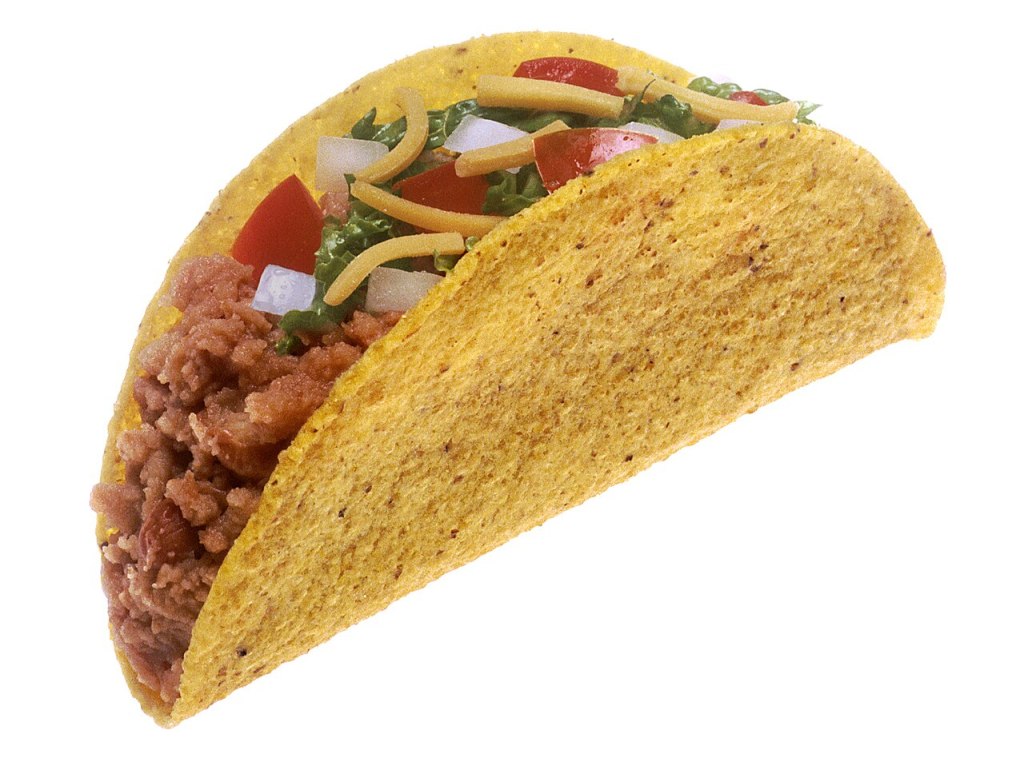
As a work of the U.S. federal government, this image, of “Hard-shell taco with meat, cheese, lettuce, tomatoes, and onions” and is in the public domain.
Venus flytrap, which is simply an English translation of the plant’s scientific name, is inoffensive enough. However, its much older common name of “tipitiwitchet” or “tippity twitchet” (Destynnie K Berard; Barry Rice, 2018) is neither innocent nor inoffensive. Why? Because “tipitiwitchet” or “tippity twitchet” was a rather vulgar name for a woman’s genitals, which is presumably based upon the slang term “tippet-de-witchet” (Jonathan Green, 2026).
[Ed. – ‘taco’ should not be confused with the Trumpian acronym ‘TACO’, which has an altogether different meaning…]
** In a bit of a blow to the ‘flytrap’ name of the plant, a ScienceNews article from 1935 informs us that spiders were the carnivore’s main prey, forming 28% of the catch identified in hundreds of traps. Flies were a close second, with 24%. Furthermore, “Other prey included beetles, ants, and roaches. There was one tiny toad, a scorpion, a couple of snails, and one daddy longlegs. In general, the plant’s victims were mainly insects that fly little or not at all; there were few highly active fliers like bees and wasps” (quoted from here).
*** Since insect visitors can vary in size it is reasonable to ask what is the smallest creature than can trigger the trap. The answer appears to be “that flytrap sensory hairs can sense prey with a body weight as small as a mosquito” (Gunnar Bartsch), which is just three milligrams (Sönke Scherzer et al., 2019). However, such an insect won’t be trapped in the usual traps of Venus flytrap, but only in smaller traps that are sensitive to the mass of a mosquito (Gunnar Bartsch).
**** Each snap trap of Dionaea (a neutral name for the plant which avoids uncertainty over the identity of this predator’s principle prey) is not a ‘single-use’ structure, but is capable of being re-set, after an appropriate length of time. Which is..? “When the nutrient stock [from the digested insect] runs dry, the trap opens again and prepares for hunting another nutrient-rich animal” (Rainer Hedrich & Kenji Fukushima, 2021, p. 138). Apparently, “Leaves can be reused three or four times before they become unresponsive to stimulation, depending on the growing conditions” (quoted from here).
***** Reinforcing this numerical ability, there is a version of the plant whose trap remains open even after two or more trigger hair stimulations. Known as dyscalculia 1 (Rainer Hedrich & Kenji Fukushima, 2021), it is ‘the Venus flytrap plant that cannot count’.
REFERENCES
Jennifer Böhm et al., 2016. The Venus flytrap Dionaea muscipula counts prey-induced action potentials to induce sodium uptake. Current Biology 26(3): 286-295; https://doi.org/10.1016/j.cub.2015.11.057
Lukas Fasbender et al., 2017. The carnivorous Venus flytrap uses prey-derived amino acid carbon to fuel respiration. New Phytologist 214(2): 597-606; https://doi.org/10.1111/nph.14404
Rainer Hedrich & Kenji Fukushima, 2021. On the origin of carnivory: Molecular physiology and evolution of plants on an animal diet. Annual Review of Plant Biology 72: 133-153; https://doi.org/10.1146/annurev-arplant-080620-010429
Rainer Hedrich & Ines Kreuzer, 2023. Demystifying the Venus flytrap action potential. New Phytologist 239(6): 2108-2112; https://doi.org/10.1111/nph.19113
Kat O’Melia, 2023. Dionaea muscipula, Venus flytrap: A case study in adapting to environmental imperfection. The Synapse: Intercollegiate science magazine 36(1): Article 9; https://digitalcommons.denison.edu/synapse/vol36/iss1/9
Jeongeun Ryu et al., 2026. Fast cell wall softening causes Venus flytrap closure. Science 392(6803): 1183-1187; doi: 10.1126/science.aed5051
Sönke Scherzer et al., 2019. Venus flytrap trigger hairs are micronewton mechano-sensors that can detect small insect prey. Nature Plants 5: 670–675; https://doi.org/10.1038/s41477-019-0465-1
Alexander G Volkov et al., 2011. Complete hunting cycle of Dionaea muscipula: Consecutive steps and their electrical properties. Journal of Plant Physiology 168(2): 109-120; https://doi.org/10.1016/j.jplph.2010.06.007


Leave a comment