
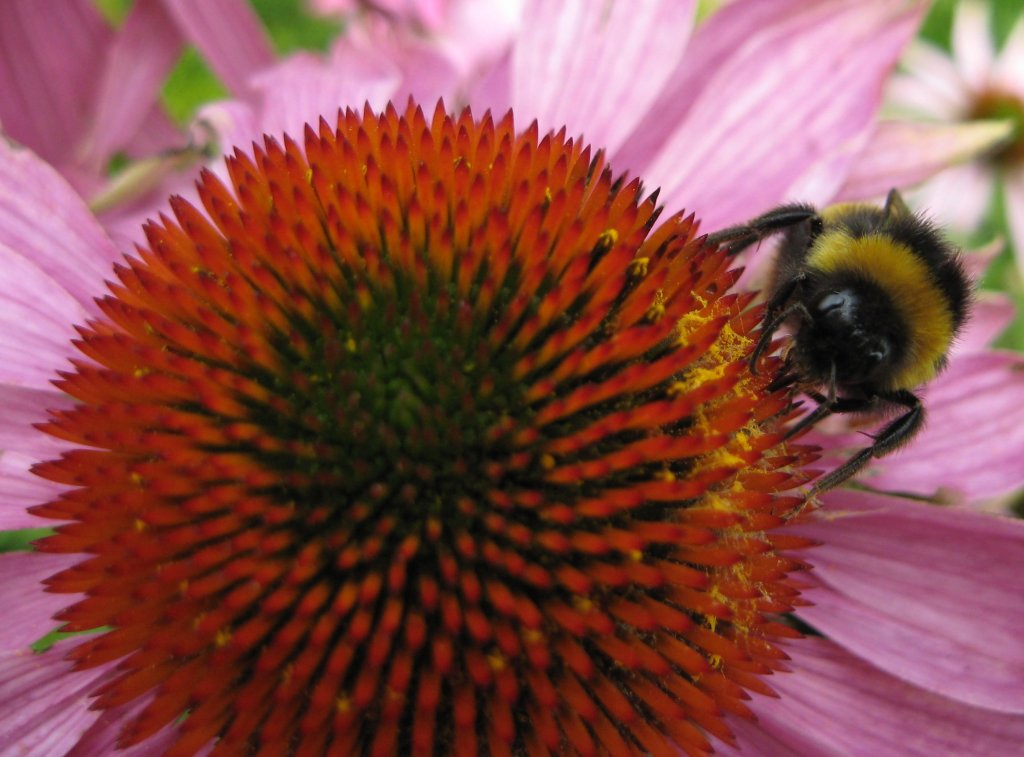
Whether or not you consider that plants can exercise some sort of ‘mind-control’, they are experts at co-opting other biota to carry out important life-promoting activities, e.g., exploiting insects for pollination services – illustrated by the Echinacea and the bee.
This chapter airs the notion of plant intelligence. This is a contentious area and in many respects ‘the jury is still out’ on whether plants are intelligent or not. Much of the debate revolves around semantic issues of definitions of intelligence and consciousness. The debate also highlights the problems humans have understanding non-humans; it’s difficult to get into the ‘mind-set’ of a plant. This chapter looks at examples of ways in which plants exhibit behaviours that are akin to co-operation, or indicate problem-solving capacity, or ‘super-sensory’ abilities. [Ed. – these examples are not yet included. Well, Mr Cuttings did say this version was very much draft and ‘work-in-progress’ in his introductory post…] Although the question of plant intelligence is somewhat left to one side, this chapter at least considers and develops an idea attributable to Michael Pollan in his 2003 book The botany of desire, which posited the notion that there is much more to plants than we humans might like to admit, and there are ways in which plants exercise a sort of mind-control over humans…
The history of science is full of episodes that may be seen with the benefit and luxury of hindsight as ‘pivotal’ moments. Arguably, one such turning point occurred at the beginning of the current millennium with publication of an article entitled “Aspects of plant intelligence” by Anthony Trevawas (2003). The author acknowledged that its title and topic was controversial, and the article predictably received a response. That from Richard Firn (2004), which presented an alternative point of view, was published in the same journal as Trewavas‘ original article, as was Trewavas (2004)’s reply thereto.
Controversial, certainly, but, now that this particular ‘genie’ – of plant intelligence – had been let out of the bottle, the scene was set for considering a more enlightened view of plant biology, that plants were imbued with more sophisticated problem-solving capabilities than they had previously been credited with (whether or not we call that intelligence…).
This notion eventually led to the establishment of the discipline of plant neurobiology (Eric Brenner et al., 2006; Barlow, 2008; František Baluška & Stefano Mancuso, 2009a, 2009b; Peter V Minorsky, 2024). Overseen by the Society for Plant Neurobiology, this academic discipline was made official with the 1st International Symposium on Plant Neurobiology in 2005.
[Ed. – The concept of plant neurobiology owes much to the ideas of influential Victorian naturalist Charles Darwin when he wrote of what has since become known as the ‘root-brain hypothesis’ (František Baluška et al., 2009; Kensy Cooperrider). But, as an official term plant neurobiology was highly likely to be controversial. Probably conscious of the likely resistance from traditionalists to the term neurobiology when applied to plants, the Society for Plant Neurobiology changed its name, to the Society of Plant Signaling and Behavior in 2009. Undeniably, intelligent behaviour by the plant neurobiologists]
As timely as discussion about any intelligent behaviour of plants may be, the idea of plant intelligence – or any sort of ‘sixth sense’ [“a power of perception beyond the five senses of touch, taste, smell, hearing, and sight”] that our vegetable companions might have – remains a rather contentious area (Trewavas, 2007; Amedeo Alpi et al., 2007; Paul Struik et al., 2008; Fatima Cvrčková et al., 2009; Michael Pollan, 2013; Yogi H Hendlin, 2022; Paco Calvo et al., 2025, etc.).
Indeed, for many, any sensible, sober, serious scientific study of this notion has probably been forever tainted by the sensationalist – if scientifically less-than-rigorous – work of people such as Dorothy Retallack on plants and response to music (Don Robertson, 2010; Chamovitz, 2012a), Cleve Backster (1968) on ‘primary perception’ in plants (Horowitz et al., 1975; John Kmetz, 1978; Robert Carroll, 2011; Mozelle Martin, 2026), and from claims in populist books such as Tompkins and Bird (1973)’s The secret life of plants (Adolph Hecht, 1974; Arthur Galston & Clifford Slayman, 1979). [Ed. – all of which – and more – is admirably considered and critiqued by Teresa Castro (2020)].
Notwithstanding such poorly-received attempts at putting plant intelligence on the legitimate plant biology research agenda in the second half of the 20th century, the dawn of the 21st century has seen a considerable revival of interest in the whole area of plant intelligence. And, as ‘non-mainstream’ as such ideas are, they are kept alive by throw-away comments in peer-reviewed scientific publications such as, “These results provide clear experimental evidence for the existence of communication channels between plants beyond those that have been recognized and studied thus far” (Gagliano et al., 2012, p. 1), and the suggestion of ‘plant anticipation’ in Alessandro Chiolerio et al. (2025) [Ed. – but, do also see Ariel Novoplansky & Hezi Yizhaq, 2026; and Giorgio Vacchiano, 2026, which challenge that notion…]
Aspects of plant ‘intelligence’
Undoubtedly plants do ‘exploit’ – which, perhaps, should be more cautiously worded as ‘plants benefit from’ – the senses and baser instincts of animals in such crucial processes as pollination and seed dispersal. For example, sweet rewards such as nectar may be offered as ‘bribes’ that encourage insects to visit flowers (Fig. 6). From the insect’s ‘point of view’ it is exploiting the plant for nutritional benefit. In so doing, if it, also, transfers pollen from stamen to stigma, that is incidental to the insect’s intention. However, from the plant’s perspective, the main purpose of providing food for the insect is for the reproductive benefit of the plant. Or colours, e.g., the rich red of ripe fruit may act as attractants so animals will consume it and help to spread the seeds in their faeces (Chrissy Sexton). Even more bizarrely, many orchid flowers not only mimic the look but also the pheromones of females of several insect species luring males to attempt copulation with the flower and transferring the orchid’s pollen in the process (Whitney & Glover, 2007). In that instance it is hard to see any benefit for the insect from this act – which is even called pseudocopulation; it seems to be solely one-sided with the plant alone as the beneficiary.
Whether such exploitation of animals can be categorised as intelligence on behalf of the plant probably depends on that word’s definition – which may differ between different individuals. It would certainly appear to be an intelligent solution to the problem of transferring pollen between immobile plants, and of dispersing seeds far beyond the limited range of a soil-fixed plant.
Plants enslaving humans
Whilst it may be debatable whether those pollination and seed dispersal examples should be considered some sort of ‘mind control’ by plants over animals, another example that certainly causes one to stop and think is provided by Pollan (2003). In his thoughtful and thought-provoking tome entitled The botany of desire, Pollan advances the notion that some plants have characteristics that humans find so irresistible that we have unwittingly aided-and-abetted their spread far beyond the geographical boundaries to which their own evolution and development would otherwise constrain and confine them.
In that way, certain plants have become widely cultivated, domesticated, and dispersed over the face of the planet to a degree which their own actions (which, as predominantly fixed-to-one-spot organisms, are severely limited) would ever have accomplished. And not only have humans given them new homes to explore – and maybe exploit to the disadvantage of native floras and fauna (Patrick Shirey & Gary Lamberti, 2011) – but have bred them into an amazing array of new kinds, thereby ensuring their longevity far beyond that which might otherwise have been their allotted span on this planet.
Although Pollan (2003) illustrates his ideas with the quartet of apples, tulips, potato, and marijuana, almost any plant species – especially crop plants such as cereals – could have been chosen. For example, and anticipating the subject of chapters 9 and 10 a little, but drawing upon Pollan’s botany of desire ideas, we must at least acknowledge the possibility that subtle ‘mind games’ played by plants may be behind human addiction to various plant-derived products such as nicotine (in tobacco (James Edward McMurtrey)) and sugar – from the tobacco plant and sugar cane, respectively – and a wide range of botanical narcotics such as opium (and heroin in particular) from poppies, and cocaine from the coca plant. Acknowledging the dependence by some humans upon plant products, we must consider the notion that plants may directly enslave us humans. And there are potentially even more stealthy ways in which plants can influence human behaviour…
Plant molecules shooting the messenger..?
Whilst the details are beyond the scope of this review, the ultimate example of this influence of plants over humans may be at the molecular level, e.g., via micro ribonucleic acids (miRNAs) ingested with our food. These molecules are short-lengths of RNA that interact with m(essenger)RNA thereby preventing its subsequent translation into protein (Kendal Hirschi, 2012; Katharina Petsche). Work by Lin Zhang et al. (2011) suggests that miRNA from consumed rice can survive digestion to be taken up into the human body where it may have an effect upon cholesterol metabolism. Although the likelihood of plant miRNAs being able to exert such an effect on human metabolism is contested by workers such as Jonathan Snow et al. (2013) and Kenneth Witwer & Kendal Hirschi (2014), reports of uptake of plant-derived miRNA into humans persist (e.g., Hao Zhang et al., 2016; Lin Zhang et al., 2019), and the subject is still one of considerable interest, and debate (e.g., Kenneth Witwer & Chen-Yu Zhang, 2017; María-Carmen López de las Hazas et al., 2023; José Luis Sánchez-Quesada, 2024).
Understandably, such potential cross-kingdom gene control is an intriguing notion and may be another way in which plants can somehow ‘control’ or influence the biology of other organisms with which they interact. Is it the case that plants – including, cotton, sugarcane and tobacco – all along have really enslaved us and turned us into unwitting accomplices for their own ambitions to colonise the whole planet and take over the world? So, who is really exploiting whom? [Ed. – and maybe a plant-dominated Earth, as proposed by Stefano Mancuso in his thought-provoking book The nation of plants, may not be such a bad thing…]
Perhaps this micro-molecular manipulation of Mankind’s metabolism is the subtlest form of ‘mind control’ of all and maybe plants are much cleverer – intelligent – than we give them credit for. They may even be cleverer than us. Or, maybe, plants are just ‘differently clever’?
The debate goes on…
Whilst it must be acknowledged that notions of plant intelligence remain somewhat controversial and contested (Rainer Stahlberg, 2006; Alpi et al., 2007; Trewavas, 2007; Chamovitz, 2018), much of this debate seems more about concerns over the language used to describe these plant phenomena rather than denial that plants exhibit complex problem-solving behaviours. [Ed. – it is helpful to try and cut through some of the semantic uncertainty at this point by saying that, for Trewavas, intelligence is essentially the capacity for problem-solving, “intelligence is based on how efficient a species becomes at doing the things they need to survive” (Trewavas, 2014, p. 76).]
Certainly, the finding that plants may exploit ‘alternative means of communication‘ and plant learning (Gagliano et al., 2012), their apparent ability to ‘hear‘ running water (Gagliano et al., 2017) [see also Chapter 5], and the evidence accumulated in books such as ‘What a Plant Knows‘ (Chamovitz, 2012a), ‘Plant Behaviour & Intelligence‘ (Trewavas, 2014), ‘Plant Sensing and Communication‘ (Richard Karban, 2015), ‘Brilliant Green: The Surprising History of Plant Intelligence‘ (Stefano Mancuso & Alessandra Viola, 2015), ‘Memory and Learning in Plants’ (Baluška et al. (Eds), 2018), and ‘The Revolutionary Genius of Plants: A New Understanding of Plant Intelligence and Behavior‘ (Mancuso, 2018), all add to a growing body of work attesting to the extraordinary sensory capabilities of plants.
Ignoring the elephant in the room
The notion of ‘plant intelligence’ is far too big and philosophical for this wider-ranging review and we must leave it there. [Ed. – and the on-going debate about plant consciousness (e.g., Lincoln Taiz et al., 2019; Jon Mallatt et al., 2021; Miguel Segundo-Ortin & Paco Calvo, 2022; Romany Williams, 2024; Russell Powell, 2025) has been completely – and consciously(!) – ignored here]
But, at least, if this section has caused us to examine our relationship with plants a little more closely, it has done a good job. As a final thought, it is more than a little ironic that Arabidopsis – a plant – has been proposed as a model organism for study of the microtubule cytoskeleton in neurons (John Gardiner & Jan Marc, 2011) – in animals.
Conclusion
This chapter aired the notion of plant intelligence and at least posited the idea that there is more to plants than that which the eye at first sight may perceive. Maybe – as Pollan (2003) argues, they do ‘control’ us after all?


Leave a comment