
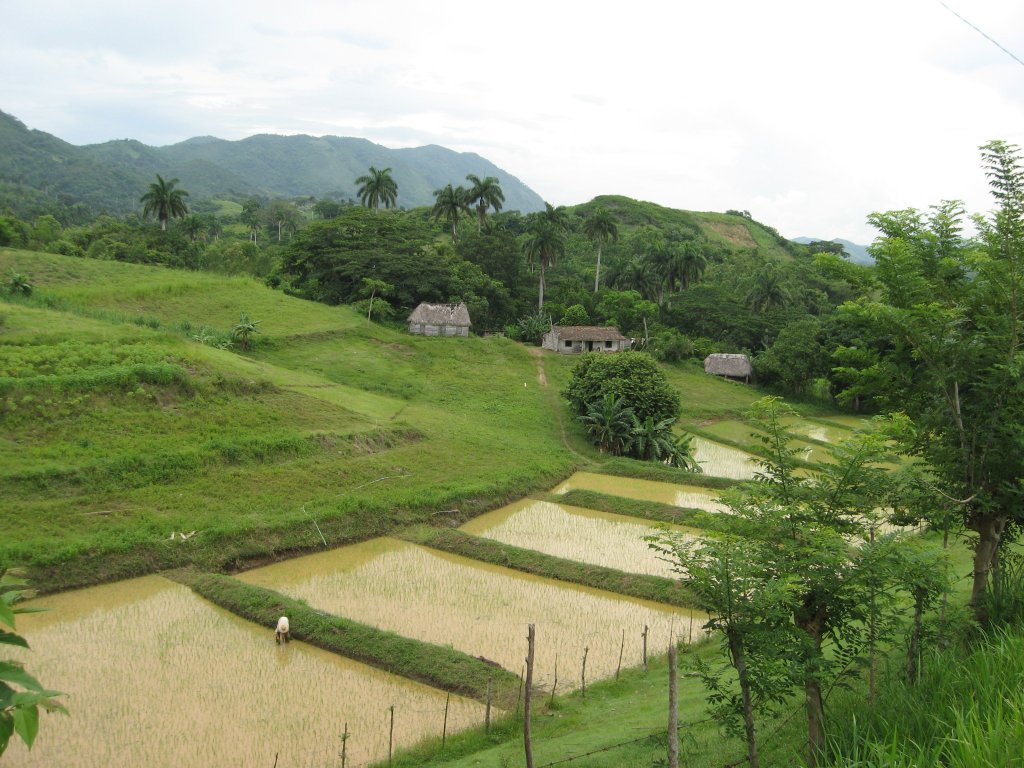
Rice, one of the major food staples of the planet, and which is responsible for feeding about a half of the world’s human population (Te-Tzu Chang, 2000), is often grown in flooded paddies (as seen here in Cuba).
Chapter 2 looked at photosynthesis, with a bias towards the oxygen that it produces. The first part of chapter 7 considers the other product of this important bit of botanical biochemistry, the energy-rich ‘food’ that is made. Although the carbohydrates, that are the chief products of photosynthesis retained within the plant, are intended for use by the developing plant, they are also consumed by hungry animals. One of which is the human animal.
Emphasising the importance of plant productivity to feeding humans is the phrase ‘all flesh is grass’. Although originally a life lesson from the Old Testament – about the short lifespan allotted to Man – it has been appropriated and alternatively applied to the fact that human beings primarily feed on plants (Trevor Herriot). Even if those humans protest that they are meat eaters, the animals from which the meat is procured will – ultimately – have feasted on plants, or plant-derived animal flesh. And no activity better underlines the importance of plant produce to people than agriculture, which is dealt with in the first part of chapter 7, 7a.
However, and arguably as a consequence of plants sustaining agriculture (which supports human life and promotes civilisation which permits development of specialisms amongst individuals), another important outcome from plant productivity is development of humanity’s artistic endeavours. That aspect of humanity, which contributes so importantly to the quality of life (to balance life’s quantity perpetuated by plants’ photosynthetic productivity), is considered in the second part of this chapter, 7b [the following post].
Agricultural revolution
Underpinning those endless vistas of grain fields that typify areas such as the mid-western USA (e.g., New York Times, 1898) is agriculture (“artificial management to enhance the food value of cultivated land” – Toby Bruce, 2012). And – although this review concentrates on plant aspects – we must acknowledge that the development of agriculture involved exploitation, and subsequent domestication, of both plant and animals by early Man. The importance attached to agriculture’s ‘discovery’ is hard to overstate. Indeed, this human activity – more than any other endeavour – has been inferred to have given rise to what we optimistically call civilisation (Krishan Kumar). Which is why agriculture has been called “the backbone of human civilization”, and “may be considered the most important step in the development of civilisation” (quote attributed to Hodder Westropp (Paul T Nicholson, 1983), cited in Graeme Barker).
[Ed. – and let’s not overlook the potential role of arboriculture – alongside pastoral-based agriculture – in the civilising of Mankind (Dorian Fuller & Chris Stevens, 2019)]
Whilst the reasons why the majority of humans chose agriculture – quite literally – as a way of life are disputed and may be many (Denis J Murphy, 2007; Rhitu Chatterjee; Glynis Jones et al., 2021; John Carey, 2023; here; Alfredo Cortell-Nicolau et al., 2025), the lure of this mode of existence was so seductive that agriculture was ‘invented’ several times in different areas throughout the world.
Although this multiple innovation was by different peoples, based around different crops, and at different times (JF Hancock, 2012; James F Hancock & Allison J Miller, 2014), it nevertheless emphasises agriculture’s role as a stabilising force in terms of the sedentary, settled societies it fostered.
One imaginative notion for our adoption of agriculture comes from Greg Wadley & Angus Martin (1993) who propose that exorphins in those cereals that were eventually cultivated produced such pleasurable effects on the first human farmers that they craved more of the drug-like substances’ sensations.
[Ed. – “Exorphins are peptides that are produced during the digestion of certain proteins in food. They are structurally similar to endorphins, the natural opioids our bodies produce that play a role in pain relief and feelings of well-being. By binding to the same receptors as endorphins, exorphins can have similar effects on the brain, creating a sense of reward or pleasure” (quoted from here). Interestingly, cereal-derived exorphins may have relevance to gluten intolerance in humans (Federico Manai et al., 2023). If such a link is established, one can only assume that initial human attempts at developing cereal-based agriculture weren’t thwarted by individuals with gluten-intolerance or coeliac disease. Or, maybe, such illnesses only became an issue after this form of agriculture became adopted and widespread..?]
This in turn drove the adoption and expansion of cereal farming. In that view humans had no choice in the matter, and plant themselves ensnared Man who was ‘enslaved’ to cultivate, improve, look after, and disperse his botanical overlords [Ed. – this is a a nod in the direction of chapter 6…]. In other words, humans are a farming-based species because we are addicted to at least some of its products.
And, beyond any role of exorphins in cultural changes and development of agriculture, others posit that production of alcohol from cereals may also have played a role (Greg Wadley & Brian Hayden, 2015). And it has been proposed that psychoactive drugs more broadly and more generally have “acted as enablers of cultural change” (Greg Wadley, 2016). Certainly, food for thought. Furthermore, others even argue for a more ancient role of psychedelics in foodstuffs on sociality and human evolution more generally (José Manuel Rodríguez Arce & Michael James Winkelman, 2021)…
Undoubtedly, Wadley and Martin (1993)’s ‘narcocentric’ view of mankind’s adherence to agriculture may seem unpalatable or too far-fetched for some. And, we must bear in mind that agriculture was not based just around cereals, but a broader range of crops such as potato and other root crops in South America (e.g., K Kris Hirst). However, the finding that genetic material in plant foods survives human digestion and can affect expression of genes in our bodies (Kendal Hirschi, 2012) supports a view that we may not be masters of our own destiny.
Furthermore, in view of the human health issues and nutritional deficiencies associated with the early transition to agriculture (Amanda Mummert et al., 2011), there must have been some very good reason(s) for humans to continue down the pathway to agriculturalisation – particularly when its development is viewed by some to be mankind’s greatest mistake (Brad DeLong, 2016; Darren Curnoe, 2017; Kirsti J Robinson)(!).
Agriculture is global (and very big business)
The importance of Man’s relationship with plants is underlined by Helmut Haberl et al. (2007) who estimate an aggregate global HANPP (human appropriation of net primary production) value of 15.6 Pg C/yr (a figure which probably doesn’t mean all that much to most of us, but which is approx. 24% of potential terrestrial primary productivity). The economic importance of agriculture is illustrated by the fact that 5 of the 10 most traded commodities in terms of daily turnover as of April 2026, were crops – coffee (in 2nd place behind crude oil), followed by wheat, cotton, corn, and sugar (in that order and filling slots 5-8) (Tejvan Pettinger).
As globally-traded commodities the price of these items – and products made from them – are subject to the vagaries of stock markets, which themselves can be affected by many factors (Chris Wolski), not least of which are globally significant events such as wars, civil unrest and crop failures. For example in January 2011 there were reports that governments around the world were buying up larger-than-usual quantities of food and stockpiling food staples in an attempt to contain panic buying and inflation itself caused by concerns over social unrest when the so-called Arab Spring was under way (Javier Blas & Chris Giles, 2011). And a consequence of this hoarding behaviour was that it drove prices of those items still higher.
Although regions of human conflict often have an element of predictability, environmentally-caused phenomena are not so foreseeable in their geography. For example, droughts don’t just happen in the more usual parts of the world such as Africa; indeed, as this piece was originally penned (summer 2012), “more than half of the continental United States” was experiencing its worst drought for decades (John Eligon, 2012), which is likely to have serious knock-on effects to agriculture in that region, particularly cereal harvests. And there were concerns over the European Union’s maize crop given the hot, dry weather in central and southern Europe during the summer of 2012 (Jack Farchy & Gregory Meyer, 2012; Gus Trompiz & Valerie Parent, 2012). And since cereals are overwhelmingly the most important source of food calories for direct human consumption, major events in the cereal sector – such as drought-impaired yields (Matteo Cavallito; Rob Jordan) – have critical implications for global food supplies.
An important additional consequence of conflict between nation states was highlighted when the USA and Israel attacked Iran on 28th February 2026 (the ‘2026 Iran War’). During most of that conflict – whilst opposing forces were actively carrying out hostilities against each other, and during a period of ceasefire – maritime traffic through the Strait of Hormuz was drastically reduced, and even halted, for weeks. Whilst that caused understandable consternation and concerns over the supply of oil to the rest of the world to fuel industry and economies worldwide (“The Strait of Hormuz is one of the world’s most critical maritime chokepoints, carrying around a quarter of global seaborne oil trade”), another consequence was sufficiency of fertiliser. So-called ‘artificial’ or ‘synthetic’ (Sarah Browning) fertiliser is added to crops world-wide to provide them with additional nutrition to boost yields. Reduction in supply – and attendant increase in price of what is available – compromises the ability of global agriculture to produce the food needed to supply humankind and their domesticated animals. And, “About one-third of the world’s fertilizer travels through the strait, according to the United Nations” (quoted in Ryan Hanrahan; Chloe Taylor & Sam Meredith).
But, it isn’t just fertiliser itself that’s moved through this region, it’s also liquified natural gas, which is used to produce fertiliser (Nima Shokri & Salome MS Shokri-Kuehni; Caitlin Welsh; and here). Its movement – and therefore supply to the rest of the world – is also constrained. And, alongside oil, approx. 20% of all liquified natural gas used globally is transported through the Strait of Hormuz. [Ed. – for a consideration of global agrifood implications of the 2026 conflict in the Middle East – with particular focus upon Impacts on energy and fertilizer trade, and food security – see the FAO report here]
How many food plants are there?
Perhaps the most viscerally important human exploitation of plants is agriculture’s food dimension. In that regard, how many species are consumed by humans? Although an easy enough question to ask, it is surprisingly difficult to answer. Certainly, carbohydrates from rice (Fig. 7), wheat and maize – ‘the Big Three’ – dominate human consumption (Sean Mayes et al., 2012). That, however, really only deals with so-called ‘staples’, foods that are “eaten regularly and in such quantities as to constitute the dominant part of the diet and supply a major proportion of energy and nutrient needs”. But even as far back as the 1990s that rather blinkered view was challenged by workers such as Robert Prescott-Allen & Christine Prescott-Allen (1990) who concluded that 103 plant species accounted for 90% of the world’s food supply in the 146 countries they examined [Ed. – which is far more than “Just 15 crop plants provide 90 percent of the world’s food energy intake” spoken of by the FAO [Food and Agricultural Organization of the United Nations] in its 50 year anniversary publication in 1995 (and a ‘stat’ repeated in the fourth of Kew’s State of the World’s Plants and Fungi reports in 2020)].
Contributing to the 10% not covered by Prescott-Allen & Prescott-Allen (1990)’s 103 species, about 30,000 other plant species are exploited as food, while at least 7,039 plant species are considered to be edible. Whatever the precise number – and one acknowledges that the species concerned are likely to vary from country-to-country and even region-to-region, and possibly even seasonally, etc. within a political land unit – one is right to celebrate the range of food plants exploited and consumed throughout the world. And a more varied plant diet is important because a staple food does not meet a population’s total nutritional needs. However, on the plus side, staple foods typically are well adapted to the growth conditions in their source areas, e.g., they may be tolerant of drought, pests or soils low in nutrients.
It is nevertheless a sobering thought that the major crops today are still those originally tamed during agriculture’s infancy. As Denis J Murphy (2007; p. 8) puts it, “It is especially noteworthy that, despite all the impressive developments in agriculture and breeding over the last twelve millennia, the dozen-or-so plant species that were originally chosen by early Neolithic farmers remain our most important dietary items to this day. This applies most particularly to the ancient crops from the grass family, including the cereals…”
How unimaginative are we in our diet as a species! Or is it more the case that we recognise a good thing when we see it? Certainly, cereals are the food-source supremos in this regard, and not only for human food needs: Of the approx. 2.4 billion tonnes of cereals produced in 2010, around 1.1 billion tonnes are destined for food use, around 800 million tonnes (35% of world consumption) are used as animal feed; the remaining 500 million tonnes are diverted to industrial usage, seed (importantly to provide the next year’s harvest) or are wasted (FAO Statistical Yearbook 2012, Part 3 Feeding the world: Trends in the crop sector; p. 182). Indeed, “more of the earth’s surface is covered by wheat than with any other food crop” (FAO Statistical Yearbook 2012, Part 3 Feeding the world: Trends in the crop sector; p. 186). And although wheat is the third most-produced cereal after maize and rice, in terms of dietary intake, it is currently second to rice as the main food crop, given the more extensive use of maize as an animal feed (FAO Statistical Yearbook 2012, Part 3 Feeding the world: Trends in the crop sector; p. 186).
All our egg(plant)s in one basket?
Notwithstanding the great diversity of plants that are used as food, globally we still place reliance – possibly over-reliance? – upon a handful of staples. It’s never a good idea to ‘put all one’s eggs in one basket’, so are we hostages to fortune with this over-dependency upon so few crop species? As we are becoming concerned about future food supplies, there is a pressing need to explore further plant diversity with a view to exploiting it. In that regard the concept of ‘orphan crops’ is important.
Orphan crops are “crop species which have been under-exploited for their contribution towards food security, health (nutritional/medicinal), income generation and environmental effects” (Ranjana Bhattacharjee, 2009). Developing this notion, Mayes et al. (2011) consider the potential of these underutilised crops to improve security of food production, along with a diversification away from over-reliance on staples. Indeed, as Ian Scoones et al. (1992) make clear, there is much more to plant sources for humans than the more readily counted and enumerated handful considered above.
For example, there is also the not-so-obvious so-called ‘hidden harvest’ (Mark Nicol) – of wild and foraged foodstuffs. Although that may sound like a return to a pre-agriculture, hunter-gathering way of life (Peter Rowley-Conwy & Robert Layton, 2011; Nancy W Comstock, 2023) [Ed. – do note that this lifestyle was not completely abandoned with, or superseded by, the advent and expansion of agriculture, it persists in the 21st century (Andrea B Migliano et al., 2017, 2020)], it is probably better regarded more as a way of diversifying diet; variety is the spice of life, after all.
Crop disease, cautionary tales
The dangers of over-reliance on a few staples are graphically illustrated when we consider what happens if any one of them is affected by disease. Historically, wheat stem rust (Puccinia graminis f. sp. tritici) is the most feared and devastating fungus disease affecting wheat (Gail Schumann & Kurt Leonard, 2000). When infected, wheat yield losses of 70% or more are possible. However, for over 30 years until 1999, wheat stem rust had largely been under control primarily due to the widespread use of wheat cultivars carrying resistance to the disease (Schumann and Leonard, 2000).
Towards the end of the 20th century though wheat stem rust regained its former fearsome reputation with the appearance of ‘Ug99’. Ug99, a single race of the disease first identified in Uganda in 1999, is a special cause for concern because it has overcome the resistance in most wheat cultivars. Worryingly, it is estimated that 80-90% of all global wheat cultivars growing in farmer’s fields are now susceptible to Ug99 or variants. And such is the global concern over this threat that The Borlaug Global Rust Initiative (BGRI) was established in 2005, as “a global community of hunger fighters committed to sharing knowledge, training the next generation of scientists and engaging with farmers for a prosperous and wheat-secure world. This community of thousands of hunger fighters from hundreds of institutions is working together to: reduce the world’s vulnerability to threats to wheat, particularly from disease and climate change; enhance world productivity to withstand global threats to wheat security; facilitate sustainable international partnerships to contain these threats; engage with farmers for a wheat-secure world; and train the next generation of hunger fighters” (quoted from here).
In a rather understated way, Jerald Pataky & Karen Snetselaar (2006) consider the fungus corn smut (Ustilago maydis (Armi Djamei, 2023)) to be “a troublesome disease of corn [maize]”. Whereas, rice blast (Magnaporthe oryzae) – another fungus – is by far the most important disease of the many diseases that attack rice (David TeBeest et al., 2007). Indeed, so great is the potential threat for crop failure from this disease that it has been ranked among the most important plant diseases of them all, hence its No. 1 ranking by Ralph Dean et al. (2012) in ‘The Top 10 fungal pathogens in molecular plant pathology’.
Quite how important a threat to food security these three fungi are is made clear in Table S1 of the Supplementary material to Matthew Fisher et al. (2012), which shows that potentially 2,417 million people could be fed 2,000 calories per day on the harvest that is annually destroyed by rice blast, stem rust, and corn smut. However, if late blight (a fungus-like oomycete, Phytophthora infestans – Jean Ristaino et al., 2018) infection of potato and soybean rust (Phakopsora pachyrhizi – John Rupe & Layla Sconyers, 2008) are factored in those two pathogens together potentially account for another 1,879 million mouths (Fisher et al., 2012). And such figures do not take into account post-harvest storage losses. Four fungi and one oomycete together ‘stealing’ the food from up to 61% of the current world population is depressingly impressive! Furthermore, Matthew Fisher et al. (2012) also bemoan the fact that human activity is intensifying fungal disease dispersal by modifying natural environments – and thus creating new opportunities for evolution – to the extent that fungal infections will cause increasing attrition of biodiversity, with wider implications for human and ecosystem health, unless steps are taken to tighten biosecurity worldwide.
If those figures are not dire warning enough, for a comparatively recent horror story of the devastation that can be wrought by the deadly combination of plant disease agent and staple crop one needs look no further than the Irish Potato Famine of the mid-19th Century (Joel Mokyr). This ‘event’ directly or indirectly led to the deaths of an estimated 1 million Irish-men -women and -children and caused another 1-2 million to emigrate, many going to the USA. However, one good thing to have come out of that otherwise sorry saga is the demonstration that plant disease could have an organismic basis, which was instrumental in the birth of plant pathology as a distinct discipline (Gail Schumann).
The ‘Great Famine’ is also widely used to illustrate some of the dangers of monoculture. Monoculture in the agricultural sense is defined as “the growing over a large area of a single crop species (e.g., Triticum aestivum, bread wheat), or of a single variety of a particular species” (Michael Allaby, 2018a). In the Irish case the monoculture crop was the potato, particularly the variety known as the ‘lumper’.
Although poorer in quality than other varieties of potato, the lumper was high yielding (Carolyn King) and well suited to the growing conditions in Ireland (Cormac Ó Gráda). Consequently, it was propagated and planted widely; however, propagation was by vegetative means so almost all plants were genetically identical. Hence, when the late blight infected one plant, almost all the other plants in the immediate area succumbed as well, consigned to this collective fate by their similar genetic make-up. And, because of the widespread planting of this genetically uniform single variety, wind-borne spores could infect plants further afield.
The risk of similar calamitous crop failures notwithstanding, there are powerful arguments in favour of monoculture – the most widespread agricultural practice in much of the developed world today (DR Gossett, 2023) – such as uniformity and predictability of growth, development and yield, which facilitate management, especially harvesting (Melissa Petruzzello). But such practice comes with costs (Allison Balogh; Kavya Murugesh; James Hiemstra), not least of which is the need to invest heavily in protecting the crop lest an event of Irish Potato Famine proportions befall the harvest.
Furthermore, the practice of growing the same crop over many years is heavily dependent upon substantial additions of expensive ‘artificial’ fertiliser to maintain crop yields which would otherwise be compromised by depletion of natural levels of nutrients in the soil. There are also concerns that such a system is not natural – a polyculture [“the practice of growing more than one crop species together in the same place at the same time”] is the norm in natural ecosystems (EC Lefroy et al., 1999) – and reduces biodiversity (Peter Kogut, 2026). Not surprisingly, “the economic and ecological wisdom of monoculture is widely debated” (Allaby, 2018a). There is also the suggestion that monoculture reinforces reliance on a limited range of foods, which is not in the long term interests of a healthy human population (Pollan, 2007): Diversity in diet – which needs to be supported by diversity of crop production – is generally good.
United front
Given the importance of the agricultural sector it’s probably no coincidence that the Food and Agriculture Organization (FAO) is one of the oldest permanent specialised agencies of the United Nations. Established in October 1945 – just a few weeks after large parts of the so-called civilised world had officially ceased hostilities and paused in their insane attempts to destroy themselves in World War II (which global conflict brought its own problems of poverty and food shortages to hundreds of millions of people) – its mandate is “the raising of levels of nutrition and standards of living and ensuring humanity’s freedom”, and “leads international efforts to defeat hunger and improve nutrition and food security”.
Green Revolution
Those FAO goals were recognised in, and led to, the Green Revolution of the mid-20th century, which resulted in significant increases in productivity of cereals – especially wheat and rice – in large part from the development of new, high-yielding varieties (Andrew Pereira). Famously associated with Norman Borlaug (Sanjaya Rajaram, 2011), this work has been recognised as of such importance that Borlaug was awarded the Nobel Peace Prize in 1970.
But one of the costs of sustaining the high yields of Green Revolution crops was an environmental one – or at least one occasioned by concerns over what effect(s) the heavy use of pesticides and fertilisers to maintain those high yields might be having in the wider environment (Prabhu Pingali, 2012). Additionally, and allied to higher yields, was a better-fed population whose population growth rate was substantially enhanced, which led to the creation of more mouths to be fed (Dana Desonie). Thus, rather than remove hunger, it can be argued that the Green Revolution helped to exacerbate the problem of insufficiency of food, it was a victim of its own success. The quest for better ways to produce the requisite high yields of crops helped fuel the next major advance, the rise of direct genetic manipulation approaches to crop improvement.
Gene Revolution
Although traditional crop breeding has successfully underpinned and sustained many millennia of agriculture there are limits to what is possible with that approach. For example if one wanted to introduce the drought tolerance of, e.g., a desert-dwelling plant into wheat, the usual techniques of cross-pollination in the anticipation of cross-fertilisation and development of drought-resistant wheat plants would not work. Nature will not allow this cross, the species involved are too distantly separated by evolution and their genetic make-ups too dissimilar to produce viable embryos, let alone actual offspring. So, such a cross – no matter how agriculturally desirable – cannot be undertaken. The great promise of the current phase of agricultural development – the Gene Revolution – therefore is the potential to introduce genes for specific traits into a plant from whatever source, irrespective of breeding barriers. Although that rather glib statement conveniently ignores all of the hurdles that must be overcome for genetic modification (GM) or genetic engineering (GE) to work, it captures the essence of the technique (Philippe Crouzet & Barbara Hohn, 2001; Halford, 2014).
Indeed, one of the more recent GM developments is the introduction of a gene from a bacterium for a protein that confers the ability to tolerate various abiotic stresses – such as water deficit – better (Paolo Castiglioni et al., 2008) and is already being exploited in DroughtGard™ transgenic maize by Monsanto (Matt DiLeo, 2012).
However, it must be borne in mind too that GM is not a replacement for traditional plant breeding, but an extra (Nigel Halford, 2012) to the existing array of techniques and strategies that have been developed and successfully exploited down the centuries. Notwithstanding the extremely emotive issue of whether GM/GE is ‘good’ or ‘bad’, to date many food crops have been subject to genetic modification: apple, melon, papaya, soybean, squash, plum, sugar beet, Polish canola, sweet pepper, pineapple, potato, tomato, maize, rice, and wheat. Worldwide, as at 2024, GM crops are commercially planted on about 210 million hectares in 28 countries cultivating 10 different crops. However alluring – and increasingly so if the stats are to be believed – this technology is, as Van Montagu (2011) reminds us, it is a very long way from GM in the laboratory to GM agriculture. Anecdotally, the estimated cost of developing a new GM variety is US$100 million (Halford, 2012). Nevertheless, GM continues to hold great promise.
Amongst approaches that are likely to deliver better crops are: the integration of microorganisms into agricultural production systems, and protecting plants against the ever-increasing threats of abiotic and biotic stress (Arie Altman, 1999); improvement in the nutrient content of seeds and edible plant parts, improved WUE (water-use efficiency) – “more crop per drop”, and improved N efficiency (Elizabeth Pennisi, 2010); creation of ‘smart’ crop varieties that yield more with fewer inputs (Chikelu Mba et al., 2012); and crops better able to resist pests and disease (Toby Bruce, 2012). Some or all of which may require use of biotechnology – including GM (Altman, 1999); Pennisi, 2010; Bruce, 2012).
In fact, nothing less than “radically rethinking agriculture for the 21st century” has been advocated by NV Federoff et al. (2010). And there is clear potential and incentive to engage in such work since it is estimated that wheat’s use of solar radiation could be increased by 50% (Matthew Reynolds et al., 2012) through changes in such aspects of its biology as modifying specificity, catalytic rate and regulation of Rubisco, introducing chloroplast CO2 concentrating mechanisms, optimizing light and N distribution of canopies, and minimizing photoinhibition. No easy challenge, but definitely something to aim at! However, GM on its own is probably no longer enough (and never really was).
Green Revolution 2.0
Data for 2010 from the FAOStats site show that there is a marked difference between world average yields of the ‘big three’ (rice, wheat and maize) crops and the yields achieved in some of the best performing countries. For example, global average of 5.1 tons per hectare for maize cf. 29.2 tons per hectare in Israel (and 3.1 cf. 8.9 in the Netherlands for wheat; and 4.3 vs 10.4 in Australia for rice) [global averages from Chart 113, page 305; country values from interrogation of FAO database here].
Although the reasons for those differences in yield may be many, their existence demonstrates the potential for yield increase that already exists without any further crop improvement. This so-called ‘yield gap’ (“the gap between average and potential yields” – David Lobell et al., 2009), which constitutes a considerable underachievement of crop potential, represents a substantial proportion of the total global harvest. So, despite the original Green Revolution, and the current Gene Revolution, clearly more needs to be done to develop agriculture.
One way of closing this gap is to apply additional fertiliser (e.g., Nathaniel Mueller et al., 2012), especially those containing such essential elements as N and P (which are usually in shortest supply in the soil and hence tend to constrain plant growth – Thomas Kätterer, 2007; Holm Tiessen, 2007, respectively). However, such a remedy is expensive and may be beyond the reach of many of the world’s small-scale farmer e.g., in sub-Saharan Africa (SSA). Furthermore, such fertilisers are also environmentally damaging (e.g., Johan Rockström et al., 2009) – apparently, making and applying N fertilisers contributes half the carbon footprint of agriculture and causes environmental pollution (Debra Holtz, 2026). In such situations a biotechnological approach is relevant.
A major initiative financed in 2012 was the award of more than US$10 million to the UK’s John Innes Centre by the Bill and Melinda Gates Foundation (since January 2025 renamed as the Gates Foundation) “to test the feasibility of developing cereal crops capable of fixing N as an environmentally-sustainable approach for small farmers in sub-Saharan Africa to increase maize yields”. The goal of the study is to develop cereals with built-in N-fixation courtesy of symbiotic bacteria, in a manner similar to root-nodules of legumes (J Allan Downie, 2007). And this notion is not as science-fiction fanciful as you might think because the pathway that facilitates development of mycorrhiza between flowering plants and fungi is similar to that involved in nodule development. Whilst cereals presently form mycorrhiza they don’t yet have N-fixing nodules, but a little molecular magic may be all the encouragement that’s needed to kick-start that ancient ‘dormant’ ability (Myriam Charpentier & Giles Oldroyd, 2010).
Although the work will focus upon maize – the most important staple crop for small-scale farmers in sub-Saharan Africa [SSA], and is a staple food for approx. 50% of the population in that region – it should also be applicable to other major cereals such as wheat, barley and rice (Raquel Brandao). This project is very much in the spirit of the path towards Pingali (2012)’s second Green Revolution, GR2.0. [Ed. – unfortunately, as of the mid 2020s, the dream of nitrogen-fixing cereals has yet to be achieved (Kaiyan Guo et al., 2023; Ken Giller et al., 2025; GMO Promises, 2026)]. However, and concerns regarding the safety of GM crops in major potential markets as Africa (e.g., Ademola Adenle, 2011) aside, one is mindful that to date adoption of ‘agbiotech’ solutions in areas such as sub-Saharan Africa has been low (Obidimma Ezezika et al., 2012).
So, regardless of how environmentally-sympathetic or benign the science may be, hearts and minds will need to be won over too if such solutions are to be effective in reducing food poverty and insecurity. And not forgetting affordability! But is this enough? Arguably, a more sustainable approach to agriculture is needed, which requires more than just biotechnology. Or, in the words of John Beddington (2010), “Put simply, we need a new, ‘greener revolution’. Important areas for focus include: crop improvement; smarter use of water and fertilizers; new pesticides and their effective management to avoid resistance problems; introduction of novel non-chemical approaches to crop protection; reduction of post-harvest losses; and more sustainable livestock and marine production. Techniques and technologies from many disciplines, ranging from biotechnology and engineering to newer fields such as nanotechnology, will be needed”. By ‘greener’ he might mean ‘brown’…
Brown Revolution?
Alongside GR 2.0, a parallel revolution is under way. In some respects this so-called ‘Brown Revolution’ (Kate Langford; Mary Beth Albright; Kurt Lawton; Clay Pope), “an educational campaign to increase awareness of the importance of soil and the risks associated with failing to safeguard this critical asset”, shifts attention away from the green plant and more towards the soil (which in many parts of the world is brown in colour).
In keeping with chapter 1’s notion of plants in tune with other biological and abiotic factors as true partners within an ecosystem, this Brown Revolution advocates an approach that tries to take account of all components of an ecosystem. This is the notion of ‘holistic management’, which “uses a decision-making process to help ensure that the actions taken to restore land and livelihoods are ecologically, socially and economically sound based on the context described by the people involved” (quoted from here).
Arguably, therefore this is a much more sympathetic approach, amongst whose tenets are the use of livestock to mimic the vast herds that used to roam the planet in a way that helps to ‘heal’ the soils (Busani Bafana, 2012), allowing them once again to capture and store both carbon (and thereby impact upon the amount of GHGs in the atmosphere – Michael Mann) and water (which will help otherwise impoverished supplies of water in some parts of the world – Jonathan Foley et al. (2011)), and reverse the trend towards desertification (“the persistent degradation of dryland ecosystems by human activities and climatic variations”) (Daniela Ibarra-Howell, 2012) which takes potentially fertile agricultural land out of production).
The importance of this approach is underlined by investment from both the Howard G Buffett Foundation and the Bill and Melinda Gates Foundation to boost the work of N2Africa, “a large scale, science-based “research-in-development” project focused on putting nitrogen fixation to work for smallholder farmers growing legume crops in Africa”. Such investment should help to fund improved soil fertility in Africa, which should ultimately boost productivity. And this is not just a solution for Africa, this approach is also being applied to areas of the intensively-farmed USA, such as the grasslands of South Dakota (Lisa M Hamilton, 2011).
Although the Brown Revolution referred to here is not quite the same movement as that coined by Norman Spinrad (2008) – which espouses the view that the “Two hundred and fifty trillion kilos of it [faeces] produced per annum by man and beast” represents an untapped energy source” – the opportunity for the faeces of grazing animals to contribute directly to the nutrient status of the soil over which they roam has some parallels.
Another approach – a sort of ‘blue revolution’? – is through improved water management (Mueller et al., 2012), which is likely to be a major determinant of future agricultural yield.
[Ed. – having here mentioned green, brown, and blue for various food and agriculture-related ‘revolutions’, this section is still not as colourful as the terms applied to various agricultural revolutions in India, which feature: red, yellow, silver, pink, and evergreen (Abhishek Pundir)]
How many more mouths to feed?
“Earth provides enough to satisfy every man’s needs, but not every man’s greed”
(attributed to Mahatma Gandhi, and quoted from here)
When agriculture began to take shape in about 8,000 years BCE, there was an estimated world population of approx. 5 million (Toshiko Kaneda & Carl Haub, 2022) human beings. It is testament to the success of that food production system that world population has grown to its present [20th April, 2026] 8.3 billion. However, although that degree of population increase is an impressive achievement, it says nothing about how well-nourished each of those individuals is or how efficient agriculture actually is. Nor does it tell us how secure are the food sources themselves, which show marked disparities between nations and areas within nations. Indeed, it is this unavoidable dependence upon plants and their photosynthetic endeavours that is a cause of future global anxiety and current concerns about the security of our food supply. How will we manage to feed – and continue to feed – the 10 billion (Norman Borlaug, 2003) or even 9 billion (Beddington, 2010) mouths forecast for 2050 or thereabouts?
The importance – and urgency – of such work is underscored by headlines such as “500m children at risk of malnutrition damage”, or “The hunger epidemic: 300 children die every hour from malnutrition as world’s poor cut back on food” (Ambrosia Sabrina, 2012). Both of those attention-grabbing statements refer to Save The Children’s “A life free from hunger” Report, which presents a dismal picture of a world currently unable to ensure sufficient food for all. If page viii of that report is correct in stating that “The world has enough food for everyone”, then the fact that there are so many malnourished people implies that access to that food is impaired or that the food that is produced is not nutritional enough. Politics often gets in the way of food translocation (or human strife may lead to mass movement of people away from their homes to other areas where they may overwhelm the available food supply resources…), so investing in crops that can grow where they are needed – rather than relying on import of the processed products, which is politically sensitive – may be a better solution. But, that will require investment in technology etc. to develop those crops, that can tolerate more saline soils or drier or nutrient-impoverished soils. As succinctly put by Kate Raworth (2012), “Humanity’s challenge in the 21st century is to eradicate poverty and achieve prosperity for all within the means of the planet’s limited natural resources”…which…”demands far greater equity – within and between countries – in the use of natural resources, and far greater efficiency in transforming those resources to meet human needs.”
Sadly, despite our apparent technological capacity to feed sustainably 10 billion (Norman Borlaug, 2003), in the end it will probably be more down to politics and co-operation between nations – which often have different priorities – than exploitation of the available biotechnology. As H Charles Godfray et al. (2010) recognise, a multifaceted and linked global strategy will be needed to ensure food security that is not only sustainable but equitable.
Present challenges to secure a future for all
A major current concern is future food security, a highly desirable state which exists “when all people, at all times, have physical, social and economic access to sufficient, safe and nutritious food which meets their dietary needs and food preferences for an active and healthy life” (quoted from here, and here). But that is not just dependent upon crop production. As Beddington (2010) recognises, “There is an intrinsic link between the challenge we face to ensure food security through the twentyfirst century and other global issues, most notably climate change, population growth and the need to sustainably manage the world’s rapidly growing demand for energy and water”. Or, as put by Martin Parry (2010a), “One of society’s major challenges is to grow more on less land, using less water, fertiliser, fungicides and pesticides than ever before” (views somewhat echoed by Richard Conniff, 2016).
Whilst that makes for a tough enough challenge, the scale of the task is not played down by Parry (2010b) who concludes that, “Given the rise in human population and the inevitable consequences of climate change, the challenges of achieving secure and sustainable supplies of both food and energy are Herculean”. Herculean or not they need to be tackled – and overcome – and our relationship with plants – not least our understanding of all aspects of plant biology – will play a key role in how successful we are in that endeavour.
Conclusion
This chapter developed some of the ideas introduced in chapter 2 and considered the essential and fundamental role of plants in feeding humans and their livestock. It also considered some of the challenges we all face in terms of food security in the immediate future and discussed some aspects of the human role in achieving this. Undoubtedly, achieving food security is likely to stretch all of our economic, infrastructure, sustainability, biotechnological, etc. know-how and imagination to overcome, and which is also crucially dependent upon appropriate international co-operation between Mankind.


Leave a Reply