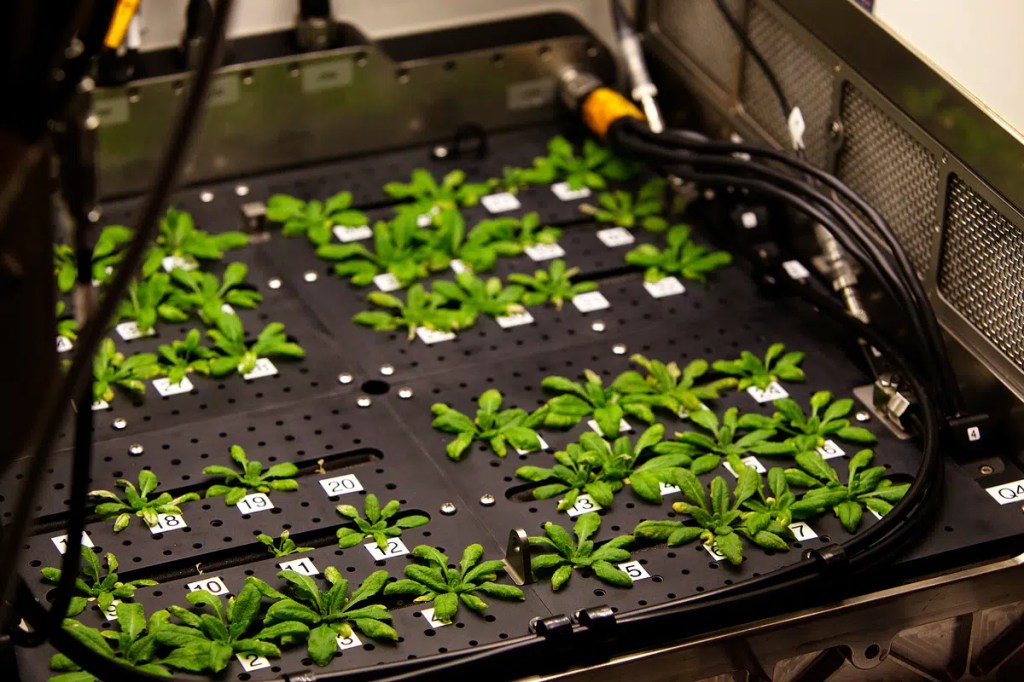
This is the fourth of a quartet of posts that showcase plants performing phenomena that hint at intelligent behaviour. These posts provide evidence to support the book’s draft chapter 6 The intelligent plant(?). Previous examples of plants behaving cleverly have made nods in the direction of botanical arithmetic with ‘multiplication’ (colour-changing sexual apparatus in a saxifrage), addition (snap-trapping of Venus flytrap), and subtraction (leaf mimicry in the chameleon vine). Completing that arithmetical foursome we here have an example of division.
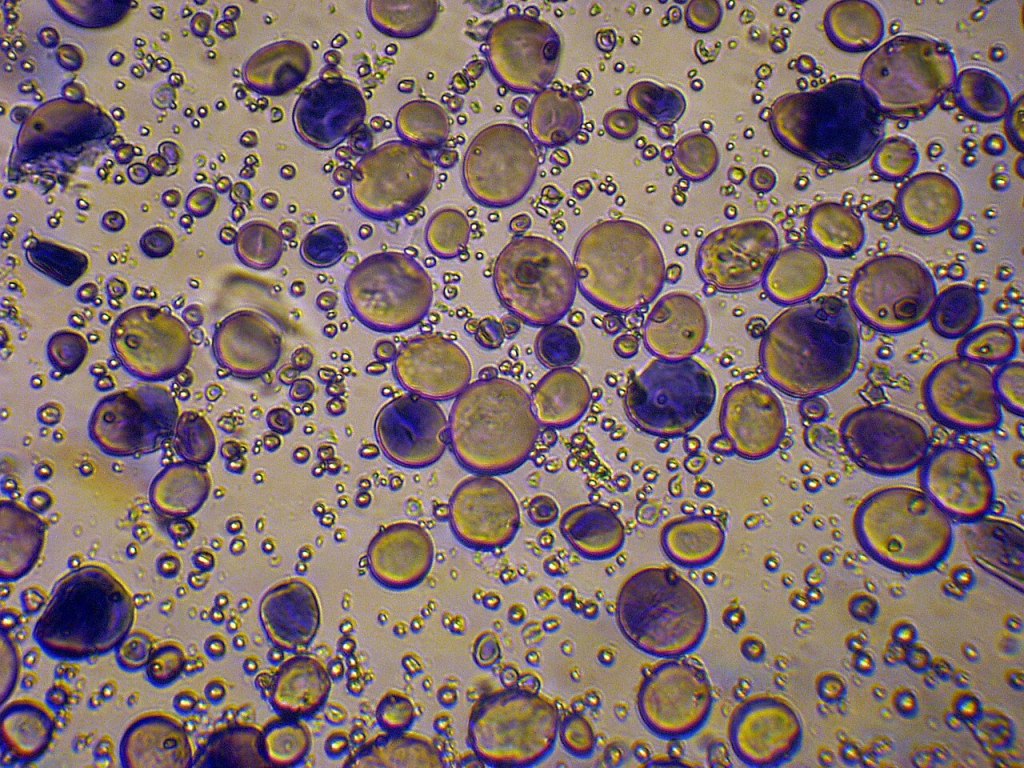
This image. entitled “Granules of wheat starch, stained with iodine, photographed through a light microscope”, by Kiselov Yuri, is in the public domain.
Plants are more than capable of producing their own food, by photosynthesis (Matthew P Johnson, 2016; Ming Y Zheng, 2023; Hans Lambers & James Alan Bassham, 2026). The sugars made during this process are used by the plant to produce energy during respiration*, which is used to drive further metabolic processes, growth and development (Jose Chen Lopez, 2016)**.
Sugars that aren’t used straight away are usually stored as starch (Mark Stitt & Samuel Zeeman, 2012). That starch can then be broken down to sugars that can be consumed in respiration, growth and development (Alison Smith & Mark Stitt, 2007). But, plants don’t just grow during the sunlight hours, they also grow (and respire) during the night. This presents them with a ‘problem’, how do they ensure that their starch reserves last long enough for their night-time food-using activities until it can be replenished by day-time photosynthesis again?***
As you’d expect, plants have been around long enough that this problem has been recognised and solved (otherwise we probably wouldn’t have any plants on the planet today). So, how do they do it?
Investigating this behaviour, Alexander Graf et al. (2010) showed that “starch degradation is under circadian control**** to ensure that carbohydrate availability is maintained until the next anticipated dawn”. Although “The mechanism by which starch degradation in leaves at night is controlled by the clock is not yet understood” (p. 387, Alison Smith et al., 2026), it has been proposed by Antonio Scialdone et al. (2013) that it is accomplished by plant arithmetic.
Nocturnal numeracy…
Recognising that “the rate of decrease in starch reserves in Arabidopsis ***** leaves is adjusted to accommodate variation in the time of onset of darkness and starch content, such that reserves last almost precisely until dawn”, Scialdone et al. (2013) deduced that an arithmetic division computation – between the starch content and expected time to dawn – was required to accomplish this phenomenon.
The hypothesis (D Deeptanshu & Shubham Dogra) Scialdone et al. (2013) developed to explain this behaviour proposed that “During the night, mechanisms inside the leaf measure the size of the starch store and estimate the length of time until dawn. information about the size of the starch store and the time until dawn is encoded in the concentrations of two kinds of molecules (called S for starch and T for time). If the S molecules stimulate starch consumption, while the T molecules prevent this from happening, then the rate of starch consumption is set by the ratio of S molecules to T molecules, in other words S divided by T” (quoted from here).
Importantly, the model reproduced the results of previous experiments, including those in which dawn arrived unexpectedly early or unexpectedly late, which made it a good model – explanation – of what was happening in the plant. But, an even better model of a phenomenon is one that makes predictions. Those predictions were successfully “tested in plants perturbed by a night-time light period or by mutations in starch degradation pathways. Our experiments indicate which components of the starch degradation apparatus may be important for appropriate arithmetic division” (Scialdone et al., 2013). And the calculations made by plants are precise enough that they not only prevent starvation but also make the most efficient use of their food.
A reminder of how impressive this bit of arithmetic is
Whilst it’s relatively easy just to accept that information, it’s worth pausing to reflect on what a remarkable achievement plants accomplish with that little bit of maths (and which is best left to the words of those who’ve studied this phenomenon).
To restate the issue, “Starch accumulated in Arabidopsis***** leaves during the day is converted to sucrose at night at a linear rate such that starch stores are depleted almost exactly at dawn” (p. 115, Smith et al., 2026). But, the length of day – and consequently, night – aren’t always the same in any 24-hour period. Not a problem, “Remarkably, the rate of degradation can adjust to unexpected changes in the time of onset of night to ensure that both of these criteria continue to be met. For example, if plants grown in conditions of 12 hours of light and 12 hours of darkness are subjected to an unexpected onset of darkness, at only 8 hours after dawn, the subsequent rate of starch degradation is half of that on the previous night so that the starch store once again lasts almost precisely until dawn” (p. 115, Smith et al., 2026). Furthermore, “Similarly, the rate of starch degradation can be adjusted appropriately in response to an unexpectedly long period of light. The mechanism responsible for adjusting the rate of starch degradation to match the length of the night involves the circadian clock, the internal 24-hour timing mechanism of the plant that is reset at dawn every day” (p. 115, Smith et al., 2026)******. All-in-all that’s most impressive time-keeping.
Keeping with the clever plants notion, and commenting upon Scialdone et al. (2013)’s work, Prof. Richard Buggs (of Queen Mary, University of London) is reported as saying: “This is not evidence for plant intelligence. It simply suggests that plants have a mechanism designed to automatically regulate how fast they burn carbohydrates at night. Plants don’t do maths voluntarily and with a purpose in mind like we do” (quoted by Helen Briggs, 2013). And, as far as I’m aware, the actual molecules that are predicted to be involved in this calculation are not yet known – and haven’t been isolated. But, and nevertheless, clever or not, it does seems to be a very neat solution to what – for a plant – represents an existential (Candace Osmond) problem; running out of food reserves (before they can be replenished by photosynthesis) can be a matter of life or death.
For more on the ability of plants to ‘know’ maths [math in the USA], see the fascinating exploration of this topic by Stéphane Douady et al. in Do plants know math?
* A frequently-cited misunderstanding about plants amongst students and – by extension, the general public – is that plants photosynthesise but don’t respire (e.g., Jennifer L Maeng & Amanda Gonczi), or “plants only use oxygen (respire) in the dark (Driver et al. 1994)” (p. 135 here), or “that plants only photosynthesise and only animals respire”.
The reality is that plants do both; they respire all the time [24/7], but photosynthesise only during daylight.
At the risk of creating additional potential confusion, it is worth noting that the regular respiration we’re talking about in this post – and which takes place in both the light and at night time – is also known as ‘dark respiration’ (Jose Chen Lopez, 2016). That is to distinguish it from photorespiration, a biochemical process that only occurs during daylight when photosynthesis is operating (Thomas N Brennan & Bryan Ness, 2021).
And, to conclude this little excursion in to the world of respiration, two types of ‘dark respiration’ are recognised, aerobic, and anaerobic (Jacob Leah, 2023). Although both of these bits of biochemistry produce energy, oxygen is needed for aerobic respiration, whereas anaerobic respiration takes place in the absence of oxygen. In terms of the amount of energy they produce, “aerobic respiration … can yield up to 38 ATP molecules per glucose molecule, anaerobic respiration can only produce about 2 ATP molecules” (Jacob Leah, 2023). [Ed. – Adenosine triphosphate (ATP) (Jacob Dunn & Michael H Grider, 2023) “is a vital energy-carrying molecule found in the cells of all living organisms, serving as a fundamental fuel source necessary for life” (Jack Lasky, 2014)].
Whilst aerobic respiration is the more usual form of respiration in plants – and is what ‘dark respiration’ usually means – they can undergo anaerobic respiration in situations where oxygen is unavailable, or is present but at low concentrations (L Rezvani, 2025; Nirmita Sharma, 2025) (e.g., in waterlogged soil).
** In addition to being an energy source, these sugars also provide carbon molecules that can be converted and interconverted into a wide range of organic molecules – such as cellulose – that contribute to growth and development of the plant.
In a typically cuttingsesque, left-of-field (Candace Osmond) additional bit of information, release of photosynthetically-produced sugar to specific zones of the root helps to determine the composition of microbial communities at those sites. Since many of those microorganisms support the plant’s performance by, e.g., supplying nutrients, protecting against pathogens, or helping it cope with drought stress, this is a rather important dimension to plant sugar biology. And sugar is also important in the production of lateral roots, which help to produce the roots from which the sugar can be released into the rhizosphere (David McNear Jr, 2013; Hannah Trivett).
*** To give some idea of how much fixed carbon can be stored away for night-time use, for plants grown with equal day and night periods of 12 hours, approx. 40% of day-time photosynthesis accumulates as starch, the rest is used for sucrose synthesis to fuel day-time growth, etc. And, when plants are grown with short days and long nights, 60% or more of the carbon fixed during photosynthesis is converted to starch (which insights were gratefully gleaned from page 116 of Smith et al. (2026).
**** We don’t have space – or time(!) – to say that much about circadian clocks here, but in brief, “Biological activities that cycle in approximately twenty-four-hour intervals are called circadian rhythms (from the Latin circa, meaning “about” and dies, meaning “a day”). Circadian rhythms allow plants to anticipate environmental cycles and to coordinate their activities with them. Circadian rhythms are not simply responses to changing external conditions, as they continue even when a plant is placed under constant conditions. This continuation indicates that circadian rhythms are controlled by endogenous (internal) timing mechanisms, collectively referred to as the biological clock” (Margaret A OIlney, 2021).
For a good introduction to plant circadian clocks and rhythms, see Katherine Hubbard’s quite short video lesson, and Antony Dodd’s longer presentation [Ed. – and which will also introduce you to the concept of ‘agricultural chronotherapy’…]. For a more technical article on this phenomenon, see Maria Eriksson & Andrew Millar (2003). For a historical perspective on plant circadian rhythms, see C Robertson McClung (2006), and for a review of the physiology of circadian rhythms in plants, see Alex AR Webb (2003). (And don’t overlook Wikipedia’s Circadian rhythm ‘page’)******.
***** It’s probably important to emphasise at this point that most of what we know about control of starch degradation is largely from work with Arabidopsis thaliana, commonly-known in English as thale cress (Stephen Harris). That plant is just one of approx. 369,400 species of flowering plant (Anna Green; Rebecca Morelle). But, you’ve got to start somewhere. And Arabidopsis is probably as good a place to start as any. And, arguably, it is the best place to start because it has been adopted as the pre-eminent, primary model plant species: “Model organisms are species which are easy to grow and manipulate that are extensively studied to gain novel insight into fundamental biological processes” (e.g., here; Chris Somerville & Maarten Koornneef, 2002; Maarten Koornneef & David Meinke, 2010; Andrew Woodward & Bonnie Bartel, 2018; Rachel Ehrenberg, 2025; John Kimball, 2025).
Other plants – when they’ve been sufficiently well-studied – may work differently. But, for now, this is what is known about the situation in Arabidopsis.
However, mindful of the dangers of extrapolating to all plant species from work with just one, Scialdone et al. (2013) also examined the situation in Brachypodium distachyon. As a grass, Brachypodium (Karen-Beth Scholthof et al., 2018) is a quite different plant to Arabidopsis, which is in the mustard family (John Kimball). But, and as for Arabidopsis, starch content in Brachypodium leaves increased through the light period, and the approximately linear decrease of starch with time following either a normal night (12 hr after dawn) or an unexpectedly early night (8 hr after dawn) was such that starch reserves were almost depleted by dawn (Scialdone et al., 2013). Although this is only two plants out of the wide variety of plants that exist in the planet, these results do go some way towards establishing how widespread this behaviour – and its arithmetic basis – may be amongst plants.
****** As you might expect, the plant’s circadian clock isn’t just involved in reserve-mobilisation at night time. It plays an important part in the timely regulation and operation of many different processes or phenomena in plants, e.g., pollinator attractiveness, herbicide resistance, drought resistance, flowering time, disease resistance, leaf movement, bud dormancy, and rice tillering (Stacey Harmer, 2026). Furthermore, plants with a circadian period that is appropriately matched to environmental cycles have increased photosynthesis, growth, survival, and competitive advantage compared to plants whose clock is mismatched to regular changes in the environment (Antony N Dodd et al., 2005). ‘Clock-watching’ is clearly advantageous to the plant.
The concept of the plant circadian clock is taken further in the word ‘chronoculture’ (Gareth Steed et al., 2021; Anita Hajdu et al., 2026), which term combines elements of chronology [“the science that deals with measuring time by regular divisions and that assigns to events their proper dates”] with agriculture [“the science, art, or practice of cultivating the soil, producing crops, and raising livestock and in varying degrees the preparation and marketing of the resulting products”]. Chronoculture envisages that “A better understanding of circadian rhythms in crop plants can help improve agricultural production” (Christopher Buckley & Mike Haydon, 2025). For some examples of how knowledge of plant circadian clock s might impact agricultural practice, see the video by Antony Dodd.
REFERENCES
Antony N Dodd et al., 2005. Plant circadian clocks increase photosynthesis, growth, survival, and competitive advantage. Science 309(5734): 630–633; doi: 10.1126/science.1115581
Jacob Dunn & Michael H Grider, 2023. Physiology, Adenosine Triphosphate. [Updated 2023 Feb 13]. In: StatPearls [Internet]. Treasure Island (FL): StatPearls Publishing; 2026 Jan-. Available from: https://www.ncbi.nlm.nih.gov/books/NBK553175/
Maria E Eriksson & Andrew J Millar, 2003. The circadian clock. A plant’s best friend in a spinning world. Plant Physiology 132(2): 732–738; https://doi.org/10.1104/pp.103.022343
Alexander Graf et al., 2010. Circadian control of carbohydrate availability for growth in Arabidopsis plants at night. PNAS 107(20): 9458-9463; https://doi.org/10.1073/pnas.0914299107
Anita Hajdu et al., 2026. Circadian clocks in crop productivity: Mechanisms, breeding strategies, and chrono-agricultural applications. Agronomy 16(13): 1236; https://doi.org/10.3390/agronomy16131236
Stacey L Harmer, 2026. Time after time: a quarter century of progress in plant circadian biology. npj Biol Timing Sleep 3: 16; https://doi.org/10.1038/s44323-026-00076-2
Matthew P Johnson, 2016. Photosynthesis. Essays Biochem 60(3): 255–273; doi: https://doi.org/10.1042/EBC20160016
Maarten Koornneef & David Meinke, 2010. The development of Arabidopsis as a model plant. The Plant Journal 61(6): 909–921; doi: 10.1111/j.1365-313X.2009.04086.x
C Robertson McClung, 2006. Plant circadian rhythms. Plant Cell 18(4): 792-803; doi: 10.1105/tpc.106.040980
David H McNear Jr, 2013. The rhizosphere – roots, soil and everything in between. Nature Education Knowledge 4(3): 1.
L Rezvani, 2025. Aerobic and anaerobic respiration in plants. J Plant Biochem Physiol. 13(3): 360.
Karen-Beth G Scholthof et al., 2018. Brachypodium: A monocot grass model genus for plant biology. The Plant Cell 30(8): 1673–1694; https://doi.org/10.1105/tpc.18.00083
Antonio Scialdone et al., 2013. Arabidopsis plants perform arithmetic division to prevent starvation at night. eLife 2: e00669; https://doi.org/10.7554/eLife.00669
Alison M Smith & Mark Stitt, 2007. Coordination of carbon supply and plant growth. Plant, Cell & Environment 30(9): 1126-1149; https://doi.org/10.1111/j.1365-3040.2007.01708.x
Alison M Smith et al., 2026. Essential plant biology. Taylor & Francis Group, LLC.
Chris Somerville & Maarten Koornneef, 2002. A fortunate choice: the history of Arabidopsis as a model plant. Nat Rev Genet 3: 883–889; https://doi.org/10.1038/nrg927
Gareth Steed et al., 2021. Chronoculture, harnessing the circadian clock to improve crop yield and sustainability. Science 372: eabc9141; doi: 10.1126/science.abc9141
Mark Stitt & Samuel C Zeeman, 2012. Starch turnover: pathways, regulation and role in growth. Current Opinion in Plant Biology 15(3): 282-292; https://doi.org/10.1016/j.pbi.2012.03.016
Alex AR Webb, 2003. The physiology of circadian rhythms in plants. New Phytologist 160(2): 281-303; https://doi.org/10.1046/j.1469-8137.2003.00895.x
Andrew W Woodward & Bonnie Bartel, 2018. Biology in bloom: A primer on the Arabidopsis thaliana model system. Genetics 208(4): 1337–1349; https://doi.org/10.1534/genetics.118.300755


Leave a Reply