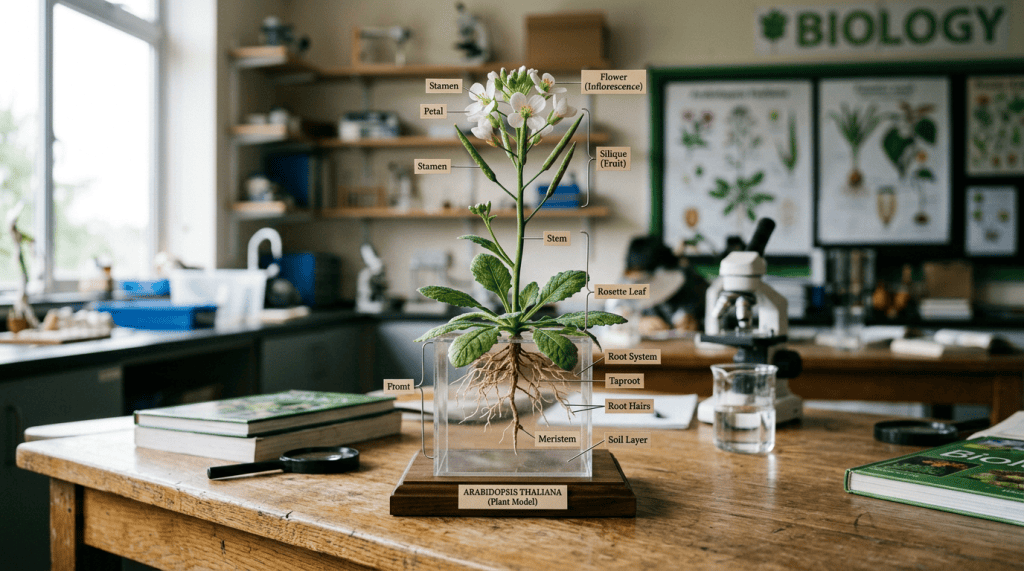
Draft book chapter 1 spent some time making the case that there wasn’t such a thing as ‘a plant’, there are hundreds of thousands of different species – and that’s just flowering plants. But, there is – arguably – a situation where we might acknowledge that there might just be ‘one plant’ after all. That’s what this section is all about…
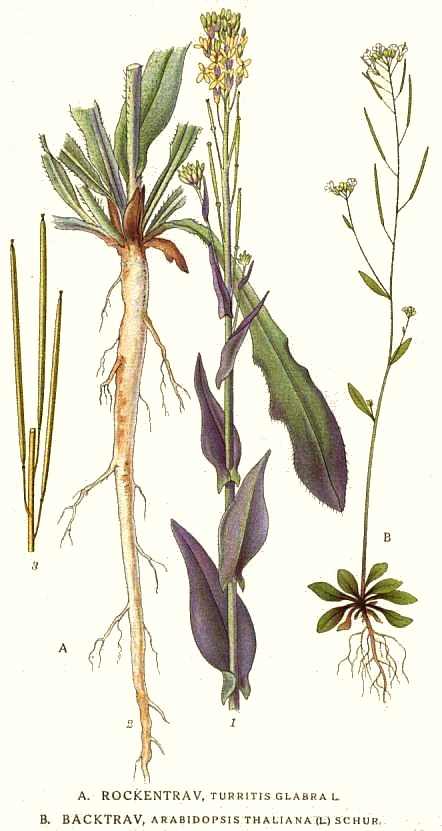
This image, entitled “A. Rockentrav, Turritis glabra L., B. Backtrav, Arabidopsis thaliana (L.) Schur.” (from Bilder ur Nordens Flora) is in the public domain.
Having spent considerable time – and quite a few words – above convincing you that there really isn’t such a thing as ‘the’ plant, I risk undoing all of that hard work in this section. Because there is a situation where it is easy to believe that there really is a singular plant: Arabidopsis thaliana. And the reason for singling-out this species is because of its use as a so-called model species for plant biology.
What is a model plant?
“Model plants* are extensively-studied plant species chosen for the ease of investigating particular biological phenomena or for their value in biotechnology or agronomy. Research on model plants provides biological insights relevant to other organisms in areas such as biochemistry, genetics, physiology, ecology, evolution and development” (quoted from here). [Ed. – for a good – if a little technical – consideration of what a model species is, and should achieve, see the articles by Richard Flavell (2009) and Soham Ray et al. (2022).]
What is the model plant?
The model organism selected for this singular honour in plant biology is Arabidopsis thaliana (DW Meinke et al., 1998; Anthony Woodward & Bonnie Bartel, 2018; Marc Somssich, 2019; Madhabendra Mohon Kar & Ayan Raichaudhuri, 2022; Abel Cerdà; Gülce Tekin, which is commonly-known in English as thale cress (Stephen Harris)**.
Although the plant has been known for many hundreds of years, and Linnaeus had a hand in naming it in the 18th century [Ed. – that’s what the L. stands for in its full scientific name of Arabidopsis thaliana (L.) Heynh. (Marc Somssich, 2019)], its promotion as a model organism for plant studies didn’t really take place until the 1950s. However, interest in use of this plant soon increased and in 1965 the first International Arabidopsis Symposium took place. Since that time – and particularly since the 1980s (Richard Flavell, 2009) – the amount of work undertaken with this rather unlikely star of the botanical firmament has ‘exploded’, and the number of scientific papers published that report the various plant biological findings and discoveries made with this small botanic has ‘mushroomed’ in the intervening decades (Gülce Tekin; Ibrokhim Y Abdurakhmonov, 2022).
Why? What is it about Arabidopsis that makes it so attractive as a model organism? Some of the advantages of using this plant as the model for all of plant biology are…
Why is Arabidopsis the model plant?
One of the most valuable traits of Arabidopsis is its rapid growth. The entire life cycle – from seed-germination to production of seed for the next generation – can take place within 6 to 8 weeks, which allows scientists to study multiple generations in a short amount of time. This trait is extremely valuable in trying to get results when grant-funded research has to be carried out within short time periods from a few months to three years or so (e.g., here, here, here, and here).
Not only can Arabidopsis grow quickly, but its growth requirements are reasonably simple and it can be grown under relatively basic conditions, in the laboratory in pots or Petri dishes with minimal space. This greatly reduces costs and logistical challenges of research with this plant compared to other species with more exacting growth requirements, especially if they need to be grown outside [Ed. – for a useful comparison of the challenges of laboratory-based investigations compared to field work, see Chris Goforth’s highly readable blog post “Science Sunday: Field Research vs. Lab Research”]. Importantly, Its small size means researchers can cultivate hundreds of samples in a single growth chamber, maximizing data collection and experimental variation. Furthermore, each plant can produce thousands of seeds, providing abundant opportunities for the sample sizes required for statistically-robust evidence to support research findings (Jorge Faber & Lilian Martins Fonseca, 2014; Chittaranjan Andrade, 2020).
So much for the practicalities of working with Arabidopsis. Some of the most compelling arguments for its favoured status as a model plant relate to its DNA, in particular its genome [“The complete set of DNA (genetic material) in an organism”]. The Arabidopsis genome is comparatively small – about 135 mega base pairs (Justin Corfield). Whilst that value may not be particularly meaningful on its own, it means that it is compact and easier to work with compared to other plant genomes. That small size greatly facilitated publication of its complete sequence in 2000 (The Arabidopsis Genome Initiative, 2000). Knowing the genome sequence allows scientists to identify the genes that ultimately – largely – dictate how the plant ‘works’ and interacts with its environment (Sarah Lee). With that insight one can slowly put together the information of what gene does what and how it contributes to the overall biology of the plant.
Additionally, Arabidopsis is highly amenable to genetic transformation, particularly through the Agrobacterium tumefaciens-mediated method. This enables scientists to add or silence [prevent genes already present from making their protein] genes with high efficiency, allowing for the creation of transgenic lines to study gene expression, protein function, and genetic pathways. Combined with the availability of such genetic manipulation as the gene-editing CRISPR technology (McKenzie Prillaman), “Arabidopsis offers an unmatched toolkit for plant genetic engineering”. These techniques of molecular biology and therefore the modern-day emphasis on studying the genes that underpin plant growth and development – particularly the ability to add or remove or change a gene to see what effect that has on plant biology – has led to an almost unprecedented increase in our knowledge and understanding of the biology of plants. So much so that it has produced “a trove of genetic information that has facilitated numerous studies in plant biology”.
Since the first International Arabidopsis Symposium in 1965, the Arabidopsis research community is now well-established – and global – providing expertise, resources, and protocols, which further strengthen the species’ position as a model organism. [Ed. – although this argument is a little ‘circular’ (Richard Nordquist; Kassiani Nikolopoulou) in that widerspread use of Arabidopsis encouraged development of this community of researchers, whose work further encouraged use of Arabidopsis as a model plant, which in turn inspired more people to work with the plant. But, whichever way you look at it, there’s a lot of Arabidopsis scientists out there.]
And, although not of general plant biological relevance, “As a member of the Brassicaceae family [Melissa Petruzzello] it is linked to more important cultivated species such as cabbage, mustard and radish” (Alan Mullan & Dr Aleksandra Marsh). [Ed. – Which, at least, should make Arabidopsis an appropriate model for those crops…]
Altogether – and there are other more-technical reasons (e.g., GP Rédei, 1975; here; here; Abel Cerdà; Anthony Woodward & Bonnie Bartel, 2018) – that’s a pretty impressive list of reasons in favour of Arabidopsis as the model plant. [Ed. – and, since “A. thaliana is easy to look after compared with animal model organisms” (Alan Mullan & Dr Aleksandra Marsh) – and poses fewer ethical considerations than research on primates (Marci Regambal; Constança Carvalho et al., 2018) – it has even been used to provide insights into the biology of animals, including humans (Gülce Tekin; Alan Jones et al., 2008).
Some Arabidopsis achievements…
And quite what has been achieved by studying Arabidopsis is celebrated in an extremely useful timeline that highlights “some of the exceptional discoveries, innovations, and community milestones in Arabidopsis research over the past 150+ years” is the Open Access scientific article by Catherine Freed et al. (2025). Beginning in 1873 with the report of the first Arabidopsis mutant (Vladimir Tarakanov), it concludes in 2024 with the commercial release of anthocyanin-rich purple tomatoes (Cathie Martin & Eugenio Butelli, 2024). Development of that crop was directly aided by “Arabidopsis-based gene discovery” because “AtMYB12 protein from Arabidopsis revealed that AtMYB12 increases flavonoid accumulation and phenylpropanoid biosynthesis in tomato” (Freed et al., 2025). Altogether, “This timeline showcases multinational Arabidopsis efforts from as early as 1873 to the present, divided into five categories: technology, community, landmark paper, resource, and application”. [Ed. – readers might – correctly – surmise that lack of details regarding the innovations, etc. in Arabidopsis research in this post is down to the limits of Mr P Cuttings’ understanding of the significance of such matters – and their quite/highly detailed technical nature…].
For more on breakthrough discoveries using Arabidopsis, see Nicholas Provart et al., 2015; Anthony Woodward & Bonnie Bartel, 2018; Siobhan Brady et al., 2025; here; and here.
That’s quite a catalogue of achievements [i.e., when you look at the specifics within the articles cited above re breakthroughs, etc. with Arabidopsis] – which has been hard-won by thousands of researchers in institutions across the globe over decades of intensive work, often on government-funded projects. And that’s great. It is something that’s well worth celebrating. But, Arabidopsis is a very particular type of plant.
But, what is Arabidopsis not?
Arabidopsis is not a crop plant (Diane Boudreau et al.). Rather, it is a small, weedy, terrestrial, herbaceous (Jeffery Bartel), dicotyledonous, flowering plant (an angiosperm (Martin Huldrych Zimmermann & Peter Stevens) in the cabbage family, the Brassicaceae (which is also known as the Cruciferae)).
As such, it’s not a monocot (such as an orchid, a grass, or a palm), or a tree***, or an epiphyte, or a seagrass (Pamela L Reynolds). Neither is it a gymnosperm (Christopher J Earle), or a fern, or a moss, or a liverwort, nor any other type of non-angiosperm plant within the plant kingdom (Becki Brunelli; Samantha Fowler et al.). Neither is it a green alga****, nor any of the other important photosynthetic algae such as brown seaweeds, or cyanobacteria. In other words, because Arabidopsis is a very specific type of flowering plant, its in-depth study doesn’t – necessarily – advance our understanding of the biology of any other type of photosynthetic organism.
Some of those ideas are dealt with in more detail in the comprehensive article here. In particular the following constraints: the limited ecological relevance of Arabidopsis [which may not accurately represent the diversity of plant species with different growth habits or environmental adaptations]; its small size and simple morphology [which can be inadequate for studying traits like wood formation or complex root systems***]; and its limited complexity [Arabidopsis is a relatively simple plant compared to more complex crops, which may decrease its applicability for studying intricate plant traits or interactions]. And even when/where Arabidopsis insights may have relevance to a crop plant, there can be major problems in applying that knowledge to crops (Cristóbal Uauy et al., 2025).
[Ed. – For more on the disadvantages/limitations of Arabidopsis as a plant model, see Gülce Tekin; Anthony Woodward & Bonnie Bartel, 2018; Sarah Shailes; and here]
So, what’s the answer?
New – and additional – model plants.
Although Arabidopsis has reached – and continues to retain – a pre-eminent position amongst those who study plant biology, there are many who have questioned the ability of that plant to be a true model for all types of plants. Not surprisingly therefore, researchers have studied other plants throughout the period in which Arabidopsis attained ascendancy, and have promoted those plants as models for particular investigations, e.g., tomato (Solanum lycopersicum (Wei Liu et al., 2022)), and maize (Zea mays (Fakhriddin Kushanov et al., 2022)). But, with better appreciation of the shortcomings of Arabidopsis, many more plants are being put forward as candidate reference plants.
Without the space here to list all of those, it’s worth mentioning a few to give a flavour of the diversity of model plants now being studied almost as intensively as Arabidopsis. In attempts to gain insights into the early stages of land colonisation by plants, Marchantia polymorpha (common liverwort) is being widely promoted (Igor Cesarino et al., 2020). Phragmites australis (common reed), “a common perennial grass, which can tolerate many different environments such as salt marshes and arid areas” (Juniper Kiss) is being investigated as an invasive species (Igor Cesarino et al., 2020). The crop-destroying scourge of plant parasitism (Alex Twyford, 2018; Pervin Erdogan, 2022; Olga Cannavacciuolo et al., 2024) is being examined with Striga hermonthica (witchweed). Striga is “a widely distributed parasitic plant that feeds on monocotyledonous plants (e.g. rice, maize, millet, sorghum)” (Juniper Kiss) (Igor Cesarino et al., 2020). And Eutrema salsugineum, “a halophytic (salt-tolerant) Arabidopsis look-alike plant” (Juniper Kiss), is a major contender for studies of salt tolerance amongst plants (Igor Cesarino et al., 2020).
For more information on model plant alternatives to Arabidopsis, see Andrew Wood et al., 2000; Paul Gepts et al., 2005; Xianmin Diao et al., 2014; Caren Chang et al., 2016; here; Charles Delwiche et al., 2017; Juniper Kiss; Igor Cesarino et al., 2020; here; Soham Ray et al., 2022; and Sandhya Yadav et al., 2023.
What can we conclude from this?
We do need to continue to work with Arabidopsis as a ‘model’ plant – the global infrastructure of connections, collaborations, laboratories, and expertise is already in place for that. But, we also need to continue to work on other – and develop more – such ‘reference’ plants, and – arguably – each of the hundreds of thousands of species to fully comprehend what plants are and what they are capable of. There’s plenty of work for everyone interested in plant biology.
The reality of the situation is admirably summed up by Chris Somerville, one of the early pioneers of work with, and advocates for the use of, Arabidopsis (Elizabeth Pennisi, 2000; Chris Somerville & Maarten Koornneef, 2002): “It’s a wonderful place for people to learn about the basic process,” he says. “So first you go to Arabidopsis and you say, well, how is Arabidopsis doing this aspect of biology? And then you can translate it now into the other plants — the other plants we care about” (quoted from Rachel Ehrenberg, 2025).
* Instead of ‘model’ plant, the best alternative term I’ve come across to date is ‘reference plant‘ (Caren Chang et al., 2016). That seems to be a much more honest acknowledgement of the sort of information that such a plant can actually provide.
** Because we Botanists are always keen to give a ‘shout-out’ to those who study organisms of somewhat lesser merit, we are happy to state that those other biological disciplines have their own model species, e.g., fruit fly (Drosophila melanogaster) (Alan Mullan & Aleksandra Marsh), and the nematode Caenorhabditis elegans (Mark Edgley et al.) (Alan Mullan & Aleksandra Marsh) for the Zoologists, Escherichia coli (Alan Mullan & Aleksandra Marsh) for the Bacteriologists, and Escherichia virus T4, a bacteriophage for the Virologists. And it would be very remiss of me not to mention the plant-like Emiliania huxleyi, a “unicellular marine coccolithophore alga, extensively studied as a model phytoplankton species” (quoted from here) by our Phytoplanktonological partners, and the unicellular yeast Saccharomyces cerevisiae (Steve James) for our fungi-favouring friends.
For a more comprehensive listing of non-plant model organisms, see here, and Alan Mullan & Aleksandra Marsh. For a more comprehensive listing of plant models, see here. For more on a variety of ‘popular’ model organisms – but which is in no way comprehensive (although does cite many sources…), see Alyssa Cecchetelli & Lukas Morgan.
*** For many years Mr P Cuttings was a fervent advocate of the view that, since Arabidopsis was not a tree, it was of little use in understanding the cell biology of wood formation in trees [Ed. – his research specialism for many years, e.g., here, and Nigel Chaffey, 2002]. Sadly(!), working with colleagues in the Swedish University of Agricultural Sciences [SLU] it was discovered that, by appropriate manipulation of its growing conditions, Arabidopsis could be encouraged to make wood. Not only that, but the wood it made was rather similar to that produced by a proper tree (Nigel Chaffey et al., 2002). So, another hurdle – to more general relevance of this weedy herb to plant biology – seems to be have been surmounted, and it does appear that Arabidopsis may have some utility in understanding tree-related questions such as wood formation (Jing Zhang et al., 2011; Alicja Dolzblasz et al., 2026)…
**** Which organisms may – or may not – also be included in the plant kingdom when known as the Viridiplantae…
REFERENCES
Ibrokhim Y Abdurakhmonov, 2022. Introductory chapter: Model plants for discovering the key biological processes in plant research. IntechOpen; doi: 10.5772/intechopen.103759
Siobhan Brady et al., 2025. Arabidopsis research in 2030: Translating the computable plant. Plant J. 121(5): e70047; doi: 10.1111/tpj.70047
Olga Cannavacciuolo et al., 2024. Developing crops that can fight off parasitic plants. Front. Young Minds 12: 1207431; doi: 10.3389/frym.2023.1207431
Constança Carvalho et al., 2018. Ethical and scientific pitfalls concerning laboratory research with non-human primates, and possible solutions. Animals (Basel) 9(1): 12; doi: 10.3390/ani9010012
Igor Cesarino et al., 2020. Plant science’s next top models. Ann Bot 126(1): 1-23; doi: 10.1093/aob/mcaa063
Nigel Chaffey, 2002. Why is there so little research into the cell biology of the secondary vascular system of trees? New Phytologist 153(2): 213-223; https://doi.org/10.1046/j.0028-646X.2001.00311.x
Nigel Chaffey et al., 2002. Secondary xylem development in Arabidopsis: a model for wood formation. Physiologia Plantarum 114(4): 594-600; https://doi.org/10.1034/j.1399-3054.2002.1140413.x
Caren Chang et al., 2016. Field guide to plant model systems. Cell 167(2): 325-339; doi: 10.1016/j.cell.2016.08.031
Charles F Delwiche et al., 2017. Land plant model systems branch out. Cell 171(2): 265-266; https://doi.org/10.1016/j.cell.2017.09.036
Xianmin Diao et al., 2014. Initiation of Setaria as a model plant. Front. Agr. Sci. Eng. 1(1): 16‒20; https://doi.org/10.15302/J-FASE-2014011
Alicja Dolzblasz et al., 2026. The value of Arabidopsis as a model for secondary xylem research. New Phytologist 252(2): 558-574; https://doi.org/10.1111/nph.71403
Pervin Erdogan, 2022. Parasitic plants in agriculture and management. IntechOpen; doi: 10.5772/intechopen.98760 [From the Edited Volume Parasitic Plants, Edited by Ana Maria Gonzalez and Héctor Arnaldo Sato]
Jorge Faber & Lilian Martins Fonseca, 2014. How sample size influences research outcomes. Dental Press J Orthod 19(4): 27-29; doi: 10.1590/2176-9451.19.4.027-029.ebo
Richard Flavell, 2009. Role of model plant species. Methods Mol Biol. 513: 1-18; doi: 10.1007/978-1-59745-427-8_1
Catherine Freed et al., 2025. A timeline of discovery and innovation in Arabidopsis. The Plant Cell 37(5): koaf108; https://doi.org/10.1093/plcell/koaf108
Paul Gepts et al., 2005. Legumes as a model plant family. Genomics for food and feed report of the Cross-Legume Advances Through Genomics Conference. Plant Physiol. 137(4): 1228-1235; doi: 10.1104/pp.105.060871
Alan M Jones et al., 2008. The impact of Arabidopsis on human health: diversifying our portfolio. Cell 133(6): 939-943; doi: 10.1016/j.cell.2008.05.040
Fakhriddin N Kushanov et al., 2022. Maize (Zea mays L.) as a model system for plant genetic, genomic, and applied research. IntechOpen; doi: 10.5772/intechopen.104658 [https://www.intechopen.com/chapters/81949#]
Wei Liu et al., 2022. Solanum lycopersicum, a model plant for the studies in developmental biology, stress biology and food science. Foods 11: 2402;. https://doi.org/10.3390/foods11162402
Cathie Martin & Eugenio Butelli, 2024. The purple tomato story; from Laboratory bench to the consumer. ACS Food Sci Technol 5(1): 19-28; doi: 10.1021/acsfoodscitech.4c00692
DW Meinke et al., 1998. Arabidopsis thaliana: a model plant for genome analysis. Science 282(5389): 662, 679-682; doi: 10.1126/science.282.5389.662
Madhabendra Mohon Kar & Ayan Raichaudhuri, 2022. Overview of Arabidopsis as a genetics model system and its limitation, leading to the development of emerging plant model systems. In Model Organisms in Plant Genetics. IntechOpen; doi: http://dx.doi.org/10.5772/intechopen.99818
Nicholas J Provart et al., 2015. 50 years of Arabidopsis research: highlights and future directions. New Phytologist 209(3): 921-944; https://doi.org/10.1111/nph.13687
Soham Ray et al., 2022. Model plants in genomics, pp 241–264. In: Ram Lakhan Singh et al. (eds), Plant Genomics for Sustainable Agriculture. Springer, Singapore; https://doi.org/10.1007/978-981-16-6974-3_9
GP Rédei, 1975. Arabidopsis as a genetic tool. Annual Review of Genetics 9: 111-127; https://doi.org/10.1146/annurev.ge.09.120175.000551
Marc Somssich, 2019. A short history of Arabidopsis thaliana (L.) Heynh. Columbia-0. PeerJ Preprints 7: e26931v5; https://doi.org/10.7287/peerj.preprints.26931v5
The Arabidopsis Genome Initiative, 2000. Analysis of the genome sequence of the flowering plant Arabidopsis thaliana. Nature 408: 796–815; https://doi.org/10.1038/35048692
Alex D Twyford, 2018. Parasitic plants. Current Biology 28(1): R857-859; https://doi.org/10.1016/j.cub.2018.06.030
Cristóbal Uauy et al., 2025. Challenges of translating Arabidopsis insights into crops. The Plant Cell 37(5): koaf059; https://doi.org/10.1093/plcell/koaf059
Andrew Wood et al., 2000. Bryophytes as model systems. The Bryologist 103(1): 128-133; doi: http://dx.doi.org/10.1639/0007-2745(2000)103%5B0128:BAMS%5D2.0.CO;2
Anthony W Woodward & Bonnie Bartel, 2018. Biology in bloom: A primer on the Arabidopsis thaliana model system. Genetics 208(4): 1337-1349; doi: 10.1534/genetics
Sandhya Yadav et al., 2023. Bryophytes as modern model plants: An overview of their development, contributions, and future prospects. J Plant Growth Regul 42: 6933–6950; https://doi.org/10.1007/s00344-023-10986-1
Jing Zhang et al., 2011. Arabidopsis as a model for wood formation. Current Opinion in Biotechnology 22(2): 293-299; https://doi.org/10.1016/j.copbio.2010.11.008


Leave a Reply