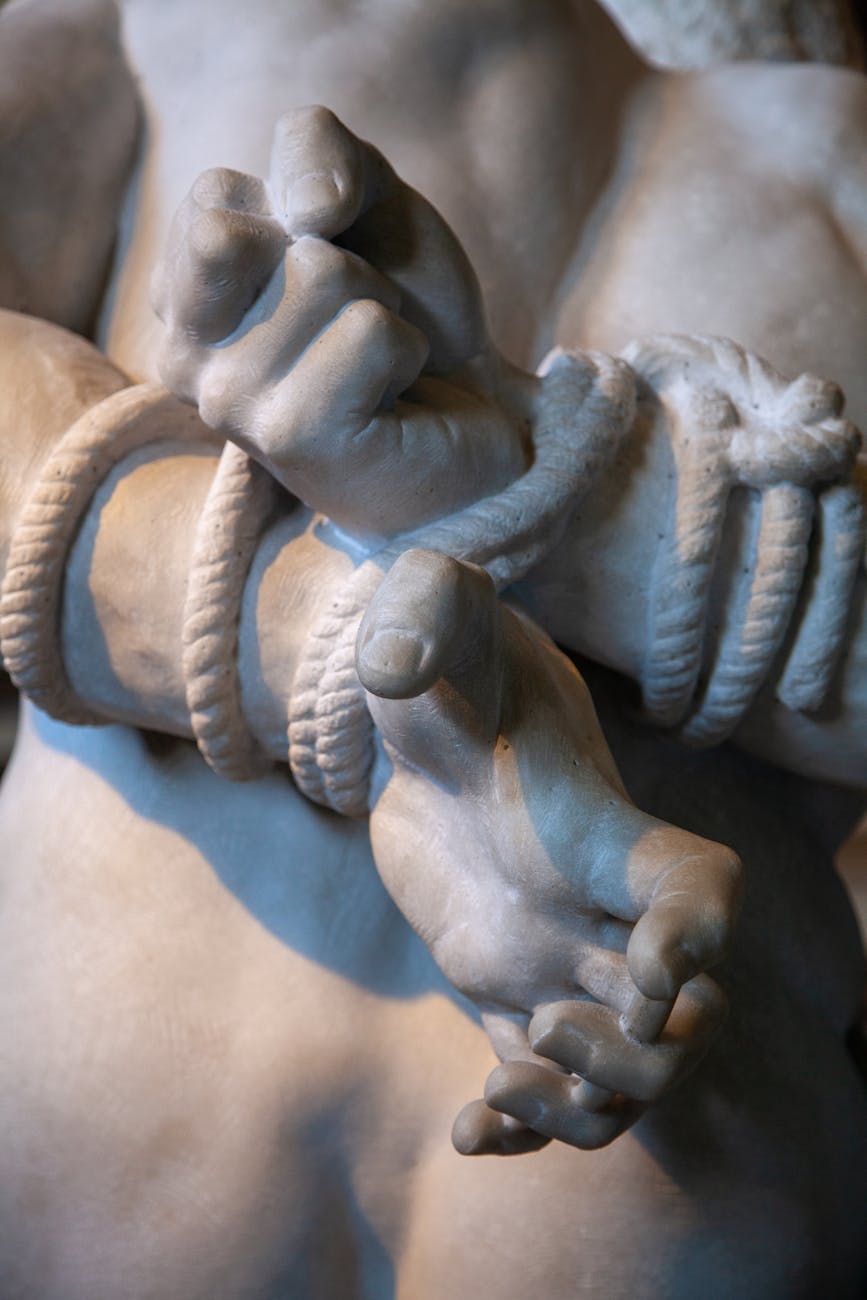
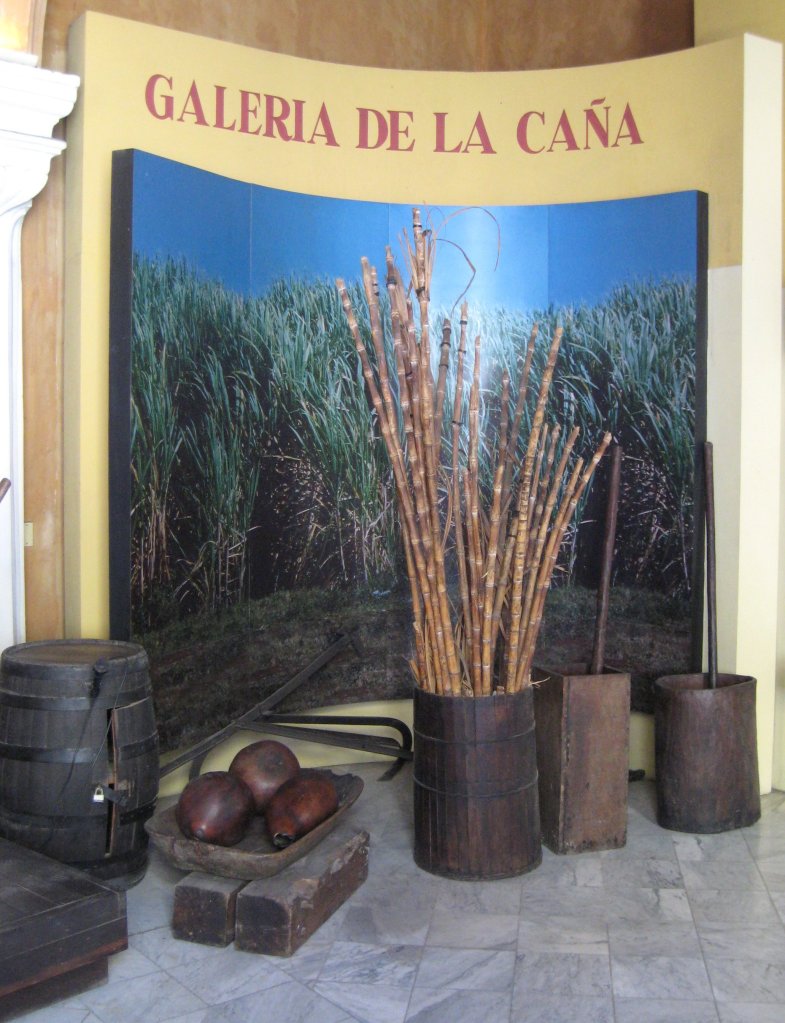
Sugar cane, a major source of sugar, is at the root of some of Mankind’s greatest injustices to his fellows in the slave-owning barbarism of the plantation system practised particularly in the West Indies and South America. Also shown are other items of the sugar-refiner’s craft in the Museo del Ron (Havana, Cuba).
It is widely acknowledged that plants are important providers of medicines, materials, and foodstuffs, which help keep us happy and well, clothed and housed, and fed. So much for some of the obvious ways in which we exploit the plant resource. Less well-recognised is a darker side of our relationship with plants which has had profound effects on our recent past, continues to affect our present, and will have major influences on our future well-being.
Historically, the quest for spices, and the industrial-scale commercialisation and production of cotton, tobacco and sugarcane have led to some of the worst cases of Man’s inhumanity to Man, such as human slavery. But those dark periods of human history have spawned arguably darker times as they in turn have given rise to the main forms of ideology – communism and capitalism – that drive much of today’s global politics and economics, and have laid the foundations for some of the most persistent health issues – tobacco-related deaths and sugar-associated obesity and diabetes – of the modern age.
Whilst we rightly celebrate the positive benefits that plants provide, there is a less well-known ‘negative’ side to that relationship. This chapter explores some of the darkest plant-related episodes in human history as we focus on slavery in connection with cultivation of cotton, tobacco, and sugarcane. Arguably, our continuing relationship with those three crops is also responsible for many of our modern-day health concerns – cancers from smoking, obesity and diabetes related to sugar – and can unfavourably influence our stewardship of the environment, as exemplified in the case of the Aral Sea. Generally, our association with plants is benign, and brings a great deal of benefit to Mankind, but human greed and folly can so easily tip the balance the other way.
Plants, the perfect poison..?
We are used to thinking of plants in the context of “the four Fs of ethnobotany, Food, Fibres, Fuel, and pharmaceuticals” [source: Anonymous], i.e., as providers of food, drink, clothing, medicines (and not to forget the oxygen they also produce!). But that primarily only considers the ‘good’ side of plants. We may occasionally also acknowledge that plants provide a plentiful range of toxins and poisons (Karin Fester, 2010; Norman L Christensen; Melissa Petruzzello). And recall that those plant poisons have been used to harm people – whether accidentally or intentionally (by one’s self (Romain Torrents et al., 2023) or AN Other (Kambiz Soltaninejad, 2023)) – for hundreds of years (Aaron J Reardon; Jenny Laville; Sebastian Wendt et al., 2022; Binish, 2025). But, plants – particularly when in the hands of people – have an even darker side. This chapter attempts to raise awareness of that less-than-benign aspect of the relationship between plants and people, which is underappreciated – at best – and often unrecognised – at worst (and at our peril!).
The spice trade
Humans have a habit of causing harm to other humans in their lust for money and/or power. The spice trade dramatically demonstrates both of those ‘justifications’. Spices are plant-derived ‘flavourings’ such as nutmeg, cloves, cardamon, cinnamon, and pepper. Although an ancient quest for a highly-sought-after commodity with records as far back as 2600 BCE, the Spice Trade really hotted-up when the major European powers entered the arena, from the 15th century (Mark Cartwright, 2021; Eric Bullard, 2022). Spices – or, rather the search therefor and control over the trade thereof – were the joint obsessions that seemed to monopolise many of the seafaring expeditions of the European nations – e.g., the Netherlands, Spain, Portugal, and England – in the 15th, 16th and 17th centuries, the so-called Age of Exploration (Brendan Wolfe, 2020; Amanda Briney, 2024) or of Discovery (Cait Caffrey, 2021; Jean Brown Mitchell, 2026) (or of Exploitation, if you were on the receiving end of it…).
Featuring such notable historical figures as Christopher Columbus, Vasco de Gama (Dave Roos, 2024), Ferdinand Magellan, Francis Drake, Cornelis de Houtman, and Jacob van Neck, and the various East India Companies (particularly the Dutch East India Company, and its English counterpart) established at that time to exploit the trading opportunities presented by long-distance ocean voyaging (summarised from here), these were exciting times that unfortunately brought out some of the worst excesses of human behaviour. Why? What was the allure of those ‘dried plant bits’ which we take so much for granted nowadays?
“In the culinary arts, the word spice refers to any dried part of a plant, other than the leaves*, used for seasoning and flavoring a recipe, but not used as the main ingredient” (Danilo Alfaro, 2022). More specifically, spices “are aromatic plant materials derived from seeds, bark, roots, fruits, flowers, or other plant parts” (Allison Johnston)”.
* “Why not the leaves? Because the green leafy parts of plants used in this way are considered herbs” (Danilo Alfaro, 2022). Somewhat annoyingly, there appears to be no formal definition of spice, a word whose meaning has changed throughout history (Ian Anderson, 2023). For more on the difference between spices and herbs, see Jonathan Hogeback, and here. And for a list of herbs and spices, see Melissa Petruzzello, and here.
However they are defined, dried, aromatic plant parts known as spices quite literally ‘spiced-up’ meals – for those who could afford them – and thereby provide some variation in tastes, smells, and the overall experience of eating.
[Ed. – for those who couldn’t afford spices – which was the great majority of people – there was plenty of taste variation already available in the Mediaeval diet with tasty, readily-to-hand vegetables and herbs].
Whilst highly flavoured spices could have helped to disguise the taste of rotten meat] or other ingredients that had begun to spoil, it is considered an unlikely practice because the cost of the spices would be much higher than the other ingredients they were presumed to ‘hide’ (Elsie Park, 2012; Elizabeth Chadwick, 2026).
Additionally, many spices promoted sweating (Jennifer Billing & Paul Sherman, 1998) – hence cooling of the body (Craig Freudenrich; Katie McCallum, 2020) – which, particularly in hot climates, helped to keep a person a little bit cooler.
Furthermore, many spices also have anti-microbial properties (Billing & Sherman, 1998 (and the scicomm article about this work here); M Melvin Joe et al., 2009; Shashi Bhusan Chaturwedi et al., 2021) [Ed. – the so-called antimicrobial hypothesis (Ching Feng Yong & Jose C Yong, 2021)]. Which discovery probably means that, in those long-distant days before widespread refrigeration was available, spices probably reduced the chances of microbial contamination of foods and may actually have saved lives. And that’s not just of historical significance, today such plant products are actively investigated because of their anti-microbial (e.g., Chaturwedi et al., 2021), and possible anti-cancer (Christine Kaefer & John Milner, 2008; Wamidh H Talib et al., 2022; Katarzyna Kostelecka et al., 2024) properties.
[Ed. – which are yet more examples of the benefit of secondary plant compounds to mankind, discussed in chapter 9. But, do also see Antoine Dujon et al. (2023)].
More practically – although less evidence-based – were claims that some spices could help to prevent the Plague (Nuri McBride, 2020; Hendrick Pahl, 2024) (aka the Black Death (Thea Baldrick, 2022), or bubonic plague (Greg Beyer, 2025)) (Jong Kuk Nam, 2014; Joshua J Mark, 2020; Lauren Nitschke, 2021 [https://www.thecollector.com/the-black-death-medieval-cures/]; Jennifer O’Neill, 2025).
[Ed. – regarding spices and the Plague, there is a suggestion that the Western appetite for spices, and its traditional route to Europe via the Silk Road (more correctly, roadS) and other maritime trading routes, may have helped the spread of this dreaded disease into Europe (Sheikh Rafi Ahmed, 2021).]
And – more exotically – spices were rumoured to have had aphrodisiac (Regina Boyle Wheeler, 2025) properties (Matthias Hirsch, 2023; Rafael Masciovecchio, 2026).
As hinted at above, the allure of spices was all too real during the European Middle Ages (Alli Templeton) – from the 5th to late 15th centuries (Paul Freedman, 2015).
But, their real appeal to those in the West was that their sources were deeply obscure (from somewhere in the mysterious East, the mystical, but aptly-named, ‘Spice Islands’ (Virginia Gorlinski; Kayla Johnson, 2026)). Consequently, they were comparatively rare items, which were therefore highly-prized (and coveted), and extremely expensive – especially by the time they had passed through the hands of multitudinous ‘middle-men’ who all wanted to receive ‘their cut’ (Adam Hayes, 2026), from source to end-user (e.g., here). So, to have access to one’s own supply of spices meant the opportunity to gain control over the trade therein. And if that trade was vested within a nation state, that country could exercise considerable economic clout over would-be competitor nations, etc. An attractive proposition, indeed! However – as is so often the case – the whole episode is typical of many human endeavours; on the one hand we have great feats of derring-do and unadulterated heroism by those who sailed off into the unknown to visit new lands and seek out new opportunities, on the other we have examples of man’s great inhumanity towards his fellow man.
To give just a flavour of the sort of behaviour that went on during this period, I offer the following:
“Further atrocities…abound in the Portuguese accounts. It was, as they say, a brutal age, especially where religion was concerned. … The Spanish, Dutch and English, no less than the Portuguese, delighted in casual mutilation, experimented with vivisection, and as part of the judicial process took torture for granted. It is supposed that since all Europeans lived in mortal fear of the multitudinous East, exemplary punishments inflicted on whoever was to hand served as a necessary deterrence” (John Keay, 2005, pp. 177/178).
As unpleasant as this was, it could be argued that some of the outrages perpetrated during the spice trade were ‘incidental’ to the economic activity itself. However, that clearly contentious claim cannot be levelled at the shameful episode of plant-and-people interaction considered next.
The transatlantic slave trade
The slave trade was not ‘invented’ with the plantation system (Melvin Kranzberg & Michael T Hannan; John Simkin, 2020) in the Caribbean (with which it was so understandably associated), but has been around since antiquity (Irfan Hussain). However, one of the most infamous periods of slavery relates to the widespread use of enslaved Africans to work on the sugarcane plantations of the West Indies and Brazil, and the tobacco and cotton plantations primarily in the southern States of the USA, principally from around 1640 (Hilary McDonald Beckles, 2002). This was another period of horrors, but on an industrial scale, which surpassed even the excesses of the Spice Trade. For, despite such seemingly innocent-sounding expressions as the Middle Passage and Triangular Trade, those terms belie the horror of the realities that produced the smoking tobacco, the cotton garment or the sugar cube for wealthy – and overwhelmingly white – Europeans.
The Middle Passage refers to the long sea voyage from West Africa to the Caribbean (Robert Livingstone), which was frequently undertaken in appallingly inhumane conditions during which many of the ‘cargo’ of slaves died. Triangular Trade refers to the three-sided route undertaken by the slave ships: from Europe to Africa (with goods/money to acquire the slaves from willing African partners), thence to the Americas (the Middle Passage) to exchange slaves for cash/cotton/sugar/rum, then back to Europe (with considerable amounts of high-value goods on board to sell and generate profit for investors in the venture back in European ports.
And not only individuals but cities grew prosperous on this trade. For example, Liverpool (in the UK) made money from slavery in several ways: building and repair of slave ships; slave trading; slave-produced goods – cotton, sugar etc.; production of exportable goods – pottery etc.; and insuring and financing the above operations and industries (Dorothy Kuya, 2014). But, business on the backs of its black workforce was booming and the need for a continuous input of labour to fuel those particular engines of commerce and enterprise kept the slave ships very busy. It is estimated that between 12 and 15 million human beings – mainly from Africa – were transported from the mid-15th to the mid-19th century, and, by the early 18th century, the British were its main practitioners, transporting as many as 3 million of those hapless individuals.
[Ed. – To put the ‘middle passage’ leg of the journey into context, this was the second of a three-part translocation; there was also a First and a Final Passage. “The First Passage was the forced march of Africans from their inland homes, where they had been captured for enslavement by rulers of other African states or members of their own ethnic group, to African ports. Here they were imprisoned until they were sold and loaded onto a ship [for the Middle Passage]. The Final Passage was the journey from the port of disembarkation in the Americas to the plantation or other destination for enslavement into forced labor” (quoted from here).]
And the life of a slave was hard; work was arduous, the hours long, conditions were often brutal with the penalties for disobedience often extreme and inhuman (Calvin Schermerhorn, 2009); consequently, life expectancy was generally short (Hilary McDonald Beckles, 2002). And all of this inhumanity was driven by one of the most indefensible motives of all, financial gain of the exploiter via the provision of relatively cheap labour to harvest raw plant material which could then be converted into high value products for the wealthy inhabitants principally of Europe. But the injustice of such a system was attacked by many brave people – both slaves and freed men and women – and it could not last forever. However, and although various nations legislated against the practice, progress was generally slow. For example, although the UK introduced its Abolition of Slave Trade Act of 1807. Unfortunately, slavery – i.e., owning of and profiting from the labours of slaves – itself was not abolished, just the trading of or in slaves. Indeed, it was not until the UK’s Abolition of Slavery Act of 1833 (Natasha L Henry) that slavery was abolished, in the British Colonies (although even then slaves could continue to be ‘apprenticed’ until 1838).
[Ed. – it is important to note that the Abolition of Slavery Act of 1833 did not come into force until 1834, almost a year after the law had received royal assent. Furthermore, although enslaved children under the age of 6 years were free from slavery by the act, anybody older than that had their status converted from ‘slave’ to “apprentice labourers”. However, since those apprentices had to work without compensation – as a transition to freedom – they were not slaves in name only (e.g., although they were permitted to buy their release, even if that was against the will of their employer). The period of ‘apprenticeship’ lasted until 1838, after which date “full emancipation was granted to all throughout the British Colonies”. A long drawn-out process. And this was only in that part of the world over which Great Britain held sway, the British Empire (Jessica Brain). Many parts nominally under Britain’s ‘sphere of influence’ did not free their enslaved population until many years later. Although, other European countries were well ahead of Great Britain in their attempts to rid themselves of the taint of slavery, e.g., in 1794 slavery was abolished in the French Colonies, and in 1811 slavery was abolished in Spain and the Spanish Colonies.
[Ed. – as an aside – but a most important one – it is important to know that the full name of the 1833 act that abolished slavery is “An Act for the Abolition of Slavery throughout the British Colonies; for promoting the Industry of the manumitted Slaves; and for compensating the Persons hitherto entitled to the Services of such Slaves” (quoted from here). Which last part enshrined in law the right for those who formerly owned slaves to be compensated for the loss of their ‘workers’. To initiate this claim process, “When the Act came into effect on 1 August 1834, owners had to complete forms recording the numbers and value of enslaved people in their possession to claim compensation”. Whilst we rightly applaud the notion of freedom for slaves, it is much harder to accept that slave-owners should receive compensation for doing what was always the right thing to. Supplemented in law by the Slave Compensation Act 1837 (which law came into effect the day it received royal assent, unlike the near 12-months delay in commencement of the Act that began the process of freeing those same slaves), the sum of £20 million (Michael Anson & Michael D Bennett, 2022) was paid out – on behalf of British taxpayers – to those who had formerly owned slaves. To put this sum into perspective, that £20 million was “equivalent to 40% of state expenditure in 1834” (Emily Miller; Catherine Hall), in other words many billions of Great British Pounds. Although claimants – and there were approx. 47,000 claims (Emily Martin) – were quick to claim their compensation, because of “The ways in which these debts were calculated and transferred to different government bonds and funds meant that the residue of these slavery payments was not cleared until 2015”.]
The battles to emancipate an enslaved population continued throughout the 19th century, and were often hard fought because of the vested interests of those who profited from the trade in, or the labour of, the enslaved peoples. In many respects the American Civil War (Gaines M Foster, 2018), which raged and was waged from 1861 until 1865 (Warren W Hassler; James McPherson, 2023), was a brutal conflict rooted in part in the slave-owning tradition of certain States (Gary Gallagher; John Coski, 2017).
The outcome of this most barbaric and uncivil conflict was that the non-slave-owning northern states prevailed, and the 13th amendment to the United States’ Constitution was passed in 1865 – and promptly adopted by the majority of States. This amendment states that “Neither slavery nor involuntary servitude, except as a punishment for crime whereof the party shall have been duly convicted, shall exist within the United States, or any place subject to their jurisdiction” (quoted from here). And – less than 100 years later – Article 4 of the United Nations’ 1948 Universal Declaration of Human Rights (United Nations, 2013) proudly proclaims that “No one shall be held in slavery or servitude; slavery and the slave trade shall be prohibited in all their forms”.
[Ed. – interestingly, as we’ve seen with the UK’s attempts at abolition of slavery, “the 13th Amendment was passed by Congress on January 31, 1865, and ratified by the states on December 6, 1865”, i.e., not until several months later (although it should be recognised that the Civil War didn’t end until 26th of May, 1865, so the amendment probably could not have been effected until that date, at the earliest…)]
Legacy of the transatlantic slave trade
Undeniably the transatlantic slave trade is not one of humankind’s most glorious moments. Indeed, this dark period of history has been considered a crime against humanity by UNESCO (the United Nations Educational, Scientific and Cultural Organization), but not until 1999. First commemorated in 1998 [https://www.unesco.org/en/days/slave-trade-remembrance], the International Day for the Remembrance of the Slave Trade and its Abolition takes place on the 23rd of August each year and reminds the world of one of humanity’s bleakest acts. And on 25th March 2026, “States at the United Nations General Assembly adopted a resolution declaring that the transatlantic trade in enslaved Africans and the racialised slavery that followed constituted the ‘gravest crime against humanity’” (quoted from here).
And after slavery was officially over, what then? What was to become of the “millions of people of African origin all over the world” as a consequence of this modern African diaspora?
[Ed. – the original African diaspora is considered to be the dispersal of humans across the globe from their place of origin in Africa, the ’out of Africa’ hypothesis (Pat Shipman, 2003) (and discussion thereof with Adam Chou here) or theory.]
The majority of those displaced people were generally compelled to make their home in their ‘adopted’ countries, and had to compete with the established citizens of those lands and islands, who were often white. Thus, one of slavery’s legacies can be seen in continued unpleasantness which culminated in many memorable – and quite rightly infamous – moments in 20th century history, such as issues around Civil Rights in the USA (Clayborne Carson, 2026), and the involvement of such iconic figures as Claudette Colvin (Taylor Dior-Rumble, 2018; Jeanne Theoharis), Rosa Parks, Malcolm X (Lawrence A Mamiya), and Dr Martin Luther King Junior (David L Lewis), and – more recently – the #Black Lives Matter movement.
The subsequent subordination, subjugation and segregation of black peoples by those of other hues throughout the world is exemplified in the former apartheid regime in South Africa. [Ed. – interestingly – and rightly so – the crime of apartheid (John Dugard) is also recognised as a crime against humanity (Nkosinathi Thema).]
And events such as the emigration of West Indians from the Caribbean to places such as the UK from the late 1940s generated its own tensions, problems and disquiet, which occasionally manifested themselves in so-called ‘race riots’, notably in the United Kingdom (Fred R van Hartesveldt, 2023), and in the United States (Melissa Petruzzello).
Another shameful period of history accompanied attempts to rid the world of the scourge of slavery, the arguable justification that inspired the colonisation of African states by the European powers (Saul David) – principally, Britain, France and Germany, but also Belgium, Italy, Portugal, and Spain (Harry Magdoff et al.) – from the mid-19th century. This rather undignified activity – the so-called ‘scramble for Africa’ (Saul David) – frequently resulted in abuses of the indigenous – usually dark-skinned – populations by the occupying – and overwhelmingly ‘white’ – colonial powers. Release of those African states from colonial control throughout the latter half of the 20th century not infrequently led to what can best be described as ‘racial tensions’ and economic problems as those fledgling countries began to emerge from under the yoke of colonialism (Ivelaw Lloyd Griffith; James A Robinson & Leander Heldring, 2013; Elias Papaioannou & Stelios Michalopoulos, 2015; Harry Magdoff et al.).
Rise of political -isms
But, it is also the view that the transatlantic slave trade and its associated wealth-creation helped to develop, and spread the ideas and practices of, capitalism, “an economic system where private individuals or businesses own capital goods, and the free market controls the production of goods and services” (Daniel Liberto), which played a key role in the economic development of the UK, other major European economies and the USA. So, in a curious way, the trio of cash crops (Tyler Biscontini, 2024) – sugar cane, cotton and tobacco – may have helped to create one of the major global political-economic philosophies of the modern day. Even more curiously, one of that threesome is implicated in development of communism, “a political and economic ideology advocating for a classless society through communal ownership of all property and the abolition of private ownership” (James Chen, 2026), another major economico-political philosophy, and one which tends to act in opposition to capitalism.
[Ed. – I’m not sure how appropriate – or relevant, or helpful – this may be here, but for more on the differences between capitalism, communism, and socialism, see here, here, and Cynthia Resor (2021). For rather less serious – but quite informative, if a little irreverent – insights into the distinctions between those – and other – economic-political systems or ‘isms’ – yes, it’s the ‘two cows’ analogy – see here, and here]
Marxism’s botanical roots
Without intending in any way to underplay the very real and negative associations with the plantation slave’s life, there are suggestions that conditions for the workers in the UK’s Lancashire cotton mills (which converted much of the USA’s raw cotton into cloth and thereby helped to maintain and perpetuate the plantation slavery system (Mark Harvey, 2019; Chris Thompson, 2023)), with their insanitary conditions (inside the mills as well as at home (Peter van der Heyden, 2020)), slum housing and harsh working conditions (Mark Cartwright, 2023), were comparable to those of the slaves on the plantations of the USA. For example, “If the cost to the Lancashire mill hands was not as high as to the field hands who lived and died in slavery, the difference must have been one of degree and not of kind” (Henry Hobhouse, 2005, pp. 186/187).
And the indignities suffered by those British labourers didn’t go unnoticed at the time. Particularly by Friedrich Engels (Oscar J Hammen; Pete, 2024; Clay Halton, 2026), a German national who spent several years working in the family business in Manchester (in the north-west of England) in the mid-19th Century (Oscar J Hammen). Arguably, his first-hand knowledge of the conditions endured by the cotton mill workers and their families (published in Engels’ book The condition of the working class in England (Michael Roberts, 2020)) helped to develop his political ideology.
When combined with the political thoughts of his very good friend Karl Marx (Lewis S Feuer et al.), this led to their joint authorship of The Communist Manifesto. When those ideas were subsequently taken further and published by Marx in his influential tome Das Kapital they became better known to the rest of the world as Marxism (David T McLellan et al., 2026), which ideology underlies the various forms of present-day Communism, in countries such as China, Cuba, Laos, North Korea, and Vietnam.
The rest – as they say – is history. Specifically, the history of a large part of the globe in the early and mid-20th century as variations on the theme of Marxism were behind various regime changes that took place in nations as diverse as Tsarist Russia, China, and Cuba. And ideological differences between different groups of people – each convinced of the superiority of their chosen political system – gave rise to some of the most divisive and destructive confrontations since the Second World War, e.g., the conflicts between the two Koreas (Allan R Millett, 2026) and the former two Vietnams (Ronald H Spector, 2026). To say nothing of the rather unsettling time when nuclear-armed Russian missiles were stationed close to the USA during the Cuban Missile Crisis of October 1962.
Admittedly a rather large burden to attribute solely to cotton plants, but it is curious nonetheless that a present day legacy of plant-based slavery should be Communism/Marxism on the one hand and better developed and more widely spread Capitalism on the other.
Slavery – neither forgotten nor gone
Sadly – and a universal declaration notwithstanding – slavery has not been abolished and continues around the world to this day (Caroline Nye, 2008). And in 2026 approx. 50 million people are considered to exist in a state of slavery (and within a depressingly long list of countries), although nowadays the activities involved may be a little more diversified than the plantation system of the southern States of the USA or the Caribbean. Indeed, presently this ‘economic practice’ is more likely to be referred to as chattel slavery (the traditional meaning of slavery), bonded labour, trafficking, forced labour, and forced marriage (Caroline Nye, 2008), or by the more graphic term of ‘human trafficking’ (“a crime against humanity. It involves an act of recruiting, transporting, transferring, harbouring or receiving a person through the use of force, coercion, or other means, for the purpose of exploiting them”).
In 2012 The International labour Organization (ILO) estimated that 20.9 million people were victims of forced labour (including human trafficking) globally, trapped in jobs into which they were coerced or deceived and which they cannot leave. Or, to put it another way, “around three out of every 1,000 persons worldwide are in forced labour at any given point in time”. And amongst all of this there remain many slave workers in present day ‘sweat shops’ – “work environments that possess three major characteristics—long hours, low pay, and unsafe or unhealthy working conditions. Sweatshops may also have policies that severely restrict workers’ freedoms, including limiting bathroom breaks and even conversations with fellow workers. At its worst, violence is used” (quoted from here) – of the garment trade, much of which uses plant-derived fibres.
Plants get their own back?
Having been duped into aiding-and-abetting Man’s inhumanity to his fellow humans, it seems almost fitting that the exploited triplet – cotton, tobacco and sugarcane – should have exacted some sort of revenge on their human tormenters. Thus, in ways reminiscent of some vengeful god of old, that troubled trio have subsequently wreaked their own particular havoc upon humankind.
First, cotton’s thirst for water is legendary (along with rice, sugarcane and wheat it is one of the world’s four ‘thirstiest’ crops – Tim Davies, 2003). And much of the water used by the crops is not therefore directly available for human consumption, which contributes to general concerns about security of future water supplies (Werner Aeschbach-Hertig & Tom Gleeson, 2012). Furthermore, “cotton accounts for 24 percent of the world’s insecticide market and 11 percent of the sale of global pesticides”. But such is the worldwide demand for products made from cotton (which, although it is losing ground to man-made fibres or ‘synthetic’ fibres (Roger Tomkins), is still ‘king’ amongst vegetable ‘fibres’ (Henry Louis Gates Jr)) – e.g., from, its use in manufacture of garments (Rachel Crumbley, 2009) and more exotic cotton-composites in industrial applications (Brett C Suddell, 2009)) and therefore the profits it can generate – that Man has considered it worthwhile to divert rivers to irrigate this crop.
That, coupled with the ambitious plans of a certain Mr Joseph Stalin (Ronald Francis Hingley) – who practised his own variant of communism, Stalinism (Moses Levi, 2014) in the early-mid 20th century – in what was then known as the Soviet Union (the USSR (Union of Soviet Socialist Republics (Martin McCauley; Jans Bock-Schroeder, 2026)) to achieve self-sufficiency in cotton were the primary driving forces that led to one of “the greatest man-made environmental disasters in history” (Philip Whish-Wilson, 2002, p. 29).
The area concerned is centred upon the Aral Sea, which straddles the boundary between Kazakhstan and Uzbekistan in central Asia. Once the fourth largest inland body of water on Earth, with a surface area of 66,000 km2, it was barely 20% of its former volume as we entered the 3rd millennium of the Common Era (Whish-Wilson, 2002). The main reasons why the lake shrank was a marked reduction in inflow of water from the Syr Darya and Amu Darya rivers that were the lake’s main sources of inflowing water. And that reduction in flow was because the path of those rivers had been diverted to irrigate the agriculture in the region, principally cotton during the Soviet era (David Tarr & Eskender Trushin; James McDonald, 2017; Adarsh Badri, 2023; Mariana L Rhoades, 2024).
Although probably unintentional, the consequences of that intensified agriculture were not just lowered water levels of the Aral Sea, but a whole host of other associated effects, chief of which is probably the sharp decline in health of the human populations in the region (Whish-Wilson, 2002; Anchita et al., 2021). Despite attempts at restoration of the region, health issues remain, amongst which are cardiovascular diseases, thyroid dysfunction, reproductive disorders, and metabolic alterations (Zespół Redakcyjny, 2026; Piotr Rzymski et al., 2026), at least some of which may be attributable to the chemicals applied to keep the cotton crops pest and disease-free (Whish-Wilson, 2002; Nina Munteanu, 2021).
And this catalogue of consequential cotton cultivation-connected calamities is in addition to the industry-related byssinosis, “an occupational lung disease caused by inhalation of cotton or jute dust in inadequately ventilated working environments” (quoted from here), that threatens millions of workers in the cotton industry worldwide, even today (Asaad Ahmed Nafees et al., 2022; Ömür Güngör, 2024; A Hemalatha et al., 2025).
[Ed. – the calamitous situation regarding the Aral Sea was officially acknowledged by the Soviet Union, just before its break-up in 1991, when it declared the region to be a disaster area (Martha A Sherwood, 2023), “A Soviet sea, killed by an obsession with ‘white gold’” (William S Ellis, 2026). And the Aral Sea is not the only large body of water in the central Asian region that’s suffered calamitous shrinkage.
The Caspian Sea (Elizabeth D Schafer, 2023; Aleksey Nilovich Kosarev et al., 2026) has suffered a similar fate. Although apparently unrelated to Soviet agricultural intervention as for the Aral Sea, its reduction in volume is inferred to be a combination of “anthropogenic and climatic influences on the regional water balance” (Jesse Duku et al., 2026 (and the related scicomm article by Tom Hale).]
Secondly, and if the preceding tale wasn’t doom-and-gloom enough, there is a widespread view that sugar may kill you – or, at the very least – cause harm. That is the main message of Robert Lustig et al. (2012) who claim that sugar is as toxic to health as alcohol (another product in which plants are heavily implicated!), and should therefore be regulated. Citing sugar – and HFCS (High Fructose Corn Syrup (Justin D Garcia, 2024)) in particular – as a ‘primary culprit’ behind such conditions as heart disease, cancer and diabetes, they propose regulation – including taxing sugar products more heavily – as one way of dealing with this issue. They even suggest an age limit of 17 for the purchase of drinks with added sugar.
By way of fuelling that particular debate, evaluating the relationships between HFCS and prevalence of type 2 diabetes in 43 countries, Michael Goran et al. (2013) suggest that countries with higher availability of HFCS have a higher prevalence of type 2 diabetes, and which is independent of obesity. Whilst recognising that the preceding reports focus on fructose (a monosaccharide, a ‘simple sugar’) in corn syrup rather than sucrose (a disaccharide commonly known as sugar which is traditionally sourced from sugar cane, sugar beet, palm trees or maple trees), sucrose is hydrolysed to its component monosaccharides, glucose and fructose, during digestion by humans (Goran et al., 2013 (and the news release about this work here)). And sugar is widely added to food and drinks.
This is a bitter-sweet legacy for a plant-derived product that humans never really needed in the first place – after all, we already had plant-derived honey, “Long before sugar cane was distilled and crystallized, honey was the great sweetener” (Hobhouse, 2005, p. 54) – and which was largely responsible for the establishment of slavery in the Americas in the 16th century (Lluis Bohigas, 2025).
Thirdly, although tobacco smoking may have started out as a minor curiosity in the late 15th century when it became known to Europeans from the Americas, from the voyages of Christopher Columbus and others, the practice was promoted as being of some benefit to health (Jack Henningfield, 2026 and that set the cancer time-bomb ticking.
[Ed. – interestingly, Frenchman Jean Nicot (Kara Rogers) is credited with introducing tobacco to France from Portugal in 1560 from where it spread to England. Apart from that somewhat dubious ‘claim to fame’, his name is also commemorated in the chemical nicotine, an alkaloid that is one of the main compounds found in tobacco that make tobacco-smoking very addictive. And the tobacco genus Nicotiana was named in his honour by Linnaeus (Kara Rogers)…]
Consequently, and due in no small measure to the invention of the cigarette – or, rather modern cigarette manufacture and marketing techniques – by James Buchanan Duke in the late 19th century (John Winkler, 1942; Simon Clark, 2012; JR Broadus, 2023), smoking in the 20th and 21st centuries has become a global problem with serious health consequences. This may seem odd for a plant-product that the human body does not actually need. However, “smoked tobacco is the most addictive commonly used drug, with heroin and alcohol somewhat less so” (David Nutt et al., 2007, p. 1048), and quickly becomes something the body can’t do without and is dependent upon.
And therein lies the root of the harm that tobacco causes, not only on a personal level, but also upon society at large in health costs and lost productivity (Jack Henningfield, 2026). Although nicotine – one of the many chemicals in tobacco smoke and the main source of its addictive nature (Jack Henningfield, 2026) – can be used as an insecticide (Silvia Zechmann; Maria Higgins, 2026) (and which might be considered a benefit from a crop protection point of view), almost everything about the smoking habit is deleterious, as the following statements attest:
“Tobacco is estimated to cause up to 40% of all hospital illness and 60% of drug-related fatalities” (Nutt et al., 2007, p. 1049).
“Tobacco is the single largest preventable cause of cancer in the world today”.
Globally, at least 852 million people are currently [as at 2012] estimated to be tobacco users (Gary Giovino et al., 2012, p. 676).
“Tobacco smoking is currently responsible for approximately 30% of cancer deaths in developed countries, and for an increasing proportion of the cancer deaths in developing countries. … If current smoking patterns persist, then in the 21st century there will be more than 1 billion deaths attributed to smoking” (Paolo Vineis et al., 2004, p. 99).
And this addictive quality – pernicious and destructive as it is – is not restricted to nicotine, but extends to a wide range of other plant-derived substances such as opium and heroin from opium poppies, and cocaine from the coca plant (Tom Blickman, 2014; Edmund Murphy, 2022). Which quality of plants was previously touched upon in chapter 6 when considering the ‘mind games’ that plants play with people. It looks like some plants need us as much as we need them…
Conclusion
We rightly celebrate the benefits we derive from plants – medicines, food and clothing are some of the more obvious examples. But as this essay has attempted to show, that relationship can easily change from benign to malign when greed and folly take over. So, whilst some of the darkest episodes in human history – such as the transatlantic slave trade – have undoubtedly been ‘inspired’ by plants, it is not the plant’s fault that human frailty has led to such outrages and crimes against humanity. We must not forget that our relationship with plants can be a double-edged sword, we must be on our guard not to cut ourselves too often – or too deeply.


Leave a Reply