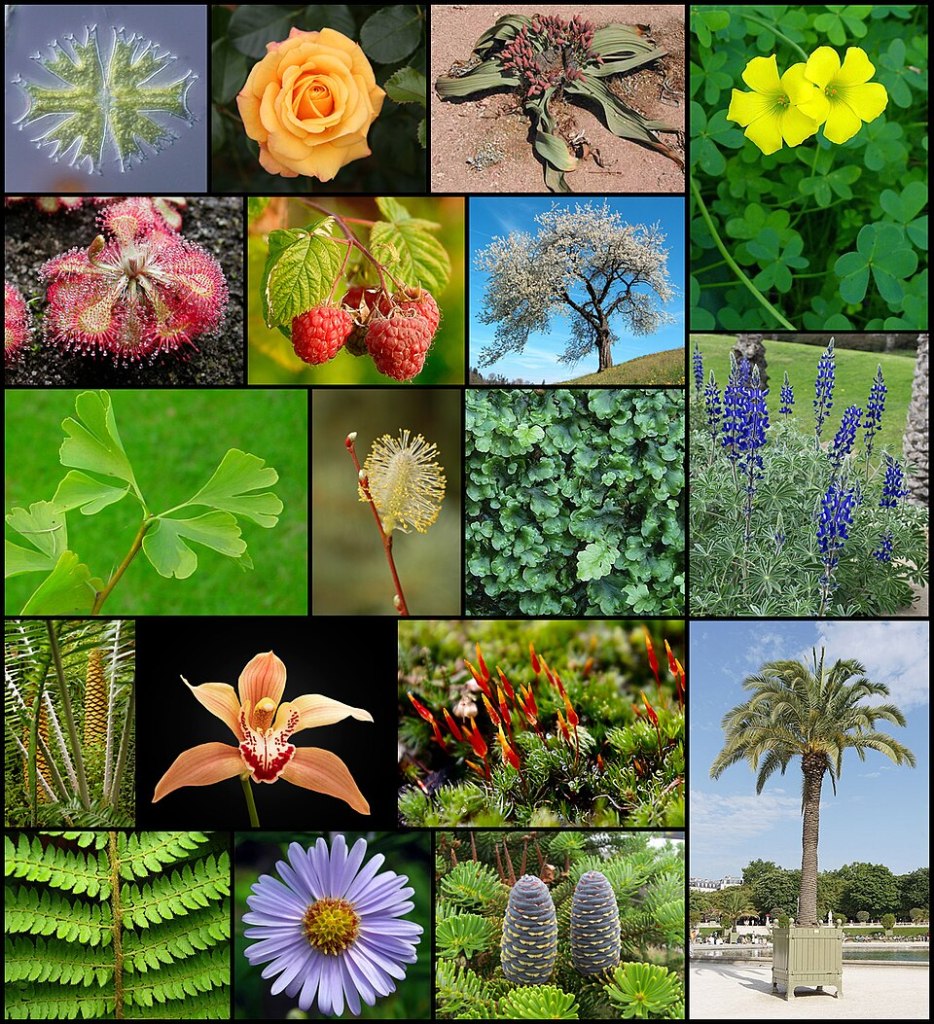
This image, entitled Diversity of Plants, by MathKnight, is used under the Creative Commons Attribution-Share Alike 4.0 International license.
They say that everybody has a book in them (Kevin Sites). Whether or not that is true, and whilst Mr P Cuttings waits to secure a publishing deal (!?), he thought it would be a service to share with the global, plant-minded community a draft outline of his own botanical book project.
What you will find in this post – and the series of posts that follow – is Mr Cuttings’ vision for what he believes is his magnum opus, which deals with his views of plants (and plants-and-people).
Some important features to note
What follows in the 12 ‘chapters’ or so is not intended to be the last word on any of the topics covered, but it should be a reasonably-carefully considered contribution to those subjects from a plant enthusiast.
It is written in – what Mr Cuttings sincerely hopes is – an accessible style; the potential audience for these items is upper school-age children to undergraduates (and their teachers), and – arguably, more importantly – the interested layperson [Ed. – i.e., all those for whom this blog was created].
Whilst it is not intended to be a series of heavyweight academic articles, it has been written with academic rigour – evidence-based in particular – in mind [Ed. – surely, after all Mr Cuttings has said in previous posts, you’d expect nothing less..?]. It is intended to be a collection of thoughtful essays that will encourage everybody to think more widely about plants, and appreciate their importance.
To add value to its pedagogic aspirations it cites many widely-available educational sources (although ones that have been chosen largely for their academic credentials in terms of being evidence-based). But, it also includes several journal articles and books to allow interested readers to pursue in more depth those topics that interest them. [Ed. – NB, web sites – including encyclopaedias and dictionaries – are incorporated as in-text citations (with named authors and dates where known). Although scientific articles and books are also accessible via links in-text, fuller citation details of those are brought together in a list of references to be provided at the end of this series of posts]
And, most importantly, it is nowhere near complete(!): Indeed, much of it was paused at the end of 2012. Although some attempts at updating have taken place, they are not finished. Nevertheless, I hope it will be of value in its present state. [Ed. – comments from readers about the content, etc. are invited – and encouraged]
What’s is the project’s overall message?
That can be encapsulated in a potential title for the project, Miserable, naked, hungry: A celebration of plants*. Breaking that down a little more, we can say:
Background It is widely acknowledged that plants are important providers of medicines, materials, and foodstuffs, which help keep us happy and well, clothed and housed, and fed. So much for some of the obvious ways in which we exploit the plant resource. Less well-recognised is a more ancient and profound role of plants, not only in our present day lives but also in our own history and that of the planet.
Scope Drawing upon 10 facets of plant biology – including their fundamental role as terra-formers, their remarkably economical structure created from the most basic of ingredients, and their role in promoting Mankind’s wellbeing – this review explores aspects of those intimately and inextricably intertwined plant-people interactions which give us all cause to celebrate those verdant marvels of nature.
Conclusions Plants, and our relationships with them, have arguably made us what we are today; our continued relationship with them is likely to dictate our future on this planet as we grapple with global issues of food security, dwindling fossil fuel reserves, and climate change. The story of plants is the world’s greatest story with a tremendous scope that ranges backwards through 3.5 billion years of dimly understood Earth history and stretches forwards to an uncertain future, and which embraces such pivotal events as development of oxygenic photosynthesis, and the birth of agriculture. If we are to encourage a greater recognition and understanding of the crucial roles plants play in all our lives, their story – which is also ours – needs to be more widely heard and celebrated. It is hoped that a better appreciation of the manyfold ways in which we interact with plants will promote a greater responsibility towards plants and the plant resource, and will in turn lead to an increase in the number of plant scientists.
Introduction
As a botanist who has made a career from working with, and talking about, plants, it’s obvious to me why plants are important. I might also be forgiven for assuming that everybody else also thinks that plants are important. Unfortunately, it appears that it is not so. Take for example concerns over what has been called ‘plant blindness’ (Bud Hoekstra, 2000; William Allen, 2003) [Ed. – but, note moves to rename this phenomenon as ‘plant awareness disparity (PAD)’ (Kathryn Parsley, 2020)]. This term covers both a general lack of appreciation of the value of plants (and presumptions that animals are better, or more important, or more interesting – so-called ‘zoochauvinism’ (James Wandersee & Elisabeth Schussler, 2001) – than plants), and a lack of awareness of plants in the environment because often they appear below our line of sight (15o Laboratory ™)**. Consequently, we – botanists and plant scientists generally – need to ‘up our game’, both to lower the public’s gaze and raise the profile of plants.
However, with this as a background it’s no surprise that there are concerns that knowledge and appreciation of plants and plant products is set to dwindle still further. And it’s not just the lay public that may be guilty of an underappreciation of plants, but the academic community, too. Reflecting upon the north American experience with its decline in botany students and botany classes, DW Woodland (2007) worries that botanists might become the ‘dinosaurs’ of the 21st century. A view that is reinforced by Andrea Kramer et al. in their assessment of botanical capacity to address grand challenges in the United States. And in the UK we recently bade farewell to the last class who studied botany (Sinéad Drea, 2011). Consequently, there are fears that we won’t have enough ‘plant-literate’ scientists in future to ensure that plants are studied to the benefit of mankind.
However, all may not yet be lost. Raising the profile of botany amongst our students (as urged by Gordon Uno (2009)) can make an important difference. For example, in the UK, Aurora Levesley et al. (2012) have found that “a single concerted effort at the start of undergraduate study (e.g., the Gatsby Plant Science Summer Schools) can have a clear and lasting effect on the attitudes of students toward plant science”. There is every reason to believe that it is possible to inspire the next generation of plant science researchers, we just have to raise their awareness of plants. It is therefore incumbent upon us ‘botanists’ to convey the importance of our subject matter at every opportunity (e.g., David Hershey, 1989). After all, if we don’t – or won’t or can’t – justify the importance of plants, who else will? And, as Hershey (2002]) chillingly notes, “We have met the enemy and he is us”!
For a discipline whose subjects are amongst the oldest (bristlecone pine at >5,000 years – Christopher Earle), tallest (e.g., coast redwood at >110 m – Christopher Earle), and contribute to some of the biggest (Great Barrier Reef – a symbiotic association based upon photosynthetic algae – Timothy Henkel, 2010), living structures on the planet, that can move surprisingly quickly (e.g., white mulberry pollen propelled at approximately half the speed of sound – Philip et al., 2006)), and who just happen to feed the entire human population (!), this ought to be straightforward: Plants are amazing and fully deserving of our more detailed study. In an attempt to stem the tide of phytological ignorance, it is timely to offer reasons to celebrate plants and the ‘plant resource’ and underline the importance of plants to us all. To that end this project has been undertaken.
Why now, why 2012? [Ed. – well, Mr P Cuttings did say this was originally written about 14 years ago…]
Simply, put, much better sooner than later (we just happen to be in 2012 as this review is written): The longer we delay promoting the message that plants are important, the worse the situation gets; and the more entrenched our ignorance and lack of appreciation of plants potentially becomes. But, if you need some more tangible justification for choosing 2012, I offer the following.
As a UK citizen 2012 is a momentous year in the history of the British monarchy as it is the Diamond (60th) Jubilee of the accession of Queen Elizabeth II. In that Union Flag-waving, patriotic regard, one cannot ignore the fact that the 2012 Summer Olympic and Paralympic Games (officially the Games of the XXX Olympiad) took place in London. And 2012 is the bicentenary of the birth of one of England’s most celebrated authors, the Victorian Charles Dickens (Philip Collins). As a novelist his books were notable for championing the ‘underdog’ and chronicling the plight of the downtrodden in society, in which role plants are often cast. February 2012 saw the first broadcast of the BBC2 TV series ‘How to grow a planet’ [Ed. – which was essentially the film version of The Emerald Planet (David Beerling, 2007), probably the ultimate plant-and-planet tome]. One hopes that has helped to prepare the ground so that the general audience is keen to know more about these vegetable wonders and planetary sculptors.
The first global ‘fascination of plants’ day was held in 2012 – on May the 18th. And continuing in a world-view theme, 2012 has been designated International Year of Cooperatives by the United Nations General Assembly [the UN]. Although probably going beyond the UN’s narrow definition, but nevertheless appropriate, co-operation between plants and people – arguably one of the oldest ‘cooperatives’ of all – is a theme of this project, so fits in very well with this global appreciation. Additionally, the UN has also designated 2012 the International Year of Sustainable Energy for All, in which capacity plants and plant products can be expected to continue to play a prominent role. Rather more mystically, according to the Chinese Zodiac, 2012 is the Year of the Dragon (Raymond Pun). As the “ultimate auspicious symbol signifying success and happiness” (Sedat Girgin), this is consistent with the notion that our continued relationship with plants may yet bring humankind rich rewards of success and happiness. And, after suitable pause for appropriate reflection, 2012 is the first year in which we should be beginning to provide answers to Claire Grierson et al. (2011)’s 100 plant questions [Ed. – and which catalogue of queries was revisited by Emily May Armstrong et al. (2023)…]
So, 2012 is a year of celebration; of many celebrations in fact! What better time, then, to remind us of the enormous debt we owe plants, and celebrate them? However, rather than just compile a catalogue of what plants do for us, I want to explore some of their less obvious and not-so-frequently aired aspects, and in particular to remind us of that all-important plant-human relationship. Accordingly – and in a calculated nod in the direction of the Olympics and the ultimate test of stamina, endurance and all-round athleticism the Decathlon (Lindsay Rohland, 2024) – this project will consider 10 aspects of plants and ‘plantness’.
Overview of the chapters…
The project is provisionally titled “Ten things everybody should known about plants”. In keeping with that notion, chapters were assigned suitably numerical titles (admittedly, some more forced than others, and in need of amendment…). Those follow, along with some idea of each chapter’s – intended – contents.
Chapter 1 Not just one plant…
tackles the notion that there isn’t such a thing as a ‘typical’ plant. In doing so it reveals the tremendous diversity of form, etc. amongst the members of the Plant Kingdom – which it does via a tour of the 12 groups of so-called land plants with named examples and indications of their importance to humanity and the planet more generally. The concept of a plant, and an enhanced appreciation of plant diversity, is further increased by inclusion of the green and red algae, and is extended to other oxygen-releasing photosynthetic organisms such as diatoms and cyanobacteria.
This chapter also makes the point that plants rarely exist on their own, and are often more resilient and better able to withstand the environment when in association with other organisms in cross-Kingdom partnerships (e.g., lichens, legume’s nodules of nitrogen-fixing bacteria). Arguably, none of these mutually-dependent relationships is more important than mycorrhiza, which root-based, intimate plant-fungus association may well have been instrumental in facilitating the development of our land flora in the first place. And once established, much of the landscape we have on Earth today is due in no small way to plants – in their more generic guise as vegetation – and, importantly, to humanity’s relationship with it.
Chapter 2 Diatomic oxygen
considers oxygen, the so-called ‘waste product’ of photosynthesis. Oxygen is a simple molecule that consists of two atoms of that element, and is commonly represented by its shorthand formula, O2. Yet, for all its seeming simplicity, release of oxygen by photosynthesis created the conditions on Earth that greatly facilitated the evolution of animals. This chapter discusses the great debt that is owed by the majority of life forms to plants and their photosynthetic endeavours via primary productivity. This chapter also introduces ideas of ways in which photosynthesis might be ‘improved’ to meet the needs of an expanding human population, and also underlines the need for more plant scientists to effect those changes.
Chapter 3 Three tissue systems
reveals the remarkable economy of design and structure that plants embody. All done with just three ‘tissue systems’ – dermal (covering the external surface of the plant this provides the important interface between plant and planet), vascular (the long-distance transport pathway for water, food, and other materials that support and fuel the plant), and ground (which embraces all of the cells between the other two systems). Nevertheless, as few as they are, this is sufficient to produce the tallest living structures on the planet, and diverse enough to provide for many of humanity’s material needs via cell types such as fibres. The utility of plant cells is showcased by a consideration of the great variety of fibres that plants produce and which people have exploited over millennia.
The economic design of plants is underlined by a consideration of the multiple roles played by roots, stems, and leaves. Botanical ingenuity is also a major source of inspiration for solutions to human design problems in the increasingly important field of biomimetics.
Chapter 4 Four elements
emphasises the relative simplicity of the fundamental ‘ingredients’ – minerals from the soil, light and heat from the sun, oxygen and carbon dioxide from the atmosphere, and water – that are needed to sustain plant life (even if a few liberties have been taken with modern-day interpretations of the ancient notion of the four ‘elements’). And that is also a testament to the remarkable adaptability of plants, not only to survive, but to thrive, in those environments where there is either an insufficiency or an excess of one or other of those four basic ingredients.
Chapter 5 Five senses
explores some of the plant parallels with the five main human senses. Plants are masters of the sedentary lifestyle and expert at being in-tune with their environment. Indeed, being able to do so is a matter of life or death for a plant. The chapter concludes that plants are sensitive beings, and have versions of all five human senses. Plants are like us, only different!
Chapter 6 A sixth sense?
airs the notion of plant intelligence. This is a contentious area and in many respects ‘the jury is still out’ (Gary Martin) on whether plants are intelligent or not. Much of the debate revolves – and resolves – around semantic issues of definitions of intelligence and consciousness. This chapter looks at examples of ways in which plants exhibit behaviours that are akin to co-operation, or indicate problem-solving capacity, or super-sensory abilities. Although the question of plant intelligence is somewhat left to one side [Ed. – Mr P Cuttings is a well-known ‘fence-sitter’ in matters of controversy…], this chapter at least considers and develops an idea attributable to Michael Pollan in his book The botany of desire, which posited the idea that there is much more to plants than we humans might like to admit, and there are ways in which plants exercise a sort of mind-control over humans…
Chapters 7 Seven seas of rye…
develops some of the ideas introduced in Chapter 2 and considers the essential and fundamental role of plants in feeding humans and their livestock. I.e., it looks at photosynthesis in terms of fuelling the quantity of human life. It also deals with some of the challenges we all face in terms of food security in the immediate future, and discusses some aspects of the human role in achieving this desirable security. Overcoming this problem is likely to stretch all of our economic, infrastructural, sustainability, biotechnological, etc. know-how and imagination to achieve a satisfactory outcome. And is also crucially dependent upon appropriate international co-operation between people.
Because of a mishearing of the lyrics of Queen’s song Seven Seas of Rhye, this chapter also looks at the place of plants in art, literature, etc. which helps to improve the quality of human life.
Chapter 8 Eight millimetres (height of the grass on Wimbledon’s tennis courts – Roshneesh Kmaneck, 2025)
is more than a nod in the direction of plants to provide us with a variety of leisure activities and the opportunity to enrich our lives – whether we be ill, in need of ‘rehabilitation’, or just want a bit of space (as long as it’s green!). Leisure activities that help us to keep active and fit are considered, as well as plant products that are essential to some of those activities and past-times. The Japanese notion of ‘forest bathing’ is not ignored…
Chapter 9 Issue 9, volume 20 of The Plant Cell (Christian W Gruber et al., 2008) [Ed. – I did warn you that some of the titles were a little contrived…]
deals with some of the most fundamental reasons to celebrate plants, the incredible range of so-called secondary products plants make, which has given us many of our modern-day medicines and drugs, and continues to represent a vast unexplored chemical treasure trove. Several examples are chosen to illustrate the range of remarkable medicinal compounds: e.g., quinine, the malaria medicine obtained from the bark of a South American tree (but which also aided and abetted the empire-building and colonial expansion practised by European states in the 19th century…); a hunger-suppressing compound from Hoodia, a desert plant whose interesting properties were known to and used by the San people of South-western Africa for centuries (and which story has interesting insights into the treatment of indigenous people’s intellectual property right); and curare, originally a poison that helped indigenous people of South America hunt monkeys, etc., but which was ‘repurposed’ as a powerful anaesthetic and used for many years in Western surgery.
This chapter briefly looks at a range of plant secondary compounds (with emphasis on their use by humans), and also looks at the ability of plants to protect themselves from herbivory and microbial infection by the use of a cocktail of chemical compounds.
Chapter 10 Ten Fascinating facts about slavery (Jamie Frater) [Ed. – this is one of those titles – drawn from a published source – that just doesn’t sound right…]
explores some of the darkest episodes in human history and considers the depths of humanity’s seemingly endless capacity for inhumanity as it begins by looking at the spice trade, and plant-inspired slavery. It then considers some of the unexpected consequences of slavery and plantation-farming of cotton, tobacco, and sugarcane: the development of Communism; environmental damage in the Aral Sea region of the former Soviet Union and the cotton-farming of the Stalin era; the sugar-fuelled obesity issue of many Western countries; and health concerns from tobacco smoking.
Although those often-harmful consequences can be traced back to plants, it is not the plant’s fault but human greed and folly that has led to such outrages against humanity. This chapter is a reminder that we mustn’t forget that our relationship with plants can be a double-edged sword; we must be on our guard not to cut ourselves too often or too deeply.
As incomplete and ‘drafty’ as it is, the following posts look at those chapters in more detail. [Ed. – it is also to be hoped that by announcing this to the world Mr P C will be prompted to get his act together and get on and finish it!]
* I thank Phytophactor (the ‘nom de blog’ of Illinois State University’s Emeritus Professor of Botany Dr Joseph Armstrong) for unwittingly providing this project’s title (he begins his economic botany classes with those three little words (or “cold, naked, and hungry”)).
** “So, what’s the meaning of the name: 15º Laboratory? It has been experimentally determined that individuals prefer to view objects that lie between 0o to 15o below the imaginary horizontal line that represents their own eye level” (quoted from here). In other words, anything below that – e.g., most plants – is not seen.
REFERENCES
For full citation details of articles and books, you’ll have to wait until the end of this series of posts.


Leave a Reply