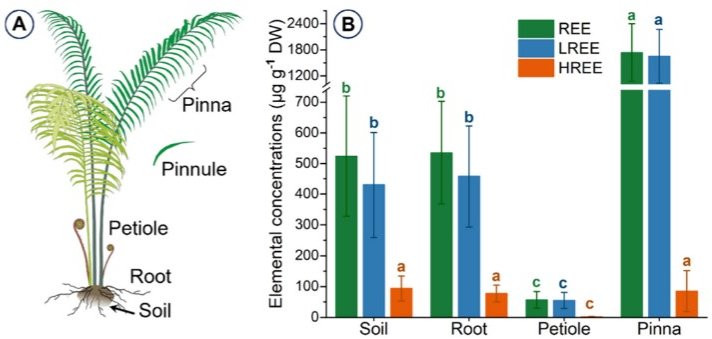
Figure 1. B[lechnum]. orientale the hyperaccumulator of REE. (A) Morphological characteristics of B. orientale. (B) Dry weight concentration (μg g−1) of REE, light REE (LREE), and heavy REE (HREE) in soil and different organs of B. orientale. LREE include lanthanum (La), cerium (Ce), praseodymium (Pr), neodymium (Nd), samarium (Sm), and europium (Eu), while HREE comprise gadolinium (Gd), terbium (Tb), dysprosium (Dy), holmium (Ho), erbium (Er), thulium (Tm), lutetium (Lu), plus yttrium (Y).23 Different letters indicating significant differences (ANOVA, Duncan, p < 0.05) among different parts of the soil and plant system. Error bars show standard errors. From He et al. (2025); used with permission.
This was never intended to be such a long post. But, the more I got into researching it, the more interesting – and lengthy – it became. Consequently, I can honestly say that this was one of the most absorbing items I looked into in 2025. So, consider this post your ‘long read’ to finish off the year; Mr P Cuttings’ gift to all the blog’s readers.
Background: Plants and metals
The typical plant require 17 elements* for full and proper functioning throughout a complete life cycle (Cristie Preston). The great majority of these essential nutrients are obtained from the soil, and their ability to extracting them from the soil is a remarkable property of plants. But, their remarkableness doesn’t end there.
Many plants have the – additional – ability to take up elements that they don’t necessarily need from the soil. In the case of so-called – but, misnamed** – heavy metals (Richard M Fisher & Vikas Gupta; Anne Marie Helmenstine; Paul J Jannetto & Clayton T Cowl, 2023; Martin Koller & Hosam M Saleh, 2018; Lauren Leffer), those elements are harmful to most plants [Ed. – worry not, plants that can do accumulate them usually ‘park’ those harmful chemicals in places – such as the vacuole (Guo Yu et al., 2019) – where – or otherwise detoxify them – e.g., by use of plant-derived compounds such as phytochelatins and metallothioneins (Melanie Mehes-Smith et al., 2013) – when – they can do little harm to the plant that accumulates them…].
More specifically, heavy metals
Presence of excess – and harmful – heavy metals in the soil can be a real barrier to use of that rooting medium to grow crops (Prodipto Bishnu Angon et al., 2024; Jagannath Biswakarma; Shea Toppel). Removing those materials from the soil is therefore desirable [Ed. – but better for humans not to release them into the environment in the first place. Whilst natural sources – e.g., from volcanic eruptions (Danielle Beurteaux) – can’t be helped, there should be no need to add to the problem from anthropogenic activities, such as mining (e.g., Victoria Gill)…].
By removing such harmful chemicals from the environment, plants that do so – particularly those designated as hyperaccumulators (Roger D Reeves et al., 2018; Basharat Ahmad Bhat et al., 2025) – can deplete soil loads to a value at which one can safely grow crops to feed people and their domesticated animals (Sana Ashraf et al., 2019). Use of metal-accumulating plants in this way is known as phytoremediation (Linnea Stavney).
The study of this post’s interest
But, plants can be used for more than reducing heavy metal burdens in soils – as has been shown in the work of Liuqing He et al. (2025) who have discovered that a fern accumulates the rare earth element-containing mineral monazite. There’s quite a lot to unpack in those last 9 or so words, but here goes…
The plant of interest
Liuqing He et al. (2025) worked with a fern (Warren H Wagner) known in English as SE Asian hard-fern or centipede fern (Dash Gouri Kumar et al., 2015), Blechnum orientale. The fern was growing in ion-adsorption type REE deposits [“rare-earth element ores in decomposed rocks that are formed by intense weathering of REE-rich parental rocks (e.g. granite, tuff etc.) in subtropical areas” (quoted from here) (Anouk M Borst et al., 2020; Yakang Ye et al., 2025; Xu Zhao & Jingzhao Dou) in Guangzhou, South China. Samples of different parts of the fern – and the soil in which it was growing – were taken for analysis of rare earth elements…
What on earth are rare earth elements [REEs]? (Or, REE 101…)
Rare earth elements (REEs) – or rare earth metals, or just rare earths – are a group of 17 chemical elements. Those 17 are the 15*** so-called lanthanides (Anne Marie Helmenstine; Taro Saito)****, plus scandium (Eric Loewen), and yttrium (Chin Trento)*****. REEs have come to prominence in the affairs of humankind in this millennium particularly because they are used in many technological aspects of modern-day life, e.g., permanent magnets, batteries, lasers, and super-alloys, catalysts and polishes, and electric vehicle traction motors, wind turbines, domestic appliances, and in all portable communication technologies (speakers). Because they seem indispensable to our hi-tech, gadget-dependent, modern age, REEs have been called “the seeds of technology”. [Ed. – REEs also – probably – play a part in plant physiology*****]
How rare are REEs?
Although designated as rare, REEs aren’t particularly rare on earth: “While most of these elements are not actually rare in terms of general amount of these elements in the earth’s crust, they are rarely found in sufficient abundance in a single location for their mining to be economically viable” (quoted from here). With overall concentration in the planet’s crust of 150-220 ppm (parts per million), some REEs are – individually – as abundant as, or even higher than, that of copper or zinc. But, since the mineral combinations in which REEs occur are not distributed evenly over the Earth, this contributes to their perceived ‘rarity’. Notwithstanding that rarity, known – and substantial [e.g., Bayan Obo in Inner Mongolia, China, which “contains the greatest quantity of REE known”] – deposits of REEs exist around the world, and are actively exploited.
What is monazite?
One of the minerals that contain REEs is monazite (Hannah Kilmore). However, because the REE composition of monazite can vary quite substantially depending on its source******, monazite is considered to be a group of minerals rather than a single entity, a so-called mineral ‘supergroup’. [Ed. – monazite (La) – in which the REEs are Ce, La, Nd, or Sm (or, rarely, Bi) – was determined to be the form of the mineral found in the fern by He et al. (2025). However, chemical analysis of the fern shows presence of almost all of the 17 REEs in the plant’s tissues [see Table 2 in the article’s Supplementary Information]]. And, because of the small size of the crystals formed within the fern, the mineral is here termed ‘nanoscale monazite’.
More on the monazite mineral discovery
Having considered some generalities above, what did He et al. (2025) find in their fern?
To appreciate that we first need to group REEs into the two categories analysed by He et al. (2025): Light REEs [lanthanum (La), cerium (Ce), praseodymium (Pr), neodymium (Nd), samarium (Sm), and europium (Eu)], designated LREEs; and heavy REEs [gadolinium (Gd), terbium (Tb), dysprosium (Dy), holmium (Ho), erbium (Er), thulium (Tm), lutetium (Lu), plus yttrium (Y)], HREEs.
Second, we need to say a few words about the parts of the fern that were analysed for REEs. Doing so is made a lot easier by reference to the image above – Fig. 1 from the paper by He et al. (2025). By analogy with a flowering plant, the parts of the fern sampled were the root (the underground portion), the pinna (the fern equivalent of a leaf [also known as a ‘frond’ (Alejandro Vasco et al., 2013)]) whose component parts are termed pinnules – which are a little like a flowering plant’s ‘leaflets’), and the ‘petiole’ [also called a ‘stipe’ (Alejandro Vasco et al., 2013)], a stem-like part that connects the pinnae to the roots. For – essential – purposes of comparison, He et al. (2025) also sampled the soil in which the fern was growing. Their main results are illustrated in Fig. 1B (which is also helpfully reproduced at the top of this post).
In terms of REE distribution in fern parts, He et al. (2025) found no significant difference between concentrations of REE categories in soil and root. This finding is consistent with the root acting like an indicator******* for the particular soil REE concentration.
Compared to the other fern parts, concentrations of both REE categories were very much lower in the petiole – and lower than those in the soil. Ordinarily, when dealing with heavy metal uptake by plants, that situation – lower metal concentrations within the plant part than those in the soil – might indicate exclusion of the elements (AJM Baker, 1981; Barbara Leitenmaier & Hendrik Küpper, 2013; Katrin Viehweger, 2014). On that basis, by reference to heavy metal accumulation terminology*******, the petiole could be categorised as an REE ‘excluder’*******. However, it is more likely here to indicate that REEs are not localised in that organ but merely ‘in transit’, within the xylem-localised transpiration stream (Kyra Plats et al., 2024) of that plant part, en route to the pinnae. [Ed. – plus, it is possible that entry of REEs into the petiole’s vasculature may be somewhat restricted by the root.]
It’s within the pinnules (“the main REE-accumulating organ” of the fern (He et al., 2025)), the individual component parts of the pinnae, that we have a most interesting situation. Here, the concentration of LREEs – which are localised extracellularly – significantly exceeds their soil value, whereas HREE concentration shows no significant difference from their value in the soil. In other words, the pinnae appear to be accumulating LREEs, but excluding – to some extent – HREEs. This indicates operation of a mechanism by which the plant is able to distinguish between the two categories of REEs. This investigation is certainly raising some interesting questions about the biology of REEs within plants********. But, back to the mineralogy…
Overall total REE values were: pinna (1735 μg g−1), root system (535.3 μg g−1), petiole (57.03 μg g−1), and, per Fig. 1B, approx. 520 μg.g-1 for soil. Clearly, the leaf-like parts of the fern accumulate REEs compared to the values found in the soil. However, whether that degree of REE accumulation by the pinnae relative to the soil can be defined as hyper-accumulation is a moot point…
Is this fern really a hyperaccumulator?
A hyperaccumulating plant has been defined as one with tissue concentrations of the particular element of 1,000 μg/g DW (Brooks et al., 1977), in the specific case of nickel-accumulating plants. That definition was extended by AJM Baker & RR Brooks (1989), “Hyperaccumulators of Co [cobalt], Cu [copper], Cr [chromium], Pb [lead] and Ni [nickel] are here defined as plants containing over 1000 u.g/g (ppm) of any of these elements in the dry matter”. Whilst none of that applies strictly to REEs, the value is retained as the benchmark for REE hyperaccumulating plants as seen in Antony van der Ent & Elizabeth L Rylott (2024): “The currently widely accepted definition of trace element hyperaccumulators are plants which, when growing in their natural habitat, rather than metal-amended artificial media, contain the elemental concentrations in excess of … 1000 µg g−1 nickel (Ni), arsenic (As), or Rare Earth Elements (REEs)”. Appropriately therefore that value is the one used by He et al. (2025) (and stated in their Supplementary Table 1) in their work.
Having seen where He et al. (2025) set the threshold for REE hyperaccumulating plants, how does their fern results measure up?
In terms of reported values, He et al. (2025) state that neither petiole nor root show REE values that exceed a soil concentration of approx. 520 μg.g-1, i.e., neither of those organs is a hyperaccumulator. But, at an average value for total REEs of approx. 1665 μg g−1) for the pinnae – which clearly exceed the 1000 μg.g threshold – Blechnum orientale can be considered a hyperaccumulator.
However, that concentration applies in the case of accumulation of LREEs en masse. As far as I’m aware, whenever hyperaccumulating heavy metal plants are discussed, the degree of hyperaccumulation relates to a single specified element. LREEs is a broad category that includes lanthanum (La), cerium (Ce), praseodymium (Pr), neodymium (Nd), samarium (Sm), and europium (Eu). Mathematically, with a total concentration in the pinnae of 1665 μg.g-1, there is no way that each of those 6 elements can have a concentration above 1000 μg.g-1. And if one looks at He et al. (2025)’s data [shown in Supplementary Table 2], the greatest concentration of a single REE in a pinna is 611.10 ± 272.74 mg.kg-1, for lanthanum. Converting that value to the units used in the article, that equates to approx. 611 μg/g, which is below the hyperaccumulating threshold of 1000. In other words B. orientale does not hyperaccumulate any single rare earth element.
Without in any way wishing to undervalue He et al. (2025)’s work or their important contribution to the study of REE accumulation in plants, it does seem that we have a bit of an issue in the way that the categorisation of plants in respect of accumulation of REEs is reported. Should the capacity to act as a REE (hyper)accumulator be based upon those elements in their totality – as in He et al. (2025) here (and in articles by Wen-Shen Liu et al., 2020; and Yuanyuan Wang et al., 2023)? Or, should it be more akin to the rationale used for heavy metals, where hyperaccumulation seems to be taken on an element-by-element basis? [Ed. – is a way around this for REE mineral-accumulating plants – as demonstrated for Blechnum orientale by He et al. (2025) – to consider the elemental composition of the mineral? In which case one could legitimately sum together the concentrations of the component elements, and hyperaccumulation – or otherwise – would relate to that aggregated concentration…]
Blechnum orientale is not the only – or first – REE-accumulating plant
That’s true – as He et al. (2025) acknowledge in their article, “22 plant species have been identified as REE hyperaccumulators”. Notable amongst those plants are ferns (see e.g., Table 1 in Chang Liu et al., 2018). And the stand-out example in that group of plants is Dicranopteris linearis, which can hyperaccumulate “light rare earth elements La, Ce, Pr and Nd (LREEs) up to about 0.7% of its dry leaf biomass” (Xiaoquan Shan et al., 2003). [Ed. – for some sort of taxonomic balance, although there appear to be very few – known – REE-hyperaccumulators amongst the flowering plants, pokeweed (Phytolacca americana) is notable for accumulating “REEs up to 623 μg g-1 in dry leaves” (Quote from Chang Liu et al., 2018). [Ed. – most of which is accounted for by yttrium (per Figure 2 in Hideki Ichihashi et al. (1992)].
But, what distinguishes He et al. (2025)’s work from that of others is identifying the particular mineral form – monazite – in which the REEs are present within the plant. As He et al. note for REEs in plants generally, “little is known about their physical occurrence, such as the morphology, structural state, and mineral species, at the micro- or nanoscale, beyond approximate chemical compositions and bulk concentrations”. Not only is the mineral form of interest, the fact that it can be made in a living organism under quite mild conditions at the Earth’s surface is intriguing. Why? Because “in geological environments monazite typically forms in igneous and metamorphic rocks at >500 °C and moderate pressures” (He et al., 2025).
As another ‘first’ for this discovery, it is noteworthy that the particular phytomineralisation phenomenon that creates the nanomonazite is that of a chemical garden (Oliver Steinbock et al.). In the fern situation it is proposed that mineralisation is “driven by the high local concentration of metal salts (REE and phosphate) in an aqueous environment, specifically within the extracellular spaces in these hyperaccumulators” (He et al., 2025). And what is created is a rather elegant dendritic [‘branched, tree-like’] crystalline structure, ‘nanoscale monazite’.
Global – real? – significance of the work
Although He et al. (2025)’s investigation raises interesting questions about the biology of REEs in plants and how their phosphorus requirements are met********, it is the wider consideration of what the discovery of monazite in a fern means that may be the most significant aspect of the work. To appreciate that we need a bit of context about…
REEs and geopolitics
Maintaining adequacy of supply of REEs, which is challenged by a seemingly never-ending demand for these elements, is a major modern-day concern (e.g., Rick Mills; here). And the global importance of REEs to geopolitics – particularly between China and the USA (e.g., Eduardo Baptista & Selena Li; Aaron McMillan) – is summarised in this sound bite, “Yttrium plays a critical role in everything from aircraft engines to semiconductors. China controls the vast majority of the market—and that’s not changing anytime soon” (Lorenzo Lamperti).
With that as background, could the mineral within the fern be …
A sustainable source of REEs?
As highly-sought after minerals for technology and industry, REEs are mined from the ground. As with many intensive metal-extraction processes, obtaining REEs comes with considerable associated environmental cost(s) (ZH Weng et al., 2013; Vicky Wilding; Petra Zapp et al., 2022). The discovery of an important REE-containing mineral within the tissue of a land plant opens the possibility that some REEs may be extractable from plant tissues, via ‘phytomining’*********. Phytomining would arguably be a much more environmentally-sensitive method of extraction – and potentially a sustainable source – of certain REEs. But, “Despite this potential, phytomining for REE remains at an early stage. Its economic feasibility depends on the development of cost-effective and efficient REE extraction methods from plant biomass” (He et al., 2025).
However, you can’t just plant the fern in the ground and it will miraculously extract REE(s) and create monazite in its leaves. For this to have a chance of working – and to be economically-viable and commercially exploitable – the plants needs to be growing in soil which already contains the REEs. Although REE-rich areas include many sites in places such as Brazil, Russia, and India (Bruno Venditti), “by 2011, China accounted for 97 percent of world production” (but with a small drop to 87% of global refined production in 2023). So, just as the source and supply of traditionally earth-extracted REEs is an important bargaining point in global trade deals (particularly that between China and the USA), fern-sourced REEs are likely to suffer similar issues. Fern sources of REEs haven’t solved the problem of REE supply, they’ve just shifted it from soil to plant. [Ed. – whether we’ll now see embargoes upon, and/or tariffs applied to, trade in stocks of Blechnum orientale remains to be seen…]
So, whilst He et al. (2025)’s work won’t necessarily address issues of scarcity of the REE in the first place, it does offer – potentially – a cleaner way of obtaining the REE (and in a relatively ‘pure’ form as monazite?). This should have environmental benefits, and go some way to solving future REE-mining-associated problems [Ed. – although not those that currently exist and persist from past and current extraction activities.].
Back to the investigation…
Whilst answering the questions it has set out to, all good science will almost inevitably raise further questions (Jo Van Every). That is certainly the case with He et al. (2025)’s investigation. Fascinated by that work, Mr P Cuttings has been doing some thinking…
Blechnum orientale is a perennial plant, one that grows for several years. Not only that, but it is quite a large plant – “2 m +” tall. Potentially, that is quite a lot of biomass that can accumulate REEs, and which has great relevance to any exploitation potential of this chemical resource.
The plants sampled for their investigation were approximately 1.5 years old (personal communication from Prof. Jianxi Zhu – one of the corresponding authors of the He et al. (2025) paper) and already had accumulated substantial amounts of the REEs. One therefore wonders how much more REE they could accumulate if left to grow for several more years. Although there may well be a limit to how much REE can be accumulated – e.g., before fronds are impaired in function and die – the potential to increase REE concentrations in fronds is worthy of investigation. And, if individual fronds die through excess REE accumulation (and can then be harvested…), hopefully other fronds will be formed – and which also accumulate REEs – as the plant persists through several growing seasons. Potentially, REE-enriched fronds could be repeatedly harvested producing a sustainable supply of plant material from which REEs might be extracted via phytomining********* – as a more environmentally-sympathetic alternative to traditional mining.
Although not sampled by He et al. (2025), Blechnum orientale also has a rhizome, a stem-like structure that grows close to the surface of the soil. For completeness, it would be interesting to know whether this organ accumulates REEs. One suspects that it may not, probably acting like the sampled, similarly stem-like petiole in terms of being a transport route for REEs, on their way to the fronds. But, maybe worth checking, nevertheless.
Best to leave those ‘monazite musings’ there, lest the over-active imagination of Mr P Cuttings takes us further away from what’s actually reported [Ed. – and makes this post even longer…]. But, plenty of follow-up questions to be … followed-up.
To find out more…
For more on this geopolitically, economically, and strategically important work, see Paul Arnold, David Nield, Hannah Millington, Na Chen, Muflih Hidayat, Rowan Dunne, Giann Liguid, Kanyshai Butun, Noel Budeguer, Abhimanyu Ghoshal, Ramananda Sengupta, Elliot Bramble, Darren Orf, here, and here.
* Although it’s the elements that plants need, they are usually present in the environment – and therefore acquired by plants – in forms different from the electrically-neutral atoms (Lee Johnson). For example, phosphorus is usually taken up by the plant as a phosphate ion – PO43- (Kate Baird) – from the soil (Brett Harman). Most of the metals are taken up as positively-charged ions, cations (Richard M Renneboog), e.g., magnesium as Mg2+, and calcium as Ca2+. Nitrogen may be taken up as the cationic ammonium ion – NH4+, or as the anionic (Richard M Renneboog) nitrate ion, NO3–. Nevertheless, regardless of the form in which they may be available in the environment [e.g., as electrically-charged ions or combinations of atoms] essentially as a nutrient is in terms of the elements.
** For more on the erroneous nature of the term ‘heavy metals’ – “keep this term for music not for science” (Peter M Chapman, 2007) – see the commendably down-to-earth discussions in John Duffus (2003), Peter M Chapman (2007, 2012), Olivier Pourret & Andrew Hursthouse (2019), and Olivier Pourret.
*** Which 15 are: lanthanum, cerium, praseodymium, neodymium, promethium, samarium, europium, gadolinium, terbium, dysprosium, holmium, erbium, thulium, ytterbium, and lutetium (Robert L Cullers; Anne Marie Helmenstine).
**** More correctly, lanthanides should be called lanthanoids (Anne Marie Helmenstine).
***** Interestingly – and similar to some heavy metals that are also essential plant nutrient elements such as copper, zinc, and manganese (Ahmad H El-Sappah et al., 2024) – some REEs appear to benefit plant growth (Rudolf Kastori et al., 2010; Munir Ozturk et al., 2023; Wei Dong et al., 2025; Samantha A McGaughey et al., 2025). However, and like essential heavy metals, REEs may elicit a hormetic response from plants (Vincent Hulst; Arshad Jalal et al., 2021; Mirko Salinitro et al., 2021; Elena A Erofeeva, 2024) in which they may be beneficial at low concentrations, but toxic or harmful at higher concentrations (e.g., Angela Martina et al., 2025).
****** In addition to its varied REE composition, this group of phosphate-based minerals may also contain thorium or uranium. These elements are notably radioactive. Their presence therefore makes monazite mining – which is already hazardous (BA Katsnelson et al., 2009; Pedro Paulo da Costa Alves Filho et al., 2024) – even more so.
But, this also means there is the possibility that monazite REE-extraction could also be a source of radioactive materials that could be exploited as a ‘clean’ nuclear energy source (Isabelle Dumé; Mujid Kazimi; Nick Touran). The monazite identified in the fern by He et al. (2025) appears not to contain either thorium or uranium [neither element was listed in the results of their chemical analysis of fern tissues]…
******* For illustration of the terms excluder, indicator, and accumulator, see Figure 3 (page 646) in Baker (1981); for a text-based explanation, see the Introduction section to Barbara Leitenmaier & Hendrik Küpper (2013)’s review article.
******** For example, an intriguing feature is the phosphorus requirements of the fern. Whilst the focus is upon REE accumulation, monazite is a compound of REEs and phosphate. Phosphate tied-up in mineral crystals is presumably not – readily – available to the plant for its nutritional requirements [phosphorus is an essential element (Doug Grandel), a macronutrient, that is required in relatively large amounts, compared to so-called micronutrients (Ines Hadju)]. The more REEs are complexed with phosphate, the more problematic ensuring adequacy of this nutrient for the plant becomes. How the fern manages this situation is of considerable interest to plant biology more widely since phosphorus is one of the essential nutrients whose availability in the environment is often limiting for plant growth [Ed. – with widespread concerns about adequacy of phosphates globally to supplement phosphates in soils (Julia Martin-Ortega et al.; C Eduard Nedelciu et al., 2020; Elly Rostoum), maybe phytomining********* the phosphates from this monazite-accumulating fern might also be something to consider – and possibly even more important for humanity than extracting REEs for luxury gadgets..?
For information, phosphorus was found at a near-hyperaccumulated concentration of approx. 935 mg.kg-1 [units equivalent to μg.g-1] in the pinnae of Blechnum orientale by He et al. (2025) [and see Table 2 in Supplementary Information], which is a quite remarkable feat for a plant growing in phosphorus-deficient conditions (He et al., 2025).
********* Extracting metals from plants is the field of ‘phytomining’. For more on this topic, see P Dang & C Li, 2022; Truong Dinh et al., 2022, 2025; Christos Kikis et al., 2024.
REFERENCES
Prodipto Bishnu Angon et al., 2024. Sources, effects and present perspectives of heavy metals contamination: Soil, plants and human food chain. Heliyon 10(7): e28357; https://doi.org/10.1016/j.heliyon.2024.e28357
Sana Ashraf et al., 2019. Phytoremediation: Environmentally sustainable way for reclamation of heavy metal polluted soils. Ecotoxicology and Environmental Safety 174: 714-727; https://doi.org/10.1016/j.ecoenv.2019.02.068
Alan JM Baker, 1981. Accumulators and excluders ‐strategies in the response of plants to heavy metals. Journal of Plant Nutrition 3(1–4): 643–654; https://doi.org/10.1080/01904168109362867
Alan JM Baker & RR Brooks, 1989. Terrestrial higher plants which hyperaccumulate metallic elements. A review of their distribution, ecology and phytochemistry. Biorecovery 1: 81-126.
Basharat Ahmad Bhat et al., 2025. Plant hyperaccumulators: a state-of-the-art review on mechanism of heavy metal transport and sequestration. Front. Plant Sci. 16: 1631378; doi: 10.3389/fpls.2025.1631378
Anouk M Borst et al., 2020. Adsorption of rare earth elements in regolith-hosted clay deposits. Nat Commun 11: 4386; https://doi.org/10.1038/s41467-020-17801-5
RR Brooks et al., 1977. Detection of nickeliferous rocks by analysis of herbarium specimens of indicator plants. Journal of Geochemical Exploration 7: 49-57; https://doi.org/10.1016/0375-6742(77)90074-7
Peter M Chapman, 2007. Heavy metal-music, not science. Environ Sci Technol. 41(12): 6C; PMID: 17626408
Peter M Chapman, 2012. “Heavy metal”—cacophony, not symphony. Integrated Environmental Assessment and Management 8(2): 216; https://doi.org/10.1002/ieam.1289 [Ed. – interestingly – but, probably, purely coincidentally – published on 1st April, 2012…]
Pedro Paulo da Costa Alves Filho et al., 2024. Artisanal mining of monazite and cassiterite in the Amazon: Potential risks of rare earth elements for the environment and human health. Environmental Management 73: 1201–1214; https://doi.org/10.1007/s00267-024-01964-8
P Dang & C Li, 2022. A mini-review of phytomining. Int. J. Environ. Sci. Technol. 19: 12825–12838; https://doi.org/10.1007/s13762-021-03807-z
Truong Dinh et al., 2022. Phytomining of rare earth elements – a review. Chemosphere 297: 134259; https://doi.org/10.1016/j.chemosphere.2022.134259
Truong Dinh et al., 2025. A review of phytomining. Mineral Processing and Extractive Metallurgy Review 1–16; https://doi.org/10.1080/08827508.2025.2547974
Wei Dong et al., 2025. Phyto- and microbial-based remediation of rare-earth-element-polluted soil. Microorganisms 13: 1282; https://doi.org/10.3390/microorganisms13061282
John Duffus, 2003. “Heavy metals” a meaningless term? (IUPAC Technical Report). Pure and Applied Chemistry 75(9): 793-807; https://doi.org/10.1351/pac200375091357
Ahmad H El-Sappah et al., 2024. Plants’ molecular behavior to heavy metals: from criticality to toxicity. Front. Plant Sci. 15: 1423625; doi: 10.3389/fpls.2024.1423625
Elena A Erofeeva, 2024. Plant hormesis: The energy aspect of low and high-dose stresses. Plant Stress 14: 100628; https://doi.org/10.1016/j.stress.2024.100628
Liuqing He et al., 2025. Discovery and implications of a nanoscale rare earth mineral in a hyperaccumulator plant. Environmental Science & Technology 59(48): 25973-25981; doi: 10.1021/acs.est.5c09617
Hideki Ichihashi et al., 1992. Rare earth elements (REEs) in naturally grown plants in relation to their variation in soils. Environmental Pollution 76(2): 157-162; https://doi.org/10.1016/0269-7491(92)90103-H
Arshad Jalal et al., 2021. Hormesis in plants: Physiological and biochemical responses. Ecotoxicology and Environmental Safety 207: 111225; https://doi.org/10.1016/j.ecoenv.2020.111225
Paul J Jannetto & Clayton T Cowl, 2023. Elementary overview of heavy metals. Clinical Chemistry 69(4): 336–349; https://doi.org/10.1093/clinchem/hvad022
Rudolf Kastori et al., 2010. Rare earth elements: Yttrium and higher plants. Zbornik Matice srpske za prirodne nauke / Proc. Nat. Sci, Matica Srpska Novi Sad 118: 87—98; https://doi.org/10.2298/ZMSPN1018087K
Christos Kikis et al., 2024. Soil phytomining: Recent developments—a review. Soil Syst. 8: 8; https://doi.org/10.3390/soilsystems8010008
BA Katsnelson et al., 2009. Toxicity of monazite particulates and its attenuation with a complex of bio-protectors. Med Lav. 100(6): 455-470.
Martin Koller & Hosam M Saleh, 2018. Introductory chapter: Introducing heavy metals. InTech. doi: 10.5772/intechopen.74783
Dash Gouri Kumar et al., 2015. Blechnum orientale Linn.: An important edible medicinal fern. International Journal of Pharmacognosy and Phytochemical Research 7(4): 723-726
Barbara Leitenmaier & Hendrik Küpper, 2013. Compartmentation and complexation of metals in hyperaccumulator plants. Front. Plant Sci. 4: 374; doi: 10.3389/fpls.2013.00374
Chang Liu et al., 2018. Element case studies: Rare earth elements, pp. 297-308. In: Antony Van der Ent et al. (eds) Agromining: Farming for Metals. Mineral Resource Reviews. Springer, Cham; https://doi.org/10.1007/978-3-319-61899-9_19
Wen-Shen Liu et al., 2020. Spatially resolved localization of lanthanum and cerium in the rare earth element hyperaccumulator fern Dicranopteris linearis from China. Environ. Sci. Technol. 54(4): 2287–2294; https://doi.org/10.1021/acs.est.9b05728
Angela Martina et al., 2025. The soil-plant continuity of rare earth elements: Insights into an enigmatic class of xenobiotics and their interactions with plant structures and processes. J Xenobiot 15(2): 46; doi: 10.3390/jox15020046
Samantha A McGaughey et al., 2025. Interactions of rare earth elements with living organisms and emerging biotechnical applications. Plants People Planet 7(5): 1251-1274; https://doi.org/10.1002/ppp3.70010
Melanie Mehes-Smith et al., 2013. Coping mechanisms of plants to metal contaminated soil. InTech. doi: 10.5772/55124
C Eduard Nedelciu et al., 2020. Global phosphorus supply chain dynamics: Assessing regional impact to 2050. Global Food Security 26: 100426; https://doi.org/10.1016/j.gfs.2020.100426
Munir Ozturk et al., 2023. Role of rare earth elements in plants. Plant Mol Biol Rep 41: 345–368; https://doi.org/10.1007/s11105-023-01369-7
Kyra Plats et al., 2024. Stomatal behaviour and water relations in ferns and lycophytes across habits and habitats. AoB PLANTS 16: plae041; https://doi.org/10.1093/aobpla/plae041
Olivier Pourret & Andrew Hursthouse, 2019. It’s time to replace the term “heavy metals” with “potentially toxic elements” when reporting environmental research. International Journal of Environmental Research and Public Health 16(22): 4446; 10.3390/ijerph16224446
Roger D Reeves et al., 2018. A global database for plants that hyperaccumulate metal and metalloid trace elements. New Phytologist 218(2): 407-411; https://doi.org/10.1111/nph.14907
Mirko Salinitro et al., 2021. Induction of hormesis in plants by urban trace metal pollution. Sci Rep 11: 20329; https://doi.org/10.1038/s41598-021-99657-3
Xiaoquan Shan et al., 2003. Accumulation and uptake of light rare earth elements in a hyperaccumulator Dicropteris dichotoma. Plant Science 165(6): 1343-1353; https://doi.org/10.1016/S0168-9452(03)00361-3
Antony van der Ent & Elizabeth L Rylott, 2024. Inventing hyperaccumulator plants: improving practice in phytoextraction research and terminology. International Journal of Phytoremediation 26(9): 1379–1382; https://doi.org/10.1080/15226514.2024.2322631
Alejandro Vasco et al., 2013. The evolution, morphology, and development of fern leaves. Front Plant Sci. 4: 345; doi: 10.3389/fpls.2013.00345
Katrin Viehweger, 2014. How plants cope with heavy metals. Bot Stud. 55(1): 35; doi: 10.1186/1999-3110-55-35
Yuanyuan Wang et al., 2023. Accumulation, translocation, and fractionation of rare earth elements (REEs) in fern species of hyperaccumulators and non-hyperaccumulators growing in urban areas. Science of The Total Environment 905: 167344; https://doi.org/10.1016/j.scitotenv.2023.167344
ZH Weng et al., 2013. Assessing rare earth element mineral deposit types and links to environmental impacts. Applied Earth Science: Transactions of the Institutions of Mining and Metallurgy: Section B 122(2): 83-96; doi:10.1179/1743275813Y.0000000036
Yakang Ye et al., 2025. Application of multi-source remote sensing and topographic factor integration in the exploration of ion-adsorption type rare earth deposits: A case study from Houaphanh Province, Laos. Minerals 15: 1160; https://doi.org/10.3390/min15111160
Guo Yu et al., 2019. The mechanism of plant resistance to heavy metal. IOP Conf. Ser.: Earth Environ. Sci. 310: 052004; doi:10.1088/1755-1315/310/5/052004
Petra Zapp et al., 2022. Environmental impacts of rare earth production. MRS Bull. 47(3): 267-275; doi: 10.1557/s43577-022-00286-6


 Plant Cuttings
Leave a comment