
This image,entitled “Puzzle: “Das rätselhafte Kreuz”, made of three wooden pieces”, by Fornax, is used under the Creative Commons Attribution-Share Alike 3.0 Unported license.
A few weeks ago I shared a baffling bit of botany with you, in the post entitled, A botanical conundrum: HELP please!. The puzzle posed in that post was to find the source for a statement about the amount of photosynthetic effort that plants put into producing the mucilage secreted by their roots.
In essence, it was a case of ‘stating one’s sources’ [a topic that should be familiar to anybody whose read any of my posts before!]. To summarise that post. The Wikipedia page about root mucilage stated that “Plants use up to 40% of their energy secreting root mucilage, which they generate from photosynthesis that takes place in the leaves”.
The source cited by Wikipedia for that statement was McNear Jr (2013) who told us that “Newman (1985) examined a variety of plant species and estimated that roots can release anywhere from 10 to 250 mg C /g root produced or about 10-40% of their total photosynthetically fixed carbon”. So, whilst I could see where Wikipedia got its 40% figure, I didn’t yet have sight of the source that McNear Jr was citing.
Unable to get hold of the Newman (1985) paper – apart from its abstract – I sought readers’ help. Although those who responded weren’t able to provide the full Newman paper, their contact inspired me to do an internet search for the conference collection that the Newman paper was part of (rather than just the separate article…). That worked, and the full article (and the collection in which it was included) was found at the invaluable resource known as the Internet Archive, amongst the items in the special publications series of the British Ecological Society number 4, Ecological interactions in soil: Plants, microbes and animals, edited by AH Fitter et al. (1985).
However, reading Newman’s full article I still couldn’t find anything that supported McNear Jr’s statement about “10-40% of their total photosynthetically fixed carbon”. What I could see was Newman’s text stating that “soluble exudation is most often in the range 10 – 100 mg g-1 root” and insoluble material is “often 100-250 mg g-1” (p. 114). For completeness, the paragraph from which that quote is taken is shown below.
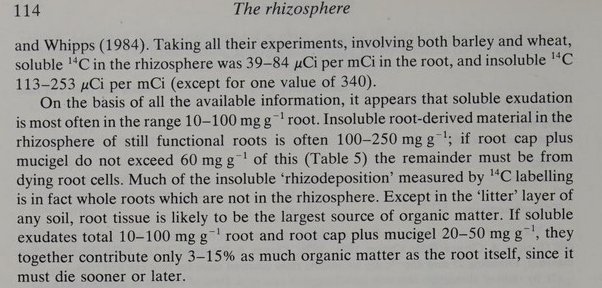
So, in referring to the source cited by McNear Jr. I’ve been unable to find the 10-40% information. I therefore – and still – have no idea where McNear Jr’s figures – reproduced in the Wikipedia page – come from [but see the PS below…]. Should, anybody write about the amount of photosynthate that goes into production of root mucilage, I’d encourage them to use the Wikipedia/McNear Jr statement cautiously.
In terms of citable – i.e., suitably source-stated – ‘stats’ about root mucilage and photosynthesis we are left with the source referred to in the original Botanical conundrum post (and cited by McNeal Jr, although in connection with a quite different statement…): Rovira (1969), “Exudation from intact roots which are functioning normally is slight and of the order of 0.1 to 0.4% of the carbon photosynthesized by the plant”*.
Disappointingly, this phytological puzzle is probably not phully solved. But highlighting it does indicate the care that needs to be taken when citing sources for statements of fact. And, on that thought I really think we must leave that issue there [Ed. – be assured, he won’t!]. Cheers!
PS, a plausible interpretation – and fuller resolution of this conundrum – has been suggested to me by a follower on BlueSky: “What are the odds the problem was just reading Rovira “0.1-0.4” as 10-40% ?” In the absence of any information from David H McNear Jr, I’m happy to go along with that suggestion. Many thaks to that BlueSky commentator (kept anonymous because I don’t have explicit permission to mention their name – but happy to give a name-check if permitted so to do).
* For completeness, Rovira (1969) cites two sources for his range. Barbara McDougall & AD Rovira (1965), which tells us that “The radioactivity of the exudates collected over a 48-h period from roots in plant nutrient solution indicated that approximately 0.1 per cent of carbon-14 assimilated was exuded by the roots”. And Rovira & McDougall (1967), which cites the previously mentioned 1965 paper and states, on page 439, “During the period 0.1 to 0.4% of the assimilated 14C was exuded”. That statement is presumably what translates as “0.1 to 0.4% of the carbon photosynthesized by the plant” in Rovira (1969)’s Botanical Review article.
REFERENCES
Barbara McDougall & AD Rovira, 1965. Carbon-14 Labelled Photosynthate in Wheat Root Exudates. Nature 207: 1104–1105; https://doi.org/10.1038/2071104a0
David H McNear Jr., 2013. The rhizosphere – roots, soil and everything in between. Nature Education Knowledge 4(3): 1.
EI Newman, 1985. The rhizosphere: carbon sources and microbial populations, pp. 107-121. In Ecological interactions in soil: Plants, microbes and animals, AH Fitter et al. (Eds), Special publications series of the British Ecological Society number 4, Blackwell Scientific Publications, Oxford.
Albert D Rovira, 1969. Plant root exudates. Bot. Rev 35: 35–57; https://doi.org/10.1007/BF02859887 [For those with access to JSTOR, the stable link is https://www.jstor.org/stable/4353764]
Albert D Rovira & Barbara McDougall, 1967. Microbiological and biochemical aspects of the rhizosphere, pp. 417-463. In Soil biochemistry, Eds A Douglas McLaren & George H Peterson, Marcel Dekker Inc., New York [Available at Internet Archive]


Leave a comment