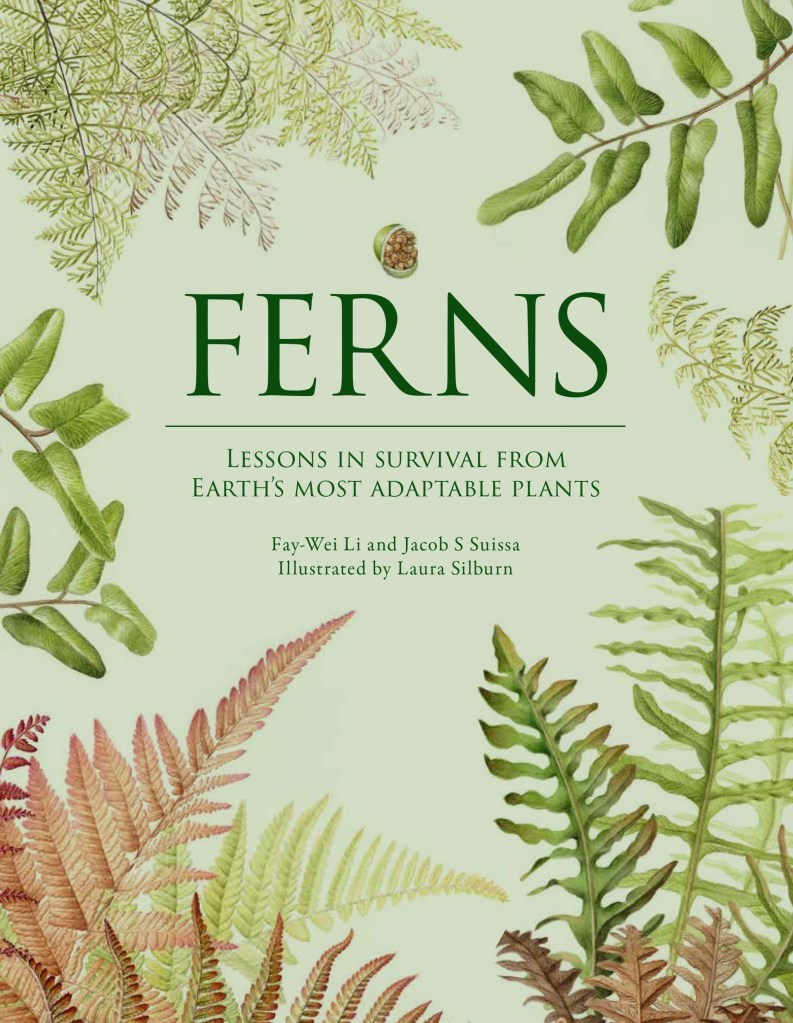
Ferns: Lessons in survival from Earth’s most adaptable plants by Fay-Wei Li & Jacob S Suissa, and illustrated by Laura Silburn, 2025. Hardie-Grant Publishing.
Having recently penned a post about the rare earth element-accumulating fern Blechnum orientale, I was understandably keen to read more about ferns and their biology. I was therefore very pleased to obtain a copy of Ferns: Lessons in Survival From Earth’s Most Adaptable Plants by Fay-Wei Li & Jacob S Suissa [which book – shortened to just Ferns – is here appraised].
Before considering the published item, it’s appropriate to consider the backgrounds of the authors – and the illustrator. Who are Li, Suissa and Silburn? What are their qualifications to produce a book about ferns?
Great expectations…
I first became aware of first author Fay-Wei Li when he co-published a description of a new fern genus that I covered in a blog post. Named in honour of Lady Gaga (Michael Levy, Ben Beaumont-Thomas), the genus Gaga contains 19 species (Fay-Wei Li et al., 2012). I got a sense of fun of this botanist in reading the etymology section of the scientific article that explained the derivation of the name Gaga and of some of the species. Which was further enhanced by his expression of ecstasy in the image that illustrated the Gaga fern-find story here*. With that as background I have high hopes for his foray into popular science writing.
I don’t know so much about second-named author Jacob Suissa. I was aware of some of his research into ferns when gathering background material in another project, e.g., Jacob S Suissa & William E Friedman (2021, 2022); Jacob S Suissa (2025) [Ed. – for the press release about this work, see here]. Suissa clearly knows a lot about the vascular tissues – the internal ‘plumbing’ – of ferns, and his academic credentials for writing about the biology of these plants appear solid.
Additionally, I’ve discovered that Suissa has the ability to write about ferns (e.g., here) – and botany more generally – in his articles published in The Conversation. The Conversation is a web-based publication whose “professional editors work with academics to turn knowledge and insights into easy-to-read articles, and make them accessible to general readers”.
Furthermore, Suissa – along with Ben Goulet-Scott – co-founded Let’s Botanize (Randall Brown), “an educational non-profit using plant life to teach about ecology, evolution, and biodiversity. Their goal is to democratize the study of plant biology by creating accessible and entertaining content, without compromising scientific rigor” (quoted from here). In Suissa we therefore have both an academic background in fern biology and a proven ability in writing about plants for a general audience – and an interest in doing so.
I know less about botanical artist Laura Silburn. Although she has declared that “Illustrating this title was my dream project, working with some excellent botanists, to explore the diverse world of ferns. With over 40 illustrations the book represents a once in a lifetime project working on the plants I love the best”. And you can get a sense of the effort, care, and attention to detail she brought to her work on Ferns in this video clip. A look at her gallery will give some insight into her impressive illustrative artistic ability.
In Li, Suissa, and Silburn, we have three individuals who are well-qualified as a team to provide text and illustrations for Ferns. What does this talented pteridophytic trio deliver? Are they – and what they’ve produced – as ferntastic (Alie Ward) as we might expect?** [and a spoiler alert]
Overall appreciation
Ferns is a very readable book, with engaging text and a good story that links all the chapters together. Ferns is very well written throughout with some lovely phrasing***. However, at times the language is quite technical**** – and such terms are not always explained in-text – and replete with English idioms. The book therefore requires quite a high degree of English language skills and knowledge to appreciate the text fully. But – for those who do – Ferns is a beautifully-crafted book.
So much for the words, what about the illustrations? Ferns is lavishly illustrated throughout. The main images are the full-page depictions of 19 named ferns, with the facing page containing their scientific name (plus family), English common name, and about a third of a page of informative text about the plant. But, there are also numerous much-smaller images liberally scattered throughout the book, depicting various aspects of fern biology (although without scale bars so that one could appreciate the size of the features that are illustrated and described).
In terms of content, the authors remind us that, “throughout these chapters, we have focused a great deal on fern diversity, biogeography, evolution, and physiology” (p. 172). From that point of view Ferns is an excellent introduction to the biology of these remarkable plants.
Overall, this beautifully-written and -illustrated book makes a very good case for the adaptability of ferns – and it is entirely believable that these wondrous non-seed botanics may be “Earth’s most adaptable plants”. After all, ferns “have survived every mass extinction event over the past 400 million years” (p. 172)…
Taking Ferns apart…
Ferns’ approx. 185 pages is divided between an Introduction, 10 numbered chapters, Further reading, and an Index.
The Introduction provides a short overview of what follows in the rest of the book, and explains what topics the book will cover: “we will follow along the evolutionary path of ferns, uncovering their biology, ecology, and unique relationships with the natural and human-made world. In the end we will consider their place in the future of the planet” (p. 9).
Each of the chapters***** starts with a quote (several of which are explicitly about ferns), and is a good mix of text and illustrations. Sub-headings indicate the content of chapter sections – and help readers to navigate the text.
The Index occupies two, 4-columned pages, and features entries from ‘Aboriginal’ to ‘Zygopteris’, via: apomixis; Azolla, biodiversity; Bonaparte, Napoleon; Carboniferous; cyanobacteria; DNA; ecosystem; epiphytes; evolution; farina; Gaga; hybrid; Isoëtes; Jurassic period; kudzu; liverwort; moths; nardoos; orchid; photosynthesis; pteridomania; reproduction; symbiosis; tree fern; Victorian age; walking fern; x Cystocarpium roskamianum; zombie tree fern. [Ed. – why are so many entries italicised? Those entries don’t appear to indicate illustrations, and they’re not all scientific names (indeed, the penultimate entry above is a scientific name of an inter-generic hybrid but is not italicised in the Index – although it is in-text)…]
The section on Further Reading is divided between Books [nine books as general further reading, all of which have ferns in their titles], and Scientific journal articles. The later listing of items is in alphabetical order of first author. Appropriately – by way of emphasising the authors’ credentials for writing the book – it includes several articles where either Li or Suissa – and in one instance both (Jacob S Suissa, Fay-Wei Li & Corrie S Moreau, 2024) – are authors or co-authors. Out of a total of approx. 60 articles, 22 were published after 2019 (and 34 have publication dates post-2009); Ferns is very up-to-date in terms of the science it includes.
Sources stated, sort of, sometimes…
There are no explicit indications of the relationships between scientific journal articles listed and statements of fact stated in the text. However, Li & Suissa do name-check many scientists whose work they cover in the book, and whose relevant scientific article(s) can sometimes be found by searching on the stated scientist’s name (e.g., Dr Xavier Noblin and colleagues work on ‘sporangium catapults’ (p. 23), which relates to Noblin et al., 2012 listed on p. 189; and Dr Lena Q Ma’s research into ‘arsenic-accumulation in brake fern’ (p. 178), which ties up scientific journal article Ma et al., 2001 on p. 189). But that bit of detective work doesn’t work – well, not easily anyway – for all journal articles listed (e.g., mention of Scott McAdam and his discovery that fern stomata lack ABA signalling (p. 38); McAdam was not found as a first author amongst the listed articles, so is his paper cited..?). And there are several listed sources with no obvious relationship to particular statements in-text. Much-more explicit linking of statements to sources is needed for many of the articles listed in Ferns.
Plus, there are many instances of statements – with no clear relationship to any named individuals – in the text that do require sources (and which don’t appear to be covered by the journal articles that are declared). For example: “over 11,000 fern species” (pp. 7, 32); “Around 30 percent of all extant ferns are epiphytes” (p. 50); “a plant loses 400 molecules of water for every molecule of CO2 that enters” (p. 37); “nearly 12,000 ant species” (p. 89); “death of Napoleon Bonaparte has been speculated to be a result of arsenic poisoning” (p. 179); and “over 110,231,131 tons (100 million metric tons) of nitrogen fertilizers are applied every year” (p. 182).
Ferns, a fascinating feast of ferny facts
I began this post by saying how keen I was to read more about ferns and their biology. I was, and was well-rewarded by many facts about fern biology that were new to me in this book. For example – and not wishing to give away all of the book’s ‘secrets’ – I learned that: the leather fern, Acrostichum, thrives in salt marshes and mangroves; an extinct fern from the Carboniferous period, Archaeopteris, had “true woody growth rings” (p. 13); ferns have hormones called antheridiogens, and a photoreceptor known as neochrome; and that carrying fern spores was supposed to make the bearer invisible – which ‘fact’ is referred to by Shakespeare in Henry IV. Unfortunately, apart from the Shakespeare reference, no sources were provided for those facts.
A note about the sub-title
With respect to the book’s sub-title, do we get ‘lessons in survival’? Yes, we do. For ferns, and from their perspective. So, if you were expecting lessons for human survival – in the style of Beronda Montgomery’s book Lessons from plants – you’ll be disappointed; caveat emptor.
But, a very good amount of fern science is shared with readers throughout the book. This is indicated by numerous name-checks to the scientists who have done the work – and which mentions usually tie-up with their relevant scientific articles that are listed in a separate section at the back of the book. It’s nice to see that. Not only does it respect the achievements of those individuals, it makes the important point that real people have unearthed what we now know about ferns. In that regard, Ferns is also a people-and-plants book.
Summary
Notwithstanding its shortcomings – and there are a few – Ferns by Fay-Wei Li & Jacob Suissa is a beautifully written and illustrated book (thanks to artist Silburn) that provides a super introduction to the biology, variety – and importance – of ferns. It deserves its place as recommended reading on the botany curriculum of all good educational establishments, and on the bookshelves of all those who want to know about these ferntastic plants. Furthermore, Ferns is not only readable, it’s a pleasure to read.
* One suspects that neither Li nor his visage were as happy when he heard news about the closure of Duke University’s herbarium which housed – amongst many other botanicals – the important specimens that substantiated his discovery of the new fern genus Gaga (Kaylee McKinzie, Hannah Seo)…
** Yes – with a few reservations.
*** For example: “These early ferns walked, so that the ferns of the following geologic period – the Carboniferous – could run” (p. 13); “spores that will be taken to far-flung places on the coattails of wind currents” (p. 22); “signifying its past presence” (p. 31); “those fern lineages that diversified under the tyranny of flowering plant trees” (p. 32); “when transplanted outside of its native range, S.[alvinia] molesta is like an unruly kid in a candy store running around without parental supervision” (p. 146). Although purists may baulk at the use of somewhat anthropomorphic language for plants, this reviewer liked the book’s phrasing.
**** Examples of technical terms that are introduced – as is appropriate and necessary to the information being shared – but which are often just stated without much by way of explanation or definition include: “morphological changes” (p. 14); “epiphytic plants” (p. 18); “the smallest unit of taxonomic circumscription is the species” (p. 30); “mitochondrial genome” (p. 43); “that is because it [nitrogen in the atmosphere] is in its N3 state” (p. 94); “molcajete” (p. 103); “imbricating leaves” (p. 106); “cope with the xeric conditions” (pp. 119, 132); “indeterminate leaves” (pp. 141, 144). A glossary would certainly have been a most useful addition to the book to help readers cope with these terms. The stand-out exception to this general lack of explanation is the very technical term poikilohydry on p. 56, which is explained.
***** To give a taste of the book’s contents [and which probably does include ‘spoilers’ [Ed. – but that’s because Mr Cuttings is so enthusiastic about the book that he wants to encourage others to read it by providing suitable ‘teasers’…], my impressions of Ferns’ 10 chapters are as follows:
Chap 1 What is a fern? defines and describes a fern, with lots about the fern life cycle (with full-page illustration) and the evolutionary journey of ferns.
Chap. 2 Ferns in the shadows in which the fossilisation process is explained, more on fern evolution and competition with flowering plants, photoreceptor pigment neochrome discussed and the concepts of horizontal gene transfer, and ‘patchwork genes’ are introduced.
Chap. 3 Ferns on trees features an introduction to the notion of ‘mountain passes’, and more on the rise of the angiosperms that forced ferns to retreat to the shadows of the understorey or the trunks of trees, plus plenty about the epiphytic fern lifestyle.
Chap. 4 Ferns as trees provides an introduction to the Cyatheaceae, the scaly tree ferns [nearly all 700 species of which fern family have “figured out how to become trees” (p. 67), but which don’t produce wood], and the ‘root mantle’ – that can support an entire ecosystem, and a ‘shout-out’ for extinct – but wood-forming – tree ferns.
Chap. 5 Ferns and animals Although ferns aren’t dependent upon animals for fertilisation, nearly 800 pp. of insects herbivores feed on ferns, the concept of ‘soral crypsis’, some ferns produce a Bt-like toxin, extra-‘floral’ nectaries and ants, domatia, ‘cryptic ant associations’, and hints at ‘fern blindness’ – “Ferns surely have many animal associations that go unseen because of widespread bias” (p. 99).
Chap. 6 Ferns in the water features many – and quite dramatic – facts about the aquatic Salviniales, in particular Azolla – aka ‘aquatic alfalfa’ (p. 109), the aquatic fern that changed the world – and its nitrogen-fixing cyanobacteria, and ‘the Azolla event’. We also read about the ‘Salvinia effect’ (which seems to be the fern equivalent of the flowering plants’ ‘lotus effect’), and the cautionary tale of Australian explorers O’Hara and Wills whose absence of appreciation of Aboriginal culinary techniques led to their untimely demise.
Chap. 7 Ferns in the desert is a chapter title that should make every reader sit up, and provides lots of information about remarkable ‘resurrection ferns’ – “drying without dying” (p. 126), Sadleria, a fern that is “often the first plant to colonize newly formed lava in Hawaii” (p. 119), fern parthenogenesis (apomixis), and triploid lineages.
Chap. 8 Ferns as weeds encourages us to recognise that some ferns are aggressive, weedy or invasive, e.g., small-leaved climbing fern, which “While not a tree fern, it is perhaps the tallest fern in existence” (p. 137), and is “the fern that ate the south [of USA]” (p. 137) [i.e., it’s the fern equivalent of kudzu], transpiration is discussed in some detail – but the term is not actually named. Biological control of ferns is covered, and we learn that Salvinia molesta – is in the top 100 world’s worst invasive species, and that bracken has a guerilla-type clonal growth form.
Chap. 9 Ferns and humans includes – how could it not? – something about the Victorian Britain fern-craze known as pteridomania, and there is a good mention for the Wardian case, and the 11th – 7th Century BCE mention of ferns in Chinese poetry. Li & Suissa wonder whether Ferns [yes, their book] may have been a top seller in the 1860s [Ed. – We can’t know that, but Mr Cuttings is happy to predict that the book may well be so in the 21st Century]. There is also a whole section about ptaquiloside (David Bradley), a highly-carcinogenic compound from bracken. Plus, plenty on food fern uses, with the Japanese starchy delicacy, warabimochi, mention of ferns as ‘survival foods’, and the sweet-tasting rhizome of licorice fern [Ed. – with authors Li & Suissa suggesting that the compound polypodoside A “could be the next stevia” (p. 166)]. And, yes, Li’s Gaga fern is included here (and illustrated).
Chap. 10 Ferns of the future looks at some of the roles that ferns might play in the future, e.g., arsenic-hyperaccumulating brake fern and phytoremediation, and fern agriculture, with Azolla and its nitrogen-fixing cyanobacteria. Despite challenges from human exploitation of habitat and climate change, authors are optimistic that ferns will survive into the future.
REFERENCES
Fay-Wei Li et al., 2012. Gaga, a new fern genus segregated from Cheilanthes (Pteridaceae). Systematic Botany 37(4): 845-860; doi: https://doi.org/10.1600/036364412X656626
Jacob S Suissa, 2025. Fern vascular architecture reveals how developmental constraint can generate novel morphology. Current Biology 35(22): 5610-5617.e3; https://doi.org/10.1016/j.cub.2025.09.064
Jacob S Suissa & William E Friedman, 2021. From cells to stems: the effects of primary vascular construction on drought-induced embolism in fern rhizomes. New Phytologist 232(6): 2238-2253; https://doi.org/10.1111/nph.17629
Jacob S Suissa & William E Friedman, 2022. Rapid diversification of vascular architecture underlies the Carboniferous fern radiation. Proc. R. Soc. B 289: 20212209; https://doi.org/10.1098/rspb.2021.2209
Jacob S Suissa, Fay-Wei Li & Corrie S Moreau, 2024. Convergent evolution of fern nectaries facilitated independent recruitment of ant-bodyguards from flowering plants. Nat Commun 15: 4392; https://doi.org/10.1038/s41467-024-48646-x


Leave a Reply