
Eucalyptus by Stephen D Hopper 2025. Reaktion Books.
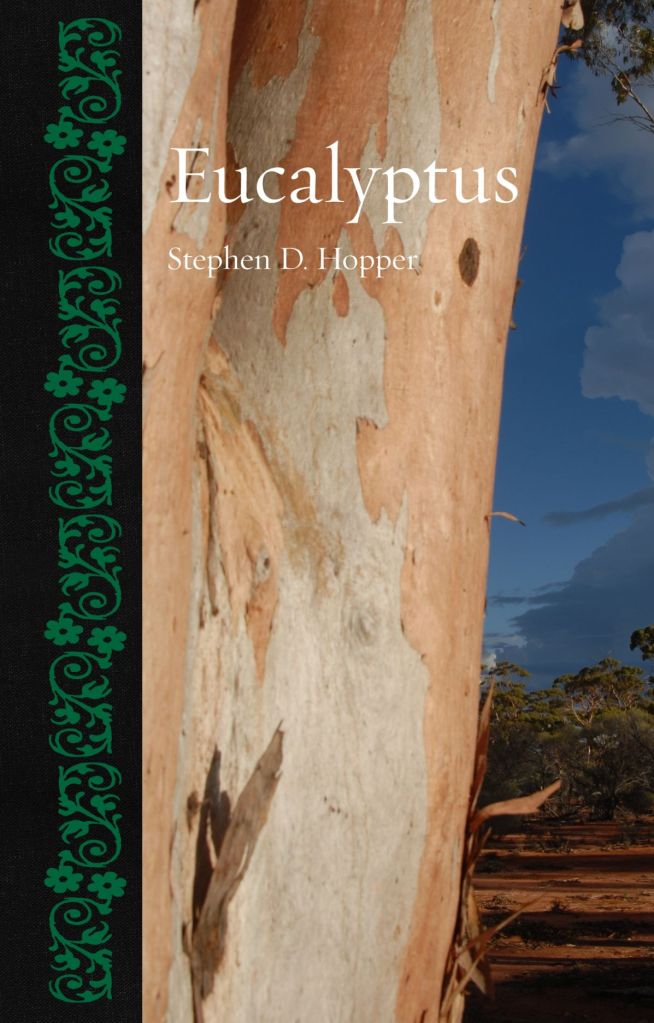
I have had the pleasure of reviewing many titles from Reaktion Books’ Botanical series over the years (e.g., Palm by Fred Gray, Oliver Southall’s Rowan, Mulberry by Peter Coles, and Dan Torre’s Orchid). But Eucalyptus* by Stephen D Hopper [which book is here appraised] is rather different.
Yes, with its focus on plants and people, Eucalyptus does what a Botanical series title should – and is expected to – do in “integrating horticultural and botanical writing with a broader account of the cultural and social impact of trees, plants and flowers” (p. ii) (and being very well-written and abundantly illustrated throughout). But, with its specific aim “to explore aspects of Aboriginal and Western scientific knowledge systems pertaining to the eucalypts” (p. 9), it is quite clearly distinct from other titles in the Botanical series.
The Aboriginal knowledge dimension is the principal focus of the first few chapters of the book which look in-depth at the Aboriginal concept that’s known amongst non-Aboriginals as The Dreaming, and, in particular, the role of eucalypts in the history and culture of those first people to colonise the land we call Australia. Aspects of Western science provides the bulk of the information shared in the remainder of the book. Consequently, you don’t get the more usual Reaktion Books’ fare of the impact of the featured plants in painting, literature, music, as tropes in theatre or television stories, or adorning postage stamps: Eucalyptus introduces a new dimension and trajectory to that Botanical series. Although I don’t know what other titles are being considered for this book series, I doubt that any will match the approach used here by Hopper for eucalypts. I’m therefore prepared to stick my neckout and declare this Botanical series title to be unique.
Instead, what you do get is many first-hand accounts of the intimate association of eucalypts with creation tales and Aboriginal culture. And devoting a large part of the book to that sort of ethnobotanical and cosmological information is a first for this book series. But, it’s an understandable approach given the totemic status of many eucalypt trees and their ancient association with Aboriginal peoples, which partnership provides us today with insights into ways in which these plants and their products can be shared to the benefit of all who live in present day Australia and globally. And recognition that long-established and -practised Aboriginal practices of eucalypt management are important in modern-day attempts to conserve and preserve eucalypts in the wild.
Importantly, the chapters dealing with Aboriginal insights are written with great respect by Hopper and display a deep reverence for that ancient wisdom and the culture that continues to maintain connection with it by way of oral histories passed down from one generation to the next. And that recognition is acknowledged in the book’s Foreword – by Senior Cultural Advisor for Wudjari people, Ron (Doc) Reynolds – who expresses respect for what Hopper has achieved in sharing stories and information in the book, which “are a testament to the man who recognizes that the cultural significance of eucalypts is of utmost importance for future generations, alongside many other aspects that are now understood for these spiritual trees and shrubs” (p. 8).
Having very firmly set the scene for the importance of eucalypts in the context of Aboriginal knowledge systems – which stretch back tens of thousands of years – in the book’s first two chapters**, the third chapter strikes a different tone. Although we get more Aboriginal knowledge here, we also get several first-hand accounts and anecdotes about eucalypts by European ‘visitors’ to Australia. Whilst Europeans were impressed with the stature of some eucalypts there was little meeting of minds between the newly-arrived Westerners and settled First Nations people, and “This tradition of plant blindness and indifference or hostility to Aboriginal culture would persist following colonization for all but a few of the newcomers for almost two centuries” (p. 100). Accordingly, “This chapter examines early interaction between European botanists and the Tasmanian Palawa Aboriginal people, in the context of the discovery and naming of the genus Eucalyptus. In so doing we learn of the tragic suppression of the only Indigenous culture of Aboriginal people that had existed in isolation for more than 10,000 years, at a time when European scientific knowledge was expanding rapidly” (p. 81).
That theme of ‘West knows best’ is a feature of the remaining six chapters that concentrate on insights into study of eucalypts from the Western scientific point of view. That initial European involvement with eucalypts had – a not unexpected – utilitarian view of the resource value of these trees and Hopper is prepared to ‘tell it like it is’ (or, was, rather…) (Taegan Goddard). In particular, the reputation of RBG Kew in discussing the practicalities of the ‘botany of empire’ is somewhat bruised as Hopper brings it into focus European colonisation and exploitation of Australia in describing how the taxonomy of eucalypts was dealt with in an economically pragmatic – if not terribly scientific – way [Ed. – and that candid assessment is from someone who was a former director of that otherwise venerable botanical institution]. In so doing Hopper gives interesting insights and information about the personalities involved in the early days of identifying and scientifically naming Eucalyptus species. Although quite technical at times [e.g., mention without explanation of ‘DNA markers’ (p. 114), ‘genomic DNA approaches’ (p. 114), and ”whole genome duplication” (p. 120)], Chapter 4 is a fascinating account of the historical aspects of Eucalyptus taxonomy (with lots of plants-and-people insights).
Chapter 5 provides a quite in-depth detailed account of the biogeography of eucalypts in Australia – which contrasts with the more ‘gentle biology’ we are more used to in other Botanical series titles. In Chapter 6 I was surprised to read eucalypts come in such a range of sizes, “From the giants of the tall forests to the diminutive coastal mallees less than 1 metre (3.25 ft) tall” (p. 131). Like most readers, I suspect, I was aware of the immense stature amongst these trees – e.g., “We now know that the tallest flowering plants on Earth are included in the exceptional forests of Tasmania, including specimens of E[ucalyptus]. regnans (up to 92 metres/302 ft; see illus. 1), E. delegatensis (88 metres/289 ft)” (p. 94). I was therefore expecting all members of that group to be tall trees. But, having here been introduced to the notion of mallees, multi-stemmed eucalypts, which are essentially shrubs, I was not expecting to discover from my further researches that “many eucalypts [Mr Cuttings’ emphasis] are mallees … and rarely taller than 10 metres (33 feet)” (quoted from here). Additionally, amongst some very basic floral biology in this chapter – e.g., “An anther and its supporting filament are known together as a stamen” (p. 131) – we are introduced to the notion of “triangular eucalypt pollen” (p. 131)***.
Chapter 7 is another rather technical section that tells us ‘How Australia made the eucalypts’ – which, as for Chapter 4, is not typical Botanical series material, whereas, Chapter 8, which looks at cultivation of eucalypts abroad (i.e., outside of Australia) and modern uses, is much more familiar Reaktion Books’ territory. Amongst the plants-and-people material in this chapter are tales of how eucalypts planted near Rome reduced incidence of malaria, and French colonial practices on Madagascar to ensure eucalypt plantations were established there. Utility of eucalypts have seen them translocated to and transplanted in many countries world-wide. So much so that “Today Eucalyptus is the most widely grown hardwood on Earth” (p. 166). So commonplace – and long-standing – have attempts been to establish eucalypt plantations in California that Hopper tells us, “Some Californians I have met have expressed surprise at the claim that eucalypts are native to Australia” (p. 178). Notwithstanding its extensive transportation and plantation to other countries****, Eucalyptus is the iconic tree of Australia (Genelle Weule). Unashamedly – and unapologetically***** – therefore Hopper’s book is a celebration of this amazing tree. The modern uses of eucalypts – which nicely contrasts with the traditional Aboriginal uses covered in Chapters 1-3** – is covered in a decent 3.5 pages, and culminates in Hopper’s bold claim that “The world today cannot survive without eucalypts” (p. 186). Finally, Chapter 9 considers eucalypt conservation. Why? Because, of the 822 species of eucalypts, “193 (23 per cent) meet international criteria as threatened and 36 are considered to be too poorly known to assess their conservation status” (p. 187). In terms of threats, “conversion of habitat to crops and pasture is by far the major cause of decline” (p. 187). In that respect, eucalypts are – sadly – in a similar boat to many other threatened plants.
Other parts of the book
Timeline – where would a Botanical series title be without its timeline? Eucalyptus’ stretches from 59–44 million years ago when “Series Eucalypteae genera first evolve” (p. 203) to 2025 when “Dean Nicolle et al. argue for sinking Angophora, Blakella and Corymbia into Eucalyptus” (p. 210). Both of which entries are an indication of the technical nature of several of this book’s Timeline entries – and a reminder of the information shared in some of the chapters dealing with Western science.
References
Are provided for the Introduction and the nine numbered chapters. The sources stated are principally books and journal articles [several of which have Hopper as an author – which attests to the academic credentials of the book’s author]. In terms of up-to-datedness of the book, at least 100 of those sources are dated post-2010. Although this section has 234 numbered notes, several of those numbers [which relate to the super-scripted numbers within the text] have more than one source, e.g., No. 2 (p. 219) has 8; No. 9 (pp. 219/220) has 9; Nos 3 and 1 on p. 222 each have 5 sources; similarly for Nos 16 and 1 on p. 225. In other words, Eucalyptus provides plenty of sources for its factual statements******.
Index
This occupies approx. 13, two-columned pages, from ‘Aboriginal/Aborigines’ to ‘woodland’, via: Acacia, bark; birds; conservation; cultivation; disturbance (landslide, fire, flood etc.); diversity; endemism; evolution; fire; fossils; gigantism; granite outcrop; hybridization; hypanthium; insects; juvenile growth; Kew, Royal Botanic Gardens (Royal Gardens); life history/cycle/ways; mammals, marsupials; mycorrhizae; native title; nectar; nut (fruits); OCBILS; oil; old growth; plantation(s); pollinators; rainfall, effects; rainforest; seedling; stamen; taxonomy; threatened species; uses; volcanic; and wetlands.
Bibliography
This purpose of this listing, of books and journal articles over approx. 4 pages – more than 24 of which are dated post-2010 – is not clear to this reviewer. Are they full citation details of some of the sources mentioned in the References section?
Associations and Websites
This short section provides names and URLs for 17 organisations, some of which at least have explicit connection with eucalypts, e.g., Atlas of living Australia, Eucalypt Australia, and Plants of the world online.
Summary
Reaktion Books ‘broke the mould’ for titles in their Botanical series with Elizabeth Lawson’s Moss and lichen. They’ve done so again with Stephen Hooper’s Eucalyptus, in which the Australian First Nations’ perspective is given attention on equal footing to that of the western scientific perspective in dealing with these unique plants. Eucalyptus is also a quite personal book. Written by an individual who has published numerous scientific articles about eucalypts, it is also authored by one who, moreover, has spoken with those of Aboriginal heritage to understand these iconic trees more holistically than a narrow scientific perspective usually implies. In so doing Hopper has given us a book that should “stimulate others to wonder about, and care for, one of the most important genera of plants on Earth” (p. 17).
* Although the book’s title is an unitalicised Eucalyptus, it is used here italicised because that is how I show titles of books in these appraisals. Whilst italicised Eucalyptus is also the name of the main genus of plants known as eucalypts, it isn’t – probably – the only one. Issues concerning Eucalyptus and eucalypts [a general name for similar plants to those in the genus Eucalyptus] also seem to have been of concern to author Hopper. As he explains in note 2 to the Introduction: “To comply with the publisher’s aim to use a single-word title [Ed. – in which case, how did authors Dan Torre, and Mike Maunder for their Botanical series’ titles Carnivorous plants, and House plants, respectively manage that..?] I adopt ‘eucalypts’ in this book to cover the four technical genera of Eucalyptus, Corymbia, Blakella (Michael D Crisp et al., 2024) and Angophora. This enables inclusion of traditional broad interpretations of Eucalyptus prior to 1995, while providing the latest insights into the four main groups today recognized by DNA studies among the true eucalypts. … Controversies over precisely what is meant by the generic name Eucalyptus is a matter for continuing research using the best available scientific evidence and solid theory within the context of the international rules for botanical nomenclature” (p. 211). That latter point is underlined by the Timeline entry for 2025 [another indication of how up-to-date this book is]: “Dean Nicolle et al. argue for sinking Angophora, Blakella and Corymbia into Eucalyptus [Ed – i.e., changing their scientific name back to be being species of Eucalyptus]. Their reasons are yet to be tested in the context of the International Code on Botanical Nomenclature” (p. 210).
In short, it seems fair to say that the classification of eucalypts is ‘complicated’ [e.g., “Controversies over precisely what is meant by the generic name Eucalyptus is a matter for continuing research using the best available scientific evidence and solid theory within the context of the international rules for botanical nomenclature” (p. 211)], and by no means settled (e.g., Dean Nicolle et al., 2025; Lyn G Cook et al., 2025).
All of which leaves me wondering why the more inclusive title ‘Eucalypts’ wasn’t chosen for this book’s title. Removal of the letter ‘u’ would have made matters somewhat simpler.
** Amongst the many Aboriginal uses of eucalypts covered in these chapters, those such as spear-throwers, shields, spears, boomerangs, huts, canoes, didgeridoo, to tan hides, to stun fish, and for food and medicine may be considered the more obvious ones. But, they also have more unusual uses, e.g. a mixture of eucalypt gum and kangaroo dung makes a type of cement, and construction of gnaama boorna (‘waterhole trees’) [for more on this phenomenon see Cat Williams]. But, for me, the most intriguing belonged to the Warlpiri people who “use smoke from the leaves of bloodwoods (wirrkali in their language) mixed with the hair of a murder victim to detect a killer from the direction in which the smoke blows” (p. 44).
*** Since triangular refers to a 2-dimensional geometric shape, a triangle, I’m intrigued to know what it means in relation to 3-dimensional pollen. Maybe a triangular pyramid or tetrahedron is meant? Unfortunately, no image is provided to tell us exactly what Hopper hand in mind.
**** Which globe-trotting is what prompts Hopper to call eucalypts the ‘universal Australian’.
***** Although, apologetically and with due humility, Hopper states in the Acknowledgements, “My ancestors contributed to the destruction of eucalypt woodlands and forests for agriculture in Victoria (Wemba Wemba country) and New South Wales (Biripi lands). It is my hope that this book makes a small contribution towards reparation of such damage, and poses a way for a brighter future with eucalypts for our descendents” (p. 240).
****** Nevertheless, there are places in the book where sources are needed but not clearly provided. For example: “Fire and other disturbances assist regeneration by temporarily removing most of the seed and seedling predators and pathogens. … Fire also provides ashbeds (see illus. 81), clears the ground facilitating flooding and dust storms and fertilizes topsoil in which nutrients are concentrated in otherwise nutrient-poor soils. Branch death through fire, drought, storm damage, rainfall and landslide stimulates the drying out of fruits and the release of seed” (p. 141); “The tolerance of young germinants to waterlogging and salinity varies by species” (p. 146); re cotyledons, “They are usually dark green above and maroon below, the latter caused by a light-sensitive pigment that is helpful for photosynthesizing in low ambient light” (p. 146); and “The leaf litter was what is termed allelopathic, so nothing native grew under these eucalypt plantations” (p. 177).
REFERENCES
Lyn G Cook et al., 2025. Eucalyptus was not the problem: A response to “The genus problem – Eucalyptus as a model system for minimising taxonomic disruption” by Nicolle & al. Taxon 74(3): 507-514; https://doi.org/10.1002/tax.13357
Michael D Crisp et al., 2024. Perianth evolution and implications for generic delimitation in the eucalypts (Myrtaceae), including the description of the new genus, Blakella. Journal of Systematics and Evolution 62(5): 942-962; https://doi.org/10.1111/jse.13047
Dean Nicolle et al., 2025. The genus problem – Eucalyptus as a model system for minimising taxonomic disruption. Taxon 74(3): 495-506; https://doi.org/10.1002/tax.13240


 Plant Cuttings
Leave a reply to Gerhard Cancel reply