
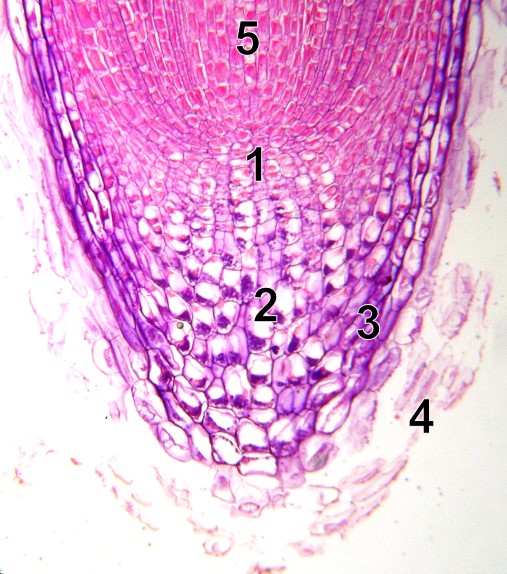
This image entitled “Root tip magnified 100× under an optical microscope” by SuperManu is used under the Creative Commons Attribution-Share Alike 2.5 Generic license.
Here’s a puzzle for you.
In another project, I’m writing about roots and their mucilage*. Engaging in my research for that topic I was intrigued to learn that “Plants use up to 40% of their energy secreting root mucilage, which they generate from photosynthesis that takes place in the leaves” (quoted from here).
Wow! So, nearly half of what plants make in photosynthesis goes – ultimately – to feeding the microbes and invertebrates in the soil. That’s very generous of plants – working for the greater ecological benefit of the planet. Who’d’ve thought it?
That gem of information came from Wikipedia’s ‘Root mucilage’ page. And the more I thought about it, the more astounding a fact it seemed: That really is an awful lot of a plant’s hard photosynthetic work released into the soil rather than going into making more plant tissue. Still, a source was provided for that Wikipedia statement, David H McNear Jr (2013), so it should be OK; it should be a fact. Maybe, but nevertheless, and suitably sceptical, I checked the source stated.
In that stated source, McNear Jr tells us “Newman (1985) examined a variety of plant species and estimated that roots can release anywhere from 10 to 250 mg C /g root produced or about 10-40% of their total photosynthetically fixed carbon”. Fair enough, Wikipedia has taken that 10-40% value correctly from that article; job – providing a source for a statement of fact – done.
In his turn, McNear Jr has done his job in citing his source for that 10-40% figure, the article by Newman (1985). However, in citing Newman for his numbers, is McNear Jr is – however unintentionally – effectively ‘passing the buck’, and ‘kicking the can down the road’? Whilst McNear Jr has provided evidence for his statement, we’re no closer to seeing the actual/original source of the numbers. As you might expect, I remained sceptical about – what still seemed to me to be – such a high figure of diverted photosynthetic effort. The obvious next step was to find out what Newman (1985) – as McNear Jr’s source – had to say about this. And that’s where I hit a problem.
In trying to track down the Newman item on the web the best I could manage was locating the article’s abstract at CABI Databases. The abstract told me that “Soluble exudate production by living roots is usually within the range 1-10 g per 100 g root dry weight increase; root cap plus mucigel may provide a further 2-5 g per 100 g”. Whilst that gives an idea of how much of the mass of a root is effectively released into the soil, it didn’t say anything about “10-40% of their total photosynthetically fixed carbon” being released. If the information wasn’t in the abstract, I assumed it much be within the body of the article. I therefore needed to look at the entirety of Newman’s article to get any further with my initial query, but to which I didn’t have access.
Which is where I’m asking readers of this blog for help:
Can anybody supply with me with a full copy of the Newman (1985) article?
But, even without Newman (1985) in full, the plot thickens somewhat. In the same paragraph in which McNear Jr provides the 10-40% figure we find this sentence “Rhizodeposits have been classified based on their chemical composition, mode of release, or function but are classically defined (Rovira, 1969) to include sloughed-off root cap and border cells, mucilage, and exudates”. I was interested in the notion that there were various hierarchies of materials released from roots into the soil, and noting that rhizodeposits was a sort of over-arching umbrella term that included mucilage and exudates, I was keen to have a look at the Rovira (1969) article.
In consulting Rovira (1969)** I was interested to note that on p. 44 it said, “Exudation from intact roots which are functioning normally is slight and of the order of 0.1 to 0.4% of the carbon photosynthesized by the plant”***. And in the conclusion it stated, “Although the quantities of organic compounds exuding from roots is not large, seldom exceeding 0.4% of the carbon photosynthesized”. As Rovira (1969) observes, a figure of 0.4% of the carbon photosynthesised is not large. And it’s certainly a lot less than the 40% figure in McNear Jr and Wikipedia.
Furthermore, Rovira’s range of 0.1 to 0.4% bears more than a passing resemblance to McNear Jr and Wikipedia’s 10 – 40%. Could a transcription or typographical error – albeit of x100 – account for the difference between the two sets of figures? Or, is it just a coincidence? Even more assuredly, we need to see what Newman (1985) says. [Ed. – or, is Mr P Cuttings missing something that’s obvious to everybody else? We need to know.]
So, a repeat of my plea, can anybody send me a copy of the full Newman (1985) article? Or point me in the direction of where I can get it? [Ed. – or point out the error in Mr C’s thinking…]
Cheers!
* Although not strictly necessary for this post, something about root mucilage is relevant. So, here’s Google’s ever-helpful AI Overview about this marvellous mucosal material, “Root mucilage is a gel-like substance secreted by plant roots, primarily composed of polysaccharides, that protects the root cap, lubricates root growth, and forms a rhizosheath. It helps soil particles adhere to the root, which in turn improves water and nutrient absorption, protects against pathogens, and maintains hydraulic conductivity as the soil dries.
Composition and formation
Composition: Primarily made of polysaccharides (long chains of sugar molecules), with some proteins, lipids, and minerals.
Secretion: It is secreted by root border cells at the root tips as the root grows through the soil.
Formation of rhizosheath: The mucilage combines with soil particles, microbes, and the root tip to form a structure called a “rhizosheath”.
Functions
Lubrication: Aids in the movement of the root through the soil.
Soil aggregation: Binds soil particles together, which helps stabilize the soil and can prevent erosion.
Nutrient and water acquisition: Retains water, which is crucial for plant survival in dry conditions. Maintains hydraulic conductivity by preventing gaps from forming as the soil shrinks and dries. Can facilitate the absorption of ions like iron and phosphate. Contains enzymes that help mobilize nutrients in the soil.
Plant protection: Provides a barrier that can prevent the entry of pathogens. May contain defensive compounds to ward off herbivores and pathogens.
Interaction with soil life: Acts as a nutrient source for beneficial soil microorganisms. Serves as a matrix for the rhizosphere microbial community”. [Ed. – Mr P Cuttings is sorry about foisting that upon you. When he writes about this topic properly he will provide better-phrased, and fully source-cited prose.]
** Readers may be interested to note that Rovira (1969)’s paper is the ‘citation classic’ for the week of 23rd – 30th of December 1985 in/according to Current Contents.
*** Rovira (1969) cites two sources for his range. First, Barbara McDougall & Albert D Rovira (1965), which tells us that “The radioactivity of the exudates collected over a 48-h period from roots in plant nutrient solution indicated that approximately 0.1 per cent of carbon-14 assimilated was exuded by the roots”. And second, Albert Rovira & Barbara McDougall (1967), which cites the previously mentioned 1965 paper and states, on page 439, “During the period 0.1 to 0.4% of the assimilated 14C was exuded”. That statement is presumably what translates as “0.1 to 0.4% of the carbon photosynthesized by the plant” in Rovira’s Botanical Review article.
REFERENCES
Barbara McDougall & Albert D Rovira, 1965. Carbon-14 labelled photosynthate in wheat root exudates. Nature 207: 1104–1105; https://doi.org/10.1038/2071104a0
David H McNear Jr., 2013. The rhizosphere – roots, soil and everything in between. Nature Education Knowledge 4(3): 1.
Newman, E. I. The rhizosphere: carbon sources and microbial populations. Ecological Interactions in Soil. A. H. Fitter. Oxford, Blackwell Scientific Publications: p. 107. (1985) [citation as shown in McNear Jr article; abstract available here]
Albert D Rovira, 1969. Plant root exudates. Bot. Rev 35: 35–57; https://doi.org/10.1007/BF02859887 [For those with access to JSTOR, the stable link is https://www.jstor.org/stable/4353764]
Albert D Rovira & Barbara McDougall, 1967. Microbiological and biochemical aspects of the rhizosphere, pp. 417-463. In Soil biochemistry, Eds A Douglas McLaren & George H Peterson, Marcel Dekker Inc., New York [Available at Internet Archive]


 Plant Cuttings
Leave a reply to The Week in Botany November 24, 2025 Cancel reply