
The genius of trees: How trees mastered the elements and shaped the world by Harriet Rix, 2026 [in paperback] (and 2025, in hardback). Bodley Head, an imprint of Penguin Books Ltd.
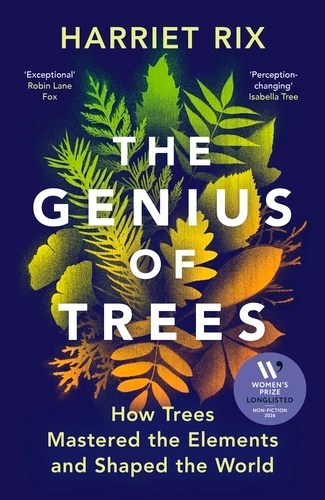
The image above is the cover of the title’s hardback 2025 version (before the sub-title was tweaked to How trees mastered the elements and shaped the world in the 2026 paperback…).
A few posts ago I reviewed How flowers made our world by David George Haskell. That author’s argument, that much of what we see around us on planet Earth today is the result of the actions and interactions of flowering plants, was quite persuasive. And it seemed likely that that was the end of the story. But, that view is challenged in Harriet Rix’s The genius of trees [which book is here appraised] – particularly in view of its sub-title How trees mastered the elements and shaped the world.
With such an intriguing title and sub-title I had very high expectations for this book. However, having now read it, I am somewhat conflicted in what to say about it.
Author Rix is clearly an enthusiast for trees. And throughout The genius of trees she is a most articulate and passionate advocate for those wonderful verdant creations of nature. All of which is to be applauded. But, whilst that makes for a very readable and informative book, they are not enough to make this a great book. What’s sadly missing from large swathes of the book is the evidence for the numerous statements that Rix makes – and a number of issues with the science that’s shared with us.
Having made that bold claim, what’s my evidence? Let’s deal with the positives first.
The good…
Although the particular thrust of the book is stated in its sub-title, How trees mastered the elements and shaped the world, that mention of elements really deals only with the first half of the book. Rix’s full emphasis – of trees as masters of both the physical and biological factors that surround them – can be clearly seen in the titles – and particularly the sub-titles – of the book’s eight chapters. Since that useful information doesn’t appear on the publisher’s site for the book, to give potential readers more insight into the book, I’m happy to advise that those chapters are:
1, Trees shaping water: How trees brought water down and sent it back up; 2, Trees shaping soil: How trees invented earth in their search for growth; 3, Trees shaping fire: Why do trees evolve to burn?; 4, Trees shaping air: How trees trap carbon, and the problems that this has caused; 5, Trees shaping fungi: How trees use fungi for their own advantage, and how they sometimes lose; 6, Trees shaping plants: How trees shaped the plants underneath them (and how in some cases those plants grew up to become trees themselves); 7, Trees shaping animals: Trees shape animals chemically and physically, and mainly use them to move; and 8, Trees shaping people: How trees shaped humans physically, mentally and politically, through interactions with earth, wind and fire*.
As a consequence, The genius of trees has the potential to be a very good book about trees and their relationship with their physical environment, and the other lifeforms whose planet they share. There is a special emphasis generally on the biology of trees, and – more specifically – on their ecology, in particular how they interact with physical factors in their environment (earth, wind, air, and fire), and biological factors (fungi, plants, and animals).
For those of you looking for more ideas of the book’s scope, the Index is always a good place to start. In approx. 19, two-columned pages, it goes from ‘Abbasid Mosque, Samarra’ to ‘Zoroastrianism’ via people, plants (common and scientific names), places, and topics (e.g., aesculin, Amazon rainforest, bacteria, Bengal famine, Bronze Age, carbon dioxide, Chanel No. 5 tree, climate change, deserts, Devonian period, DNA, electrochemical impulses, eyeshadow, fire, fossils, fungi, Gaia hypothesis, Gondwana, herbivory, High Carbon Dioxide gene, insects, isoprene, Jurassic period, K-strategists, karst landscape, kinaesthetic memory, leaves, lightning, lycopsids, magnesium, Minoan civilisation, The Mother Tree, nectar guides, nitrogen, ombrophilous plants, oxygen, paganism, photosynthesis, pollen, Quetzalcoatl, rainbow fossils, Rhynie chert, roots, seeds, soil, sugars, Taiping Rebellion, tree planting programmes, truffles, ultramafic rock, ultraviolet radiation, volatile organic compounds, water, wildfires, wood wide web, xylem, zamia staggers, and Zeelandia.
For this reviewer, one of the book’s most interesting chapters is number 8, which deals with the ways in which the evolution and lives of human beings have been – and are – intimately interconnected with trees. Although the other seven chapters develop different aspects of Rix’s thesis of how trees have shaped everything they touch – or that touches them, it is that last chapter that really brings this idea home, and in a very relatable way. The facts* that Rix marshals to support her argument are quite persuasive. Arguably, human beings truly are ‘children of the trees’. Acknowledging that is why we should be looking after what’s left of them on our planet much better than we currently are.
The bad…
In terms of the information that Rix presents us with throughout the book – and on average there’s more than one fact on each page – we have a great mix of plant anatomy, plant biochemistry, plant physiology, environmental science, human evolution, molecular biology, and plant geography. All of which adds factualism to the more intangible sense of wonder and awe in the achievements of trees that author Rix shares with us. But, I have two issues with The genius of trees. The dearth of stated sources for factual statements, and some examples of science being communicated poorly.
State your sources…
The evidence base for the book’s many facts is provided via two sections, Notes and Bibliography. Notes are listed by chapter (and Introduction) and numbered – which correspond to super-scripted numbers in-text. Many of these Notes are to sources whose citation details are shown in full in the Bibliography (of the publications listed there over approx. 29 pages, 156 are dated post-2015 (including 10 from 2024, and one in 2025), which indicates how up-to-date The genius of trees is). Over approx. 16 pages, we have 161 Notes (several of which often cite more than one source). Which number you might think would deal with the evidence for all of the facts that Rix shares with us. Sadly that is not the case (and some Notes provide facts but without their source being stated, e.g., Note 3 on p. 223, Note 11 on p. 227).
Facts provided in the great majority of foot notes (at the bottoms of pages within the introduction and numbered chapters) are stated without sources provided (e.g., destruction of library at Amedi by British troops in 1919 (p. x), and that 37% of gymnosperms are in danger of extinction (p. 5)). As are many, many factual statements in-text, such as: “When modern humans evolved about 40,000 years ago” (p. x); “an estimated six trillion trees on the planet” (p. x); a combination of lignin and cellulose providing a casing of Kevlar strength; “the fact that trees cover 30 per cent of the world’s landmass” (p. 41); “glutamate is fundamental in pollen and spore germination” (p. 130); and “Arbuscular mycorrhizal (AM) fungi, first recorded inside tree roots in the early Devonian period, 419.2 million years ago” (p. 131). And there’s a great chunk of text – pages 40-52 in Chap. 2 – that’s bristling with facts but without any indication of their sources***.
All of which is a great shame because there was much in the book that was new to me**** (and about which I’d have liked to have been able to find out more…). For example: that Pando may be as much as a million years old; “The deepest recorded taproot is that of a wild fig, which grows down 121 metres” (p. 32); that members of the Vochysiaceae ‘weaponise’ aluminium; “ginkgo, a tree so fire retardant that Buddhist monks planted it around shrines to protect them from burning” (p. 66); “Pollen tends to be negatively charged so it will attach to the female flower” (p. 105); and “Trees (or their associated bacteria) appear to be responsible for 24.6 – 49.9 Terragram of methane uptake globally” (p. 115).
Get the science right…*****
Comments above should impress you with the scientific nature of much of the book’s content. And that intention is made clear in Rix’ statement that The genius of trees “is a story of science” (p. xi). With that as an important dimension to the book, how does the science fare? Not being a specialist in all of the branches of science covered in the book, I can’t speak for everything. But, I do know something about plant anatomy, physiology, and biochemistry. In that regard, I’ve spotted a few issues.
Incorrectly, we are told by Rix that “the leaf’s cuticle is a defensive, Byzantine wall of cells” (p. 7). As defensive as the cuticle can be (Jacques Joyard; Gulab Chand Arya et al., 2021; Isabel Molina et al., 2023), it is an extracellular layer (Jacques Joyard). The cuticle is not therefore a wall of cells, Byzantine or otherwise [Ed. – and Mr Cuttings is not sure what Byzantine means in the context of plant cells…].
In danger of misleading the readers, do “Root hairs also provide a vast surface area for the osmosis of other mineral salts” (p. 28)? Whilst root hairs do provide a large surface area over and through which minerals – and water – can enter the plant (here; here; here; DR Gossett, 2021; Claire Grierson & John Schiefelbein, 2002; Mqondisi Bhebhe, 2025, 2026), as far as I’m aware, osmosis is a term that should be reserved for the passive movement of water in that situation (Emily Clark; Mqondisi Bhebhe, 2025) (or other solvents (Richard Renneboog, 2015), but not solutes such as minerals).
Also misleadingly, we are told that “longer vessels where cells lengthen into tubes through which water can whizz up and down” (p. 155). Whilst water may ‘whizz’ upwards in a xylem vessel, I’m not aware that it can whizz down it. Water flow within a xylem vessel is uni-directional, upwards (James T Dawson, 2021; Martin Huldrych Zimmermann).
Arguably, the most serious problem in The genius of trees relates to photosynthesis. In two places there is a major error regarding the source of the oxygen released during that process: “plants use a protein called Rubisco … to hold carbon dioxide and use energy from the sun to force its two oxygen atoms together so they combine and spring away into the atmosphere as oxygen gas” (p. 98); and “Trees require chloroplasts, these tiny subcellular structures, to split off the oxygen from carbon dioxide and fix the carbon” (p. 107). The oxygen released in photosynthesis comes from water, not carbon dioxide (see here, here, here, Ms Parrott, Paul May, and James Barber, 2008). [Ed. – but which misconceptions are not helped by comments such as “Photosynthesis … produces the oxygen we breathe by transforming carbon dioxide from the air”, by plant scientist Dr Mike Haydon at the University of Melbourne…].
Related to photosynthesis, there appears to be a problem with the date of the origin of chlorophyll. As stated by Rix: “Chlorophyll evolved in bacteria living in the sea 3.5 million years ago” (p. xiii). I suspect that date is more likely to be billions rather than millions (e.g., Hayley Dunning for bacteriochlorophyll). But, since no source is provided for this statement, we’ll never know if it is the book’s error, or how the error arose. And, keeping with a carbon-chemistry theme, “methane, CH4” (p. 114) should be more correctly shown as CH4.
The mixed
In telling tales about trees, rather than just provide the science behind those interactions, Rix gives us plenty of ‘nature writing’. She tells us she was keen to see as many of the trees she writes about in their natural settings. Accordingly, she gives us glimpses into her travels across the globe to seek out her subjects, and writes poetically and philosophically about those treks, encounters, and experiences – and quite candidly when talking about the Taliban and other groups she meets on her travels. In places, Rix observes with the eye of a naturalist and writes with the soul of a poet. And generally that writing is very good. With some memorable phrases and quotables******, and personal anecdotes (who could forget the game of ‘snapdragon’, and “The year the porcelain caps appeared was also the year that my cousin and I decided to poison our siblings” (p. 122)?), The genius of trees is full of intelligent, imaginative, and enthusiastic narrative, which encourage the reader to think******* about trees, and – hopefully – see them in a new light. Rix is a true lignophile.
But, equally, in other places, the text can be a bit ‘clunky’ and requires a couple of reads to understood what is written. That is compounded with use of unfamiliar – to this reviewer – words and phrases, e.g., Navette-shaped pores/stomata, lumpen, pyriscence, umbrous, gridelin, coolth, and bletted. And there are two phrases that I still do not understand: “angiosperms were the AI critic to the Proust of the gymnosperms” (p. 42), and “like Foucault after his weekend in California, I felt like crying and declaring that I knew Truth” (p. 189).
Trees versus non-trees..?
Rix’s tree-centric world view is fine for bringing to readers’ attention the biology and ecology of trees – and thereby doing its bit to remedy the malaise known as plant blindness (Katherine Cheung; Karen Mockler; Valentin Hammoudi). But, in doing so, it risks downplaying the – equally(?) – important role of non-tree plants, as advocated by Haskell in his book How flowers made our world (which does include a chapter devoted to magnolia, the tree…).
Let’s get technical…
As you might expect for a book that discusses science, a lot of technical terms are used. Unexpectedly, few of them are actually explained or defined on their first mention; e.g., chemical electrical energy, free-radical reaction, lignin, epiphytes, bryophytes, carbon credits, mycelium, Anthropocene, diazotrophic bacteria, epigenetic changes, tracheids, serotinous, upregulate, and anion.
Picture this
Although Rix is good at creating word pictures about the trees and their habitats, the book does contain illustrations. Eight pages of colour photographs are grouped together in the middle of the book. Although each image is supplied with a legend, there appears to be no explicit link between the text and the pictures: An opportunity missed, but one that’s easily remedied in a future edition…
The opportunity and challenge
With a good bit of tidying-up (some of which is indicated in my comments above), The genius of trees can so easily be turned into a classic of plant science communication. Something to be considered for a new edition?
Summary
The genius of trees by Harriet Rix is potentially a great book about trees. Reading it you will learn a good deal about the biology and ecology of trees, in particular how they interact with physical (earth, wind, air, and fire), and biological (fungi, plants, and animals) factors in their environment. What stops it being the great book it could be is the dearth of evidence for what Rix says, and numerous instances of poorly communicated science. Nevertheless, there is much to marvel at in Rix’s book, and much to think about. It’s a great addition to the plants-and-people genre specifically, and to plant-based biology more generally.
* Generously, Rix tells us that “This entire chapter [No. 8, Trees shaping humans] owes much to the ideas superbly told in Enos’ [sic.**] The Wood Age (2021)” (p. 237). Whilst acknowledging the value of that book in dealing with the notion that ‘wood is what makes humans human’, I was surprised not to see – maybe also – mention of John Perlin’s A forest journey].
** The author of The Wood Age is Roland Ennos, whose surname is correctly shown on p. 248 of The genius of trees where the full citation is given.
*** In a few places, Rix hints at a source, e.g., “In 2020 an experiment performed by Lijuan Sun at the Institute of Ecology in Beijing…” (p. 42), but still doesn’t actually provide it for the reader…
**** Also new to me were explanations of the etymology of: Abies equi-trojani; Russulas; the dodo; and the Joshua tree.
***** Unrelated to science, but concerning a geographical claim, is this statement: “In the Guatemalan highlands, almost exactly on the opposite side of the earth and 40,000 km from Pakistan” (p. 51). That seemed like a lot of kilometres to me, so I did some checking. The Earth’s circumference at the equator is approx. 40,075 km. Since we can’t travel through the planet to move between locations on its surface, two places on opposite sides of the Earth are half the Earth’s circumference apart, about 20,038 km. If that is correct, I’m puzzled as to how Rix gets her figure of 40,000 km. [Ed. – if you could travel through the Earth, the distance between the Guatemalan highlands and Pakistan would be about 12,756 km (the planet’s equatorial diameter) (Matthew Williams), which is much less than 40,000 km…]
****** Amongst the book’s memorable phrasing are such delights as: “like the spouses of a dead climate, sometimes known by the Dickensian term the Tertiary Relicts” (p. 5); “I luxuriated like a lizard” (p. 8); “a Willy Wonka landscape of hills and hummocks and valleys” (p. 29); “conifers that stand like ziggurats, layered temples to the lightning gods” (p. 71); ”It’s the equivalent of angry dogs, bored of Pedigree Chum, turning on the humans in Britain and killing them before crunching their bones” (p. 137); and “What we might now call avarice became the defining principle of life” (p. 205). Whereas notable quotables include: “The ecologist Oliver Rackham put it best: ‘Trees and other plants,’ he said, ‘are not flammable by misfortune but by adaptation.’” (p. 60); “The species we see making up the earth’s flora and fauna are tiny, lucky fragments of what might have been” (p. 191); “Trees, therefore, didn’t only shape our bodies; they enlarged and shaped our brains every single night we slept in them” (p. 204); and “They [trees] have profound agency over earth, wind, fire and water in ways we can only partly elucidate” (p. 218).
******* Interestingly, whilst Rix favours the Darwins’ notion of the root-brain hypothesis (František Baluška et al., 2009; Paolo Pecere, 2026) (p. 33) [Ed. – which view may well ‘ruffle a few feathers’…], she does wonder if “The poetry of the wood wide web [see e.g., Tim Entwisle, 2025] may have outstripped the scientific facts” (p. 129) [Ed. – which stance should earn approval from some of those whose feathers may have been ruffled…].
REFERENCES
Gulab Chand Arya et al., 2021. The plant cuticle: An ancient guardian barrier set against long-standing rivals. Front. Plant Sci. 12: 663165; doi: 10.3389/fpls.2021.663165
František Baluška et al., 2009. The ‘root-brain’ hypothesis of Charles and Francis Darwin: Revival after more than 125 years. Plant Signaling & Behavior 4(12): 1121–1127; https://doi.org/10.4161/psb.4.12.10574
James Barber, 2008. Photosynthetic generation of oxygen. Philos Trans R Soc Lond B Biol Sci. 363(1504): 2665-2674; doi: 10.1098/rstb.2008.0047
Claire Grierson & John Schiefelbein, 2002. Root hairs. The Arabidopsis Book 2002(1), (4 April 2002); https://doi.org/10.1199/tab.0060%5D
Isabel Molina et al., 2023. Editorial: Plant cuticle: From biosynthesis to ecological functions. Front. Plant Sci. 14: 1154255; doi: 10.3389/fpls.2023.1154255
Paolo Pecere, 2026. Plant cognition after Darwin: historical and epistemological remarks. HPLS 48: 33; https://doi.org/10.1007/s40656-026-00739-0


Leave a Reply