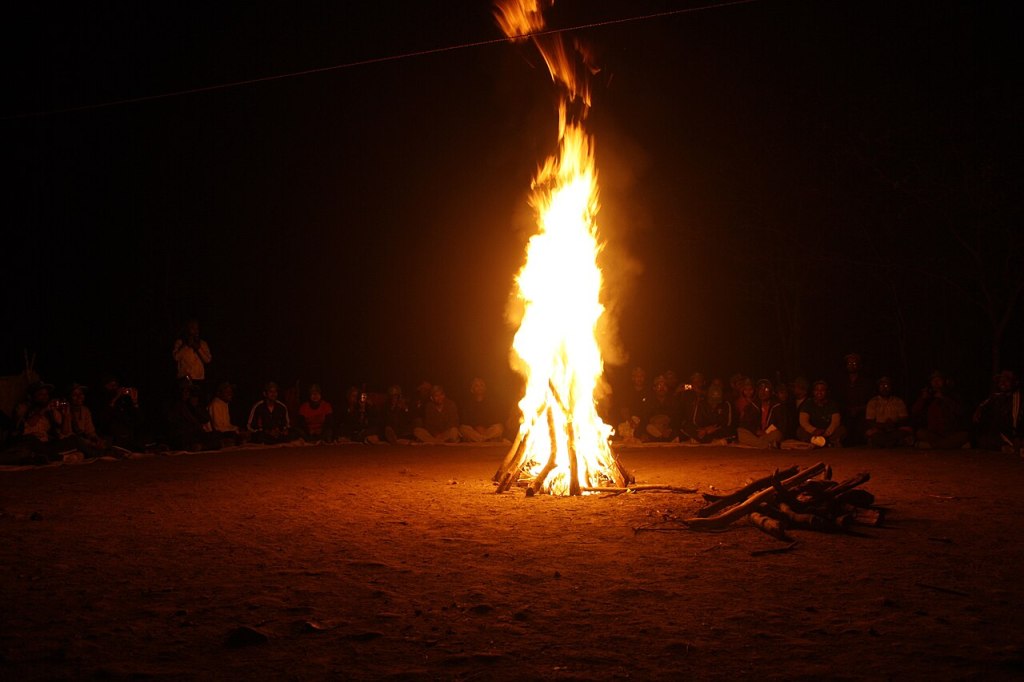
This image, entitled “29RCCMAK – Campfire at Susunia base camp and Photo has been takn [sic.] during Basic Rock Climbing Course by MAK (Mountaineers Association of Krishnanagar) at Susunia Hill, Bankura, West Bengal” by Indrajit Das, is used under the Creative Commons Attribution 4.0 International license.
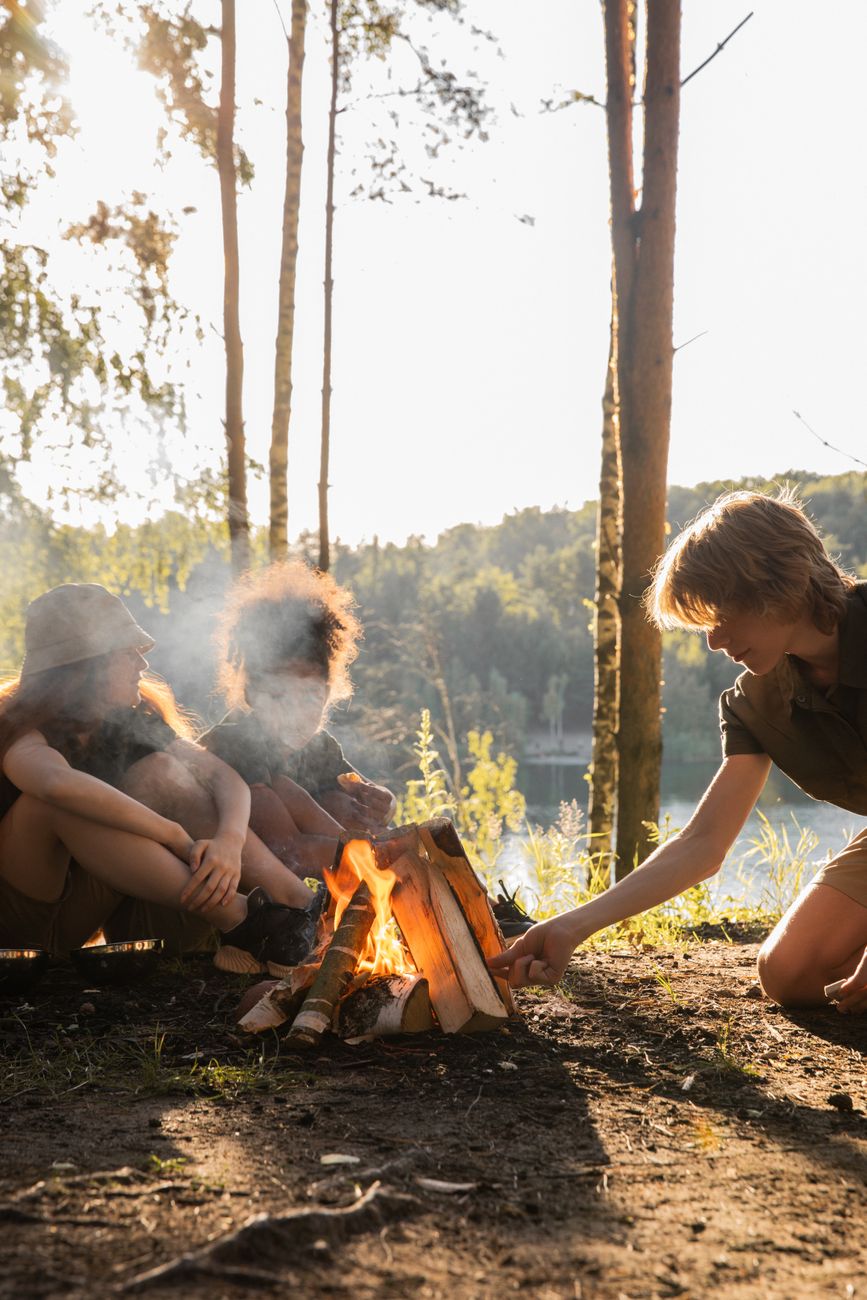
Back in the days when I tried to change people’s perceptions about the importance and relevance of plants in person, I developed an undergraduate course entitled Plants and People*. One of the sessions on that taught programme dealt with trees and wood (and people). Specifically, in considering the many uses of burning woody material, I suggested to my students that gathering around a campfire at night encouraged socialising and the sharing of stories amongst early humans. I don’t recall where I got that idea from (though I’d like to think it was one of my own…), but I was pleasantly surprised – and maybe a little relieved – when, after several run-throughs of that session, a scientific paper was published that vindicated that assertion.
That work, carried out by Polly Wiessner (2014), is ably summarised by its statement of significance: “Control of fire and the capacity for cooking led to major anatomical and residential changes for early humans, starting more than a million years ago. However, little is known about what transpired when the day was extended by firelight. Data from the Ju/’hoan hunter-gatherers of southern Africa show major differences between day and night talk. Day talk centered on practicalities and sanctioning gossip; firelit activities centered on conversations that evoked the imagination, helped people remember and understand others in their external networks, healed rifts of the day, and conveyed information about cultural institutions that generate regularity of behavior and corresponding trust” (quoted from here)**.
As gratifying as that was, another – arguably even more important – piece of work develops that ‘fireside inspiration’ notion further. Catherine Hobaiter & Nathaniel Dominy (2026) propose that gathering around a campfire in darkness was fundamental to the development of spoken language amongst humans.
Hobaiter & Dominy (2026)’s ideas build upon work that highlights the importance of gestures to communication between non-human primates, and specific illumination characteristics of a campfire. In particular they argue that, although the fire generates light, it is frequently too dim for hand gestures to be seen clearly. With that avenue of visual communication effectively blocked, there was an impetus for speech to develop so that people could share ideas, etc. Furthermore, Hobaiter & Dominy propose that the flickering frequency of campfire light affected the human brain such that the timing with the story-telling speech pattern that developed was linked to the fire’s flicker rate.
It is important to stress that these are suggestions and not statements of fact about human speech development. But, and importantly, Hobaiter & Dominy (2026) conclude their paper with six testable predictions. Examination of those should provide the evidence that either supports their suggestion or doesn’t, and will no doubt give great topics for discussion and debate – maybe around the next campfire.
Although published 12 years afterwards, what Hobaiter & Dominy (2026) propose predates Weissner’s study, on the basis that you can’t talk about stuff if you don’t have the language with which to do so. But both pieces of work add to the importance of wood in the development of humanity. And are excellent examples of the people relevance of plant products.
For more on this illuminating language-development study, see Heather Wake, here, Mike McRae, Luis Arrais, and Anastasia Scott. A particularly insightful article that critically discusses Hobaiter & Dominy (2026)’s work can be found here.
* If the stars align correctly, publication of this post should take place shortly after I deliver my ‘Trees and Man’ lecture to this year’s undergraduates at Bath Spa University. I’ve given that talk for the last several years as a guest lecturer on their Plants and People module, at the kind invitation of Dr Lori Bystrom who now leads that module. Each time I give this talk there’s more trees and wood material to add – much of it shared on this blog (e.g., here, here, here, and here). And, this time round I certainly intend to give a ‘shout-out’ to the work of Hobaiter & Dominy (2026).
** Rather pleasingly – for both the author and me – Wiessner (2024)’s article “is part of a series identified by the Editorial Board as reporting findings of exceptional significance”.
REFERENCES
Catherine Hobaiter & Nathaniel J Dominy, 2026. Firelight and the origins of spoken language. Proc. R. Soc. B 293(2078): 20260602; https://doi.org/10.1098/rspb.2026.0602
Polly W Wiessner, 2014. Embers of society: Firelight talk among the Ju/’hoansi Bushmen. PNAS 111(39): 14027-14035; https://doi.org/10.1073/pnas.1404212111


Leave a Reply