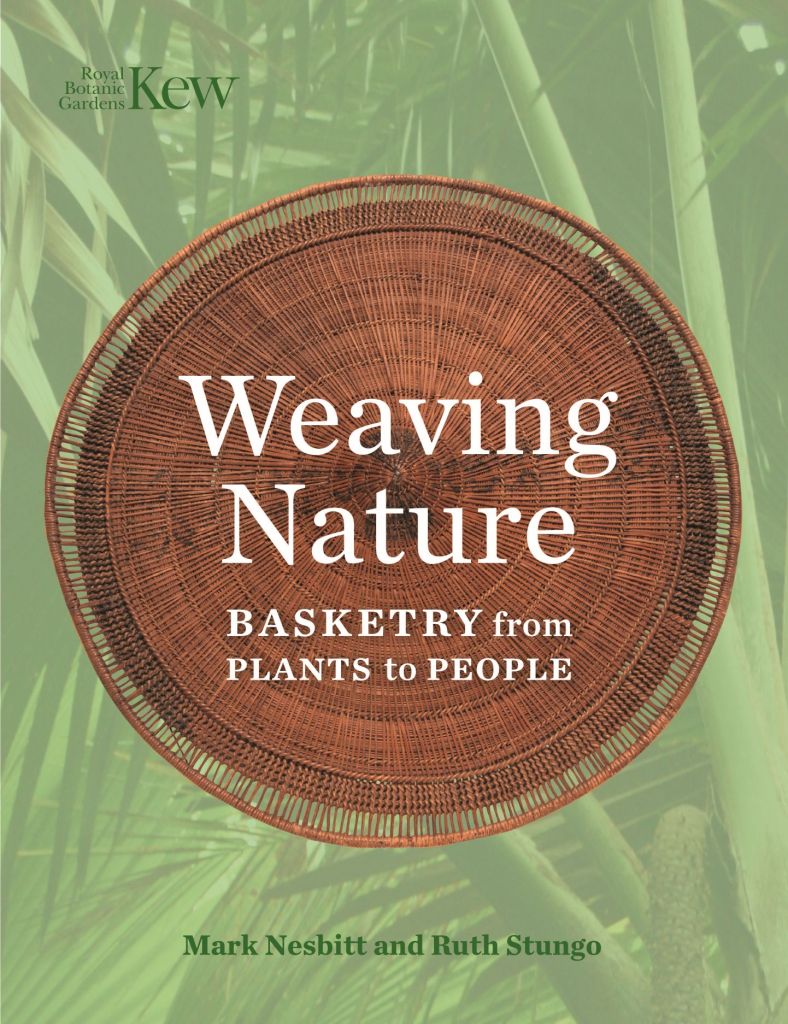
Weaving nature: Basketry from plants to people by Mark Nesbitt & Ruth Stungo, 2026. Kew Publishing.
The title of Mark Nesbitt & Ruth Sturgo’s book – Weaving nature (and that is here appraised) – is sufficiently intriguing to encourage me to want to know more. But, the first word of its sub-title Basketry from plants to people was a little off-putting. Was I really going to be interested in a book devoted to baskets? Fear not! This book isn’t just about baskets [Ed. – and Mr Cuttings’ assumption that it was betrays a lack of understanding of what the word basketry means..].
So, what is basketry?
First things first, let’s address that particular elephant in the room (Candace Osmond). What is basketry?
Conventional dictionary entries for basketry emphasise the basket side of things. For example, “1 : the art or craft of making baskets and other objects by weaving together long thin pieces of material; 2 : baskets and other objects made by basketry” (from here), or “1: basketwork; 2: the art or craft of making baskets or objects woven like baskets” (from here). Which doesn’t really get us much further forward, except to reinforce the basket-oriented nature of the word.
Fortunately, casting our net(!) wider we find these fine definitions: “Basketry—also known as basket weaving or basket making—is the art of shaping flexible materials into three-dimensional forms”; “Basketry is the ancient craft of interlacing flexible materials, such as reeds, willow, grasses, or pine needles, into three-dimensional woven forms”; “the process of weaving or sewing pliable materials into objects, such as baskets, mats, mesh bags or even furniture” (from here); “Basketry is the art of using natural materials such as wicker, roots, straw, cattail, linden bark and bast to weave practical items and decorations”. And, just for good measure, “Basketry is made from a variety of fibrous or pliable materials—anything that will bend and form a shape. Examples include pine, straw, willow (esp. osier), oak, wisteria, forsythia, vines, stems, fur, hide, grasses, thread, and fine wooden splints. There are many applications for basketry, from simple mats to hot air balloon gondolas” (quoted from here). Those definitions are much more helpful (and, dare I say it, provide important context to the book which I don’t notice in my reading of it).
Accordingly, and whilst baskets do get a decent mention, Weaving nature is about a whole lot more than those containers. For example, we find out about such artefacts (Hayden Brown) as a: broom made from from tiger grass, hat from fern rachis, paper-crafted sweat protector, “small knotted cotton purse for carrying coins” (p. 125), rain cloak of western red cedar, and a ceremonial shield made from titica (Heteropsis flexuosa* (Juliana dos Santos Carneiro da Cunha et al., 2022)) (and which amazing object provides the book’s cover picture).
Having given an idea of the subject matter of Weaving nature, let’s provide some specifics.
A book of two halves
Not seeing this information on the publisher’s site for the book, I thought it would be useful to let you know the book’s contents, which are:
Part I, Plants and baskets: Chap. 1, Introduction; Chap. 2, Plants and basketry; Chap. 3, From living plant to raw material; Chap. 4, Making; and Chap. 5, Collecting.
Part II, Using baskets: Chap. 6, Hunting and fishing; Chap. 7 Transport and storage; Chap. 8, Farming; Chap. 9, Household; and Chap. 10, Clothing and personal.
What does the book deliver?
Chapter 1 reminds us that basketry has a very long history. Quite how long is hard to say because of the problems of preserving fragile organic basketry materials in the archaeological record. But, there are ‘negative impressions’ [not a derogatory term, but one that relates to physical marks of basketry materials] in clay in Czechia that date to 26,000 years ago. And, from around 10,000 years ago, well-preserved basketry finds become more frequent in the archaeological record. Which long period has given humanity plenty of time to develop basketry skills and expertise.
In basketry, humans don’t just weave baskets, that is far too mundane a verb to apply to the achievements and craft of the basketeer. Rather, ingenious members of the human race seem more to have woven a spell over some of the most unlikely of plant parts and products and transformed them into objects of great utility, and beauty.
And the range of plants used in basketry (for which purpose, “at least a thousand” plant species are regularly used” (p. 15)) is the subject of Chapter 2, which presents an overview of the plants used for that purpose. Although the vast majority of species are flowering plants (angiosperms), gymnosperms, moss, algae, and at least one fungus are also used in basketry. Whilst details aren’t provided for all 1,000 species, 23 genera/species are considered in some depth in ‘plant profiles’. Approx. half of those are to be found in Chap. 2, the remainder are scattered throughout the rest of the book. Whilst those profiles highlight the plant’s basketry use, they also usually provide information of ethnobotanical relevance.
In Chapter 3 Nesbitt & Stungo “explore the ingenuity of humans in adapting plants for basketry use” (p. 45). They make the important point that some plants have been specifically bred for basketry use, e.g., Salix [willow] species., New Zealand flax, and Mauritius hemp, emphasising human involvement in developing materials best-suited to the purpose. The authors also remind us that some crops for other purposes can also provide basketry materials, e.g., straw from cereals, and twigs from trees, attesting to human imagination in seeing beyond the original utility of those plants. Human ingenuity has also found many ways to vary the colour of basketry materials with eye-pleasing effects. Altogether, the chapter presents a very impressive set of human interventions – over millennia, and wide cultural and geographical area, by many different groups of people – to produce the material that is actually used in basketry.
The range of techniques exploited to effect these wonderful transformations is considered in considerable detail in Chapter 4. Although the general reader doesn’t have to memorise all the fine details of these many magical manipulations, by exposure to this chapter, s/he will gain a better appreciation of what is achieved by the basketeer. In so reading you’ll be introduced to intricate practices with names such as: linking, looping, coiling, twining, interlacing, hexagonal plaiting, fold-and-stitch, and ‘mad-weave’ – “a technique so-described because of how difficult it is to do” (p. 117).
So much for the plants side of the basketry equation, Chapter 5 is all about the collectors. Specifically, those who contributed the 1,000 basketry items in the Kew economic botany collection (and several of which objects are discussed in more detail in Part II of Weaving nature). Who are these collectors? “People from many walks of life [travellers, botanists, civil servants, museum curators, professional collectors and interested amateurs]” (p. 123). As always, the biographies of Victorian collectors make for fascinating reading.
Part II, Using baskets is where the book really comes into its own – from a plants-and-people perspective. The five chapters in this part focus on basketry relevant to various activities: Hunting and fishing; Transport [Ed. – lots of proper baskets here!] and storage; Farming; Household; and Clothing and personal. Whilst the chapter headings give an idea of the uses to which basketry has been put in those categories, the sheer range and variety of actual objects created by the hands of humans is staggering. Any danger of this part of the book reading like a catalogue of objects and uses is avoided by the skilled writing of the authors and the people insights attached to the various artefacts. Part II will also banish any notion that may linger in the reader’s mind that basketry = baskets.
Other material…
Having said something about the main text of the book, it’s appropriate to say a little about the other sections in Weaving nature.
Collection and caring
This short section offers top tips for those who might be interested in collecting basketry and important advice on the information that’s needed to make collected and curated items more useful to scholars. The best bit of advice has to be that “Basketry should not be stored in places where one would hesitate to place beloved books” (p. 328)!
Further reading
All items featured here appear to be books (at least some of which are sources for chapters’ bibliography entries): general books about basketry, plus many others grouped by regions (Africa, America – North, America – South, Asia, Europe, and Pacific & Australia).
Chapter bibliographies
Books and articles, listed by numbered chapter, and often grouped by named artefact within a chapter (which helps to narrow-down one’s search for the source(s) that support particular statements in-text [see Sources?]…).
Bibliography of fungi and plants
This is a list of some books, but mainly articles, for a selection of fungi, seaweeds, and land plants (in alphabetical order of genera for flowering plants, from Adansonia digitata to Tilia) with particular relevance to basketry, and which are mentioned elsewhere in Weaving nature. Sources for (or about) almost all of the 23 ‘profiled plants’ are featured here (sources for Heteropsis are to be found on the missing page 357* [see OOPS!!]), but there doesn’t appear to be a separate list for profiled plant Pandanus).
Bibliography of collectors
Although people from many walks of life have contributed items to Kew’s basketry collection, there is not space to provide biographical details for all of them. But this section lists mainly books about some of the notable collectors amongst that group of individuals (and expeditions…).
Index
The index consists of approx. 12 three-columned pages, from Abacá to Zimbabwe. Whilst entries are principally plants (scientific names and common names), people, and places, there is also a good selection of ‘topics’ as well (e.g., arm basket, cock fighting, insect damage, net, porcupine, quiver, techniques, water carrying…).
Sources?
Even the most cursory glance of the book’s chapters will show you that there are no indications of sources of statements within the text. That revelation would normally prompt my usual comment about need to state sources. However, on this occasion, the authors have anticipated such a criticism by telling us that “For readability, we have chosen not to reference each statement through footnotes. Our bibliography is divided into four parts: further reading by region; by chapter, including literature relating to individual baskets; by plant; and by collector” (p. 5). It’s good to see that sort of statement declared in a book. At least we know why there are no in-text super-scripted figures or such like. Although it still leaves it up to the reader to make the connections between sources – spread over at least three ‘bibliographies’ – to match statements of fact to stated sources, at least we are told that. So, thank you Nesbitt & Stungo, for being up-front (Michael Carter) about this important matter.
OOPS!!
In a book that appears to be otherwise free of errors, there is one rather unfortunate – and major – issue. What should be p. 357 of the Bibliography of fungi and plants is actually repeated text from p. 367 (of the Bibliography of collectors) (!)
Having brought this matter to the publisher’s attention I am assured that this will be corrected in any future printings of the book. However, the problem remains for those copies of the book – such as the one I reviewed – from the current print run. I am therefore pleased to be able to inform owners of the ‘incorrect book’ who would like to obtain a copy of the proper text for p. 357 that they should eMail publishing@kew.org*
Did the book achieve its aim?
In the words of the authors, the book’s central purpose is: “to enable the reader to look beyond the basket, to the complex chain of operations that leads from the management of the plant in its habitat, through harvest and processing into usable elements, to the design and weaving of the final product” (p. 3). In my view, Weaving nature has certainly done that. And that’s because “The two authors bring distinct skills to this project [i.e., the book]: Stungo as a botanist, gardener, and basket maker; Nesbitt as an archaeologist, ethnobotanist and museum curator” (p. 4), and have adhered to their belief “that the stories of plants, makers, users and collectors benefit from being in mutual conversation, leading to a richer story” (p. 4). In meeting its goals, Nesbitt & Stungo have given us a book that is thorough, in-depth, detailed, scholarly, and fascinating. Weaving nature is a tome that is not only very well-written, it is accessibly so. Furthermore, it is abundantly illustrated – usually in colour – and showcases Kew’s rich collection of basketry. Overall, Weaving nature is an excellent marriage of plants and people.
Summary
Weaving nature by Mark Nesbitt & Ruth Stungo has everything you’d expect, want and need in a plants-and-people book – great writing, informative text, impressive scholarship, masses of illustrations, and plenty of ethnobotany (and it’s definitely not just about baskets!).
* If you can’t wait for that, the missing text for page 357 is the following:
“Bibliography of fungi and plants 357
Girardinia diversifolia Himalayan giant nettle
Bangsbo, E. 2014. A stinging textile: Cultivation of nettle fibre in Denmark and Asia. In: Global Textile Encounters, eds Nosch, M.-L., Feng, Z. and Varadarajan, L., pp. 245–54. Oxford: Oxbow Books.
Dunsmore, S. 2006. The nettle in Nepal: Tradition and innovation. Great Bookham: John Dunsmore Nepalese Textile Trust.
Gurung, A., Flanigan, H., Ghimeray, A.K., Bista, R. and Gunrung, O.P. 2012. Traditional knowledge of processing and use of the Himalayan giant nettle (Girardinia diversifolia (Link) Friis) among the Gurungs of Sikles, Nepal. Ethnobotany Research and Applications 10: 167–74.
Subedee, B.R., Chaudhary, R.P., Uprety, Y. and Dorji, T. 2018. Socio-ecological perspectives of Himalayan giant nettle (Girardinia diversifolia (Link) Friis) in Nepal. Journal of Natural Fibers 17: 9–7.
Heteropsis flexuosa Titica
Enrique, O.L.E.A., Gonzales, H., Chavesta, M., Acevedo, M. and Vasquez, J.B. 2018. Caracterización anatómica y fisico mecánica de las fibras de “tamshi” (Heteropsis flexuosa (Kunth) G.S. Bunting) proveniente de echarate-La Convención, Cusco. Folia Amazonica 27: 231–46.
Fadiman, M.G. 2003. Fibers from the forest: Mestizo, Afro-Ecuadorian and Chachi ethnobotany of piquigua (Heteropsis ecuadorensis, Araceae) and mocora (Astrocaryum standleyanum, Arecaceae) in northwestern Ecuador. PhD thesis, University of Texas at Austin.
Ferreira, M. and Gama, M.D. 2005. Ecologia e formas de aproveitamento econômico do cipó-titica (Heteropsis flexuosa (HBK) G.S. Bunting). Embrapa Rondonia-Documentos (INFOTECA-E).
Hoffman, B. 1997. Biology and use of nibbi Heteropsis flexuosa (Araceae : The source of an aerial root fiber product in Guyana. MSc thesis in Biological Sciences, Florida International University.
Pereira, L.A. 2004. Etnoecologia do cipó-titica [Heteropsis flexuosa (H.B.K.) G.S. Bunting] e sua relaçao com os sistemas produtivos do Amapá. MSc thesis, Federal University of Santa Catarina.
Vargas, M.P.B. and van Andel, T. 2005. The use of hemiepiphytes as craft fibres by indigenous communities in the Colombian Amazon. Ethnobotany Research and Applications 3: 243–60.
Wallace, R.H. and Ferreira, E.J.L. 2016. Exploraçao do cipó-titica (Heteropsis flexuosa (HBK) Bunt., Araceae) no Acre: Manejo e potencial de mercado. Etnobotanica e Botanica Economica do Acre, p. 340.
Hydriastele costata Gulubia palm
Petoe, P., Heatubun, C.D. and Baker, W.J. 2018. A monograph of Hydriastele (Areceae, Arecaceae) in New Guinea and Australia. Phytotaxa 370: 1–92”
REFERENCE
Juliana dos Santos Carneiro da Cunha et al., 2022. Titica vine fiber (Heteropsis flexuosa): A hidden Amazon fiber with potential applications as reinforcement in polymer matrix composites. J. Compos. Sci. 6: 251; https://doi.org/10.3390/jcs6090251


Leave a Reply