How flowers made our world: The story of nature’s revolutionaries by David George Haskell, 2026. Torva, an imprint of Transworld Publishers (part of the Penguin Publishing Empire)
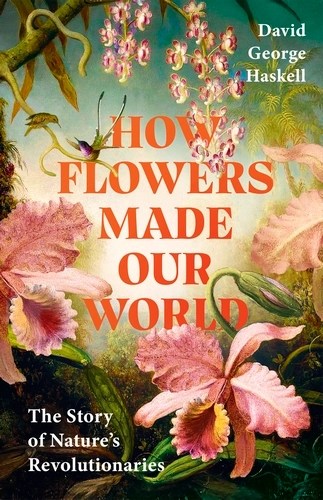
I first became aware of David Haskell when he appeared as a guest on the UK’s BBC Radio 4 episode of Rare Earth, broadcast on 22nd May, 2026. Entitled World of flowers, listeners – including me – learnt quite a lot about “how flowers changed our planet”. In that programme I recall that Haskell came over as being very knowledgeable, articulate, and with an engaging conversational style. [Ed. – that episode might still be available, to listen to on-line, or to download for later listening off-line…] When I also discovered that he had written a book about flowers I was understandably keen to get hold of a copy. Accordingly, this post is my appraisal of How flowers made our world by David George Haskell.
TL;DR (Luca Harsh): How flowers made our world: The story of nature’s revolutionaries by David George Haskell is a really good plants-and-people (-and-planet) book. In this reviewer’s opinion it only needs one small improvement to make it a great book [See And this is how the book can be elevated to greatness…].
How flowers made our world is spread over 257 pages of main text – 8 named chapters, Magnolia, Goatsbeard, Orchid, Grass, Seagrass, Rose, Tea, and Pansy – plus Preface, Speculative futures chapter, and an Afterword. The book concludes with a Bibliography, and an Index.
Haskell’s botanical knowledge and engaging conversational style come over even more strongly in the book. Scholarly accounts of flowers and flowering plants are combined with detailed, carefully-observed nature writing, e.g., flower biology of ‘triple-knot magnolia’, and cranefly orchid biology. And Haskell is not averse to including personal anecdotes, such as recounting his ecstatic response to the aroma of magnolia. Haskell’s writing style is exemplary with plenty of fine phrasing*, quotable statements**, and full of fascinating flowery facts***.
How flowers made our world is a marvellous mix of plant biology, biochemistry, ecology, genetics, evolution, and/or physiology, and plants-and-people relationships, explained in each plant-based chapter centred around the named plant. And the book would not be out of place as recommended reading for an educational course in plant biology. The plant-named chapters are a series of beautifully-crafted, written and delivered essays: This is plants-and-people writing of the highest order. All of which is enhanced by the charming black-and-white illustrations from the pen of prize-winning botanical artist Lucy T Smith (Julia Buckley) that begin and adorn each eponymously-named plant chapter (shown in reverse – ‘white-and-black’ – on the back side of the illustration page)****. Sadly – for a book whose subject matter is so clearly photogenic – no other images are included to illustrate this book.
A note about the book’s title…
Despite its name, How flowers made our world isn’t just about flowers. True, there is a great deal about the biology – and ecology – of flowers (which is full of fascinating insights). But, equally importantly, it’s also about the large group of plants known as flowering plants. Interestingly, although Haskell does use the alternative name angiosperms (but not until p. 19 – after at least 10 previous mentions of flowering plants – and only once throughout the book), he prefers to use flowering plants*****. [Ed. – for those who love this sort of thing (yes, including you, Mr Cuttings), ‘Flowers’ gets 588 mentions, and ‘flower’ 141 (both of which counts will include entries in the Bibliography); ‘flowering plants’ gets 18, and ‘flowering plant’ only 2: ‘Angiosperm’ was found just once in-text (but with several mentions in the Bibliography), and ‘Angiosperms’ was only found in the Bibliography.]
Fear allayed…
With its emphasis on flowers I was concerned that Haskell had ignored the crucial role played by early land-colonising plants such as bryophytes, and honorary plants like lichens in developing soils and substrates in which structurally more complicated plants could root and flourish. Fortunately, that was acknowledged and deftly dealt with quite early on in the book (on p. 9); thereafter it’s the legacy left by those initial habitat-crafters of long ago that has been so comprehensively built upon and dramatically extended and expanded by the flowering plants, plants that quite literally do make and shape so much of the planet that we see around us today.
Plant-named chapters
Each plant-named chapter – as you might expect – discusses the particular eponymous plant, but with a bias towards its relevance to planet and people. In doing so it often considers some quite technical issues. For example in the grass chapter Haskell goes into considerable detail about photosynthesis and the ultimate carbon-fixing enzyme RubisCO, and extends that to talk about C3 and C4 photosynthesis (Katherine Meacham-Hensold). In the chapter on tea, whilst saying a lot about Linnaeus and binomial nomenclature, we are also reminded of the darker side of plants and exploration in mentioning slavery and plantation agriculture of sugar cane and tobacco. How flowers made our world also makes an important point about both Linnaeus and Charles Darwin and their support of racist views.
Accordingly, this book has a lot to say about plants and people. Whilst not all of that will be necessarily pleasant or welcome, it is important that those topics are aired.
A flavour of what the text-based chapters are about…
Preface: although this is a very good scene-setter for the rest of the book, it also stands on its own as a great essay on the importance of flowering plants (the book isn’t just about flowers as such) to the world as we know it today, and to human interactions with our botanical brethren.
Magnolia: Great, detailed, carefully-observed nature writing, especially the flower biology of ‘triple-knot magnolia’.
Goatsbeard: An interesting account of the creation of new species of goatsbeards, and more generally about the role of chromosome duplication events in angiosperm evolution. Also includes a great explanation of natural selection: “most mutations are useless or harmful. Natural selection purges these bad ideas. But natural selection also needs a source of helpful novelties. Duplicating whole genomes vastly increases the supply of genetic variation” (p. 35).
Orchid: A triumph of a chapter! Haskell’s observations of cranefly orchid biology are a real treat.
Grass: The photosynthetically-people-providential Poaceae (featuring RubisCO and photosynthesis in some – but, appropriate, chapter-relevant – detail).
Seagrass: Very insightful regarding seagrass biology and ecology, plus positive news from seagrass restoration and conservation projects. It’s really nice to see this group of plants in the spotlight.
Rose: A stunning – but suitably serious – scentsation of a chapter, much about florals aromas and their interaction with humans and other animals.
Tea: Very good background, etc. to Linnaeus’ sexual classification system and binomial nomenclature, and a reminder of the botanical roots of colonial expansion and empire-building of – mainly – European nations.
Pansy: Lots about the dangers of translocating plants, herbicides and pesticides and disrupting local ecologies, and cut-flower industry. This features an interesting(!) essay on the UK’s Chelsea Flower Show, and includes the book’s only mention of plant blindness by name (on p. 219) (a term that is not in the Index…).
Speculative Futures: Having said much about the past and present status of flowers, flowering plants and the planet, it’s timely that here Haskell offers “sketches of how flowers might continue to remake the world. I look at two very different timescales, first the short term of the next centuries, then a much longer view of tens of millions of years” (p. 225). Also includes an in-depth look at the successfulness of weeds, and provides optimism by considering the peculiarities of Australian soils and flora.
Afterword: On Floral Beauty and Joy: slightly quirky and rather philosophical, but with an important message, “Cultivate flowers and their appreciation in your life. Offer the gift of floral celebration to others. Renewing our connection to life’s creativity and vitality may be flowers’ most world- changing gift of all” (p. 257).
Supplement: Invitations to Play with Flowers: wisely – and presumably deliberately – not called an Appendix because that word calls to my mind the appendix (Susha Cheriyedath), a part of the human body that can be removed without harming the person, i.e., it is dispensable and disposable. This section is not disposable, it’s an important and integral component of the whole book. Here Haskell encourages – urges? – us to “play with flowers”, to get ‘up close and personal’ (very personal where orchid sex is concerned!) with them, the better to appreciate and understand these diverse and important plant parts. And not just flowers as we normally understand the term, but also rice grains (“mature grass flowers” (p. 276)), and fruits (”a fruit is a mature flower” (p. 276)). With a range of activities – which include detailed instructions on how to make flower-scented butter, and rose water by distillation of plant volatiles – this more ‘hands-on’ collection supplements – and complements – the rest of the book well.
Some words about the Index…
Occupying approx. thirteen 2-columned pages, this looks quite comprehensive with entries from ‘abolitionism’ to ‘Zostera marina. See eelgrass’. By way of an insight into the scope of the book, other entries include: Amborella; agriculture; algae; aroma; bacteria; bees; beetles; brain; bumblebees; Burpee seeds; carbon dioxide; chlorophyll; chromosomes; climate crisis; colonialism; Cretaceous-Paleogene extinction event; Darwin, Charles; distillation; DNA (interestingly, an initialism used in-text without spelling out the name in full); Dutch East India Company; endosperm; evolution; extinction crisis; fire; funerary aromas; fungi; gardens; gene duplication; gene mutations; genes and genetics; grazing animals; heat; herbicides; herbivores; human evolution; hummingbirds; indigenous peoples; insects; International Perfume Museum Gardens; jasmine; joy; Kentucky coffeetrees; kinship; legumes; Linnaeus, Carl; lodicule; malaria; manatees; mangroves; mimicry; monocultures; neonicotinoids; nitrogen; olfactory receptors; opium; orchids; oxygen; oxygen revolution (curiously, Haskell doesn’t use what I consider to be the more familiar term GOE, Great Oxygenation/Oxidation Event, but his choice fits in much better with the book’s sub-title, The story of nature’s revolutionaries…); pistils; pollution; rubisco; salt marshes; seagrass meadows; seeds; sexual deception; sexuality; smell receptors; soil; stamens; stigmas; sunflowers; tea; unisexuality; violets; volatiles; wasps; weeds; wheat; woodpeckers; Xerces Society, yellow pea flowers, and zebras and grasses.
How flowers made our world is a very wide-ranging text, as befits all the ways in which flowers/flowering plants impact upon people and the planet.
… and the Bibliography
Alarm bells usually ring in my head when I see this word. Why? Because a bibliography usually indicates articles, etc. that have been consulted by the author in researching and writing the book but which are not necessarily cited as specific sources of evidence that support factual statements made in the book [e.g., “A bibliography lists of all the sources used or consulted during the research process, whether cited directly or not”].
Reading that “The stories in this book draw on the published work of thousands of scientists, horticulturalists, and other flower experts. This literature is an extraordinary intellectual ecosystem, a manifestation of human curiosity, wise attention to other species, and care for the world. My book highlights just a few parts of this web of knowledge and work, and I hope that readers will also explore, learn from, and contribute to the richness of this network” (p. 283), reinforced my initial view of what the Bibliography here is doing******.
So, what do you get? The Bibliography is an impressive list of items – primarily scientific articles, but also web sites (although without dates of access by Haskell), and a patent (registration of the Burner Bob trademark*******) – that deal with subjects that will be familiar to the reader because they have already been mentioned by the author in-text.
But, although publications listed are grouped under chapters, there is no direct link between any item in the Bibliography and specific fact(s) in the text********. In other words, none of the items in the Bibliography are specifically cited in the text [which, again, underlines the distinction between a bibliography and a reference list].
On only two occasions did I find it relatively straightforward to make that link, because of clues in Haskell’s wording. First, “In a scientific paper in 1950, Ownbey explained” (p. 27), which presumably relates to the listed publication, “Ownbey, Marion. “Natural Hybridization and Amphiploidy in the Genus Tragopogon.” American Journal of Botany 37, no. 7 (1950): 487– 499” on p. 288. Second, “As paleobotanist C. Kevin Boyce and his colleagues put it in a scientific paper, flowering plants “put the rain in the rainforests”” (p. 43), which appears to match with “Boyce, C. Kevin, Jung- Eun Lee, Taylor S. Feild, Tim J. Brodribb, and Maciej A. Zwieniecki. “Angiosperms Helped Put the Rain in the Rainforests: The Impact of Plant Physiological Evolution on Tropical Biodiversity.” Annals of the Missouri Botanical Garden 97, no. 4 (2010): 527– 540” (on p. 287).
On the plus side, approx. 285 of the sources stated are from publications dated post-2015, which makes for a book that is based upon very up-to-date publications.
And this is how the book can be elevated to greatness…
To match all listed publications in the Bibliography to relevant text would not only be a very onerous job for the reader, it is also – arguably – an unnecessary one. And that’s a pity. Having done an otherwise exemplary job in writing about plants and their science in a comprehensible way, it would have been helpful if Haskell ‘joined up the dots’ for the readers, and made those connections explicit.
Summary
How flowers made our world by David George Haskell is a great read. It’s beautifully written and communicates quite technical scientific concepts in an accessible and understandable way. If you want to be (re)assured of the importance of flowering plants [it’s not just ‘flowers’] to the planet – and people – this is the book you must read. There’s no need to wait until Christmas to get a copy!
* This book is awash with many examples of fine phrasing (some of which are also eminently quotable…). A few – of my favourites – to whet your appetite are: “By daubing their fruits or seeds in red pigment, plants tapped into this preexisting visual enthusiasm” (p. 21); “Like the Jets and the Sharks in West Side Story, this juxtaposition of immigrant communities [of goatsbeards] led to a remarkable love story” (p. 26); “Plants use sunshine to daisy-chain carbon dioxide into sugars” (p. 41); “meristems. These are botanical fountains of eternal youth” (p. 77); and “In modern terms, Linnaeus was a master of database management” (p. 164).
** Haskell’s book is memorably quotable – each of which would make a great starting point for an essay about plants (or a class discussion about plants-and-people in an educational setting). Some examples: “Yellow goatsbeard is a badass dandelion” (p. 25); “Human evolution, it turns out, partly hinges on grass physiology, a strange and consequential convergence of the storylines of plant and primate” (p. 95); “By seizing land and enslaving people, colonists gained the plants, land, and labor they needed to grow profitable flowering plants: cotton, sugarcane, tea, opium, indigo, coffee, cinchona, and dozens more. In colonial hands, “flower power” was a foundation for the horrors of empire” (p. 163); and “at any given latitude, one continent looks much like another, largely because of weeds” (p. 227).
*** Apart from the plethora of facts in-text requiring explicit sources, How flowers made our world is also replete with many facts that were new to me (and which also require to be sourced…). For example: “Bees evolved from wasps 120 million years … “Butterflies evolved from moths about one hundred million years ago” (p. 8); “Goatsbeard also goes by the name oyster plant, for the taste of the cooked root” (p. 26); “A few orchid species mimic flowers of unrelated species” (p. 61); “The saffron “threads” that we use in cooking are anther mimics” (p. 62); “seagrasses are one of the Earth’s most effective “bioengineers”” (p. 107); “Today, sea turtles so love seagrass that scientists can use them to find previously undocumented meadows” (p. 111); “The aromas of some, like figs, have toxic effects and can no longer be legally used in perfumes” (p. 133); the number of jasmine flowers picked for the perfume industry in Grasse (France), and the fact that they are used to make “parfum de mal au dos, the “backache perfume”” (p. 137); “Male bees woo females using scents that they’ve gathered from flowers” (p. 145); the identity of the world’s real ‘oldest profession’; the names of Charles Darwin’s “two gods”; the identity of the plant which it was Linnaeus’ “lifelong quest to smuggle … from China to Sweden” (p. 174); the notion of maslin cereal agriculture (Liz Susman Karp; Susan Kelley; Gemma Tarlach); the nature of Linnaeus’ claim to Dutch horticultural fame; the botanical subject matter of which “seemingly obscure academic text directly seeded French colonialism” (p. 179); and that Linnaeus’ work provided “intellectual justification for racist methods of production, including enslavement” (p. 179).
**** Lucy T Smith (“Australian botanical artist and illustrator, resident for the past twenty-four years in the UK. Since 1999, she has worked as a freelance botanical artist for the Royal Botanic Gardens, Kew” is not to be confused with other illustrators called Lucy Smith, e.g., “experienced former school teacher and psychology graduate” Lucy Smith, and “Tasmanian freelance illustrator, animal lover and full time tea drinker” Lucy C Smith…
***** This avoidance of more technical names is also evident when he talks about stomata – because he never mentions that word. Instead, he prefers to use the term ‘breathing pores’. However, as more user-friendly as it may be, it’s not as accurate it could be. Plants don’t really breathe through those pores. And, if they did, it is more usual to think of such a structure that allows oxygen in to the body and permits escape of carbon dioxide. Which is about as opposite as you can get for plant structures intimately involved with photosynthesis (CO2 in, O2 out…). Plus, the misnaming is compounded by Haskell’s statement that, “when they [the lips of the breathing pores] part, air and water vapor flows to the interior” (p. 96). One of the facts widely-known about stomata is that they are a portal through which water vapour escapes from the plant.
****** Strongly supporting the view that the book’s Bibliography is not a list of references actually used, but is more a collection of additional reading, is the seemingly ‘source overloaded’ situation in the Supplement. In that part of the book there are two paragraphs that deal with flowers and electrical fields (pp. 281 & 282). In the Supplements’ Bibliography, of the 13 items listed, 10 are to publications about the broad topic of ‘electric fields’…
******* Having seen the United States Patent and Trademark Office entry re Burner Bob in the Bibliography, I searched the text and found mention of this logo in-text (pp. 80-81). Burner Bob is a bobwhite quail, “a pro-burning mascot of grassland restoration in the southeastern United States” (p. 81), “a new campaign meant to replace Smokey Bear [the US Forest Service’s anti-fire mascot]” (p. 80).
******** Almost every page of How flowers made our world has a statement that needs a source. For some, those sources may be present in the Bibliography, but tracking them down and matching source to statement is no easy job. Matching sources to statement can only enhance the scholarship that has gone onto the book, and – importantly – provides the evidence base that critical and sceptical readers should rightly expect.
Some examples of ‘stated facts that require explicit matching with a source’ include: “Studies of DNA suggest that flowers evolved before this, sometime between 150 million and 250 million years ago” (p. 3); “In some other species of magnolia, though, the fertile flower warms above the ambient temperature by up to 10 degrees Celsius (18 Fahrenheit), especially when pollen is shed” (p. 16); “Stress makes plants mutate. Extreme heat, sudden freezes, and other environmental hardships wound the genome” (p. 39); “Across all flowering plants, about a quarter of splits in the family tree are associated with switched pollinators” (p. 68); “Today, livestock outweigh all wild mammals on Earth combined by nearly thirty times” (p. 79); and “Today, although C4 plants represent fewer than 2 percent of plant species, they do 25 percent of all photosynthesis on land” (p. 98).


Leave a Reply