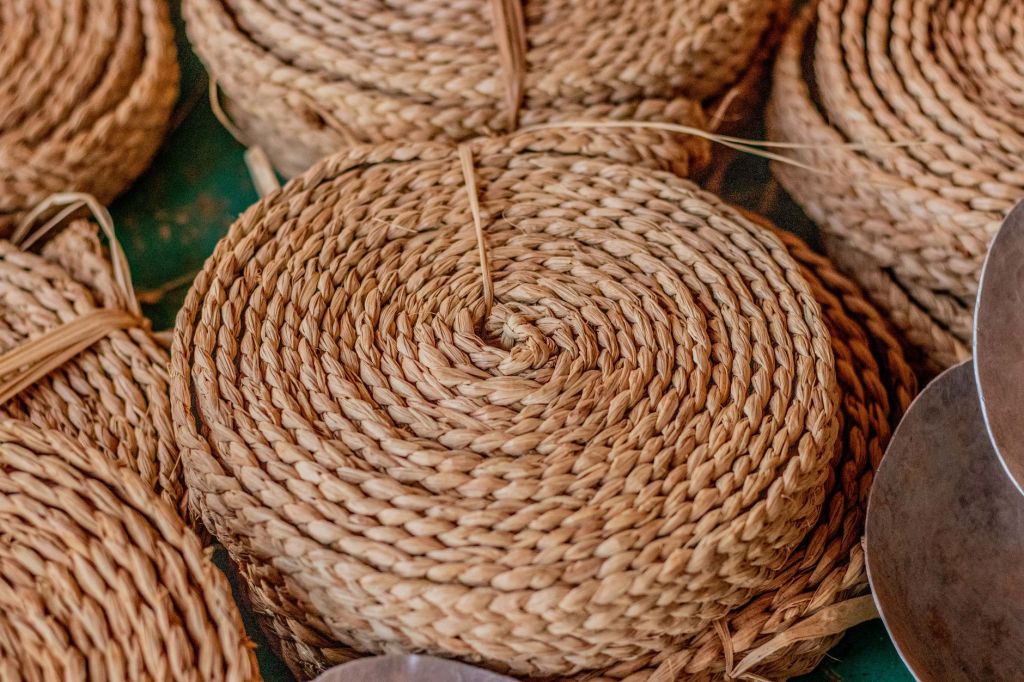
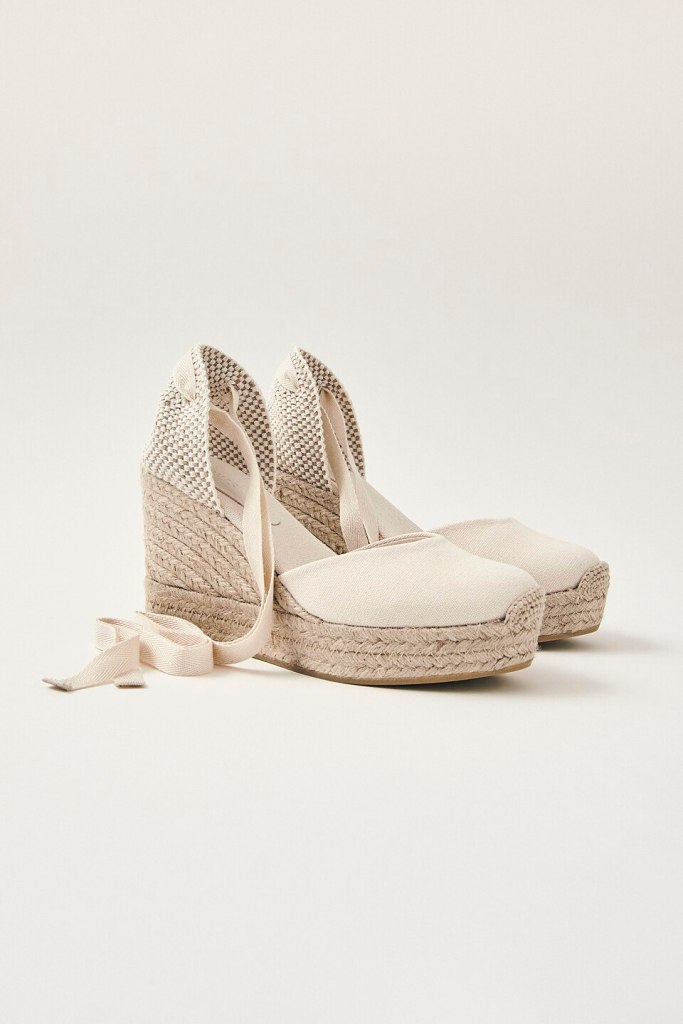
This image of a pair of espadrilles by Aholas Spa is used under the Creative Commons Attribution 4.0 International license.
Sometimes the mutest of things can be the most vocal witnesses to times long gone*. Take, for example, shoes [Ed. – yes, I do realise some wag may take issue with that statement because shoes aren’t necessarily mute since some of them have a tongue (Oliver Sweeney)…]. An excellent example of this is the work of Macarena Bustamante-Álvarez et al. (2026).
Working in the remains of the Iron Age (Julian Richards) mining site known in ancient times as Urium** in modern-day Spain’s RioTinto region, Bustamante-Álvarez et al. (2026) report on their examination of “eight soles of plant-based footwear”.
So much – but little more – one can glean from the report’s abstract. For more information, since the full paper is in Spanish*** and my knowledge of that language is inadequate to the task of reading the original, my post relies almost solely on the English language interpretation of that work produced by Guillermo Carvajal in his scicomm article about the study.
In essence, what Bustamante-Álvarez et al. (2026) found is ancient sandals, the oldest examples of which were radiocarbon-dated to between 2,000 and 2,400 years old****. These sandals are made of esparto grass (identified in the paper as Stipa tenacissima (Jose Fajardo et al., 2015)), “a fiber of notable resistance and flexibility that grows abundantly in the southwestern peninsula” (Guillermo Carvajal).
Because other examples of the footwear at the same site were dated to the 1st century AD, it is inferred that the sandals’ utility was such that the same design was used essentially unchanged for over 400 years. Which is a remarkable testament to the craftmanship of those ancient shoe-makers. Further examination of the items revealed that their production “followed precise planning: the thicker and more homogeneous ropes were used in the areas of the sole that bore the greatest stress during walking, while the finer fibers were reserved for the straps and binding elements. This differential distribution of thicknesses is not accidental but indicates skilled artisanal production and advanced knowledge of esparto’s behavior under friction and weight, systematically applied by the makers to extend the useful life of the footwear in an environment as harsh as a mine” (Guillermo Carvajal).
All of this analysis was only possible because of the peculiarities of the site-specific physical conditions of preservation of the plant-based artefacts. Normally such organic material does not last long in the archaeological record (Shelby Brown), but burial beneath a pile of ash in this instance permitted their survival. These particular dead men’s shoes [Ed. – and here I’m assuming they belonged to men rather than women because of the working environment from which they were excavated] speak eloquently of many things and “highlights the importance that the exploitation of plant fibers and their transformation into everyday products had within ancient craftsmanship, a field of the domestic economy that written sources usually address tangentially and that the archaeological record, due to the fragility of its materials, rarely manages to document with such clarity” (Guillermo Carvajal).
For more on this story, see Gary Manners, Ella Spitz, Andrew Paul, here, here, Kambiz Kamrani, and – most certainly! – Guillermo Carvajal (the scicomm item that initiated my interest in this story).
[Ed. – by way of bringing this millennia-old ethnobotanical story up to-date in the 21st century, and whilst it’s good to know that esparto is still used in crafting artefacts in Spain (e.g., Jose Fajardo et al., 2015; José Antonio González & Francisco Amich, 2015), Stipa tenacissima is also being investigated as a “promising source of bioactive compounds with antioxidant and anticancer potentials” (Mehdi El Bouchti et al., 2021).]
* For those who appreciate a bit of myth-busting, this use of human-associated objects to discern information about past lives, etc. helps to give the lie to those who promote the proverb (Kassiani Nikolopoulou) that “dead men tell no tales”. The patent falsehood of which statement is convincingly – and regularly and repeatedly – demonstrated by any ‘police procedural’ programme featuring forensic science and/or post mortem examinations. Dead bodies – and their associated artefacts – tell us lots about the person, their life and times (provided they are appropriately preserved).
** For a bit of etymological diversion, the mining connection of the ancient Latin name of the excavation site, Urium (Bustamante-Álvarez et al., 2026), is honoured in mineralogy, where ‘urium’ is the name given to “The earth that envelops the ore” (quoted from here). Historically, the word is specifically referenced in an English translation of the works of Pliny the Elder (Kenneth F Kitchell Jr, 2024) in his account of gold-mining in Hispania: “earthy sediment of this kind is called urium” (Ioan-Lucian Bolunduț, 2024). [Ed. – which surely begs the question, which was named first? The place or the earthy sediment..?]
Urium is the specific epithet for an acidophilic green alga (Stephen S Daggett, 2019), Chlamydomonas urium, isolated from the Río Tinto – ‘red river’ – in the region (María Esther Pérez-Pérez et al., 2024), “since urium was the original name of Río Tinto coined by the Romans”. [Ed. – the origins of Rio Tinto, a global metals and mining business, “lie in our namesake, the Rio Tinto or red river mines in Huelva, a region in southern Spain”].
And, “Urium in the Assamese language is the name of a plant identified with Bischofia javanica Blume”. In English, Bischofia javanica, “A Potent Medicinal Plant” (Minakshee Sarmah, 2023), is known as bishop wood.
Nowadays – certainly amongst those discerning individuals in the know [Ed. – or ‘nose’..?] – the name is most notably associated with Spain’s sherry-producing winery of Bodegas Urium (Ruben Luyten).
*** This is an interesting case where a scientific discovery is primarily published in a non-English language. [Ed. – ‘Interesting’ to Englishman Mr Cuttings perhaps, but I’m sure there will be hundreds – if not thousands – of other examples of non-English language publications throughout the world. To express surprise at this shows a very English-centric – and frankly rather arrogant, entitled, and privileged – view of the world, Mr Cuttings] For decades now it appears – and has been assumed – that English (“the most successful lingua franca the world has ever seen”) is the lingua franca (Richard Nordquist, 2020; Gordon Allen-Young, 2022; Alexandra Aikhenvald, 2026) of science (Raoul Kamadjeu, 2019; Robert Sanders, 2020; Briony Fane & Juergen Wastl). [Ed. – whether that should be the case, and whether it is good for humanity and science, is a moot point (Christine Tardy, 2004; Rogerio Meneghini & Abel L Packer, 2007; Robert Sanders, 2020; Briony Fane & Juergen Wastl)…].
Back in the day (from Ancient times until the 19th century (Alexandra Aikhenvald, 2026), it would have been Latin, the literary and spoken language of the learned (Barry Wood, 2019). A reminder of that linguistic heritage is seen today in the Latinisation of scientific binomial names of species (Ronald Coleman) (such as Chlamydomonas urium**), and the plethora of scientific and medical terms that have been derived from Latin (e.g., here, here, Andrew Dunning, Rebecca Ramdeholl; Yuliia Lysanets & Olena Bieliaieva, 2018).
**** Even with an approximate age of up to 2,400 years, these miners’ sandals are not the oldest items of footwear found in Europe. The record – to date – goes to “22 pairs of woven grass sandals discovered in the cave [Spain’s Cueva de los Murciélagos (“cave of bats”)] are some 6,200 years old — and thus the oldest shoes ever found in Europe” (Kaleena Fraga). Interestingly, these artefacts were also fashioned from esparto grass (Stipa tenacissima) (Francisco Martínez-Sevilla et al., 2023). It is therefore likely that use of this material for footwear is an unbroken practice from 21st century espadrilles (Heidi) to the 5th millennium BCE’s ‘bat cave sandals’.
With that long background and tradition, it’s little surprise to learn that the country’s ‘culture of esparto’ is one of the elements designated as a “Representative Manifestation of Intangible Cultural Heritage” (MRPCI) by Spain’s Ministry of Culture (which manages that nation’s “General Inventory of Intangible Cultural Heritage”) (more here, here, and here).
And, demonstrating some of the utility of esparto***** – i.e., it’s not used solely in footwear, there is evidence of its participation in the production of textiles. This evidence comes from presence of ropes made from esparto that were part of a wooden loom (Jason Crawford) for weaving cloth preserved by fire 3,500 years ago. No space for more on that story here, but see the interpretative article by Guillermo Carvajal, and the original scientific paper by Ricardo Basso et al. (2026).
***** Extending the utility of esparto, some of the other articles made from it include: “cord, for tying things and for weaving different types of basket, aguaderas or aguandangas (a vessel for supporting cántaros, i.e. 16-L round bottomed vessels), protection for jugs, demijhons [sic.] and bottles, and moulds for making cheese” (González & Amich, 2015); basket, beehive, belt, cheese mould, contraceptive (for sheep!), ferret basket, fishing net, hat, long rug, saddle, shepherd’s spoon, snail basket, stool, and muzzle (for mules) (Fajardo et al., 2015)…
REFERENCES
Ricardo E Basso et al., 2026. Evidence of a warp-weighted loom in the Bronze Age settlement of Cabezo Redondo (south-east Spain). Antiquity 100(411): 636-653; doi:10.15184/aqy.2026.10312
Ioan-Lucian Bolunduț, 2024. History of gold in antiquity. Mining Revue 30(1): 48-57; https://doi.org/10.2478/minrv-2024-0005
Mehdi El Bouchti et al., 2021. Stipa tenacissima L.: A new promising source of bioactive compounds with antioxidant and anticancer potentials. Life 11: 757; https://doi.org/10.3390/life11080757
Macarena Bustamante-Álvarez et al., 2026. Nuevos ejemplares de calzado en esparto en contexto minero. Excavaciones del sector “Nuevo Filón Norte 1” en Urium (Riotinto, Huelva). Pyrenae 57(2): 79-112; doi: 10.1344/Pyrenae2026.vol57num2.4
Jose Fajardo et al., 2015. Traditional craft techniques of esparto grass (Stipa tenacissima L.) in Spain. Econ Bot 69: 370–376; https://doi.org/10.1007/s12231-015-9323-x
José Antonio González & Francisco Amich, 2015. Plants traditionally used for industrial and artisanal purposes in the Arribes Del Duero (Spain). Anales Del Jardin Botanico De Madrid 72(2): e025–e025; doi:10.3989/AJBM.2335
Raoul Kamadjeu, 2019. English: the lingua franca of scientific research. The Lancet Global Health, 7e1174; https://doi.org/10.1016/S2214-109X(19)30258-X
Yuliia V Lysanets & Olena M Bieliaieva, 2018. The use of Latin terminology in medical case reports: quantitative, structural, and thematic analysis. J Med Case Rep. 12(1): 45; doi: 10.1186/s13256-018-1562-x
Francisco Martínez-Sevilla et al., 2023. The earliest basketry in southern Europe: Hunter-gatherer and farmer plant-based technology in Cueva de los Murciélagos (Albuñol). Science Advances 9(39): eadi3055(2023); doi: 10.1126/sciadv.adi3055
Rogerio Meneghini & Abel L Packer, 2007. Is there science beyond English? Initiatives to increase the quality and visibility of non-English publications might help to break down language barriers in scientific communication. EMBO Rep. 8(2): 112-116; doi: 10.1038/sj.embor.7400906
María Esther Pérez-Pérez et al., 2024. Lipid turnover through lipophagy in the newly identified extremophilic green microalga Chlamydomonas urium. New Phytologist 243(1): 284-298; https://doi.org/10.1111/nph.19811
Minakshee Sarmah, 2023. Bischofia Javanica [sic.]: A potent medicinal plant. International Journal of Biomed Research 2(5): doi: 10.31579/2834-5029/030
Christine Tardy, 2004. The role of English in scientific communication: lingua franca or Tyrannosaurus rex? Journal of English for Academic Purposes 3(3): 247-269; https://doi.org/10.1016/j.jeap.2003.10.001
Barry Wood, 2019. Latinus Scientificus: The history and culture of scientific Latin. Journal of Big History 3(2): 33-46; http://dx.doi.org/10.22339/jbh.v3i2.3230


Leave a Reply