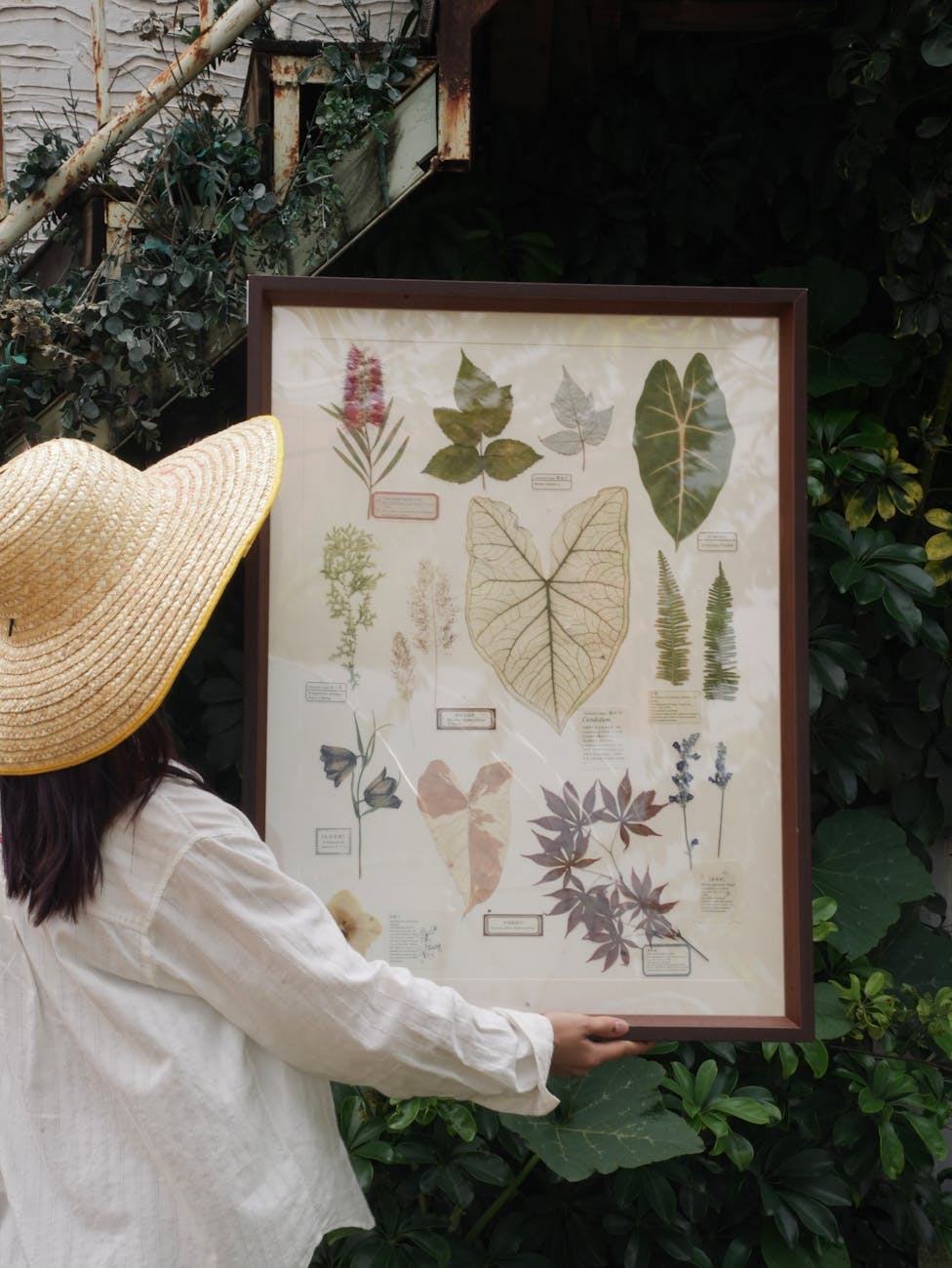
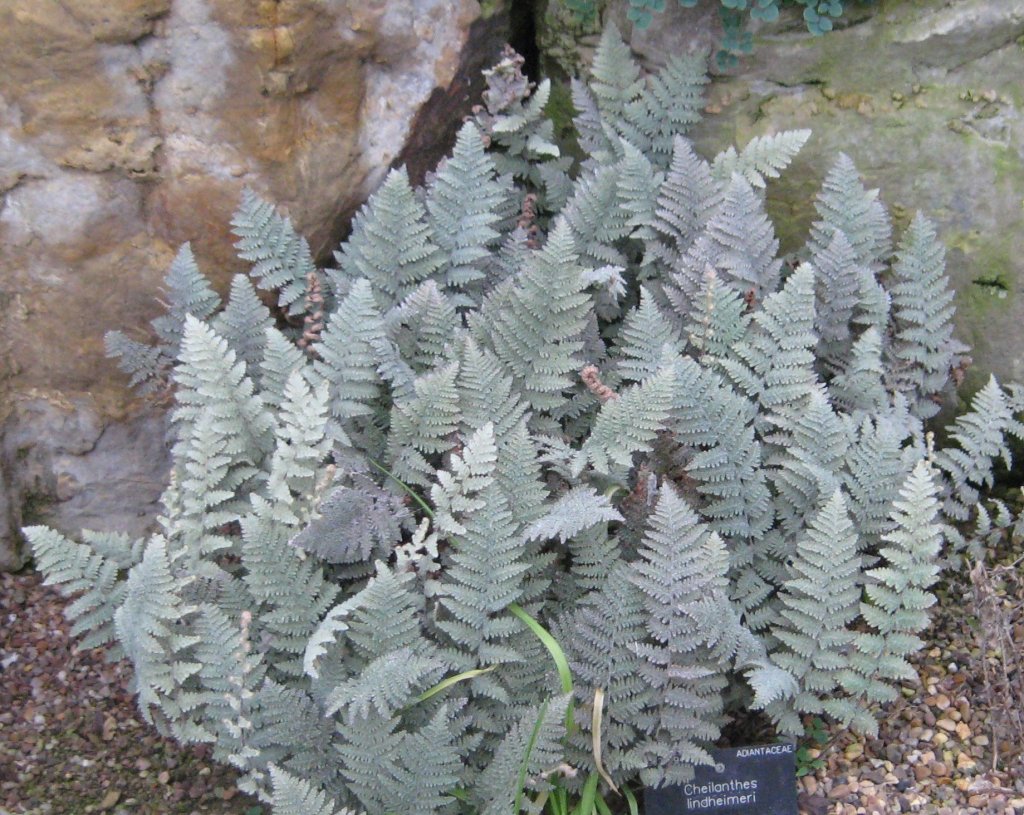
The fern Cheilanthes lindheimeri. Several species of the genus Cheilanthes have been reassigned to the newly-created genus Gaga, named in honour of celebrity chanteuse and entertainer Lady Gaga (Fay-Wei Li et al., 2012).
In considering the botanical bounty that is the food value of plants in the previous post we considered their capacity to sustain people and encourage development of agriculture and settled societies. Where people are well-fed and not having to spend hours in a daily foraging for food there is potential for a more creative side to mankind to develop and even flourish. That more artistic side of humanity – which is another consequence of plant productivity – is touched upon in this section.
[Ed. – this section is very much a work-in-progress…]
The cultural side of plants
This aspect of the influence of plants on humanity is a rather large and eclectic area. Indeed, just a search for ‘Plants in Art’ on Wikipedia turns up plenty of subcategories, including such topics as: Plants in art by artist; Plants in art by medium; Plants in art by plant; Plantae on stamps. And, within the sub-category Plants in art by subject, we have such collections as: Fruit in art by subject; Plants in art of France by subject; Anthropomorphic plants; Fictional plants; Plants forming letters or numerals; Silhouettes of plants; Talking plants; and Weed control in art. Clearly, it is not possible to cover all aspects here. Rather, I’ve included a few of the major topics which I hope convey some of the involvement of plants and plant-themes in areas of culture that have enriched our lives.
After having read this short review – and you still crave more of this sort of thing – some of the best examples of the influence of plants in the lives of people are titles in Reaktion Books’ Botanical series, “the first of its kind, integrating horticultural and botanical writing with a broader account of the cultural and social impact of trees, plants and flowers”. To give you an idea of what they cover, several books in that series have been reviewed by Mr P Cuttings in the PlantCuttings blog (e.g., Dan Torre’s Orchid), and prior to that on the BotanyOne site (e.g., Dan Torre’s Carnivorous Plants, Chrysanthemum by Twigs Way, and Oliver Southall’s Rowan). [Ed. – and, proving that it’s not just seed plants covered in that series, let’s not ignore the so-called ‘lower plants’ of mosses and – equally cryptogamic – lichens in Elizabeth Lawson’s Moss and Lichen]
For a consideration of the cultural significance of plants en masse – in gardens – see The green fuse: Essays in making sense of gardens by Peter Dale.
Poetry
Plants have appeared in poems and featured in poetry for hundreds of years. Take for example Metamorphoses (in English translation by AS Kline, 2000) by Ancient Roman poet Ovid (Edward John Kenney). Amongst the many myths covered by Metamorphoses, “a Latin narrative poem from 8 CE”, the poet tells the tale of the creation of the hyacinth (Bk X:143-219 (AS Kline, 2000). Briefly, the plant is essentially the ‘reincarnation’ of a young man, Hyacinthus, who was accidentally killed by a discus thrown by the god Apollo (Howard Oakley, 2017).
Probably, one of the most well-known plants-in-poems in the English language features the daffodil (Jenny Laville), in William Wordsworth’s ‘Daffodils’. Although its proper name is I wandered lonely as a cloud, it is an account in verse of the poet’s response to, and thoughts and feelings about, seeing a clump of this monocot bulb in flower in the Lake District region of the UK in the very early part of the 19th century. Whilst I believe that the person best placed to tell us what a poem is about is the poem’s author, for those who’d like to read the interpretations of others, see Oliver Tearle, Norman E Rosenthal, and here. [Ed. – although I’ve often felt that dissecting a poem in detail tends to ruin it, rather like teasing apart a flower to examine its component parts ruins the flower itself…]
At the other end of the plant-admiration-in-verse spectrum we have The loves of plants by natural philosopher, physiologist, abolitionist, inventor, freemason, and poet Erasmus Darwin (Thomas E Hart; Nettie Farris, 2023), published near the end of the 18th century. [Ed. – in case you’re wondering, yes, he is grandfather to Charles Darwin (Patricia Fara, 2012; 2026)]
[Ed. – a readable and searchable version of Erasmus Darwin’s tome edited by Tristanne Connolly et al. (2025) and with extensive interpretative notes, etc. is available here]
If Wordsworth wrote about plants (well, daffodils at least) in a rather romantic way [Ed. – he was one of the so-called Romantic Poets (Daniel David Wallace; David Barratt, 2022) after all…], Darwin very much ‘told us like it is’.
In its time The loves of plants was somewhat controversial (Jenny Uglow, 2002) because its verses were sexually charged – even if they were phrased in ways that may be considered quaint and somewhat impenetrable to a 21st century audience. But, why all the fuss? After all, this so-called ‘scientific poetry’ (Geoffrey Scott, 1982) was just Darwin’s attempt to explain scientific matters to a non-science-specialist audience. And, all that it did was to put into verse the sexual system for classification of plants devised by Linnaeus. Well, it certainly did that. But the problem revolves around the way in which the various categories of plants were described.
Some context is appropriate – and needed – at this point.
Linnaeus’ classification system for plants largely relied upon the numbers and arrangements of male [stamens (Melissa Petruzzello)] and female [pistils] floral parts within a flower to determine to which category a plant should be assigned. In describing each of the 24 classes (which were sub-divided further into ‘orders’) that he recognised, Linnaeus used Latin phrases – because that was the language of the learned person in Europe in the late 18th century when Systema Naturae, the publication that introduced this system to the world, was published.
Although it somewhat anthropomorphised the botanical structures involved – for example, “Mariti sex in eodem conjugio” translates to “six husbands in the same marriage” (for floral class ‘hexandria’), and, “Mariti cum genitalibus foedus conftituerunt” , which in English is “the husbands form an alliance with the genitals” (for class ‘syngenesia’) – its sexualised nature is something that would probably have been unknown to the great majority of the non-botanical, non-Latinate public. But, Darwin wrote in English. As something of a taste of what was to come for his readers, his introduction to the poem contains a summary table listing the 24 plant classes – per Linnaeus’ classification – but with English descriptions (e.g., see image thereof in the fascinating blog post about the poem and Dr Darwin by David Marsh (2024)). [Ed. – this table is also reproduced in the article by Janet Browne (1989) that examines Darwin’s Loves of plants in forensic detail.]
As bold and ‘in your face’ as that is, the poetic Dr Darwin expands upon all of this by writing about flowering plants that illustrate the arrangement of stamens and pistils for each class. And – for good measure – the angiospermous anthropomorphism is further embellished by reference to many mythological gods and goddesses (as would probably be understood by his educated readership of the time, but is probably lost on most of a 21st century audience). So much for text about context, etc., what about some of Darwin’s own words?
This following passage is written about Adonis annua. Known as pheasant’s eye in English, this flowering plant is in the Linnean class XIII Polyandria (flowers with many stamens), order Polygynia (numerous pistils as well), and is the last plant featured in Darwin’s poem.
From The loves of plants
“A hundred virgins join a hundred swains,
And fond Adonis leads the sprightly trains;
Pair after pair, along his sacred groves
To Hymen’s fane the bright procession moves;
Each smiling youth a myrtle garland shades,
And wreaths of roses veil the blushing maids;
Light Joys on twinkling feet attend the throng,
Weave the gay dance, or raise the frolic song;
—Thick, as they pass, exulting Cupids fling
Promiscuous arrows from the sounding string;
On wings of gossamer soft Whispers fly,
And the sly Glance steals side-long from the eye.
—As round his shrine the gaudy circles bow,
And seal with muttering lips the faithless vow,
Licentious Hymen joins their mingled hands,
And loosely twines the meretricious bands.—”
They (probably) don’t write ‘em like that any more…
[Ed. – Darwin “devoted much of his energy to communicating his knowledge to the wider public”, and “Darwin’s scientific poetry was the popular science of its day, and one might compare him to contemporary science communicators, such as Carl Sagan, James Burke, Bill Nye, or Neil deGrasse Tyson, in terms of his effect on the popular interest and understanding of science” (Mark Sundaram)]
[Ed. – amongst his other many achievements, Erasmus Darwin is credited with coining many of the English – ‘common’ – names of plants used today (Patricia Fara, 2026). This is perhaps a little ironic since he spent many years translating the works of Linnaeus (Penny Sarchet) (notable botanical binomial nomenclaturist, who gave us unique, unambiguous scientific names of many plants (and other organisms) so we should no longer be confused by uncertainties of identification occasioned by use of common names) from Latin into English…]
And we couldn’t conclude this section without mention of what is surely the ultimate plants-in-poetry combination, this work by American poet Berton Braley. Simply entitled Botany (Kristina Bauer) it deserves to be included here in its entirety:
Botany
“There should be no monotony
In studying your botany;
It helps to train
And spur the brain–
Unless you haven’t gotany.
It teaches you, does Botany,
To know the plants and spotany,
And learn just why
They live or die–
In case you plant or potany.
You learn, from reading Botany,
Of wooly plants and cottony
That grow on earth,
And what they’re worth,
And why some spots have notany.
You sketch the plants in Botany,
You learn to chart and plotany
Like corn or oats–
You jot down notes,
If you know how to jotany.
Your time, if you’ll allotany,
Will teach you how and what any
Old plant or tree
Can do or be–
And that’s the use of Botany!”
[Ed. – for more ‘Poetry of Botanical Foolishness’, see Sarah Gage, and the fabulously quirky Atlas of Poetic Botany by Francis Hallé with Éliane Patriarca]
Art
Plants have made a big name for themselves in art. Not least because paintings such as van Gogh’s ‘Sunflowers’ and ‘Irises’ have sold for enormous sums of money – US$39.9 million (Francis X Clines, 1987), US$53.9 million (Michael Kimmelman, 1990), respectively.
Occasionally forming the main focus of the artwork, more often plants are part of the background, helping to embellish the subject, imbuing it with additional meaning and significance. For most of us those meanings are probably long-lost and it is only with experts to guide us that we can begin to appreciate the oft-hidden symbolism that exists and discern the subtle meanings of the artist; e.g., the plant symbolism in the famous ‘Unicorn Tapestries’ analysed by Eleanor C Marquand (1938); Edward J Alexander & Carol H Woodward (1941); and Jules Janick and Anna Whipkey (2014).
Whilst van Gogh’s flower studies have something of the abstract about them, others have attempted much more realistic portrayals. And here we must make mention of Marianne North (Ellen McHale, 2020; Maria Popova) – “English naturalist and flower-painter” – who has a whole gallery devoted to her naturalistic paintings at the Royal Botanic Gardens, Kew. And outgoing this Victorian gentlewoman certainly was. For example, “Between 1871 and 1885, intrepid traveller Marianne North visited 16 countries [America, Canada, Jamaica, Brazil, Tenerife, Japan, Singapore, Sarawak, Java, Sri Lanka, India, Australia, New Zealand, South Africa, the Seychelles and Chile] across five continents and created over 800 artworks” (quoted from here).
Her 833 paintings depict over 900 species of plants from such groups as orchids, grasses, cacti, and trees (Mark Koslow); the scientific accuracy of those depictions gives her work – executed at a time when and in places where scientific photography was not widespread – a permanent value. As testament to – and suitable reward for – her keen eye for recording detail, she has several plants named after her including the pitcher plant Nepenthes northiana, which she first depicted in one of her paintings in Sarawak (Howard Oakley, 2021), and Chassalia northiana (Martin Cheek & Ian Turner, 2021; Gemma Tarlach, 2022).
And in the context of scientific accuracy mention must be made of Albrecht Dürer, late 15th/early 16th Century German painter, draughtsman and engraver (Sidney Colvin, 1911), and his 1503 watercolour known as “The Large Turf” (Tom Lubbock, 2008). This depiction stands out not only as an exquisite painting, but also as a veritable ecosystem in miniature with its primary producers presented in a life-like “state of natural disarray, confused, interleaved, entangled” (Lubbock, 2008).
Art isn’t confined to objects for display, it can also be found within the pages of books. Without encroaching too much on the next section, a book worth mentioning in this regard is The beauty of the flower: The art and science of botanical illustration by Stephen A Harris. Why? Because, “The Beauty of the Flower shows us how scientific botanical illustrations are collaborations among artists, scientists and publishers. It explores the evolution and interchanges of these illustrations since the mid-fifteenth century, the ways in which they have been used to communicate scientific ideas about plants and how views of botanical imagery change“ (quoted from here).
Straddling the worlds of literature (well, plants in words, anyway…) and art, we have the objects known as illustrated herbals (Madeleine Muzdakis, 2021; Maura Flannery, 2024). These botanical books feature plenty of illustrations of plants with details of their medicinal use (if not always proven medicinal value…).
One of the famous examples of this genre is De materia medica (Maria Christodoulou; Tess Anne Osbaldeston) by Pedanius Dioscorides. Originally produced between 50 and 70 CE, this five-volume work was the ‘go-to‘ source for plant-based medical information for hundreds of years (JS Hamilton, 2023), and many versions of the ‘book’ were produced. Using those various iterations of the manuscript, the fascinating story and “history of botanical illustration in the Mediterranean from antiquity to the early modern period” is told in Botanical icons: Critical practices of illustration in the premodern Mediterranean by Andrew Griebeler.
And, for good measure, a book of plant illustrations, The Botanical Treasury by Christopher Mills, celebrates “40 of the World’s Most Fascinating Plants through Historical Art and Manuscripts”.
Literature
Generally less abstract than many plant depictions in art and usually much more obvious-what-is-meant is the written word and the world of literature. Fortunately, a lot of the necessary work for this category has already been done – courtesy of the ‘Botany and botanists in literature’ series in BSBI News (the newsletter of the Botanical Society of Britain and Ireland). Initiated by Jack Smith in 1996, it ran for many years and contains many literary references to botany and botanists, some of which are very erudite and educational – e.g., Margot Souchier (2009)’s 6 page contribution concerning HG Wells’ tale “A slip under the microscope”, which features a Professor of Botany. To read more, past issues of BSBI News are archived at the BSBI site.
Plants – or plant allies – feature prominently in the science fiction stories The day of the triffids, and ‘The trouble with lichen’ (Nicholas Lezard, 2008), both by John Wyndham. One plant-based classic, but which is not about plants (spoiler alert: it’s about the French Revolution), is Baroness Orczy’s The scarlet pimpernel. The plant connection is that the book’s title is that it is the English common name for Anagallis arvensis.
Finally, no account of literature would be complete without mention of William Shakespeare, whose works are suffused with plant mentions and much plant lore, and whose “botanical sophistication is at a level near that of the herbalists of the time” (Edward Tabor, 1970). Read more about the Bard and botany in Mr Guilfoyle’s Shakespearian Botany, edited by Diana E Hill and Edmée Cudmore.
And for a most erudite and scholarly collection examining plants in literature, see The Cambridge handbook of literature and plants, edited by Bonnie Lander Johnson.
Finally, and for a different – but definitely literary – take on plants (and gardening), see Gardening can be murder: How poisonous poppies, sinister shovels, and grim gardens have inspired mystery writers by Marta McDowell.
For a list of 28 books that feature ‘botany in fiction’, see here. If you’d like even more titles to consider, have a look at the Guide to the literature of botany. Being a classified selection of botanical works, including nearly 6000 titles not given in Pritzel’s ‘Thesaurus’ by Benjamin Daydon Jackson published in 1880. [Ed. – items are listed in chronological order of publication within each of the 124 categories]. Although the majority of titles listed are ‘proper’ botany texts, the section on ‘EMBLEMATIC WORKS’ lists books categorised as: § 67 Poems [Yes, Erasmus Darwin’ Loves of plants does feature here]; § 68 Calendars; § 69 Mythology; and § 70 and Emblems – which headings are more in keeping with the subject of this part of the review.
Celebrity plants
Whilst it’s considered terribly bad form for those who discover a new species to name it after themselves, there is a long tradition of using the scientific name to honour – or otherwise ‘acknowledge’ – others; and for centuries plants have been named for people. Sometimes, personal animosities have been perpetuated in such names. One of the most celebrated concerns Linnaeus and his spat with fellow botanist Johann Siegesbeck who considered Linnaeus’ sexual system of plant classification to be “loathsome harlotry” [Ed. – and when one considers that Linnaeus used descriptions such as “Twenty husbands and more in the same bed with one woman” for his floral category ‘polyandria’, it’s not too surprising that it wasn’t ‘to everyone’s taste’ – and Linnaeus has been called a “botanical pornographer” (Marta Paterlini, 2007)…] No doubt smarting somewhat from that slight, Linnaeus subsequently got his revenge when he named “a small, unpleasantly sticky and rather unattractive weed” (Stephen B Heard) Siegesbeckia. [Ed. – the moral of which story must surely be that one should never annoy somebody whose job is giving names to things. It’s probably also fair to say that whoever told us to ‘say it with flowers’ didn’t have this use in mind…]
Modern-day ‘celebrities’ (“someone who is famous, especially in areas of entertainment such as films, music, writing, or sport”) and notable personalities often find themselves immortalised in the names of plants. For example, prize-winning British actress Dame Helen Mirren has a variety of pitcher plant variety named in her honour – Nepenthes Helen. Whereas veteran TV naturalist Sir David Attenborough trumps that taxonomically because he has a whole species named after him – Nepenthes attenboroughii. [Ed. – notably, Sir David “has over 40 animals and plant species named after him, and a constellation”, the latter confirming his stellar reputation]
Former American President Barack Obama has a lichen named after him, Caloplaca obamae [Ed. – with at least another 13 animals named after him, “Barack Obama has been commemorated in the scientific names of at least 14 species, the most of any U.S. president”]. Whilst a species honouring a person is always impressive, “American singer, songwriter, and actress” Lady Gaga (Michael Levy) has a whole genus of ferns (Fig. 8) named in her honour (Fay-Wei Li et al., 2012) [Ed. – for more background to this – and lots of pictures – see here].
Anybody it seems can be so immortalised; take for instance Opuntia chaffeyi. However, flattering as this would be, I suspect that specific epithet is more likely to be connected with Ellswood Chaffey, a noted plant collector, rather than the – much less-notable – author of this review.
Conclusion
This section has given us some insight into the role played by plants in the more cultural aspects of humanity in looking at poetry, art, literature, and the cult of the celebrity in the names of plants.


Leave a Reply