
In botanical time: The extraordinary lifespans of the world’s oldest living plants by Christopher Woods (Fran Sorin), 2026. Chelsea Green Publishing.
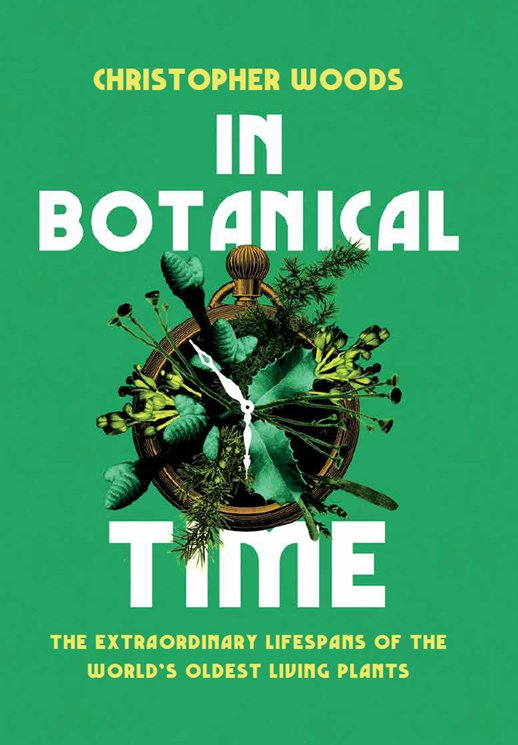
As a Botanist ‘of a certain age’ it is understandable that I begin to contemplate how much time is left to me. With such maudlin musings on mortality in mind, what ought one to make of Christopher Woods’ In botanical time [which tome is here appraised], in which all of its subjects live a lot longer than the average mortal botanist?*
Mr Cuttings’ expectations
What do I expect to see in a book that deals with long-lived botanics? From my own limited knowledge of old plants I’m expecting to see mention of three plants: Pando, the clonal aspen of the USA; bristlecone pine, the ancient conifer of California; and the ancient Scandinavian conifer whose name escapes me. What do we get in Woods’ book? All of those [Ed. – that Scandinavian tree is a Norwegian spruce (Picea abies (Christopher J Earle)), named Old Tjikko], and a whole lot more. In botanical time has therefore passed this reviewer’s first ‘test’. Having overcome that ‘hurdle’, what does it deliver?
What you get (and don’t…)
In botanical time’s approx. 230 pages of main text is divided between an Introduction and 23 numbered chapters (which generally focus on a single long-lived species, but occasionally deal with several).
Irritatingly, the book has no Index.
Even more so, there is no listing of sources used** [Ed. – nor any list of recommended further reading].
Words and pictures
In botanical time is well written***. Whilst it doesn’t have the sweeping sections of beautifully-crafted narrative we’ve seen in some other plant tomes, it does the job – of conveying information about plants – that it needs to do, effectively and in an understandable way. It is therefore both a readable – and accessible – book that should be appreciated by readers of a wide range of ages.
In botanical time is also abundantly illustrated with lots of pictures of the featured plants – which are often shown in situ in their environmentally-challenging habitats. Whilst most of the images – almost all of which appear to be in colour – are informative, some stand-out because they are quite simply stunning, e.g., Pando in the Utah winter, cypress trees in the fall near the Black Sea, and bald cypress at Caddo Lake in Texas.
BUT, and very disappointingly, for all its words, none appear to be used to acknowledge the author’s debt to those who have provided the facts that he has shared with us in his book**.
The Introduction
Contains some quite technical material in regards to a consideration of how one measures the age of living plants – carbon dating, tree ring analysis, and the expansion rate of clonal organisms. Although somewhat less technical, Woods also considers use of ‘myths and legends’ – which are often more fanciful than factual when it comes to evidence-based ages of plants. However, the latter approach has the benefit of adding “mystery and myth to the beautiful reality and make us notice them: what stories are for” (p. 9). As one who is rather fond of the ‘plants-and-people’ side of things, I couldn’t agree more with Woods on that point.
The Chapters
Presented in a sort of alphabetical order of common name, they are: Aspen [Populus tremuloides]; Baobab [Adansonia species]; Black River cypress [Taxodium distichum]; Bristlecone pine [three Pinus species in one chapter – P. aristata, P. longaeva, and P. balfouriana]; Creosote bush [Larraea tridentata]; Dragon tree [Dracaena draco]; Five sacred trees of Japan [a quintet of conifer species – Chamaecyparis obtusa, Chamaecyparis pisifera, Cryptomeria japonica, Sciadopitys verticillata, and Thujopsis dolabrata, which are not to be confused with Five Sacred Trees of Kiso]; Gran abuelo [Fitzroya cupressoides]; Jurupa oak [Quercus palmeri, more usually known as Palmer’s oak)]; King’s lomatia [Lomatia tasmanica]; Losh Run box huckleberry [Gaylussacia brachycera]; Mongarlowe mallee [Eucalyptus recurva]; Old Tjikko [Picea abies]; Olive [Olea europaea]; Pipal [Ficus religiosa]; Plants in stone: the fossils (the single chapter that doesn’t deal with extant species, but usefully gives an indication of how old plants are in terms of their existence on Earth); Qilian juniper [Juniperus przewalski]; Redwoods (3 species – in three different genera – Sequoia sempervirens, Sequiadendron giganteum, and Metasequoia glyptostroboides]; Sacred tree of Takeo shrine [Camphora officinarum]; Seagrass [Posidonia australis mainly, but which chapter also name-checks Posidonia oceanica, “the oldest known single living plant on Earth” (p. 199) [Ed. – in which case it is surprising that Woods doesn’t have more to say about this plant, in keeping with the subject of the book, but instead concentrates on the other Posidonia species, which he calls the “largest plant on Earth” (p. 200)]; Tāne-mahuta [Agathis australis]; Welwitschia [Welwitschia mirabilis, but which, Woods tells us is actually two distinct plants, subspecies of W. mirabilis]; and Ancient yews of Europe [Taxus baccata].
For their highlighted plants, each chapter contains the all-important ‘scores on the doors’, the plants’ ages. Lest there be any doubt about that information, it is placed prominently at the start of the chapter, after its heading and the scientific name of the plant. And it is also considered in more detail in the chapter itself – usually, in a suitably guarded, scientifically-defensible way (even if no sources are provided to back any of that up!). And the range of ages considered is quite spectacular, from 100 years for pipal up to 200,000 years for Neptune grass. Whilst most of the stated ages are a little cautious – vague even (because of inherent uncertainties in estimating this metric – as considered by Woods in the Introduction), the stand-out oddity is the ultra-precise 2,624 years (for a Black River cypress).
In terms of taxonomic coverage, In botanical time showcases approx. 13 angiosperms (featuring 10 dicots and 3 monocots) and approx. 18 gymnosperms (a single gnetophyte and the rest conifers). For all of their botanical diversity, what unites all but one of them (the exception is Posidonia, an ocean-bed-rooted ‘seagrass’) is that they are trees [Ed. – or tree-like in the case of the monocot dragon tree…], or shrubs. They also tend to live in fairly adverse conditions – and Posidonia is covered here by that fact. The adversity of their living conditions – in which slow growth is encouraged (if not the only ‘lifestyle’ possible), is one of the factors that may contribute to their extreme longevity. This Woods muses upon in the Introduction, and offers a ‘rule by which to live one’s own life’ – takes things at a suitable measured pace, i.e., slowly (and maybe – and just occasionally – challenge oneself in situations outside of one’s comfort zone..?). He also touches upon longevity and gene duplication, and telomerase – and for the first time that I can recall reading, explains what telomeres are, and their relevance to cell death (p. 11).
More than the botany…
The chapters are about more – usually much more – than the plant’s likely age. Having mentioned the notable plant, Woods often takes the opportunity to provide information about the biology of the chosen plant(s) and their ecology. And, in several cases, adds considerable value by considering aspects of their ethnobotany, cultural significance, and the broader ecology of the place in which they live (which is particularly pronounced in the ‘New Zealand chapter’ dealing with Tāne-mahuta [Agathis australis]).
Woods wants us to wander and wonder
In his Introduction, Woods speaks of his passion for plants, and his joy of wandering amongst them and wondering at them. As readers of In botanical time, we wander with Woods over a great deal of the planet – from the Tibetan plateau (“the roof of the world” (Andrea Thompson)) to the seabed, from North America, to Asia, Europe, Africa, and the Antipodes. And along the way we have wondered at many impressive plants. Woods has certainly achieved that goal.
How scientific is it?
In botanical time is described as a “popular-science exploration” (book’s back cover, and here). Whilst that is encouraging to read, a major part of ‘science’ is basing one’s assertions or conclusions on evidence. However, with no mention of any sources for any of the statements Woods makes, no real evidence is presented. Maybe therefore, the ‘science’ in In botanical time is more populist than popular? I suspect that is not the case, but, unless sources are stated for statements made, how can we be certain? And that’s a great pity because there is lots to learn from Woods’ words.
Is it error-free?
Generally, In botanical time appears to be error-free (as far as one can assess factual accuracy without knowledge of Woods’ sources…). However, something that needs to be pointed out is on p. 200 where Woods writes “There are 72 species of seagrass, belonging to four major genera: Zosteraceae, Hydrocharitaceae, Posidoniaceae and Cymodoceaceae”. The four ‘-aceaes’ are names of plant families not genera.
Overall appreciation
It’s probably fair to say that people are fascinated by anything to do with ‘record-breaking’. A book about old – and oldest – plants is therefore likely to have a ready-made readership. And, why not? Plants are inherently intriguing, which intrigue can only be increased by the thought of those that have reached almost unimaginable great age. Christopher Woods’ In botanical time goes a long way towards satisfying that particular thirst for knowledge.
Summary
In botanical time by Christopher Woods is a joyous celebration of the longevity of plants****. Well-written (although not source-stated) and abundantly illustrated, it is a highly-readable account of the lives – some of which are very long! – of a couple of dozen of the planet’s oldest-living plants. Ranging from single olive trees (that are much younger than we might like to believe) to individual bristlecone pines (which are as old as we’ve been led to believe), to clonal organisms that may be up to 200,0000 years old, it covers a great diversity of plant types. Apart from the essential – and all-important – plant biology and ecology, it also includes a much-appreciated dose of plants-and-people information and insight, too. Woods’ enthusiasm and respect for, and love of, plants comes across clearly in every chapter. Long may he “continue to wander and wonder” (p. 11) and share that enthusiasm with his readers.
* Probably, that one should rejoice that the plants should endure even if the frail body of Man doesn’t…
** Here are just a few examples of Woods’ statements than require appropriate sources: “Our planet Earth is 4.5 billion years old, plus or minus 50 million years” (p. 7); “Luca, an acronym for the last universal common ancestor—a single-celled bacterium-like organism, and the ancestor of all known life on Earth—is estimated to have been born 4.2 billion years ago” (p. 7); “plant life first emerged on land about 550 million years ago, during the Cambrian Period” (p. 7); “Seas are predicted to rise a foot by 2050” (p. 10); “Recently, fossilized trees dating back 390 million years were found in England” (p. 161)…
*** The book even contains some humour, e.g., this charming play on words: “For longevity, send in the clones” (p. 110).
**** If you’d like to ‘try before you buy’ – or, would just like to get a better idea of the book’s style and content – chapter 3 Black River cypress [Taxodium distichum; age: 2,624 years] is available to download for free from here.


Leave a Reply