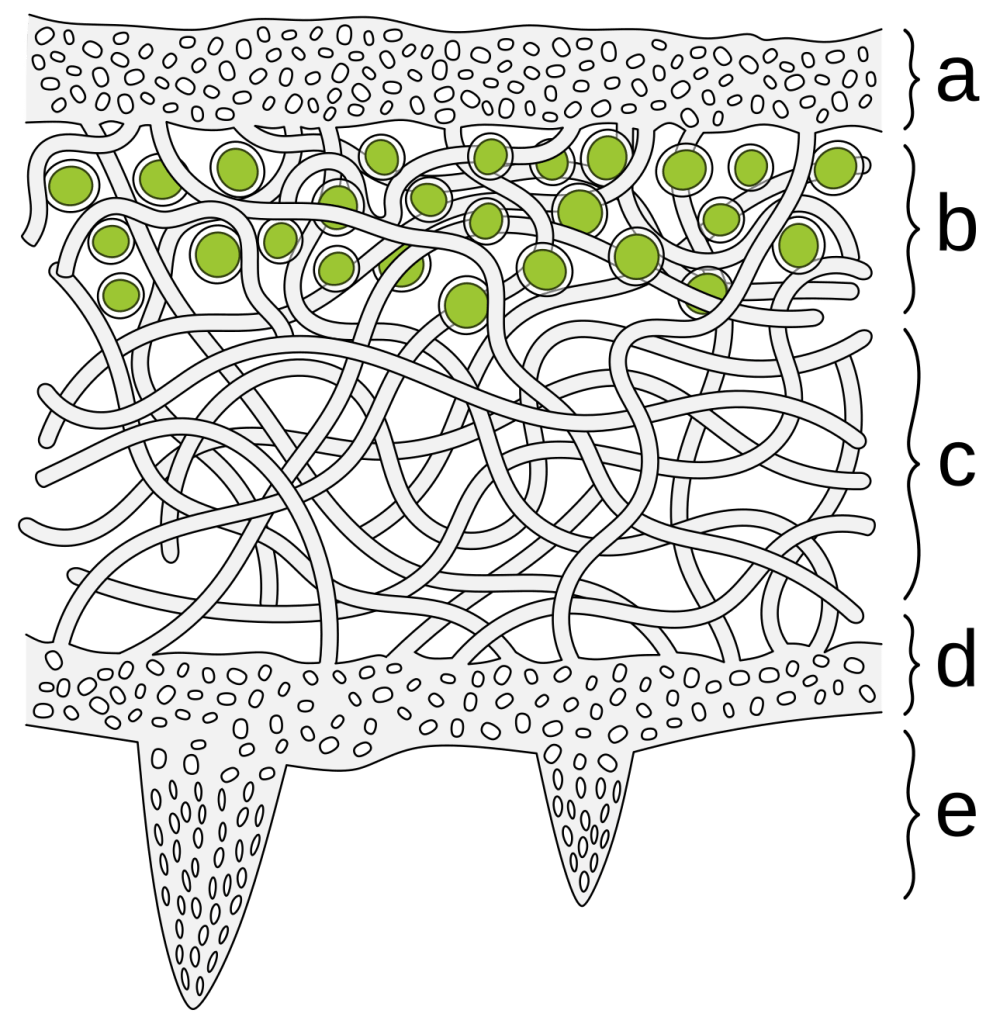
This image, entitled “Schematic cross section of foliose lichen: (a) The cortex is the outer layer of tightly woven fungus filaments (hyphae); (b) This photobiont layer has photosynthesizing green algae; (c) Loosely packed hyphae in the medulla; (d) A tightly woven lower cortex; (e) Anchoring hyphae called rhizines where the fungus attaches to the substrate”, by Nefronus, is used under the Creative Commons Attribution-Share Alike 4.0 International license.
Partnerships in nature can show us a lot about the benefits of working together to solve problems. e.g., the chalk-encased external skeletons of polyps of warm water hard corals that protect their internal, life-sustaining, photosynthetic algae, and acacia trees in Africa that provide a home for their resident herbivore-deterring ants (Craig Holdrege). But, one of the most intriguing of these mutualistic symbioses – ones in which both partners benefit from the association – is the lichen*.
More on lichens
In this arrangement, a fungus provides a ‘home’ for photosynthetic algae or cyanobacteria ‘tenants’. In turn, these ‘lodgers’ transfer some of the organic compounds they’ve synthesised to their mycological ‘landlord’ as a sort of ‘rent’ for their ‘home’. [Ed. – a lichen has also been described – and much more poetically – as “an unnatural union between a captive algal damsel and a tyrant fungal master” (a quote attributed to Scottish lichenologist Revd James Mascall Morrison Crombie – who did not accept the symbiotic nature of lichens…), cf. ‘Nature’s perfect marriage’ (WP Armstrong)]
But, these are biologically-evolved – ‘natural’ – partnerships, working within the ecology of the natural world. What if people could synthesise new mutualistic relationships, that might help us solve some of the problems of our own making?
Cracked concrete conundrum…
Take, for example, the human creation known as concrete. Concrete is a – arguably, the most (Paul Wagstaff; Colin R Gagg, 2014) – widely-used construction material on the planet. But, it is prone to develop cracks, which can limit its useful life (Caleb Stroud; Huawei Li et al., 2025).
Non-biological fixes
Although inanimate interventions exist to deal with the cracks (e.g., here, here, and here), they are time-consuming, costly, and labour-intensive. Furthermore, although more environmentally-sympathetic and sustainable, repairing concrete instead of replacing it can have its own issues of environmental-sustainability. Developing a biological – arguably, ‘natural’ – ‘self-healing’ solution to solve that issue would be a considerable boon to the construction industry – and the environment. What if, for example – and just plucking an idea out of thin air – we could create a lichen that would help to ‘heal’ concrete?
Well, guess what?! That possibility is exactly what Nisha Rokaya et al. (2025a) have investigated**.
A biological fix
As I understand the problem, healing cracks in concrete is primarily about in-filling the gaps with calcium carbonate (CaCO3), a material that’s usually added to the concrete mix contributing to strength and resistance, hardness and durability of the finished product.
The way in which Rokaya et al. (2025a) approached the problem is summarised here: “To realize self-sustained production of repair materials, the synthetic community must include three components: 1) photosynthetic microorganisms that synthesize carbohydrates from CO2, satisfying the community’s energy and carbon requirements; 2) nitrogen-fixing microorganisms that convert atmospheric N2 into organic nitrogen, satisfying the community’s nitrogen requirements for essential cellular processes; and 3) Ca2+ [calcium ion] attractors that deposit CaCO3 precipitates to heal cracks in concrete”.
Exploring various combinations of a filamentous fungus Trichoderma reesei, and diazotrophic [nitrogen-fixing] cyanobacteria Anabaena inaequalis and Nostoc punctiforme, Rokaya et al. (2025a) determined that – in the laboratory environment, in Petri dishes – the fungus paired with either, or both, of the cyanobacteria provided the right combination of organisms for potential concrete-repair.
A bit of biological chemistry
Overall, then, that multi-organism mix appears to satisfy the requirements of the self-sustaining system that were sought. Would what was found in in the laboratory environment, in Petri dishes, work in practice, in the real world? Rokaya et al. (2025a) envisage that it would function as follows: the “cyanobacteria are mainly responsible for 1) fixing CO2 and N2 from the air and converting them into O2, organic carbon, and organic nitrogen, to support filamentous fungi, … ; and 2) giving rise to high concentration of CO32- [the carbonate ion] as a result of photosynthetic activities, which is an essential process for CaCO3 deposition. Filamentous fungi are mainly responsible for 1) binding Ca2+ onto fungal cell walls and serving as nucleation sites to promote CaCO3 precipitates to heal cracks in concrete; and 2) assisting the survival and growth of cyanobacteria by providing them water, minerals, additional CO2, and protection”.
Importantly, “the branching structures and filamentous growth habit of the filamentous fungi provide more nucleation sites [for the CaCO3] and stronger framework support for mineral precipitation. … fungal hyphae with narrow diameters and long lengths form interconnected architecture, providing a larger organic template for biomineral deposition. These hyphae, when biomineralized, act as bridges connecting biominerals and enabling continuous bio-structures, which is a key factor in enabling their ability to heal wider cracks in concrete” (Rokaya et al., 2025a). Furthermore, “both participants secrete extracellular polymeric substances, containing various acidic residues and sugars that enhance the adhesion between concrete and precipitation and the cohesion among precipitated crystals” (Rokaya et al., 2025a).
Distinctive work of Rokaya et al.
Whilst using microbes – bacteria and/or fungi (Justine Dees) – to try and fix cracked concrete is not a new phenomenon***, Rokaya et al. (2025a) remind us that previous attempts suffer “from one important limitation, i.e., none of the current self-healing approaches are fully autonomous since they still require external supply of nutrients for the healing agents to continuously produce repair materials”. What therefore distinguishes Rokaya et al. (2025a)’s approach from others’ is that their goal was “to create a synthetic lichen system with a phototroph-heterotroph symbiosis, similar to natural lichens, so that the system can produce biomaterials in a self-sustained manner”.
But, it’s not really a lichen…
Although promoted as a synthetic lichen in the media (e.g., with headlines such as “Synthetic lichen points a pathway to self-healing concrete” (Linda Stewart); and “Self-healing concrete uses synthetic lichen to repair cracks with air and sunlight” (Georgina Jedikovska)), and considered to be a synthetic lichen system by Rokaya et al. (2025a), what’s been produced is not a lichen in the traditional sense of that word because it is not a fungus encasing a photosynthetic partner.
It is only lichen-like because the multi-organism mix produced is a co-operative coupling of a fungus and a photosynthetic organism. Here there is no fungal ensheathing of the photobiont. Indeed, if it works as envisaged, the living components would be encapsulated – entombed? – within the concrete ‘exoskeleton’****. It’s not even clear that the microbes should be considered true ‘partners’. After all, they are only ‘co-operating’ because they’ve been compelled to work together, bent by the hand of humans to do their bidding. Now, there’s a philosophical conundrum for you…*****.
But, does it work? Potentially…
Probably the most important point – that’s easy to miss in the media excitement about this work** – is writ large in the title of the study by Rokaya et al. (2025a), “Design of co-culturing system of diazotrophic cyanobacteria and filamentous fungi for potential application in self-healing concrete”. Note the rather important phrase “for potential application”. Whether this synthetic lichen system approach will actually wok in practice, in situ – within concrete – was not actually explored in Rokaya et al. (2025a).
To their credit, the researchers did not hide what stage their work was at when it was published, as is clear from the paper’s title and its final words: “As our future work, the survivability and self-sustained production of CaCO3 precipitates by the co-culture systems will be tested on concrete samples with existing cracks. … A series of mechanical tests will be performed on the concrete samples before and after the lichen-based self-healing process” Rokaya et al. (2025a). Do bear that in mind when reading about this work in the scicomm reports**. [Ed. – but, do also bear in mind the time delay between doing scientific work and getting it published. In the interval between the two it’s highly likely that the team behind this work may well already have tested the synthetic system in concrete and know whether it works – or not. I expect we’ll receive some concrete evidence about this work, soon.].
More questions…
Presumably, presence of the synthetic lichen system within the concrete is necessary for it to work in repairing cracks. In which case, it will be interesting to know at what stage during the mixing or pouring of the concrete the synthetic lichen system is added. Or is it only applied when, and where, cracks are seen – presumably at the surface? But internal placement of the lichen system raises further questions [Ed. – the sign of an interesting piece of work…]. Is it necessary to create gaps – cracks – in the concrete to accommodate the lichen system? How many? Is a particular density of lichen-lined cracks needed to protect the concrete against future cracking? If the lichen system is successful in healing cracks does that not then condemn the lichen to be totally encrusted with calcium carbonate and so die? During any decomposition of the dead lichen system will any chemicals be produced and released that may harm the concrete, and which may therefore require further remedial repair work? Is the concrete sufficiently porous that gas exchange between the atmosphere and the lichen system can take place, at a rate that is appropriate for the continued existence of the system? And there are other questions, but that’s enough for now: It’s certainly fair to say that Mr Cuttings’ interest is piqued by the work of Rokaya et al. (2025a)(!)
* For more on lichens, readers are referred to this blog post from Mr Cuttings [Ed. – in full-on, shameless, and seemingly unapologetic, self-publicist mode…]: “When is a lichen not a lichen?” (and sources cited therein), Elizabeth Lawson’s book Moss and lichen , and Springer’s textbook Biology of algae, lichens and bryophytes edited by Burkhard Büdel et al..
** For more on Rokaya et al. (2025a)’s terrestrial self-repairing concrete work, see scicomm articles here, Linda Stewart, Georgina Jedikovska, Hina Dinoo, Rick Kazmer, Jennifer Nichols, Nidhi Dhull, Darren Orf, here, and here.
*** For more on microbial self-repairing concrete generally, see Congrui Jin et al., 2018; Jing Luo et al., 2018; here; Rakenth R Menon et al., 2019; Aurélie Van Wylick, Aurélie Van Wylick et al., 2021; Xijin Zhang et al., 2021; Viet Huy Le et al., 2022; Dilshad Jaf, 2023; Pui Yan Wong et al., 2024; M Meghashree et al., 2025; Meirong Zong et al., 2025. And for self-healing concrete more generally, see here. [Ed. – and don’t forget that Mr P Cuttings penned a post about self-repairing concrete using fungi many years ago, in another place…].
**** Notwithstanding this modern-day feat of human ingenuity [Ed. – or the shameless manipulation of lifeforms bent to the will of people…], it seems that the conundrum of deteriorating concrete was cracked more than 2,000 years ago by the Ancient Romans.
In that instance, they didn’t resort to biological intervention, but employed a mineralogical one – the incorporation of pozzolan (Pat Gibbons) into the concrete mix (Ellie Vaserman et al., 2025). Pozzolan is typically – and traditionally – a term that is applied to various forms of volcano-produced material, e.g., pumices and tuffs. One of the most famous sites for this material in ancient times was found in Pozzuoli (near Naples, Italy), hence the name pozzolan for this material. When integrated into the concrete mix it reacts chemically with the calcium hydroxide (Ca(OH)2) to form compounds “possessing cementitious properties”, which help to repair any cracks that might otherwise form. For more on this Pompeian pozzolan story, see Dario Radley, Anthony King, Ray Laurence, and Charlie King.
[Ed. – but, it looks like this ‘secret’ had already been revealed, in 2021, with the work of Linda Seymour et al. (2022). Interestingly, the scicomm article related to that work [available here], states that “a Roman-like concrete could reduce the energy emissions of concrete production and installation by 85% and improve the 50-year lifespan of modern marine concretes four-fold”. It will be interesting to see how Rokaya et al. (2025a)’s synthetic lichen version fares in that regard.]
***** But, no sooner have we got used to the notion that a lichen-like partnership may help to solve concrete problems on Earth, than we have news that the same system may help us to produce construction materials for life on the planet Mars (Michael C Malin)******.
Most of the same team behind the work reported in Rokaya et al. (2025a) are also involved in the extraterrestrial investigation. Space doesn’t permit much more of a mention of that work here, but more details will be found in the article by Rokaya et al. (2025b) that documents the work [Ed. – which is – appropriately enough, funded by NASA [the USA’s National Aeronautics and Space Administration]].
For more scicomm media takes on this extraterrestrial dimension, see articles by Jennifer Nichols, Sumi Sarkar, Matthew Thibault, Keith Cowing, Mrigakshi Dixit, Matthew Williams, Tess Boissonneault, here, and here.
****** If this work takes off, then maybe the so-called ‘red planet’ might need to be renamed the ‘ready-mix’ planet..? [Ed – I think you’ll find that term is already applied to another celestial body, Earth…].
REFERENCES
Colin R Gagg, 2014. Cement and concrete as an engineering material: An historic appraisal and case study analysis. Engineering Failure Analysis 40: 114-140; https://doi.org/10.1016/j.engfailanal.2014.02.004
Dilshad Jaf, 2023. A review on self-healing concrete: A biological approach. Reciklaza i odrzivi razvoj [Recycling and Sustainable Development] 16(1): 1-14; doi:10.5937/ror2301001J
Congrui Jin et al., 2018. Fungi: A neglected candidate for the application of self-healing concrete. Front. Built Environ. 4: 62; doi: 10.3389/fbuil.2018.00062
Viet Huy Le et al., 2022. Self-healing concrete: a potential smart material to apply for underground construction. Journal of Mining and Earth Sciences 63(3a): 95-102; doi: https://doi.org/10.46326/JMES.2022.63(3a).11
Huawei Li et al., 2025. Lifetime prediction of damaged or cracked concrete structures: A review. Structures 71: 108095; https://doi.org/10.1016/j.istruc.2024.108095
Jing Luo et al., 2018. Interactions of fungi with concrete: Significant importance for bio-based self-healing concrete. Construction and Building Materials 164: 275-285; https://doi.org/10.1016/j.conbuildmat.2017.12.233
M Meghashree et al., 2025. Advancing sustainable concrete with bacterial self-healing technology and Kuhn-Tucker condition. Sci Rep 15: 33736; https://doi.org/10.1038/s41598-025-96971-y
Rakenth R Menon et al., 2019. Screening of fungi for potential application of self-healing concrete. Sci Rep 9: 2075; https://doi.org/10.1038/s41598-019-39156-8
Nisha Rokaya et al., 2025a. Design of co-culturing system of diazotrophic cyanobacteria and filamentous fungi for potential application in self-healing concrete. Materials Today Communications 44: 112093; https://doi.org/10.1016/j.mtcomm.2025.112093 [This content should be publicly available on March 1, 2026]
Nisha Royaka et al., 2025b. Bio-manufacturing of engineered living materials for Martian construction: Design of the synthetic community. ASME. J. Manuf. Sci. Eng. 147(8): 081008; https://doi.org/10.1115/1.4068792
Linda M Seymour et al., 2022. Reactive binder and aggregate interfacial zones in the mortar of Tomb of Caecilia Metella concrete, 1C BCE, Rome. Journal of the American Ceramic Society 105(2): 1503-1518; doi: 10.1111/jace.18133
Aurélie Van Wylick et al., 2021. A review on the potential of filamentous fungi for microbial self-healing of concrete. Fungal Biol Biotechnol 8: 16; https://doi.org/10.1186/s40694-021-00122-7
Ellie Vaserman et al., 2025. An unfinished Pompeian construction site reveals ancient Roman building technology. Nat Commun 16: 10847; https://doi.org/10.1038/s41467-025-66634-7
Pui Yan Wong et al., 2024. Advances in microbial self-healing concrete: A critical review of mechanisms, developments, and future directions. Science of The Total Environment 947: 174553; https://doi.org/10.1016/j.scitotenv.2024.174553
Xijin Zhang et al., 2021. Study on the behaviors of fungi-concrete surface interactions and theoretical assessment of its potentials for durable concrete with fungal-mediated self-healing. Journal of Cleaner Production 292: 125870; https://doi.org/10.1016/j.jclepro.2021.125870
Meirong Zong et al., 2025. Progress in self-repair technology for concrete cracks via biomineralization. Materials 18: 5004; https://doi.org/10.3390/ma18215004


Leave a Reply