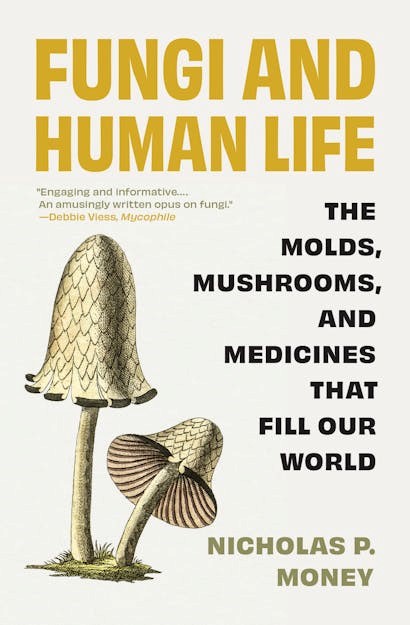
Fungi and human life: The molds, mushrooms, and medicines that fill our world by Nicholas Money, 2026. Princeton University Press.
We’ve had a flurry of popular science books about fungi in the last few years, e.g., Entangled Life: How Fungi Make Our Worlds, Change Our Minds and Shape Our Futures by Merlin Sheldrake, Sandra Lawrence’s The Magic of Mushrooms, The Hidden Kingdom of Fungi by Keith Seifert, and Alison Pouliot’s duo of Funga obscura, and Mushroom day: A story of 24 hours and 24 fungal lives. However, few, I suggest, can have been more eagerly awaited than Nicholas Money’s Fungi and human life: The molds, mushrooms, and medicines that fill our world [which and whose book is here appraised].
Why should this particular tome be so keenly anticipated?
It’s written by Nicholas Money.
To expand upon that. By virtue of what I’ve read in his other books [see Haven’t we read it all before..?] – and according to his students – I know Money is definitely a fun guy. He has the enviable knack of unearthing and writing about the most interesting tit-bits of fungal ‘trivia’* [Ed. – many of which facts are not trivial at all!]. That sort of thing engages his readers; Money makes learning about fungi fun. Plus, his writing style is also full of flourish, wit and memorable phrasing**. [Ed. – and you will increase your knowledge of unusual words***] Money not only writes very well, he also tells a terrific tale. [Ed. – and we even get a song! Well, some lyrics at least on p. 111 (!!) Does that mean we can expect “Mycologia, the musical” sometime soon..?]
And Money’s tale in Fungi and human life is – simply put – the story of the intimate (very intimate in places…) interconnection between fungi and humankind. Or, in the author’s own words, “This is the story of people and fungi, the human-fungus symbiosis that spans the local to the global, revealing how our lives are influenced through rich relationships with these extraordinary microorganisms” (p. 19). In terms of ‘local’, the first of the book’s two parts – Inward – takes an in-depth look at the role played by fungi upon and within the human body. The ancient roots of which association are discussed by Money, as he reminds us that its renewal and reinforcement takes place with every human birth. From womb to tomb, “The entire human body is affected by fungi” (p. 5). Whilst we are probably more aware of the impact of bacteria and viruses on human health and lives, Money does his very best to emphasise the – and arguably more – important impact of fungi in the affairs of Mankind.
In terms of ‘global’, Money considers the complicated and often contradictory relationship between humanity and fungi in Part II Outward. There we have an examination of the fungi that have “been staples of the human diet for millennia” (think bread, cheese, and alcoholic beverages), the “controversial experimentation with magic mushrooms in the treatment of depression”, and a reminder of the essential role that fungi play in decomposition and the cycling of nutrients that make the world go around.
In other words, Fungi and Human Life “explores the amazing ways fungi interact with our bodies, showing how our health and well-being depend on an immense ecosystem of yeasts and molds inside and all around us” (quoted from the publisher’s blurb here).
That the book is about fungi is a bonus. Despite the numerous fungi books written for the lay readership [see those several listed in this post’s first paragraph], there is still more to share about these intriguing organisms. And, in this particular tome Money keeps the focus firmly on the relationship between fungi and people. And his main mycological message is that fungi are much more intimately involved in the affairs of Mankind than we have given them credit for, and have so much untapped potential to improve the lot of Man. Accordingly, he goes into considerable detail about the medical side of mushrooms, yeasts, moulds and Mankind. In particular, I challenge you not to read Chapter 2 Touching without the urge to scratch an imagined itch on your skin(!). The insights I gained into the human biological side of the fungal-people relationship were most welcome and fascinating. Although I learnt more about faecal transplant than I probably wanted to know, I was intrigued to learn about new insights into an association of fungi with neurological conditions such as Alzheimer’s and Parkinson’s. I learned a lot about medical mycology reading this book, for which I am grateful to author Money.
Overview of book’s contents
The book’s 174 pages of main text are spread over 10 chapters (plus approx. 3 pages of an Appendix looking at the difficulty in identifying fungi from DNA fragments – quite a technical section that is appropriately placed after the book’s main message). Fungi and human life is illustrated, but only with black-and-white pictures at the start of each chapter (but whose identity isn’t revealed until pages 225/6…). Although the book is consequently primarily uninterrupted narrative, that’s not a problem with a Money monograph because of the quality of the written word. But, interesting sub-headings, e.g., “Fungi as one of the principal causes of asthma”; “All mushrooms are poisonish”; “Why mushrooms make psychedelics”; and “The necromycobiome”, help to break-up the text (and provide some indication of the text to come).
Plus, it’s not just dry facts, Fungi and human life is punctuated with stories about the people involved in the science, and Money is not averse to infusing the text with stories about his own interaction with fungi (e.g., his fungal spore-induced childhood asthma attack), and philosophical musings (e.g., when we are invited to picture one’s body as “I am a trinity, born from one cell, copied in trillions, and filled with other forms of life” (p. 6)). This is thus a very human book about a very human biological interaction [Ed. – and, in case you wanted a bit of reassurance that the subject matter of this book is relevant to the Plant Cuttings blog, we have this amazing quote: “We depend on botany, and plants depend on fungi” (p. 160)…]
The book is completed with a –surprisingly short considering the great range of topics that Money covers – Index. Its 2.33 two-columned pages go from ‘Allegro, John‘ (Raphael Tiffou, 2022; Geoffrey Smith, 2025) (who has interesting things to say about Christianity and fungi – and Money has interesting things to say about Allegro…..…) to ‘zoonoses’ (“A zoonosis is an infectious disease that can be transmitted from animals to humans and vice versa”).
This is a scicomm book
Fungi and human life is a factual book that deals with biological and medical topics which may be unfamiliar to readers. Money therefore has a duty both to try and explain those topics so that they can be understood by his audience, and to provide the necessary evidence to support those statements.
Whilst I have a reasonable appreciation of the book’s fungal biological material I have much less knowledge regarding human biology and psychology. No matter, Money’s easy-reading style meant that what I read was suitably well-explained that it was understandable. And there’s quite a lot to understand in the book. For instance there is a lot about the body’s immune system, and plenty about HIV-AIDS, COVID-19 and psilocybin’s therapeutic potential (the book is very up-to-date in respect of those last two topics). The communication side of the book is therefore addressed. What about the necessary evidence?
The biggest single part of the book is the approx. 45 pages of Notes. Arranged by chapter, the numbered items relate to the super-scripted numbers in-text and provide the sources for statements of fact made in text (and some other explanatory material where appropriate). Numerous scientific papers are cited – which are appropriate since there’s a lot of science in the book. Often – usually! – several sources ere cited in each note, including several publications from Money (which helps to underline his credentials for writing this book…). On the face of it, the stating of sources seems pretty thorough. However, some of the items within the Notes contain new information that is not sourced, e.g., Note 2 (p. 179) with its information about Candida yeasts; Note 4 (p. 183)’s estimates of numbers of bacterial and fungal cells in different parts of the body; and Note 20 (p. 199) regarding definition of terms.
So much for the Notes section, what about statements made in-text? Are they all backed-up by suitable Notes? Certainly, the majority appear to be, which is good to see. But, unfortunately, there are several instances where that is not the case. For example, the detailed account of the biology of white blood cells (3rd paragraph, p. 7); the statement that there are “Islamic prohibitions against keeping dogs in the home” (last sentence, p. 31); the use of griseofulvin to treat ringworm (2nd paragraph, p. 32); that Head & Shoulders is the “best-selling shampoo in the world” (1st paragraph, p. 34); a whole paragraph about aflatoxins (3rd paragraph, p. 139); the proportion of human’s calories that come from cereals (2nd paragraph, p. 162); and the estimates of fungal hyphal density in grassland (p. 171, 2nd paragraph). Whilst I fully expect that all such statements are accurate, it’s a shame that they indicate a lapse in – the otherwise pretty exemplary – provision of evidence for his readers.
[Ed. – Money bemoans – and quite rightly – the unsupported and unwarranted claims of purveyors of ‘mycological medicines’, which have hampered legitimate research into the true pharmaceutical value of fungal products. This is evident in his words, “There is an event horizon in mycological thinking that is crossed when enthusiasm and ego exceed experimental evidence” (p. 171), and “The study of medicinal mushrooms is lost in a madhouse of misrepresentation and pseudoscience that includes crackpot cures for terminal illnesses” (Note 27, p. 206). Recognising and applauding his need for evidence, I’m therefore a little surprised at his assertion that “The iceman’s … childhood would have been filled with stories about toadstools, and witches, and wood spirits” (p. 123). They may well have been, but Money provides no evidence to support this claim…]
Is it error-free?
Subject to suitable and satisfactory verification of the veracity of any unsourced statements of fact in the book, Fungi and human life appears to be largely error-free. Apart from what look like ‘typos’ – ‘sems’ (on p. 81, which should be ‘seems’?), and Oceana (on p. 132, which is probably meant to be Oceania?), the most serious ‘error’ relates to the chemical formula of ‘sugar’ as C6H12O2 (on p. 95) in “the most consequential chemical reaction in human history”. Presumably, that should be shown as C6H12O6? [Ed. – I know that here Money is providing a rather shorthand version of the conversion of sugar into alcohol, as “C6H12O2 >>> CH3CH2OH”. But, since that representation leaves questions about where the missing Cs, Hs, and Os from the sugar have gone since they don’t feature numerically in the ethyl alcohol formula (Jessica Clifton, 2025), it would be best to show sugar as C6H12O6 in the first place. Sometimes you can over-simplify things…]. But, all are items easily resolved in a revised edition.
Haven’t we read it all before..?
Whenever one comes across a book about fungi and people, there is always the nagging doubt that there’s only so much of that sort of information to go round, and one can’t help but wonder if you’ve read at least some if it before. I don’t know how much – if any – of the information shared by Money in Fungi and human life may already have been given an airing in any of his previous forays into fungal non-fiction (e.g., Triumph of the fungi, Mushrooms: A natural and cultural history, Fungi: A very short introduction, and/or The rise of yeast), but it’s so long ago that I read any of them that repetition (and any so-called ‘repetition’ we might rename ‘reinforcement’, an important teaching device…) wouldn’t be an issue for me: Money’s words and musings are always worth reading (and, probably, even rereading…). And, anyway, even if Money is ‘repeating’ himself here, its contents will still be new to those who are new to his work, and there is much for a new audience to enjoy. And enjoy it they will (or, should). [Ed. – I’m pretty sure that very little of what’s in Fungi and human life will be found in Money’s previous fungal books. Plus, much has happened in the world of fungi since those other books were written that there will be plenty of new material. After all, “The fast pace of discovery in medical mycology is really inspiring. … As this examination of the fungi has proceeded, the vision of the microbiome as a mostly bacterial territory has shifted to an appreciation of the diverse communities of fungi that fight and cooperate with bacteria through webs of chemical interactions to make a living on the body. Through these innovations we are beginning to fathom the extraordinary influence of the mycobiome on our health and well-being” (quoted from interview with Money on the Princeton University Press blog here)…]
Final words…
… I will leave to Money himself, “This is the story of the fungi near and far, which support the biosphere by forming mycorrhizas with plants, rotting the wastes of biology, enriching the soil, and purifying water. Life without fungi is impossible. There are as many of them living on the human body as there are stars in the Milky Way and, more importantly, they have a far greater influence on our lives than all but one of these galactic incinerators. They are everywhere and will outlive us by an eternity: in myco speramus” (p. 174)****.
Summary
Money has produced yet another great book about the fungal kingdom with Fungi and human life. This not only represents scicomm of a very high order, but is as informative and engaging as the author’s previous forays into fungal biology. It should be appreciated by students of fungi as much as by the non-specialist reader who wants to be better informed about the important part played by fungi in the affairs of mankind.
Fungi and human life is NOT a catalogue of ‘what have fungi ever done for us?’. Rather, it is a carefully crafted and considered recognition of the myriad roles fungi play in and upon the human body (principally from the perspective of health or wellbeing) and beyond that to the wider global ecosystem that humans are a part of (e.g., alcohol, psychedelics, religion, ecosystem services). Is it too early to be looking for Christmas presents?
* Fungi and human life is absolutely crammed full of facts. Some of the things you’ll learn include: sage advice on how to pronounce Latin names [although, Money assures us, “Latin names are kept to a bare minimum in this book” (p. 5)]; how much 40 billion fungal cells weigh; how much faeces the human body produces in a lifetime; discovering the identity of Money’s “hero”; finding out what is known as “champagne of the steppes” (p. 96); learning why – in Money’s opinion – fish are like mushrooms; being introduced to the value of ‘piratical metaphors’ for explaining biological facts; be disappointed that fungal spore-infused burial suits won’t work; and learning the identity of the person Money nominates for The Batshit Crazy Award in Mycology(!).
** Some of Money’s memorable phrasing include: “These tiny specks [microscopic fungal spores in the air] are destroyed after they stick to the mucus in our airways, but they carry irritating proteins called allergens that are as damaging to asthmatic lungs as birds sucked into jet engines” (p. 41); “Marmite … a fungal product that is formulated from yeast cells exhausted from the labor of crafting beer” (p. 102); “Together with maggots that writhe in the froth and beetles that nibble at sinews, the bacteria and fungi form the necrobiome that gathers at the postmortem banquet to dissolve the dead into the soil” (p. 164); and “Insouciant attitudes towards intestinal parasites are among the unearned privileges of today’s affluence… (p. 203, Note 3).
*** Fungi and human life will allow you to ‘increase your word power’ (readers of a certain age may recognise this phrase from leafing through copies of the Reader’s Digest (Reina Galhea, 2024; David Salariya, 2025) whilst waiting in dentist’s and doctor’s waiting rooms in days gone by…although, I suspect, few – if any – of these words will have featured in that venerable publication). Words in that category in Fungi and human life include: dysbiosis; synnecroses/synnecrosis; vomocytosis; mucormycosis; salmagundi; turophilia; sudoriferous; mephitic matter; formication; and henosis. [Ed. – I do want to be at the dinner party where you use any of those words in conversation!]
**** I had to Google this Latin phrase, and found that: “”In myco speramus” translates to “in fungus we trust,” a clever mycological spin on the traditional Latin motto “in Deo speramus” [in God we trust]. It celebrates the profound importance of fungi in supporting ecosystems, medicine, and the future of our planet. [1, 2, 3] This rallying cry has become a popular philosophy among biologists, ecologists, and mycology enthusiasts” (from the AI overview).


Leave a Reply