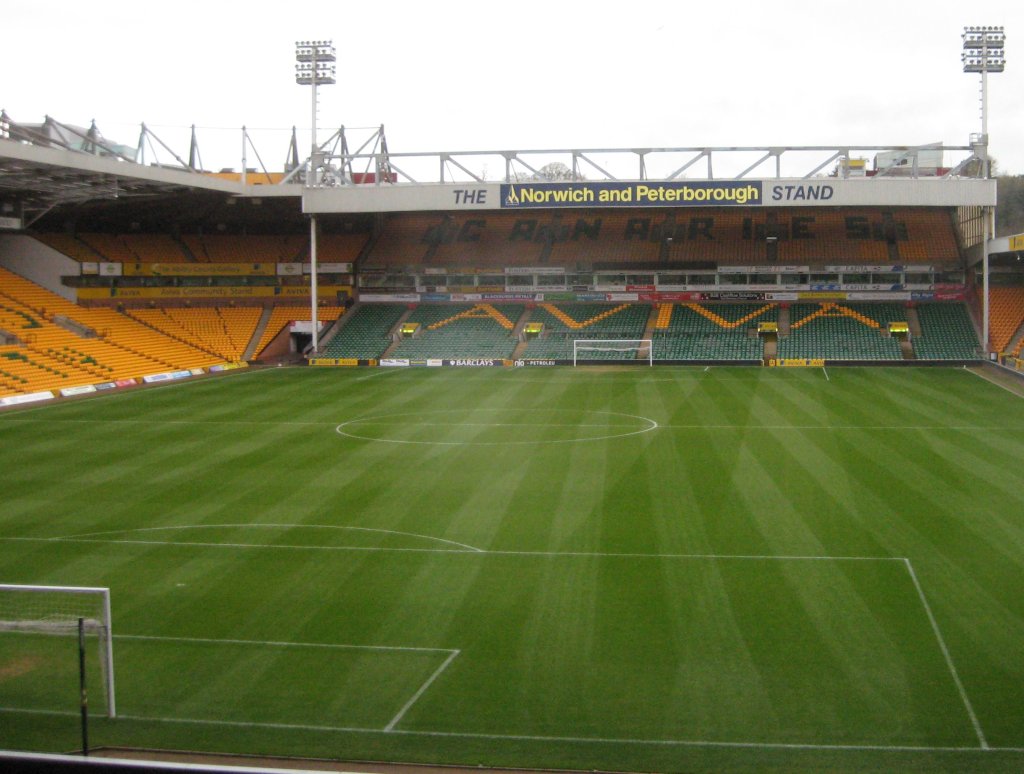
The neat, trimmed and manicured grass of the pitch of Norwich City Football Club demonstrates one of many non-food uses of plants. Whether exploitation of this plant resource makes you miserable or happy rather depends on which football team you support!
The numerical inspiration for chapter 8 comes from ‘eight millimetres’, the optimum height of the grass on Wimbledon’s tennis courts. That snippet of information leads to thoughts of plants that provide us with a variety of leisure activities and the opportunity to enrich our lives – whether we be ill, in need of ‘rehabilitation’, or just want a bit of ‘space’. Accordingly, leisure activities that help us to keep active and fit are considered here, as well as plant products that are essential to some of those activities and past-times. The contribution of plants – and ‘nature’ and ‘greenness’ more broadly – in the context of human health and wellbeing is also discussed. The Japanese notion of ‘forest bathing’ is not ignored [Ed. – although that part is not ready yet (neither is a look at the physiological impact on plants of paint applied on playing surfaces)…].
In Chapter 7 we’ve just seen that grasses – in the guise of cereals such as wheat, maize, and rice – are crucial staples for the nutrition of a large part of humanity. And the importance of this plant family to people doesn’t end there. When humans are well fed and have leisure time they often turn to grasses again. But this time it’s to provide a plethora of playing surfaces (e.g., Naomi Volain; Lindsey Blackmore; Robert Wood, 2024, and here).
Apart from the perfectly manicured lawns of the Grand Slam (Simon Rea) tennis courts of Wimbledon (which are 100% Lolium perenne (perennial ryegrass (Roshneesh Kmaneck, 2025; Tim Newcomb)), and the pitches of professional football clubs (Fig. 9) (that are probably as preened and pampered as the players (e.g., Sam Dalling)), many games and activities are played on grassed surfaces of one sort or another throughout the world. By no means exhaustive, this list of activities includes such sports as: football (which is known as soccer in the USA), baseball, rugby, lacrosse, hockey, tennis, soft-ball, polo, cricket, and rounders; field events such as archery, javelin and discus throwing; and past-times such as golf [Ed – which I recall being memorably defined as ‘a good walk spoiled‘…].
[Ed. – despite its alternative – and original – name of lawn tennis, tennis isn’t just played on a lawn of grass. Opponents also battle it out on non-grass surfaces such as clay and hard courts]
[Ed. – for more grassy activities, see here, here, here, and here. And, for a good read about the “History of Sports Field Turfgrass Surfaces”, see James B Beard]
Quite often these different sports – played on so-called ‘amenity grasslands’, natural grass surfaces which can be defined as “all grass with recreational, functional or aesthetic value and of which agricultural productivity is not the primary aim”, or “an open grassy area (park, playing field, green space) used by the public” – demand their own particular mix of grass species to provide the desired characteristics, e.g., to withstand frequent cutting and trampling (e.g., CE Hubbard, 1972, p. 423), required for their particular intended use.
[Ed. – for more of an insight into amenity grass species, and their applications and functions, see Barbara Wiewióra & Grzegorz Żurek (2023)]
[Ed. – in the USA, the sport’s name ‘football’ is reserved for American football (which is also known as gridiron football) and is played not with a spherical football but an oval-shaped ball (technically known as a prolate spheroid – as opposed to something like the planet Earth, which is an oblate spheroid (John W Foster, 2025)) that’s similar to a rugby ball. Maybe this isn’t too surprising because rugby was one of the sports from which American football originated. However, since soccer is also a sport from which it originated, Mr P Cuttings is still none the wiser why American football has the ball the shape it has…]
Extending this plant-based connection further, many of the items of equipment used in these activities are traditionally made from plant materials. For example, wood for tennis rackets (in the days when their frames were still made out of wood (Stuart Miller, 2006; Thomas Allen, 2020), and cricket bats (famously cricket-bat willow – Salix alba ‘Caerulea’ (WJ Bean, 1907) – for cricket bats (Paul Franklin)). Plant fibres – such as cotton (Hans-Dietrich H Weigmann) – also loom large in various items of sports clothing (e.g., here, here). And plant-derived rubber (Alan N Gent) has been used to provide the bouncy balls essential to some of these activities – apparently, as far back as 1600 BCE in Mesoamerica (Dorothy Hosler et al., 1999; Deborah Halber; Marina Arias & Peter J van Dijk, 2019).
[Ed. – for more – non-grass – plant associations with the Olympic Games, see Sophia Rhizopoulou, 2004]
Plants promote well-being of people
And those outdoor, grass-supported activities are not just enjoyable, but are beneficial to well-being too. Many modern-day studies espouse the benefits – to both general health and mental function – of participation in and exercise derived from such activities (e.g., J Eric Ahlskog et al., 2011; Alan Donaldson & Caroline Finch, 2012; Jiri Dvorak et al., 2012). In many respects these are merely present-day endorsements of the classical notion of mens sana in corpore sano (‘healthy in mind, healthy in body‘) (Aanya Jajoo & Eda Gorbis).
[Ed. – although the Latin phrase is attributed to Ancient Roman poet Juvenal (Billy Morgan & Frances Hutchens), it appears to develop the same idea previously advocated by even-more-ancient Roman Seneca the Younger – who died 63 years before Juvenal’s own demise]
Even for those of a more sedentary persuasion, just being outside – albeit in a ‘green space’, whether natural or urban (Richard Fuller et al., 2007) – may be sufficient to provide physical and psychological (Fuller et al., 2007; Julian Dobson et al) and health (Andrew Lee & R Maheswaran, 2010; Catherine Ward Thompson & Eva Maria Silveirinha de Oliveira, 2016) benefits. Not too surprisingly, this whole concept of ‘Connectedness with Nature’ (CN) is an area of active research (e.g., Renate Cervinka et al., 2012; here; Miles Richardson; Leanne Haywood & James Stiller, 2024; Ziv Shafir, 2025).
The health benefits of what may be termed ‘enclosed green spaces’ – or allotments or household gardens – are also recognised, for old (Theresa L Scott et al., 2020; Julia Hotz, 2025]) and young (Bambi Yost & Louise Chawla, 2009; Cathy Jordan, 2022) alike. Plus, the food you grow yourself may even be healthier for you. Indeed, the very idea of gardening as a source of life-sustaining – and good-health-promoting – food was given added importance and urgency in the ‘Dig for Victory’ campaign in the UK during World War II (John Harrison). But, it’s an activity that’s rooted deep within humanity, and an estimated 27 million people in the UK enjoy gardening, according to the gardening industry statistics for 2025.
Gardens galore
Aside from that more functional view of gardens, there is a great tradition throughout the world – not just in the UK with its ‘’nation of gardeners’ (Judith Wakelam, 2010; Noel Kingsbury, 2017; Aurélien Wasilewski, 2024; Neville Stein, 2025) – for ‘pleasure gardens’, “a park or garden that is open to the public for recreation and entertainment” (quoted from here) (e.g., those in London (Warwick Wroth, 1896, such as Vauxhall Gardens, and Raneleagh Gardens) of various forms.
[Ed. – maybe us Brits are not so much a nation of gardeners as one of garden visitors..?]
Such man-made creations were earthly representations of paradise designed to appeal to the senses, provide a place for various ‘amusements’, and represent an oasis of calm amidst the hurly-burly of a more mundane and modern-day existence in many parts of the world. The importance of such places worldwide is underlined by the recognition that the Historic England organisation in the comparatively tiny land-mass of the UK lists 1,700 (as at 20th January, 2025) registered parks and gardens of “special historic interest”. That impressive catalogue is in addition to the botanic gardens (Arthur Hill, 1915; M Alejandra Jaramillo et al., 2025) and physic gardens (Iona Glen, 2022; Katherine Tyrrell, 2025) world-wide. And let us not forget that one of the seven wonders of the ancient world (Elisabeth Deffner; Richard Sheposh, 2024) was the fabled Hanging Gardens of Babylon (David Marsh, 2021).
Plants promote productivity and recovery
Coming even closer to home there is a body of evidence that the presence of plants in the workplace – or home – improves the ‘wellbeing’ of people (Marjolein Elings, 2006), reduces sick-leave, reduces stress (Parwiz Niazi et al., 2023), and improves people’s productivity (Tina Bringslimark et al., 2007). Indeed, for some individuals, just the sight of a natural landscape from their hospital bed may be enough to aid their recovery from surgery (Roger Ulrich, 1984 [and the 40-year retrospective on that seminal work by Carlsson Elkins (2024)] or during rehabilitation (Ruth Kjærsti Raanaas et al., 2012).
Even for those not in hospital, Masashi Soga & Kevin J Gaston (2025) found that there were health benefits from simply viewing nature through windows, which led them to state that “Our findings emphasize the value of integrating nature views into urban environments to enhance health and well-being, particularly in densely populated cities where access to large green spaces is limited”. And, if you can’t see plants through a window, simply touching plants indoors can induce a feeling of calm amongst people (Kazuko Koga & Yutaka Iwasaki, 2013). Plants are good for people.
Furthermore, the health-promoting properties of gardens within the hospital setting – and the whole ‘green care’ notion (Dorit Karla Haubenhofer et al., 2010) – may have wider medical value (Deborah Franklin, 2012). In a broader social context, the benefits of engaging in horticulture as a channel for the energies of ‘adjudicated youths’ has been promoted by the New Jersey Department of Correction and Division of Juvenile Services in co-operation with Rutgers University Cook College (Joel Flagler, 1995). So, arguably, such communing with nature helps to improve the health of society, too. Small wonder, then, that in a 2012 job satisfaction survey, gardeners and florists were amongst the UK’s happiest workers (which assertion was reiterated for both in 2015, 2019, and 2024). Furthermore, “Working With Flowers Can Change Your Life” – for ‘how’, see here. And for more on “Health-Boosting Benefits” of working in gardening, see here.
Conclusion
This chapter has looked at ways in which plants provide us with a variety of leisure activities – and the opportunity to enrich our lives – whether we be ill, in need of ‘rehabilitation’, or just want a bit of space (as long as it’s green!).


Leave a Reply