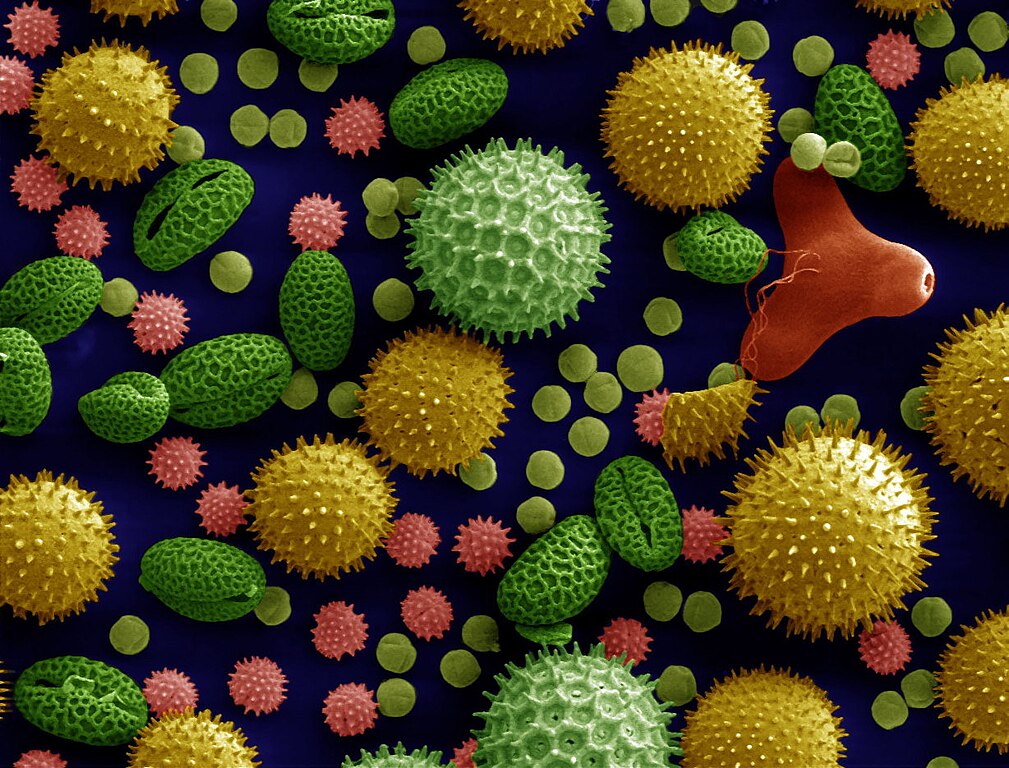
This image, entitled “colorized scanning electron microscope image of pollen grains from a variety of common plants” by Dartmouth Electron Microscope Facility, Dartmouth College], is in the public domain.
Pollen (Stephen Lewis; Sheila McCormick, 2013), or, more specifically a pollen grain is tough, incredibly tough, “Pollen has a virtually indestructible envelope” (p. 207 in Sérgio Augusto de Miranda Chaves, 2014). Much of that toughness is due to the presence of sporopollenin – “the diamond of the plant world” (James Dinneen) – in its outer wall (Grahame Mackenzie et al., 2015).
Sporopollenin is the reason why pollen can survive intact in the geological record for hundreds of millions of years (Mackenzie et al., 2015), and usable DNA can still be extracted from pollen grains that are thousands of years (Keith David Bennett & Laura Parducci, 2006), and even up to 150,000 years (Yoshihisa Suyama et al., 1996) old. A factor that likely contributes to persistence of DNA in pollen grains is the capacity of the sporopollenin to absorb ultra-violet (UV) radiation. In particular, sporopollenin can absorb UV-B radiation* (Wesley T Fraser et al., 2011), which can damage the plant’s DNA (Chen Shi & Hongtao Liu, 2021).
Although UV-B is a natural part of the electromagnetic spectrum produced by the sun – and is therefore something to which all terrestrial organisms can be exposed – it is not the only type of UV radiation from that source. The sun also emits UV-A, and UV-C, both of which – in addition to UV-B – can cause damage to living organisms**, particularly humans (Ryan Hopkins; Lynnea Walters).
Because exposure to UV is potentially so damaging to humans, people are advised – and strongly encouraged – to apply sunscreen [which is also known as sunblock, sun lotion or sun cream] to their skin to protect themselves***. Whilst these applications work – although with varying degrees of effectiveness depending on their formulation (Tabbie Wilson & Tiffany Turnbull) – and can protect the human wearer, they have unintended consequences for other forms of life.
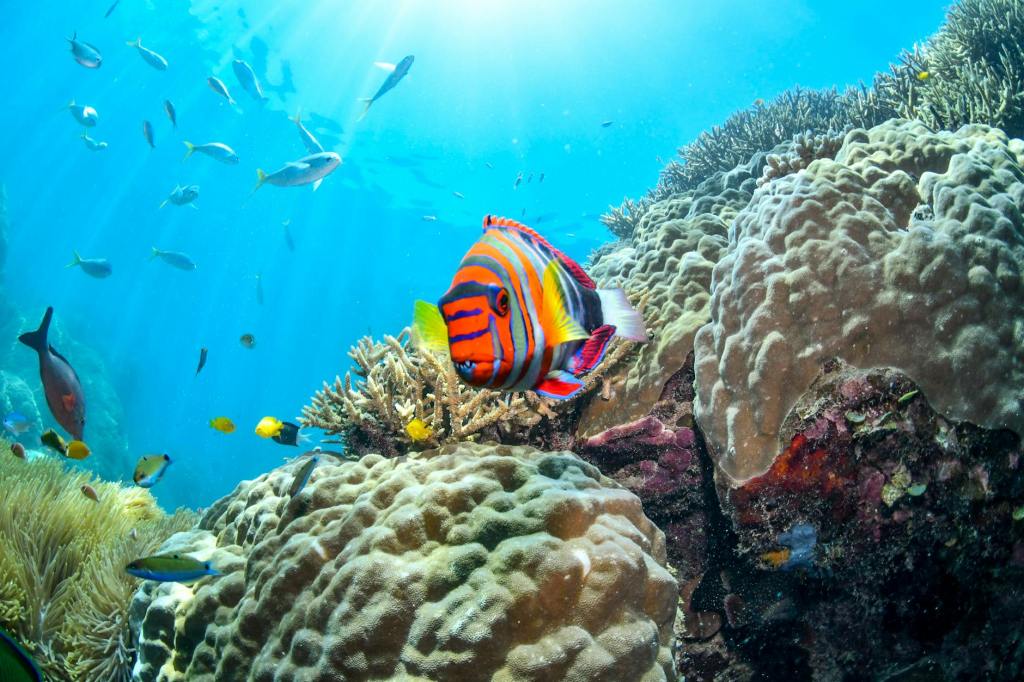
In particular, chemicals in sunscreen that is removed from the body and which ends up in the oceans can harm marine life (Helle Abelvik-Lawson; Victoria Heath; Lucy Picken). And one ocean-dweller that is particularly impacted by human-derived sunscreens is warm-water corals**** (Roberto Danovaro et al., 2008; Danielle Olson; Andy Brunning).
Recognising the environmental harm that traditional sunscreens can cause, and mindful of the UV-protecting property of sporopollenin, Chungmo Yang et al. (2025) have produced a new version of suncream*****, ******. Sporopollenin extracted from pollen of the tea plant (Camellia sinensis) was combined into a microgel (Matthias Karg et al., 2019), similar to that used in standard skincare products (e.g., here, and here).
Laboratory tests using human cells in vitro (Lynne Eldridge), and living mice, demonstrated that a microgel layer only a few microns (David Worgan) thick was effective in blocking UV-B light; i.e., preventing this damaging radiation from penetrating the microgel layer where/when it could cause damage to the skin beneath. In terms of its SPF (sun protectionfactor), the tea microgel formulation’s was about 27.
Not only was the tea pollen microgel found to be an effective UV filter, but it kept human wearers cool because the “pollen naturally absorbs less energy in the visible-to-near-infrared spectrum, which are the wavelengths mainly responsible for generating heat” (Andrew Paul). Although the cooling effect only lasted for about 20 minutes, “the amount of incident solar energy converted into heat is markedly lower for the microgel-coated surface relative to the commercial sunscreen film” (Chungmo Yang et al., 2025).
From a coral reef damage point of view, the team investigated the coral-bleaching capacity of the camellia pollen microgel compared to commercial sunscreen. Although they didn’t examine a coral reef ecosystem itself, they did examine the effects on an undisclosed species of Acropora coral [a genus within the Acroporidae family] which was selected as a representative coral “since they play an important role in reef-building and contribute to the formation of the coral reef framework while providing habitat and shelter for a wide range of marine organisms, including fish, invertebrates, and other reef-dwelling species” (Chungmo Yang et al., 2025).
Over a 14 day period, no bleaching of the coral was observed with the microgel formulation, and their natural colour was retained. This compares quite dramatically with the commercial sunscreen tested with which coral-bleaching was detected after two days, and the coral tissues were completely white on day 14. Noting that widespread bleaching of corals can “be reversed through regaining the symbiotic algae with the removal of environmental stressors [reference supplied], which in this case is in the form of toxic compounds [within suncreams]”, Chungmo Yang et al. (2025) suggest that “timely adoption of pollen microgel as a UV filter in sunscreens provides the opportunity for coral ecosystems to recover over time, potentially reinstating the natural balance across different ecologies”.
Pollen from sunflower (Helianthus annuus) was also investigated. Although it was as effective as tea pollen in protecting corals from bleaching, it only had a SPF of about 5. However, the success of the ‘pollen microgel’ approach leaves open the possibility that even more effective formulations might be found if more pollen-producing plants from nature are tested. But, with an estimated 369,400 species of flowering plants out there (let alone the 1,100 or so species of pollen-bearing gymnosperms (Christopher J Earle)), testing them all is a very tall order. But, that may not be necessary, because, as Chungmo Yang et al. (2025) recognise, “The primary raw material (i.e., Camellia pollen) is a renewable and agriculturally abundant resource, commonly collected from otherwise discarded or surplus floral biomass”.
For more on this story, see Andrew Paul, Shanna Hanbury, here, here, here, here, Yeom Hyun-a & Lee Young-wan, here, Ben Coxworth, here, Harry Cockburn, here, here, here, here, here, and Skyler Ware.
* The capacity of the plant to alter the amounts of this UV-absorbing material within pollen grains [Ed. – and spores of non-pollen-bearing plants such as club moss] has led to its use as a so-called proxy for estimating past UV levels in ancient environments (e.g., Barry H Lomax et al., 2008; Wesley T Fraser et al., 2011, 2014; Phillip E Jardine et al., 2016). [Ed. – which is a rather intriguing example of ‘forensic’ botany (Idalia Kasprzyk, 2023; Martha Sherwood) – in its broadest sense as a source of evidence to support a particular point of view].
** And it has even been proposed that UV-B may have had a major role in mass extinction of life on Earth (Charles S Cockell, 1999; Nilima Marshall; Feng Lui et al., 2023).
*** It’s worth mentioning here that many animals – including people – need some UV to help the body make vitamin D (Robert D Ashley), which is “essential for healthy bones and muscles”. Consequently, complete avoidance of UV light is not good for one’s health. However, and even using sunscreens, most people get enough UV to allow this health-promoting bit of phytophotobiochemistry to take place.
**** As if corals weren’t already under enough environmental pressure, a “catastrophic climate tipping point” (Graham Redfearn) has been reached which threatens the continued existence of these biodiverse communities (Jeff Tollefson; Paul Pearce-Kelly et al., 2025; Timothy M Lenton et al., 2025) is widely reported. And “Florida’s primary reef-building corals have been declared ‘functionally extinct’” (Jeff Tollefson).
By way of providing added value to this blog that mentions UV and coral reefs it’s worth stating that corals do have some in-built protection against both high levels of light generally (corals tend to be found in tropical regions that are generally areas of high light intensity) and UV radiation specifically (living relatively close to the ocean surface corals are at a depth where there is reasonable penetration of UV wavelengths (Patrick Neale; Zhongping Lee et al., 2013)). Their calcium carbonate skeleton offers some UV protection (Ruth Reef et al., 2009), whilst ‘chromoproteins’ produced by the coral polyp (Tamara Marshall) (that houses and hosts the endosymbiotic photosynthetic zooxanthellaealgae) provide protection against damagingly high levels of visible wavelengths (Edward G Smith et al., 2013).
***** That last-named author on this paper, Prof. Nam-Joon Cho, is the leader of the research team (at Nanyang Technological University, Singapore) that has quite a track record in developing bioinnovative uses of pollen. Previous innovations have included: a pollen-derived sponge that can absorb oil and other organic solvents from contaminated water sources (Youngkyu Hwang et al., 2021), pollen-based paper that is recyclable and reusable for digital printing (Ze Zhao et al., 2022), a pollen-based cryogel that can control bleeding (Jingyu Deng et al., 2024), and use of pollen in construction of drug delivery systems (Mohammed Shahrudin Ibrahim et al., 2025).
For a review of “Multifunctional material building blocks from plant pollen”, see Chenchen Zhou et al. (2024). And, for a scicomm article about the lab’s work, see Sandy Ong, and the group’s own introduction to their use of pollen in “Transforming Tomorrow with Material Innovations Today”. Finally, for more on Nanyang Technological University’s ‘cross economy’ approach [a system that transforms waste and resources into high-value materials, products, and services] – and which is exemplified by the pollen work, see here.
****** Another interesting use of pollen in terms of producing a coral-safe sunscreen is the approach taken by Silvia Tampucci et al. (2022). In that work, they used ‘pollen grains’ that had been hollowed-out to hold ethylhexyl triazone (Uvinul® T150), which is “an effective organic UVB filter, photostable and practically insoluble in water”. These sporopollenin microcapsules were investigated “both as a delivery system for ethylhexyl triazone and as an active ingredient by evaluating its photoprotective capacity” Silvia Tampucci et al. (2022).
As interesting as that work is it is rather undermined by the term ‘pollen grains’ that they use. Why? Because they actually worked with spores of the clubmoss Lycopodium clavatum, which are not pollen grains. Although the overall effect achieved with the spores may be similar to what may have been achieved had they used pollen – because both have a sporopollenin outer coat – it is surely important to get the name of the biomaterial employed right. Especially in a biomedical context that has health implications for those who might use the product.
REFERENCES
Keith David Bennett & Laura Parducci, 2006. DNA from pollen: Principles and potential. The Holocene 16(8): 1031; 10.1177/0959683606069383
Sérgio Augusto de Miranda Chaves, 2014. Pollen grains, landscapes, and paleoenvironments, pp. 205–222 (SciELO); https://books.scielo.org/id/zngnn/pdf/araujo-9788575415986.pdf#page=190
Charles S Cockell, 1999. Crises and extinction in the fossil record—a role for ultraviolet radiation? Paleobiology 25(2): 212-225; doi: 10.1017/S0094837300026518
Roberto Danovaro et al., 2008. Sunscreens cause coral bleaching by promoting viral infections. Environ Health Perspect 116(4): 441-447; doi: 10.1289/ehp.10966
Jingyu Deng et al., 2024. Plant-based shape memory cryogel for hemorrhage control. Advanced Materials 36(36): 2311684; https://doi.org/10.1002/adma.202311684
Wesley T Fraser et al., 2011. UV-B absorbing pigments in spores: biochemical responses to shade in a high-latitude birch forest and implications for sporopollenin-based proxies of past environmental change. Polar Research 30: 8312; https://doi.org/10.3402/polar.v30i0.8312
Wesley T Fraser et al., 2014. Pollen and spores as a passive monitor of ultraviolet radiation. Frontiers in Ecology and Evolution 2: Article 12; https://doi.org/10.3389/fevo.2014.00012%5D
Youngkyu Hwang et al., 2021. Colloid-mediated fabrication of a 3D pollen sponge for oil remediation applications. Advanced Functional Materials 31(24): 2101091; https://doi.org/10.1002/adfm.202101091
Mohammed Shahrudin Ibrahim et al., 2025. Allergen to asset: Pollen-based drug delivery systems. Advanced Drug Delivery Reviews 224: 115643; https://doi.org/10.1016/j.addr.2025.115643
Phillip E Jardine et al., 2016. Pollen and spores as biological recorders of past ultraviolet irradiance. Sci Rep 6: 39269; https://doi.org/10.1038/srep39269
Matthias Karg et al., 2019. Nanogels and microgels: From model colloids to applications, recent developments, and future trends. Langmuir 35(19): 6231–6255; https://doi.org/10.1021/acs.langmuir.8b04304
Idalia Kasprzyk, 2023. Forensic botany: who?, how?, where?, when? Science & Justice 63(2): 258-275; https://doi.org/10.1016/j.scijus.2023.01.002
Zhongping Lee et al., 2013. Penetration of UV-visible solar radiation in the global oceans: Insights from ocean color remote sensing. JGR Oceans 118(9): 4241-4255; https://doi.org/10.1002/jgrc.20308
Barry H Lomax et al., 2008. Plant spore walls as a record of long-term changes in ultraviolet-B radiation. Nature Geosci 1: 592–596; https://doi.org/10.1038/ngeo278
Feng Lui et al., 2023. Dying in the sun: Direct evidence for elevated UV-B radiation at the end-Permian mass extinction. Science Advances 9(1): eabo6102; doi: 10.1126/sciadv.abo6102
Grahame Mackenzie et al., 2015. Sporopollenin, the least known yet toughest natural biopolymer. Front. Mater. 2: 66; doi: 10.3389/fmats.2015.00066
Sheila McCormick, 2013. Pollen. Current Biology 23(22): R988-R990; https://doi.org/10.1016/j.cub.2013.08.016
Paul Pearce-Kelly et al., 2025. Considerations for determining warm-water coral reef tipping points. Earth Syst. Dynam. 16: 275–292; https://doi.org/10.5194/esd-16-275-2025
Ruth Reef et al., 2009. Coral skeletons defend against ultraviolet radiation. PLoS ONE 4(11): e7995; doi:10.1371/journal.pone.0007995
Chen Shi & Hongtao Liu, 2021. How plants protect themselves from ultraviolet-B radiation stress. Plant Physiol 187(3): 1096-1103; doi: 10.1093/plphys/kiab245
Edward G Smith et al., 2013. Screening by coral green fluorescent protein (GFP)-like chromoproteins supports a role in photoprotection of zooxanthellae. Coral Reefs 32: 463–474; https://doi.org/10.1007/s00338-012-0994-9
Yoshihisa Suyama et al., 1996. DNA sequence from a fossil pollen of Abies spp. from Pleistocene peat. Genes Genet Syst 71(3): 145-149; doi: 10.1266/ggs.71.145
Silvia Tampucci et al., 2022. Sporopollenin microcapsule: Sunscreen delivery system with photoprotective properties. Pharmaceutics 14: 2041; https://doi.org/10.3390/pharmaceutics14102041
Chungmo Yang et al., 2025. Nature’s guard: UV filter from pollen. Advanced Functional Materials: Online Version of Record before inclusion in an issue e16936; https://doi.org/10.1002/adfm.202516936
Ze Zhao et al., 2022. Recyclable and reusable natural plant-based paper for repeated digital printing and unprinting. Advanced Materials 34(19): 2109367; https://doi.org/10.1002/adma.202109367
Chenchen Zhou et al., 2024. Multifunctional material building blocks from plant pollen. Annu. Rev. Chem. Biomol. Eng. 15: 1–24; https://doi.org/10.1146/annurev-chembioeng-101121-085959

 Plant Cuttings
Leave a comment