Producing blog posts for plantcuttings.uk each week is hard work, and sometimes I lack necessary inspiration and any ‘oomph‘ to pen a piece. I’ve recently reached that point. Keen to maintain my weekly posting target, and not wanting to have to think too hard about a piece, I’ve given in to temptation and chosen the easy option. Accordingly, rather than come up with some original, in-depth post this week, I offer an item about some notable plant finds of 2025. The impetus – and idea – for that was provided by the article entitled “Fly-arousing orchid and zombie fungus among 2025 botanical and fungal finds” by Damian Carrington*. Although adopting this approach means that I don’t have to think too much about what to write, I do hope to be able to bring some cuttingsesque insights into my post.
So, in the spirit of ‘picking low-hanging fruit’ (Andrew Smith) – quite literally(!) – first up we have…
A rodentophilic tree…
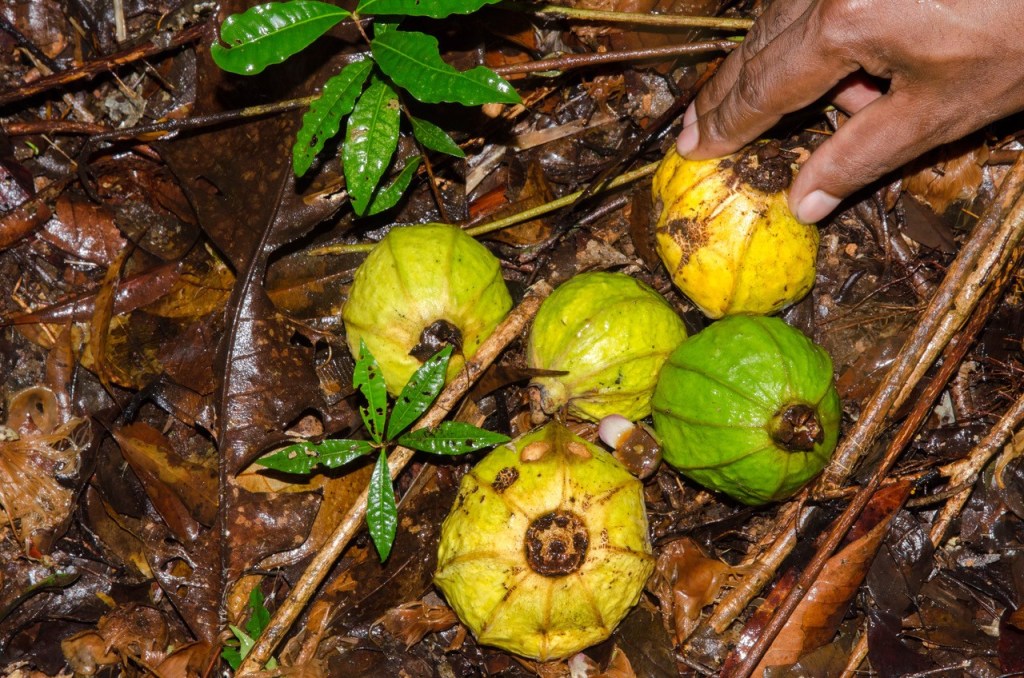
You’ve got to be intrigued by any plant whose opening line in the scientific paper announcing its ‘naming by science‘ begins with “Flagelliflory, a rare form of cauliflory, refers to plants with long whip-like branches, or flagella, on the main trunk that bear inflorescences” (Yee Wen Low et al., 2025). The botanic in this instance is Eugenia venteri, an evergreen tree that can grow to almost 20 metres, and is known from Manus Island in Papua New Guinea (Low et al., 2025).
One of the most notable features of this plant is its flowers. Not only do they emerge directly from the stem (the phenomenon known as cauliflory (WP Armstrong)), but they reside at the ends of whip-like branches that are attached to those flower-bearing stems (the aforementioned conditioned of ‘flagelliflory’). The flagella grow along the ground, and consequently the fruit that develop from their flowers is to be found at ground level. Whilst its soil-sited location seemingly makes it easy for people to harvest, little appears to be known about its nutritional value (or otherwise) apart from the fact that “The collector noted that mature fruits of Eugenia venteri have a somewhat palatable taste of guava intermixed with banana and an eucalyptus flavour aftertaste” (Low et al., 2025). [Ed. – the collector in question is “Stephanus ‘Fanie’ Venter, a botanist and naturalist who led the discovery and collection of all currently known material of this species” [Ed. – and after whom the species is named**, but who is not listed as one of the authors of the paper documenting this new species…].
What is known is that the low-growing nature of the fruit makes it suitable “to be pollinated and dispersed by non-flying mammals, such as bandicoots and native rat (Guy Musser) species of Manus Island” (Low et al., 2025). [Ed. – the latter group of animals gives us the technical terms ‘rodentophily’ [like entomophily, but with rats instead of insects] when these animals are involved in pollination, and ‘rodentochory’ [a type of zoochory, but with a named group rather than animals generally…]
Another – bloody – orchid…
The approx. 369,400 species of flowering plants are divided amongst approx. 400 families. But those species are not evenly spread in each family (Michelle Nakano). For example, the Amborellaceae [families of flowering plants end with the suffix ‘aceae’] has only a single species, Amborella trichopoda. Whereas the grass family, the Poaceae, contains around 12,000 species (David Simpson).
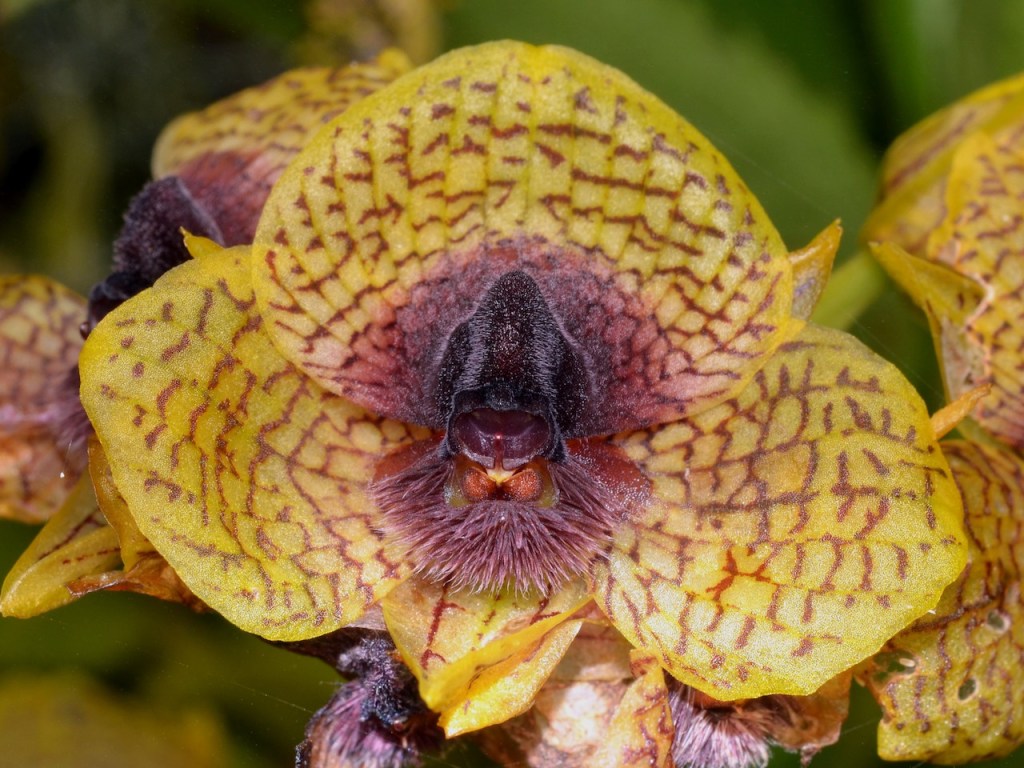
But, the angiosperm family with the greatest number of species is the Orchidaceae (the orchid family), with approx.28,000 (William Cetzal Ix et al.), or even 30,000 (Irina Druzhinina) species. However, not satisfied with that record-breaking number, botanists named yet another one in 2025***, the so-called “blood-stained orchid” (Kettley & Cheek), Telipogon cruentilabrum (Gabriel A Iturralde et al., 2025).
Although proposed as a new species in 2025, it had actually been present amongst collected orchid material from at least 1988 when it had been identified as Telipogon dendriticus. Closer inspection revealed that it had been misidentified leading to its recognition as a species new to science. [Ed. – it’s always comforting to know that plant taxonomists are only human and as fallible as the rest of us…]. One can only wonder how many other species – not just of orchids – may lie misidentified in herbaria around the world. Re-examining such specimens is likely to increase the number of known flowering plant species – probably quite considerably. [Ed. – and that’s on top of an estimated 35,000 species (Neil Bowdler; Diana Gitig) within herbaria that haven’t yet been named.]
Incendiary inspiration…
Have any readers seen “Howl’s Moving Castle”? No, neither have I. But, it is, apparently, “acclaimed animator Hayao Miyazaki’s 2004 classic” (Andrew Paul). Why do I ask?
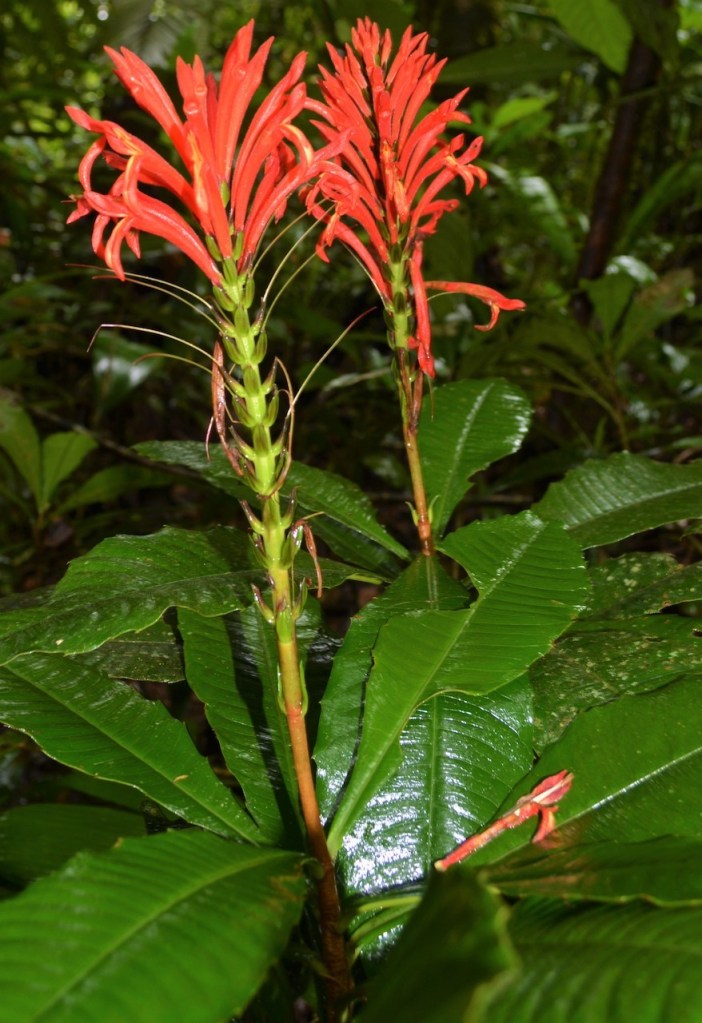
Its relevance in this post is that a new species of Aphelandra, Aphelandra calciferi, has been named after ““Calcifer”, the fire demon in the film “Howl´s Moving Castle” (Miyazaki, H., 2004. Howl’s Moving Castle [Film]. Studio Ghibli, Japan), whose vibrant coloration bears a striking resemblance to the corolla colours of this species” (Rosa Villanueva-Espinoza & John RI Wood, 2025) [Ed. – and the specific epithet is itself immortalised in the plant’s English common name of “The fire demon flower” (Kettley & Cheek)]. Which etymological exactitude gives you some insight into the mind of those who name new plants. [Ed. – at the other end of the scale, a second new species of that same genus – and reported in the same scientific article – Aphelandra floribunda, is more conservatively – and taxonomically-traditionally – so-named by reference “to the abundant flowers in each cluster” (Villanueva-Espinoza & Wood, 2025)].
Stone the crows (Gary Martin)..!
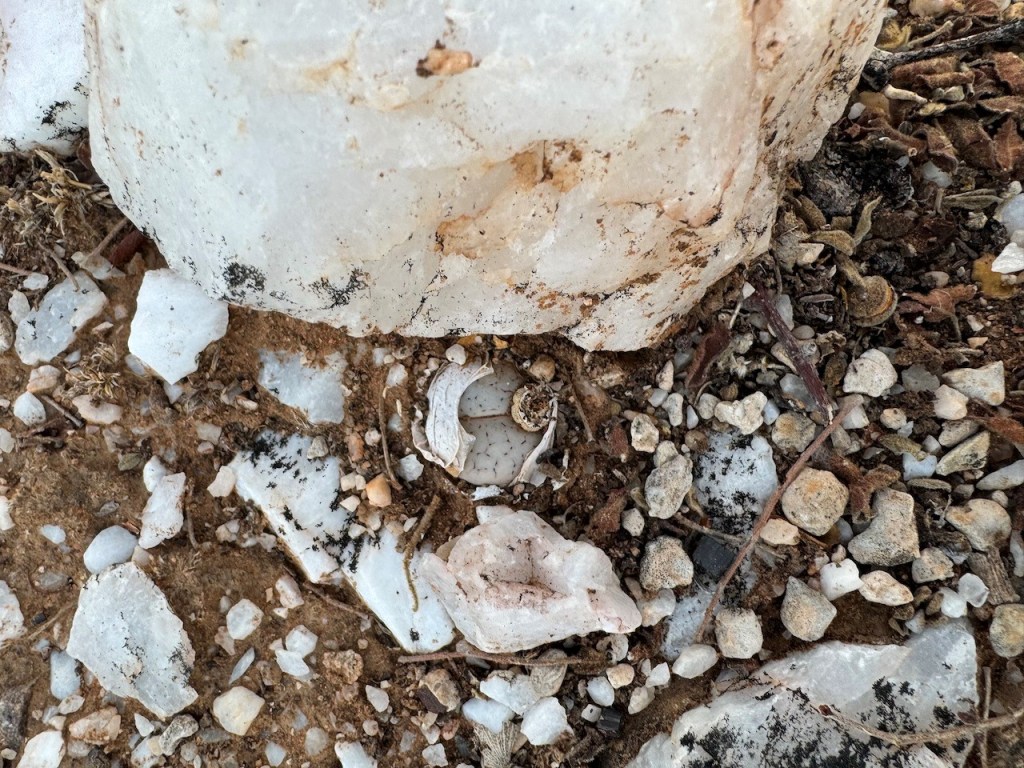
A plant not mentioned by Carrington, but highlighted in “Kew’s top 10 new species of 2025” by Sebastian Kettley & Martin Cheek, is Lithops gracilidelineata subsp. mopane. It differs from the other botanics in that list because it isn’t a new species. Instead, it’s a new sub–species (Michael A Patten, 2015; Mihai Andrei; Jamie Revell) [Ed. – that’s what the ‘subsp.’ is short for] – although it is more usually abbreviated to ‘ssp.’].
This subspecies is distinguished from other subspecies of Lithops gracilidelineata because it is “limited to a higher rainfall area with ‘mopane’ woodland (Paddy Pacey; Ida Rigby). It also differs from similar subspecies in having smooth, whitish grey leaf surface rather than a sculptured appearance and a cream or brownish pink colour” (Kettley & Cheek).
That specific taxonomic distinction is one reason why I’ve chosen to mention that plant in this post. The other reason is because it’s a member of a curious group of plants known as ‘living stones’ (Susan Mahr)****. As explained by Kettley & Cheek, living stones are “a group of plants famous for their stone-like camouflage. Although at first glance, they appear to be no more than a pebble, lithops are succulents with a single pair of leaves that admit light though an upper ‘window’ into the internal photosynthetic surfaces. The plants bear a single, daisy-like flower”.
If Lithops gracilidelineata subsp. mopane remains geographically, and ecologically, isolated from other sspp., it may, in time, become so different that it achieves the elevated status of species (Vanessa Bieker; Jamie Revell) rather than retain the subordinate rank of subspecies. Whether then we will be able to hail it as a new species for whatever year it becomes so-considered, is probably a moot point (Kelly Konya)…
Well, the task of penning this post proved considerably more interesting – and satisfying – that I initially imagined. So, thank you Mr Carrington for the impetus to put digit to keyboard on this occasion. Botanical blogging ‘mojo’ restored. And a belated happy new year to all!
* Somewhat disappointingly, the genus Eugenia (Melissa Petruzzello) is apparently named after Prince Eugene of Savoy [according to Wikipedia] rather than Eugenie, “a semi-legendary 3rd-century saint who escaped persecution by disguising herself as a man” (quoted from here).
** For completeness, Carrington tells us that information for his article was sourced from a “list of 10 “weird and wonderful” new species, produced by scientists at the Royal Botanic Gardens (RBG), Kew and their international partners, who together named 125 new plants last year.” Reading that source publication I also find that the same group named 65 fungi as new to science. Much as I like fungi, I focus only on the true plants in this post for conciseness.
For some other views on – and images of – that ‘2025 Kew list’, see Andrew Paul, Lisa Lock, and Liz Kimbrough.
*** In the spirit of “why did the Divine Propagator create so many orchids” [Ed. – presumably because of an inordinate fondness for them – but not as much as for beetles..?], readers will be pleased to know that “Telipogon cruentilabrum is one of four new rare and spectacular Telipogon species described in 2025…” (Lisa Lock)…
**** This living stone is not to be confused with a ‘living rock’ (Laura Baisas), which is technically known as a microbialite (Alfredo Yanez-Montalvo et al., 2019; Ed Landing & Markes E Johnson, 2024).
REFERENCES
Gabriel A Iturralde et al., 2025. Telipogon cruentilabrum (Orchidaceae: Oncidiinae): a new species from mid-western Ecuador, long misidentified as T. dendriticus. Phytotaxa 694(3): 271–280; https://doi.org/10.11646/phytotaxa.694.3.6
Ed Landing & Markes E Johnson, 2024. Stromatolites and their “kin” as living microbialites in contemporary settings linked to a long fossil record. J. Mar. Sci. Eng. 12: 2127; https://doi.org/10.3390/jmse12122127
Yee Wen Low et al., 2025. Eugenia venteri (sect. Jossinia, Myrtaceae): a new flagelliflorous tree from the rainforest of Manus Island, Papua New Guinea. Kew Bull 80: 733–743; https://doi.org/10.1007/s12225-025-10264-1
Michael A Patten, 2015. Subspecies and the philosophy of science. The Auk 132(2): 481–485; https://doi.org/10.1642/AUK-15-1.1
Rosa Villanueva-Espinoza & John RI Wood, 2025. Two new species of Aphelandra (Acanthaceae) from Peru. Kew Bull (2025); https://doi.org/10.1007/s12225-025-10334-4
Alfredo Yanez-Montalvo et al., 2019. Microbialites: What on Earth? Front. Young Minds 7: 112; doi: 10.3389/frym.2019.00112


 Plant Cuttings
Leave a comment