

Image from the site’s home page.
A happy – if somewhat belated – birthday to us, plantcuttings.uk*. This uncategorized post looks back at the second year of the blog.
Plant Cuttings and AI
In response to my 4th April 2025 post about the phytoplankton paradox, I was taken to task on the social media platform Bluesky (Tom Ambrose)** regarding the image that promoted the item. The concern expressed by a user was that use of “generative AI images” was “sloppy and bad – algae don’t look like colourful balls of plastic”. As a reminder, the image in question – which was generated by AI [Artificial Intelligence (Paul Sargeant, Cole Stryker & Eda Kavlakoglu) – is shown below:
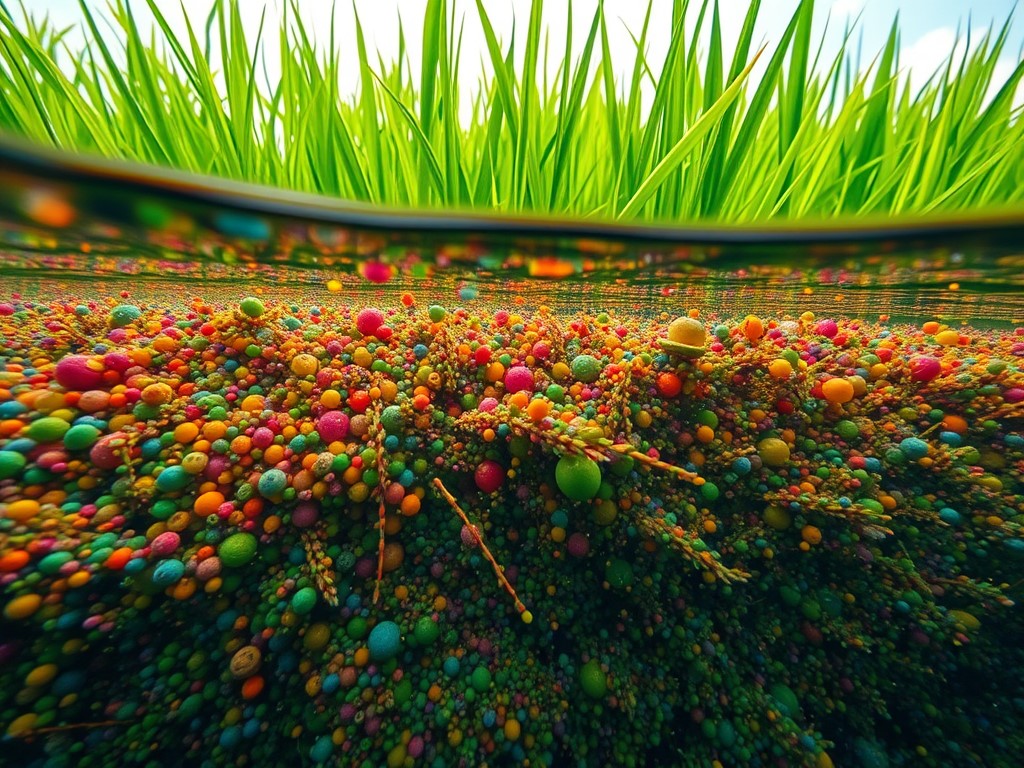
Entitled “The phytoplanktonic paradox [From algae to rice plants…I]”, that post was the first of a trilogy that began by looking at marine micro-algae and ended, in part III, with a consideration of terrestrial rice plants and response to virus infection. The concerned Bluesky commentator went on to say that “At the moment generative AI has problems making scientifically accurate illustrations – the output will always be misleading.” Whilst I understand the assertion, the images at the top of my posts have always been chosen purely as attractive, copyright-free images [whether AI-generated or from the bank of images the WordPress site makes available] to ‘beautify’ and promote the post [Ed. – they are the image that accompanies the short piece of text that’s eMailed to subscribers to alert them to a new post on the blog]. In that sense they are – and should be seen as – more “artistic interpretation” – and are not intended to be “photorealism” – as the individual who responded to the critical commentator’s original comments on Bluesky rightly recognised.
On that occasion – the 4th April, 2025 post – the image was generated by AI and was its attempt to represent the overall ‘aquatic algae to land-based rice’ nature of the series of posts. It tried, but didn’t do that well, essentially trying to show algae and rice plants. I therefore have to agree that its rendering of the micro-algae as being “like colourful balls of plastic” is not at all realistic. And, furthermore, that would be misleading if one intended this image to be used “to teach people about science” – as the critical commentator stated. But, that post’s leading image should not be interpreted in that educational sense. The image that is intended to properly reflect the post – and that I’m happy to be interpreted as having educational value – is the second one in a post, which is the cover of the book (for a book review), or a source-disclosed photograph or relevant graphic for a ‘cutting’.
I hope that allays the fears of those who may wonder about the relevance and intention of the images that accompany a post on this site. Mindful of the potential for readers to be misled by these AI-generated images, having had it pointed out to me, I will endeavour to ensure that isn’t the case, and now take a more critical approach to choice of these graphics/illustrations.
Whilst on the topic of AI, it is worth making it clear here that the text of a post is not written by AI; the words such as they are – and for better or worse – are mine own. However, I do use AI to draft the summaries of a post that are eMailed to subscribers. It’s a facility that’s available on the WordPress site that hosts the blog, and one that I’m grateful for [Ed. – as readers of the blog may have concluded, Mr P Cuttings is not always known for his succinctness, so any tool that can help him summarise the content of a post is to be welcomed…]. Regarding the costs of using AI and environmental concerns, I’m heartened by Stephen Heard’s insightful article on his Scientist Sees Squirrel blog that I’m not ‘burning down the planet’. But I will nevertheless endeavour to use AI as sparingly as I can.
Guest blogging(!)
Not only was Mr Cuttings busy writing material for his own blog, he also contributed a post to the Plant Life Belowground site, a blog run by “a group of plant ecologists interested in knowing all things about plant life belowground”. My post there on 12th February 2025, entitled “When is a rhizome not a rhizome?“, developed ideas previously aired on my own blog in the “What’s in a name? The case of Barnes’ stolon” item. [Ed. – before readers are left awestruck with the impression that Mr Cuttings is now so famous in the blogosphere that he was personally contacted directly – and unsolicitedly – by that blog to contribute a guest piece, we should make it clear that Mr PC responded to a general invitation to anybody in the whole world to contact the site’s administrator – Curtis Lubbe – if interested in contributing a post to the Plant Life Belowground site…]
It’s all about the numbers…
Well, it’s not – or, rather, it’s not supposed to be – but we do like some ‘stats’ on this site. So, I’m pleased to report that the number of subscribers to plantcuttings.uk was 136 on 7th October 2025. That contrasts with approx. 119 on the site’s first birthday. We are still growing: Yay! But, I’d always like more subscribers. So, please, do feel free to spread the word about the site and encourage anybody you can to visit the site and sign-up. And, a big thank you to those who have already signed up! I trust the content continues to be appreciated by my loyal readers.
In terms of ‘popularity’ of posts, I’m told that the post from 14th March, 2025, “When is a lichen not a lichen?“, was the “most popular [on this blog] in the past year”, with a most heartening 490 views (as at 7th October, 2025). [Ed. – if only each of those views could be translated into a subscriber…] And 18 posts achieved more than 100 views, each.
As per the intention of the site, a post was published each Friday at about 5 pm. In total that was 52 posts: 35 plant cuttings, 16 book reviews, and one ‘uncategorized’ item [the post celebrating the site’s first anniversary]. Book topics covered included: remarkable plants and remarkable trees, botanical medicines, the psychology of gardens, a textbook on cryptogams, and a couple of books about fungi. Cuttings ranged over subjects as diverse as: the origins of the potato, 18th century embalming, ‘talking trees’, wood (quite a lot of ‘woody posts’ actually…), volcanology, microplastics, sand-farming in the Levant, a trio of items with a prickly theme, and Linnaeus and the invention of binomial nomenclature. A suitably eclectic mix, I trust, and one I hope to continue into the site’s third year.
Penultimately…
For the past several cuttings items I’ve added “For more information on this topic, see…” paragraphs, which provide links to articles, press releases, blog posts, etc., by other commentators on the subject of the relevant post. By providing access to more on a story – or different interpretations, etc. – Mr P Cuttings would probably like to grandly claim that that’s a philanthropic gesture on his part as an additional contribution to increasing the general public’s botanical literacy. In reality, it’s primarily an opportunity to use the numerous additional links he’s unearthed while researching a particular topic [Ed. – Mr P Cuttings doesn’t like ‘waste’, especially relevant material about a topic. Think of these links as the ‘bibliography’ that supplements the references actually used and cited within the body of the post…]
And finally…
Thank you all again for sticking with the blog! If you’ve got a small fraction of the pleasure out of reading the posts as I have in writing them, then I consider that a job well done, and a good win-win.
Cheers!
* The actual ‘birth’ date was 7th October. But the nearest Friday after that date – the 10th October [it’s wrong to celebrate an anniversary in advance] – had been reserved for my appraisal of In the circle of ancient trees to coincide with the book’s publication date, so the 17th October posting slot was the next available date…
** Mr Plant Cuttings is on Bluesky, with the handle @plantcuttings.bsky.social. [Ed. – he’s also on what he continues to call Twitter as @NChaffey]


 Plant Cuttings
Leave a reply to Stu Cancel reply