
In the Circle of Ancient Trees: Our oldest trees and the stories they tell, edited by Valerie Trouet, artwork by Blaze Cyan 2025. Riverside Press.
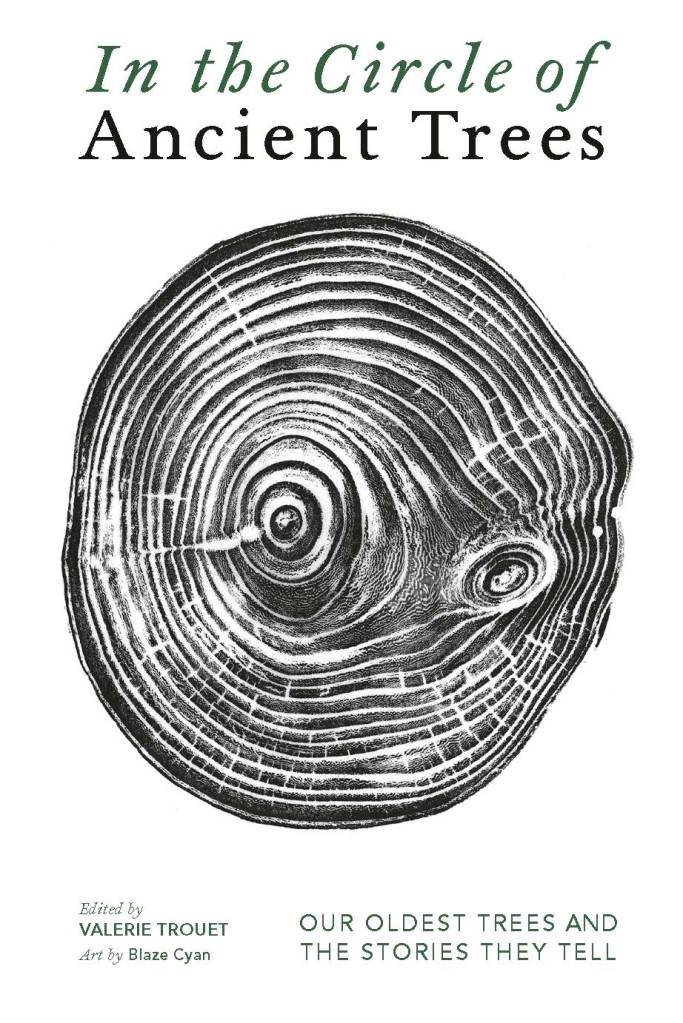
I previously had the pleasure of reviewing Valerie Trouet’s Tree story. When invited to do the same for her edited tome entitled In the Circle of Ancient Trees [hereafter termed Circular trees], I was – understandably – keen to accept. I was not disappointed. This is my appraisal of that book.
What the book is about
Circular trees is concerned with dendrochronology (Marcia Cook et al., Anne Crone et al.), the science that extracts information contained within tree-rings, annual patterns of growth present within the stems (and also roots…) of trees. The book is also about dendrochronologists, the scientists who study those tree-rings to uncover that information.
Although Circular trees considers scientific techniques and principles of dendrochronology, the authors explain those in sufficient detail for readers to understand their relevance and to be able to appreciate what they contribute to the book’s overall narrative. Additionally, Trouet’s Introduction Is a great scene-setting section providing very good accounts of tree anatomy, especially of wood formation, the history of dendrochronology and how it works as a scientific discipline, and the relevance – and crucial importance – of cross-dating [all of which concepts are further developed in the chapters that follow].
In terms of context, Trouet tells us that “fellow dendrochronologists from all over the world tell the stories of the ten extraordinary tree species that inspired them and that are inseparably intertwined with their professional paths” (p. 15). Amongst numerous examples of the achievements of dendrochronology, there are a lot of human interest stories too, both about the contributing scientists [e.g., how they became interested in dendrochronology] and how the information recorded within tree-rings relates to local or even global events of human value and importance. The flip side of that is a major theme running throughout the chapters which documents how human-related phenomena such as climate change are reflected in the tree-ring history. This account of the scientific investigation of tree-rings therefore has a very strong people element; Circular trees is a great example of a plants-and-people book.
The book in a little more detail…
Each chapter has a formulaic start: the common name of tree as used in the book; name(s) of chapter author(s) [all but that devoted to Qilian juniper are single-authored]; scientific name of tree [sometimes stating the Authority (Robert Fagen), but more usually not]; location [or geographical range of the tree in question]; and estimated age. At 22 pages the longest chapter belongs to giant sequoia; other chapters are either 20 or 18 pages long.
The chapters (which are best thought of as tree essays) are usually beautifully crafted and written. Memorable sections were the first paragraph of Momchil Panayotov’s account of Bosnian pine, and this wonderful imagery of qilian juniper: “Its gnarled and twisted stem and hat-like crown give it the appearance of a petite and weathered poet, standing at the crossroads of the ancient Silk Road” (p. 150). With writing and imagery such as that, this book is not only highly readable, it was a pleasure to do so. In addition to the text (with useful sub-headings to aid navigation), a whole page of each chapter is devoted to an approx. half-page pen-and-ink illustration of the featured tree by artist Blaze Cyan (with some interpretative text)*.
All of the tree accounts are fact-filled – which is good, but an issue is how to relate the facts provided in-text to, what are assumed to be, their sources in the Further Reading collection. Doing so is neither obvious nor easy, and this reviewer seriously doubts that all of a chapter’s facts will be sourced by the comparatively few sources cited. This is probably the book’s main flaw. Examples of facts that require sources are the following statements**: “Part of the legacy of being a conifer is a greater ability than in most flowering plants to foster the soil fungi mycorrhizae” (p. 176); “There are about three trillion trees across the forests of the planet” (p. 190); “Since woody trees first appeared around 380 mya” (p. 192); and “On average, a molecule of carbon captured by photosynthesis and stored in alerce wood takes 1,400 years to return to the atmosphere through decomposition” (p. 203).
Naming names (1)…
Of the 10 trees highlighted in the book 8 are gymnosperms (T Delevoryas), more specifically conifers (James Emory Eckenwalder) – which includes two Pinus spp., and a genus – Taxodium.
The conifers are: giant sequoia (Sequoiadendron giganteum); Bosnian pine (Pinus heldreichii); Clanwilliam cedar (Widdringtonia cedarbergensis); kauri (Agathis australis (D.Don) Lindl.); bald cypress (Taxodium spp. (L.) Rich.); qilian juniper (Juniperus przewalskii Kom); Great Basin bristlecone pine (Pinus longaeva); and lañiwal (which – uniquely in the book – is the nickname of a single representative of alerce cypress (Fitzroya cupressoides)).
The two angiosperms (Arthur Cronquist & Paul E Berry) are pedunculate oak (Quercus robur L.), and cedor (Cedrela odorata).
The trees selected represent a wide geographical spread, with representatives from southeastern Europe; California; South Africa; Aotearoa New Zealand; southeastern USA, Mexico and Guatemala; ‘most of Europe’; Central and South America and the Caribbean; Qinghai-Tibet Plateau, California, Nevada, Utah; and Chile. The great value of the showcased trees to dendrochronology is that they live for a long time. In terms of ages of the book’s trees varies, from 400-600 years (Clanwilliam cedar), to the bald cypress’s >2,600 years, and 5,000 years for the Great Basin bristlecone pine.
Don’t forget the timeline…
Each chapter also features a timeline for the showcased tree that superimposes relevant dated information on top of a highly-stylised cross-section of a tree trunk showing very regular, concentric circles that represent tree-rings. The information displayed differs for each tree, but includes such information as: oldest dated ring for the species; extreme drought years; major fire in the area; date at which Cederberg was set aside as cedar reserve; oldest dated tree ring from a kauri building timber; worst drought in nearly 800 years in Virginia; fire scar from intentional burning to protest laws restricting the use of the woodlands; one of the biggest floods in the Amazon’s history; dry period – closure of the Silk Road; C14 spike at MWK [Methuselah Walk] – major solar storm; and CO2 fertilisation effect [from elevated atmospheric CO2 concentrations] on growth is detectable. Which brief catalogue of environmental – and human-related – events and phenomena gives a pretty good illustration of the sort of information that can be gleaned from the tree-ring record and which is told in more revealing detail in their individual tree accounts.
Naming names (2)…
Although edited by Valerie Trouet – and whose name is shown on the book’s cover, Circular trees would not exist without the chapters contributed by the authors, who deserve to be named and thanked for their part in making this book what it is. It’s also helpful to provide some indication of their academic credentials, which appear impeccable, and fully justify their contribution to this collection. All 11 authors have been involved with tree-ring research for many years and bring that great wealth of experience – and love of their discipline – to the tree stories that they tell so well in the book’s 10 chapters.
By name [and the tree they write about] they are as follows [and which information is borrowed from p. 223 of the book because I couldn’t find it anywhere else, e.g. online]: Thomas W. Swetnam [giant sequoia] studies forests, climate and human history using dendrochronology, and is Regents’ Professor and Director Emeritus at the Laboratory of Tree-Ring Research, University of Arizona; Momchil Panayotov [Bosnian pine] is an Associate Professor at the University of Forestry in Sofia, Bulgaria who teaches dendrology and related disciplines; Edmund February [Clanwilliam cedar] has a Masters in Archaeology, a PhD in Botany and a lifetime commitment to the Clanwilliam cedar, and is now retired as a Professor of Biology at the University of Cape Town; Gretel Boswijk [kauri] is an Associate Professor at Te Kura Mātai Taiao School of Environment, Waipapa Taumata Rau University of Auckland; Matthew Therrell [bald cypress] is a Professor of Geography at the University of Alabama whose primary research focus is on using tree-ring records to help understand how past climate variability has affected society and the environment; Marta Domínguez-Delmás [pedunculate oak] is a Senior Researcher at Naturalis Biodiversity Center and the Cultural Heritage Agency of the Netherlands [Ed. – and author of this reviewer’s favourite chapter…]; Daniela Granato-Souza [cedro] specialises in dendrochronology in the areas of dendroclimatology and dendroecology in tropical and temperate forests, with a focus on the Amazon; Bao Yang [qilian juniper] is Professor of Physical Geography at the School of Geography and Ocean Science, Nanjing University; Feng Wang [qilian juniper] is a Postdoctoral Researcher in the Department of Geographical and Sustainability Sciences at the University of Iowa; Malcolm K Hughes [Great Basin bristlecone pine] (Regents’ Professor Emeritus, University of Arizona) is a British ecologist who moved to Arizona in 1986 to direct the Laboratory of Tree-Ring Research; and Jonathan Barichivich Henríquez [alerce cypress] is a Senior Scientist at CNRS (France) specialising in climate and global ecology.
Further Reading
Consists of three pages of 3-columned entries divided up by chapter. The number of sources cited for a chapter varies, from 3 (re cedro) up to 9 for pedunculate oak; more usually there are 5-8 sources per tree. Mainly these items are scientific articles, but also featured are web sites and books. Eleven of these sources are dated post-2019, which gives some indication of how up-to-date they are.
There is no explicit indication in-text to indicate how stated sources relate to any of the statements made – except, very occasionally, when the author refers to publication of such-and-such of their work in-text with sufficient information that the reader can match that to the stated source.
Index
Comprises approx. 3.5 pages of 3-columned entries, from ‘Adams, Rex’ to ‘Zhuo, Zhengda’. All of the featured trees are listed here – but only by common name [Ed. – the only scientific name in the Index is Phytophthora agathidicida (PTA), a disease-causing organism of some of the trees]. To give readers an indication of the subjects covered within the book, here’s a short list of some indexed terms: Amazon rainforest; avalanches; bog oaks; carbon sinks; climate change; cold snaps; deforestation; drought; earlywood; El Niño-South Oscillation (ENSO); false rings; fire scars; frost rings; General Sherman; gymnosperms; Huilliche people; Hurricane Ivan; insect attacks; International Tree-Ring Database; IUCN Red List of Plants; jet stream; La Niña; logging, alerce forests; Medieval Drought Period; mycorrhizae; Nahua culture; Notre-Dame; old-growth timber; parenchyma cells; Polo, Marco; Qinghai-Tibet Plateau; radiocarbon dating; reaction wood; sapwood; shipbuilding; stable isotopes; tree rings; Underwater Forest; volcanic eruptions; wildfires; and Younger Dryas.
Summary
In the Circle of Ancient Trees edited by Valerie Trouet is a great book. If you have any interest in trees generally – and/or dendrochronology more specifically – and/or plants-and-people stories, you are strongly encouraged to get hold of a copy.
* However, and although well-executed, the frequent instances of inclusion of cross-sections of trees that are repeated throughout the book – e.g., there are six such images in the Clanwilliam cedar chapter – gets a little wearing [Ed. – altogether, I counted 45 of them…]. That sense of fatigue is not helped by the ‘warning’ on p. 224 that advises: “Tree-ring engravings are purely decorative and do not represent the specific tree species for any chapter”].
** An interesting issue in this regard relates to lack of sources for the word ‘snags’, which, we are told on two occasions in the book, by different authors, is a term used for “standing dead trees” (re giant sequoia on p. 32, and in connection with Great Basin bristlecone pine, on p. 179). What’s interesting is that Alison Pouliot uses the term ‘stags’ for the same features in her book Funga obscura, and which fact is similarly unsourced. So, which is correct, ‘stags’ or ‘snags’? Or, are both terms correct? Without any indication of sources – for either interpretation – we can’t know. Which is another reason why a statement’s sources should be stated…
[Ed. – A very quick internet search finds that – overwhelmingly [100% of sources found] – ‘snag’ is the correct alternative term for a dead, standing tree. See Ryan Davis, Anna Stockstad, Wendy Leonard, here, Steve Lundeberg, Dave Anderson et al., here, here, here, here, and here…]


Leave a Reply