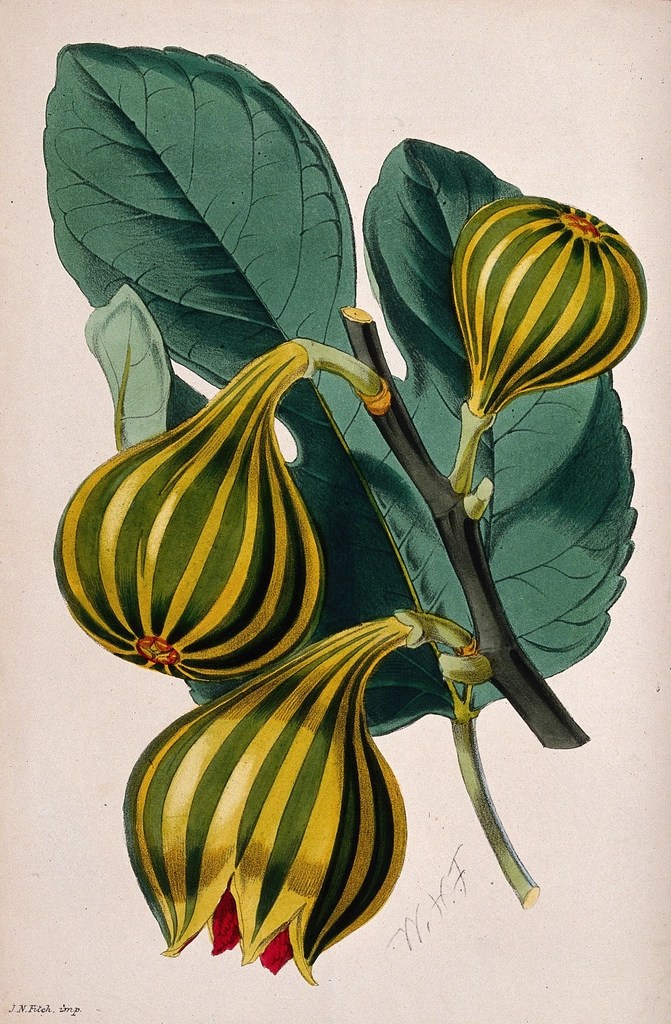

This image, captioned “Foliage and fruit [of the fig tree] drawn in 1771” [from here] is in the public domain.
Regular readers of this blog will know that Mr P Cuttings is a big fan of words (and plants). In keeping with that, and combining both interests, he’s pleased to introduce you to the term ‘ergastic substances’ this week.
Ergastic substances
The contents of a plant cell can categorised as ‘living inclusions’ and ‘non-living inclusions’ (G Priscilla Sweetlin). Living inclusions include the cytoplasm and organelles such as the nucleus, endoplasmic reticulum (ER), chloroplasts, and mitochondria. The non-living inclusions, which comprise organic or inorganic substances that are metabolic by-products of the cell, are also called ergastic substances. Ergastic substances* (or ‘cell inclusions’) are found in cytoplasm, vacuoles and cell walls and are grouped into three broad categories – reserve materials, secondary materials, and excretory materials (or ‘waste products’) (N Sannigrahi; Manasvi Gupta). [Ed. – * For more on ergastic substances, see here, here, here, Diaa M Eliman, here, here, Suresh Babu Emandi, N Sannigrahi, Manasvi Gupta].
Context
Before we consider a particular role of an ergastic substance in figs, we need to set the scene.
Trees [Ed. – what is it with Mr Cuttings and trees..?] can live a long time (Sophia Huang, Robin Lloyd). As such the carbon dioxide they’ve extracted from the atmosphere for use in photosynthesis to fuel their growth, etc. is stored in their organic parts – e.g. cell walls – for as long as the tree lives. This is why trees are useful sinks for atmospheric CO2 (Calvin Norman & Melissa Kreye, Sarah Ruiz) and therefore of great help in trying to regulate how much CO2 accumulates or remains in the atmosphere, which build-up contributes to global warming and climate change (Sarah Fecht, Rebecca Lindsey, Denise Chow & Chase Cain). But, as the trees undergo decomposition after death, the carbon that’s been locked away for maybe hundreds or thousands of years (e.g., Katie Serena) is released back into the atmosphere (Simone Webber)…
Ergastic fig trees…
However, research* reported by Mike Rowley at the 2025 Goldschmidt Conference in Prague (Czechia) has highlighted the potential for some trees to continue to act as carbon sinks long after they die. And that’s where ergastic substances re-enter the story.
Examining three fig species** in Kenya it was discovered that the trees contained calcium carbonate – an inorganic carbon (Ingar Wasbotten & Oda Wilhelmsen)-containing mineral – “both on the surface of the tree and within the wood structures”. Although calcium carbonate can be produced directly by plants as an ergastic substance (Manasvi Gupta), the calcium carbonate in this instance had probably been converted to that form by microbes [known as oxalotrophs] that decomposed crystals of calcium oxalate*** – another ergastic substance (Manasvi Gupta) that the plants had made.
Whilst this feat of microbial chemistry is well-known, and documented as the ‘oxalate-carbonate pathway’ (Eric P Verrecchia et al., 2006; Shameer Syed et al., 2020; Don A Cowan et al., 2024), its potential role in the biology of fig trees wasn’t.
Turning trees to stone…
Rather than being a gentle chemical transformation from oxalate to carbonate which may hardly be noticed, “A large part of the trees becomes calcium carbonate above ground,” says Rowley. “We [also] see entire root structures that have pretty much turned to calcium carbonate in the soil where it shouldn’t be, in high concentrations” (Alex Wilkins). Notably, calcium carbonate is the main component of the rock known as limestone (Tibi Puiu), which is why many of the scicomm reports about this phenomenon refer to such things as “Fig Trees That Grow Rocks From Carbon Discovered in Africa” (Jess Cockerill), and “By Turning Themselves to Stone, These Remarkable Fig Trees Sequester CO2 Far Longer Than Normal” (Andy Corbley). So, what’s so special about these part-petrified plants?
What does it all mean?
Finding that the calcium carbonate – and hence its inorganic carbon that was once in the atmosphere – is “ being sequestered more deeply within the wood than we previously realised” [quoted from here] means that these trees have the potential to continue to act as carbon sinks long after death. As expressed in the associated press release, “The inorganic carbon in calcium carbonate typically has a much longer lifetime in the soil than organic carbon, making it a more effective method of CO2 sequestration”. This microbial-tree chemical co-operation could therefore make a direct contribution to reducing atmospheric concentrations of CO2.
Furthermore, the soil surrounding the tree-surface-sited calcium carbonate becomes more alkaline [in the same way that ‘liming’ soil to counter acidity works (James Dineen)]. Within limits, reduced acidity of that soil generally promotes greater availability of soil nutrients (Ann McCauley et al., Isabella (Izy) Dobbins) that will benefit growth and development of plants growing in that soil.
And, if appropriate calcium carbonate-creating, fruit-bearing trees – such as the figs so far studied – are planted as part of an ‘agroforestry’ management plan, the crop can be exploited by humans.
We are often being encouraged to ‘plant a tree to save the planet’ (Chris Brooks, Michael Marshall). One of the major caveats to that very broad generalised statement is to ensure that the right types of trees are planted – and in the right place – otherwise it may be counter-productive and could do more harm than good (Augusta Dwyer, Michael Marshall, Inemesit Ukpanah, Matt McGrath, Justin Catanoso). Well, maybe these fig species could be just the right types of trees to plant (and that may be even more feasible for a wider, more global, area than their current geographical range as the reality of climate change and global warming is felt (Leonel JR Nunes, 2023)).
Although this particular biomineralization phenomenon is so far only known from a few tree species, it is likely that it will be found to more widespread once more plants have been appropriately examined****. If those other species can also be commercially exploited, then even more environmental and nutritional benefits await. All of which represents multiple benefits from this seemingly serendipitous scientific discovery.
But fig trees are not unique. These three Ficus species now join iroko (Milicia excelsa (Olivier Braissant et al., 2004; Guillaume Cailleau et al., 2011 – whose study is intriguingly-entitled “Turning sunlight into stone: the oxalate-carbonate pathway in a tropical tree ecosystem”), and breadnut (Brosimum alicastrum) (Mike Rowley et al., 2017) as oxalogenic trees. Because of their ability to “capture CO2 to turn it into limestone”, they have been dubbed ‘saviour trees’. As for the Ficus spp. discussed in this post, iroko had previously been reported to shown deposition of calcium carbonate within its roots and trunk base (Cailleau et al., 2011), and a very specific ‘iroko ecosystem’ has been described which “can act as a long-term carbon sink” (Cailleau et al., 2011).
Finding out more…
For more on this ‘oxalogenic fig’ story, see here, Jack Knudson, Jess Cockerill, here, Alex Wilkins, here, Mihai Andrei, Sanjana Gajbhiye, Okeyo Victor, Andy Corbley, here, Oleksandr Fedotkin, Austin Harvey, here, here, Drew Campbell, Sadie Harley, Andrea Muller, here, Mike Shanahan, here, Darren Orf, here, here, Pauline Kairu, David Preston, and Hong A-reum.
Finally, if you know anybody who ‘doesn’t give a fig’ for botany, maybe this story will make them change their minds..?
* I’m here reminded – by ‘thimkerbell’ at Hacker News – to alert readers to the fact that what has been reported has not yet undergone peer-review and publication in a reputable science journal.
** The “three food-producing East African fig tree” species concerned are: Ficus wakefieldii (and which is – somewhat intriguingly – listed as being ‘lithophytic’, which means growing “in or on rocks”), Ficus natalensis, and Ficus glumosa (described as a “lithophytic rock-splitter” (Jess Cockerill)).
*** One of the several names for calcium oxalate mineral inclusions in plants is ‘druse crystals’ or just ‘druses’ (Ivan Amato; Cynthia D Kelly et al.; Mayra Cuéllar-Cruz et al., 2020). Readers are encouraged to spell that word correctly if searching to find out more about these ergastic substances, so as not to get confused by results for the religious sect, the Druze (Mariam Fam) – whose name sounds remarkably similar to druse if using a voice-recognition search program/facility.
For more on druse crystals, see here; here; here; Mark S Buttrose & John NA Lott, 1978; and Vincent R Franceschi & Paul A Nakata, 2005.
**** One of the ways this inorganic-carbon-storing ability of figs was discovered was to squirt weak hydrochloric acid on to the leaves (Hong A-reum, Alex Wilkins). The well-known reaction of calcium carbonate with acid results in a lot of ‘fizzing’ – as bubbles of CO2 are released (Annie H) [Ed. – yes, the same ‘fizz test’ you would probably use to see if a rock was limestone (Tibu Puiu)]. One can only hope that the amounts of CO2 that have already been released by this procedure – and may be in future as others try to identify such biomineralising plants elsewhere – do not give off more of this greenhouse gas (Hannah Ritchie et al.) than is actually being long-term stored by the plants…
REFERENCES
Olivier Braissant et al., 2004. Biologically induced mineralization in the tree Milicia excelsa (Moraceae): its causes and consequences to the environment. Geobiology 2(1): 59-66; https://doi.org/10.1111/j.1472-4677.2004.00019.x
Mark S Buttrose & John NA Lott. 1978. Calcium oxalate druse crystals and other inclusions in seed protein bodies: Eucalyptus and jojoba. Canadian Journal of Botany 56(17): 2083-2091; https://doi.org/10.1139/b78-248
Guillaume Cailleau et al., 2011. Turning sunlight into stone: the oxalate-carbonate pathway in a tropical tree ecosystem. Biogeosciences 8: 1755–1767; https://doi.org/10.5194/bg-8-1755-2011
Don A Cowan et al., 2024. Oxalate and oxalotrophy: an environmental perspective. Sustainable Microbiology 1(1): qvad004; https://doi.org/10.1093/sumbio/qvad004
Mayra Cuéllar-Cruz et al., 2020. Biocrystals in plants: A short review on biomineralization processes and the role of phototropins into the uptake of calcium. Crystals 10(7): 591; https://doi.org/10.3390/cryst10070591
Vincent R Franceschi & Paul A Nakata, 2005. Calcium oxalate in plants: formation and function. Annu Rev Plant Biol. 56: 41-71; doi: 10.1146/annurev.arplant.56.032604.144106
Leonel JR Nunes, 2023. The rising threat of atmospheric CO2: A review on the causes, impacts, and mitigation strategies. Environments 10: 66; https://doi.org/10.3390/environments10040066
Mike Rowley et al., 2017. Moving carbon between spheres, the potential oxalate-carbonate pathway of Brosimum alicastrum Sw.; Moraceae. Plant Soil 412: 465–479; https://doi.org/10.1007/s11104-016-3135-3
Shameer Syed et al., 2020. Oxalate carbonate pathway – conversion and fixation of soil carbon – a potential scenario for sustainability. Front. Plant Sci. 11: 591297; doi: 10.3389/fpls.2020.591297
Eric P Verrecchia et al., 2006. The oxalate–carbonate pathway in soil carbon storage: the role of fungi and oxalotrophic bacteria, pp. 289-310. In: Geoffrey Michael Gadd (ed.) Fungi in Biogeochemical Cycles. British Mycological Society Symposia. Cambridge University Press; https://doi.org/10.1017/CBO9780511550522.013


 Plant Cuttings
Leave a reply to Nigel Chaffey Cancel reply