
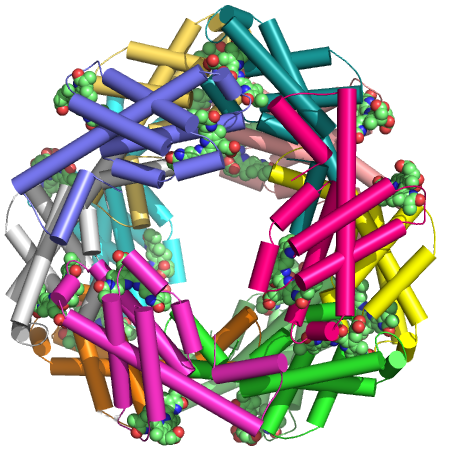
This image, by Pisaadvocate and entitled “12mer assembly of phycocyanin”, is used under the Creative Commons Attribution-Share Alike 3.0 Unported license.
Given its name, you might expect NASA [the National Aeronautics and Space Administration] to be constantly looking spaceward. True, it is concerned with much that extends away from the Earth, to the planets and on to the stars; “NASA leads the nation on a great journey of discovery, seeking new knowledge and understanding of our planet Earth, our Sun and solar system, the universe out to its farthest reaches and back to its earliest moments of existence, and to enable space exploration as well as benefit life on Earth” [quoted from here]. But, from their planet-orbiting vantage point, human-constructed satellites are uniquely placed to look Earthwards. In that way they can help to identify ‘matters of concern’ to all humanity that are much closer to home than whether there is life on Mars, or any of the moons of Saturn, etc. Accordingly, one of the domestic duties NASA has been engaged upon is looking at minerals in Earth’s deserts*.
The particular methodology employed by NASA to do that is known as EMIT, an acronym (Lindsay Kramer) of Earth Surface Mineral Dust Source Investigation**. Deployed aboard the ISS (International Space Station), EMIT uses spectroscopy technology to measure the different wavelengths of light emitted by minerals on the surface of deserts and other dust sources to determine their composition. Because different materials reflect different wavelengths of light, EMIT “analyzes light reflected off distant objects to determine what they are made of, down to the molecule”, such as the chemical composition of different dust particles. And, because it captures 285 bands in the visible to shortwave infrared (VSWIR) region of the electromagnetic spectrum – between 381 and 2,493 nm, it is a hyper-spectral spectroscopic device.
Interesting though that is, dusty deserts isn’t a particularly planty phenomenon to be pondering in a post on the Plant Cuttings blog (even though plants require soil-sourced minerals for their successful growth and completion of a life cycle (Tony L Provin & Mark L McFarland)). But! An unexpected bonus from the EMIT technology that allowed NASA to investigate terrestrial minerals* is that it can also be used to examine aquatic phenomena. And that’s where we have our plant connection.
The Tijuana River
Using EMIT, Eva Scrivner et al. (2025) investigated influx of land-derived sewage into coastal waters of the Pacific Ocean. The investigation examined “a large plume of wastewater*** flowing from the Tijuana River [(Phillip Musegaas)], just south of Imperial Beach near San Diego” [quoted from here]. When spectral data recorded in space with EMIT from the Tijuana River plume were compared with those from plume-water samples, Scrivner et al. (2025) “detected a spectral fingerprint [at 620 nm] pointing to phycocyanin”.
In other words, EMIT here appears to be able to detect biologically-relevant molecules in water, which extends its inorganic mineral-detecting remit on land. [Ed. – although it should be pointed out that Scrivner et al. (2025) are careful to state in the conclusions that “We hypothesize phycocyanin, a common accessory pigment, to be the physical source of 620 nm absorption”. The association of the spectral absorbance signal with the accessory pigment has still to be confirmed].
What’s the relevance of phycocyanin?
Phycocyanin is a so-called accessory pigment (Maria Morrow) – a molecule that captures light energy for use in photosynthesis by chlorophyll – found in red algae and cyanobacteria. Because red algae tend to be large substrate-tethered seaweeds, it’s the free-floating – planktonic – cyanobacterium, “an organism that can sicken humans and animals that ingest or inhale it”, that’s relevant to Scrivner et al. (2025)’s work. And to put phycocyanin into context we need some background to sewage – what it contains, and what it affects.
A deep dive into sewage…
Amongst the catalogue of materials contained in sewage/wastewater*** – and which are introduced into places that sewage enters – are nutrients (Acharya Balkrishna et al., 2025). The introduction of nutrients – such as nitrogen and phosphorus – into the aquatic environment provides growth-promoting material that can lead to an ‘explosion’ in populations – a so-called ‘bloom’ – of microscopic algae (also known as phytoplankton). These blooms can pose a problem for all that live in or use the affected water (Tim Smedley), whether human (e.g., here, here, here) or non-human (e.g., here, here).
This so-called ‘nutrient-enrichment’ [Ed. – a euphemism (Parker Yamasaki) if ever there was…] is otherwise known as eutrophication and is a particular problem if the blooming micro-organisms are cyanobacteria, because some of these organisms can produce compounds – cyanotoxins – that are poisonous to other life forms (e.g., here, here, here, Franca Buratti et al., 2017).
Blooming microbes…
Although population blooms [HABs, or harmful algal blooms] of these microbes can be problematic, it’s not just toxic cyanobacteria that may be a concern. Sewage can also contain pathogenic microbes such as bacteria and viruses. The dangers of sewage sludge are succinctly summarised in the case of the Tijuana River plume here: “This polluted water can pose serious health risks to swimmers and surfers, as well as U.S. Navy trainees. It also threatens marine life, fisheries, and the broader coastal ecosystem”.
Looking to the future…
Apart from demonstrating the aquatic monitoring potential of the EMIT methodology, studying the Tijuana River system is of direct relevance to the health and well-being of all who live in the affected area because “Every year, millions of gallons of treated and untreated sewage travel down this river, crossing the U.S.-Mexico border and passing through communities and a protected natural reserve before reaching the Pacific Ocean” [quoted from here]. Underlining the value of this approach to water quality monitoring, Eva Scrivner said that “EMIT could be useful for filling data gaps around intensely polluted sites where traditional water sampling takes a lot of time and money” [quoted here].
The likely detection of a cyanobacterial pigment in the Tijuana River plume is not only an indication that those microbes are present, but also indicates the potential that they could ‘bloom’ and endanger the immediate environment. Being able to detect phycocyanin – particularly its build-up – using EMIT could provide an ‘early-warning’ of a potential [cyanobacterial] HAB. In that way, EMIT can be added to another NASA space-based instrument called TROPOMI (short for TROPOspheric Monitoring Instrument) which has been used to track harmful blooms caused by Karenia brevis (more on that story here).
* In some more detail, “When strong winds on one continent stir up mineral rock dust (such as calcite or chlorite), the airborne particles can travel thousands of miles to affect entirely different continents. Dust suspended in the air can heat or cool the atmosphere and Earth’s surface. This heating or cooling effect is the focus of NASA’s Earth Surface Mineral Dust Source Investigation (EMIT) mission” [quoted from here]. Furthermore. “Scientists know that most of the mineral dust transported in Earth’s atmosphere comes from arid, or dry, regions around the globe. But they aren’t certain what types of minerals the wind carries from those regions. Different minerals affect the environment in different ways. So scientists need to know what minerals are in dust source regions if they’re going to better understand how the dust is affecting the Earth. EMIT will provide this missing dust source information. The data will allow scientists to create a new mineral map of Earth’s dust-producing regions. The map will improve computer models that scientists will use to assess the regional and global heating and cooling effects of mineral dust today and in the future”. For more on this programme, see the EMIT fact sheet here.
** Anybody who appreciates acronyms – words made from the initial letters of words in a phrase, and which are spoken as words – will be rather disappointed in this instance where ESMDSI has been bizarrely transformed to produce EMIT. What has happened to the S, D and S? And where does the T come from? As an example of an acronym, this is very poor. To show how good these initialisms (Lindsay Kramer) can be, consider acronyms such as SAG, TASER, or MAP. NASA, please do better [Ed. – you know you can; NASA is a perfect example of an acronym…]
*** By way of a bit of context, it’s worth saying that wastewater is another term often used in connection with – and in the same way as – sewage. A definition of wastewater is “used water. It includes substances such as human waste, food scraps, oils, soaps and chemicals. In homes, this includes water from sinks, showers, bathtubs, toilets, washing machines and dishwashers. Businesses and industries also contribute their share of used water that must be cleaned” [quoted from here]. Wastewater is “Often used interchangeably with the term sewage”. Which is understandable because the only difference is that ““sewage” technically denotes any wastewaters which pass through a sewer. Prior to entering a wastewater treatment plant, wastewater is sometimes called raw wastewater or raw sewage”. Technically, sewage is therefore one example of several forms of wastewater; sewage is a subset of wastewater (Wayne Byrne). Nevertheless, even though we have different words to distinguish one thing from another, sewage and wastewater can probably be considered synonyms in the context of harmful algal blooms.
REFERENCES
Acharya Balkrishna et al., 2025. Potential use of sewage sludge as fertilizer in organic farming. Cleaner Waste Systems 10: 100245; https://doi.org/10.1016/j.clwas.2025.100245
Franca Buratti et al., 2017. Cyanotoxins: producing organisms, occurrence, toxicity, mechanism of action and human health toxicological risk evaluation. Arch Toxicol. 91(3): 1049-1130; doi: 10.1007/s00204-016-1913-6
Eva Scrivner et al., 2025. Hyperspectral characterization of wastewater in the Tijuana River Estuary using laboratory, field, and EMIT satellite spectroscopy. Science of The Total Environment 981: 179598; https://doi.org/10.1016/j.scitotenv.2025.179598
 Plant Cuttings
Leave a comment