
This is the third – of several… – posts looking at uses of wood or tree products. It follows the previous pair of posts that reconsidered a wooden satellite and engineered transparent wood. This time we look – and in some depth – at one of the more imaginative uses of wood.
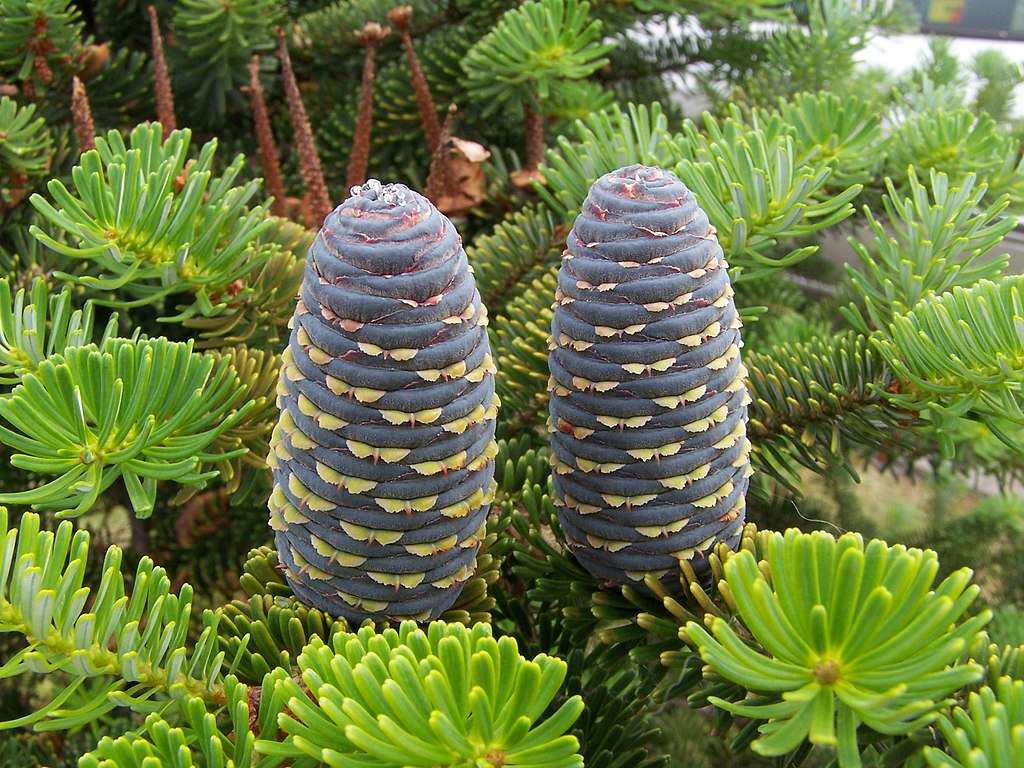
This image, captioned “cones and needles of a Korean fir” by Lestat (Jan Mehlich), is licensed under the Creative Commons Attribution-Share Alike 3.0 Unported license.
At Cuttings HQ, we’re all for finding out about offbeat uses of botanicals. But, sometimes those uses are so bizarre and unexpected that they give us cause for pause, and we have to take a step back (Richard Lueger). One such instance is the involvement of wood chips in a corpse-preservation practice practised in 18th century Austria.
The mummified body in question is that of Franz Xaver Sidler von Rosenegg, a priest thought to have died in 1746 (Tudor Tarita), and which had lain in the church crypt of St. Thomas am Blasenstein (Upper Austria) for approx. 270 years. The remarkable state of preservation of the cadaver led to it being known as the “air-dried priest” (Skuttel). Quite how the corpse had been so well preserved was a mystery that was solved when renovation work on the church necessitated removal of the ‘mummy’ to a place of safety. During its temporary residence elsewhere, the mummified remains were forensically examined by Andreas Nerlich et al. (2025).
Amongst the surprises uncovered by Nerlich et al. (2025) was the “otherwise completely intact abdominal (and pelvic) cavity, extensive packing with foreign material. This material was identified as a mixture of wood chips [described as ‘fir’ and ‘spruce’*], fragmented twigs [which “could not further be sub-classified”, e.g. to species of genus], large amounts of fabric of various types including elaborate embroidered linen [from flax, Linum usitatissimum, and “intermingled with fragments of fabric of simple stem fibers … mostly consisting of hemp [from Cannabis sativa] and flax”], and even pieces of silk [which is also considered to be plant-derived because the silkworms feed on leaves of the mulberry tree]”. Adding to that botanical catalogue, the team also found “high level zinc-ion solution impregnation (most likely zinc-chloride with small amounts of arsenic) and the addition of copper” (Nerlich et al., 2025). This cocktail of biological and chemical agents is inferred to have effected both rapid dehydration and absorption of blood and other body fluids – whose release accompany post-mortem changes – giving rise to the ‘air-dried’ nature of the corpse.
Use of large amounts of botanical materials to pack and desiccate the body is interesting enough in its own right, but the most surprising discovery was the conclusion that this packing had been “inserted into the abdominal body cavity through the rectum” (Nerlich et al., 2025). Which led the investigators to conclude, “To the best of our knowledge this is the first report on this type of conservation of a mummy, in particular the internal packing and chemical preparation via an anal route” (Nerlich et al., 2025)**.
Whilst it is understandable to focus on the apparent uniqueness of this embalming method, a suitable note of caution about such an interpretation is introduced by Tudor Tarita: “What’s most startling is that this embalming technique—rectal stuffing with absorbent material and drying agents—was previously unknown. It had never been documented in medical or mortuary texts. That doesn’t mean it was unique. It may have simply gone unrecognized in cases where decay obliterated the evidence”. Nevertheless, this example will remain one of a kind until other instances are identified.
As you might have predicted, this story has been covered in many media outlets***, e.g., Ashley Strickland, Katie Hunt, Nicola Davis, Xantha Leatham, Victoria Atkinson, Bethan Finighan, here, Charlie Buckley, Kristina Killgrove, Sheena Goodyear, here, Leman Altuntaş, Dario Radley, Russell Moul, Andrea Margolis, here, here, Michael Natale, Somashis Gupta, here, Georgina Jedikovska, Elora Bain, here, and here. For a short video about this study, see here. And, for a little more about the air-dried priest specifically, see the Atlas Obscura article by Skuttel, and the Wikipedia page in German here.
PS You may have noticed that this post has been illustrated with an AI-generated image (as were the previous couple of posts). I have revisited my concerns over the environmental cost of AI [previously shared in this blog here [under ‘responses’] after reading Stephen Heard’s most informative article. Persuaded that my very modest use of AI will not ‘burn down the planet’, I will therefore use such images – where they are appropriate.
* I know Nerlich et al. (2025)’s scientific article was from a medical journal, but it would greatly help botanically-minded readers of that article – to say nothing of the plant-curious audience of this blog – if the identity of the trees involved was explicitly stated. I’m guessing that reference to ‘fir’ indicates a species of the genus Abies, but which one? Similarly, Mr P Cuttings presumes that ‘spruce’ means a species with the genus Picea, but which one? Medicine should acknowledge its botanical origins (Maria Joseph; Biljana Bauer Petrovska, 2012; Heather Saba; Barbara Schmidt et al., 2008).
** In case you were wondering [I have to admit that I was], all of this abdominal-packing, etc., was actually carried out after death, because other indications from analysis of the cadaver suggest that the clerical gentleman “died of acute severe pulmonary hemorrhage due to destruction of lung vessels by an ongoing infection associated with a tuberculous cavity…” (Nerlich et al., 2025). Which sounds pretty bad, but probably not as bad as the alternative scenario we might have imagined.
*** Perhaps the most memorable of the stories about this phenomenon was that from Tudor Tarita, with the sub-title “A strange embalming technique emerges from the annals of history” [in case you didn’t get the pun, it relates to the allusion of anal by use of the word ‘annals’]. Childish humour, I know, but it must have been hard to resist making it [Ed. – which is probably why the temptation was not resisted… And don’t think I haven’t noticed that Mr P Cuttings couldn’t resist doing something similar in this post’s title]. As for the headline “300-year-old butt mystery cracked: Mummy preserved through rare rectal method” by Georgina Jedikovska, you must make of that what you will(!).
Katie Hunt’s punning title “A mummy called the ‘air-dried chaplain’ has long been shrouded in mystery. Scientists say they now have answers” is less humorous, but its wittiness [Ed. – think burial shroud, and to shroud or cloak something in mystery or secrecy] may be enough to raise a wry smile.
And we also have the very matter-of-fact articles entitled “18th-century monk’s anus was stuffed with wood chips and fabric to mummify him, researchers discover” by Kristina Killgrove, and “Scientists discover 18th-century Austrian mummy was embalmed through the rectum” from Sheena Goodyear, for which the phrase ‘tell it like it is’ could well have been coined. Anyway, moving on…
REFERENCES
Andreas Nerlich et al., 2025. The mystery of the “air-dried chaplain” solved: the life and “afterlife” of an unusual human mummy from eighteenth century Austria. Front. Med. 12: 1560050; doi: 10.3389/fmed.2025.1560050
Biljana Bauer Petrovska, 2012. Historical review of medicinal plants’ usage. Pharmacogn Rev. 6(11): 1-5; doi: 10.4103/0973-7847.95849
Barbara Schmidt et al., 2008. A natural history of botanical therapeutics. Metabolism 57(7 Suppl 1): S3-9; doi: 10.1016/j.metabol.2008.03.001


 Plant Cuttings
Leave a reply to Nigel Chaffey Cancel reply