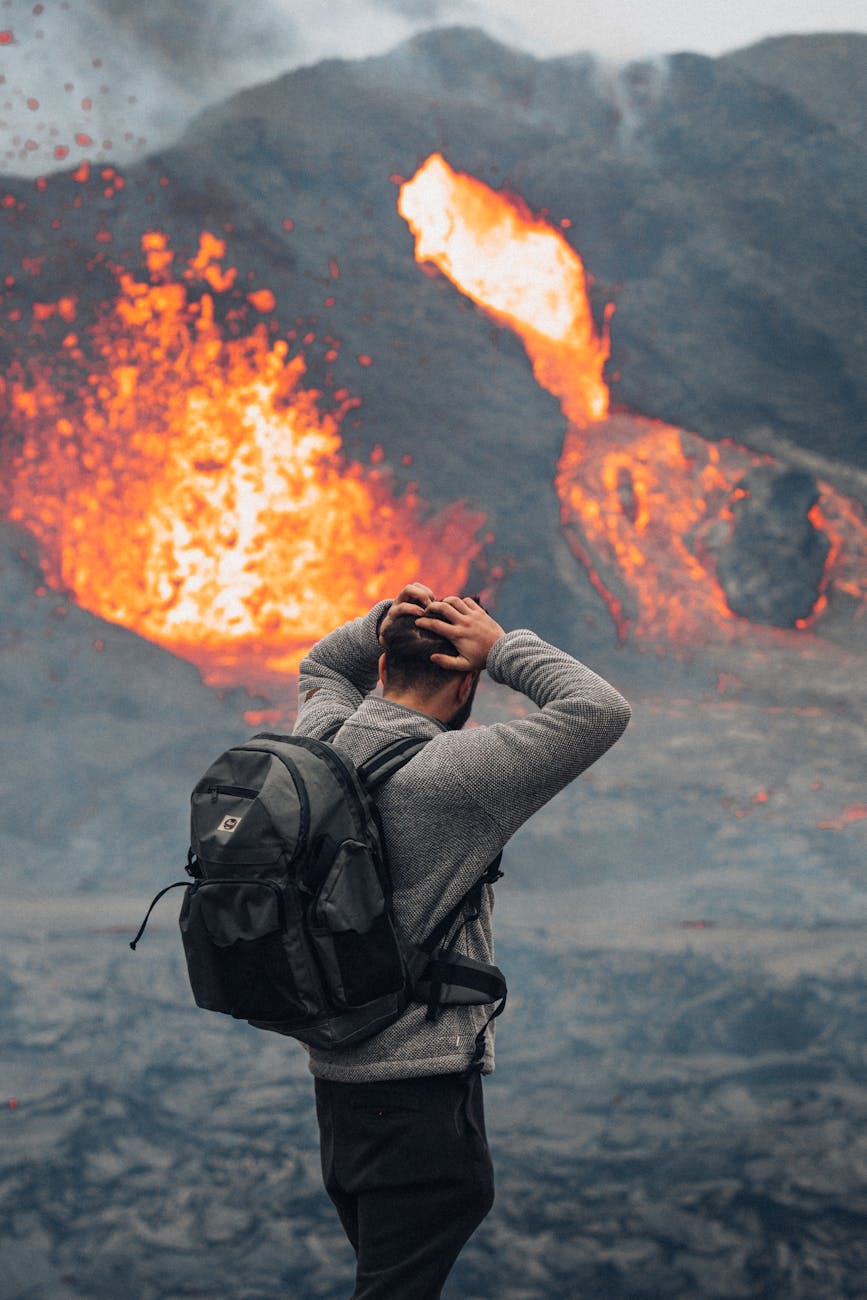
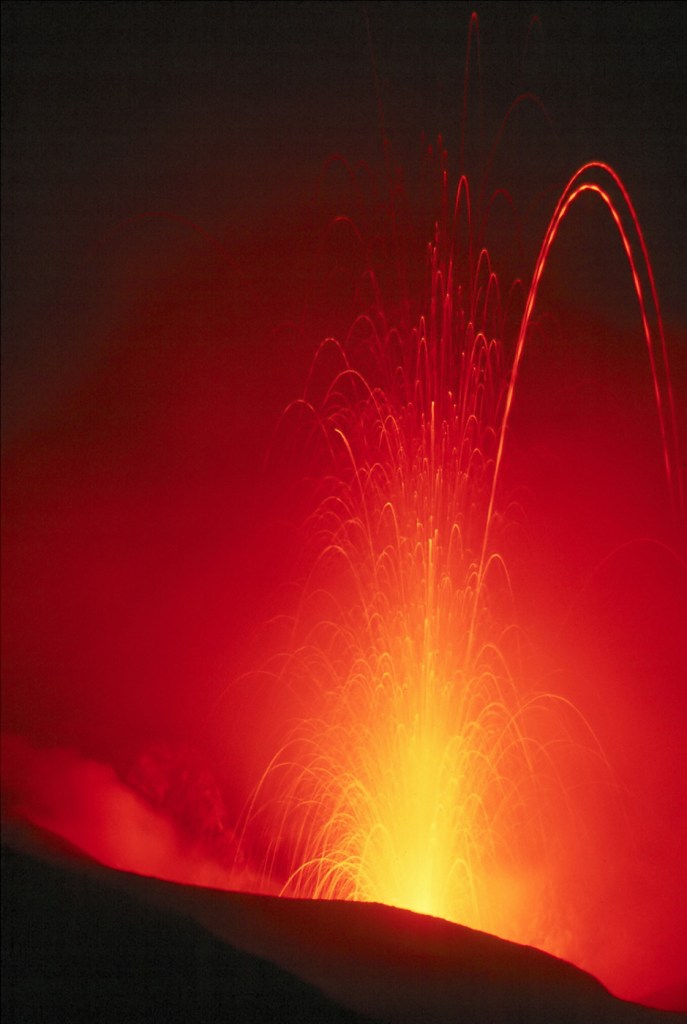
This image of the eruption of Stromboli (Isole Eolie/Italia) by Wolfgang Beyer is used under the Creative Commons Attribution-Share Alike 3.0 Unported license.
Plants need carbon dioxide (CO2) for photosynthesis (Hans Lambers & James Alan Bassham). Which process allows them to manufacture sugars that can be used as a fuel to provide energy in respiration and/or as carbon compounds that can be converted into other organic molecules to help build the plant. In this way CO2 fuels plant growth. Additional CO2 can increase plant growth over and above that produced by usual concentrations of the gas in the atmosphere.
One source of extra CO2 is anthropogenic ones – which are behind concerns over global warming and climate change (Rebecca Lindsey).
Volcanoes are another – natural and not human-activity-related – source of additional atmospheric CO2** (Alessandro Aiuppa et al., 2010; Michon Scott & Rebecca Lindsey).
As you might predict, this additional CO2 benefits vegetation adjacent to the volcano, which respond by growing more than plants not ‘fertilised’ in this way. And, because “eruptions are often preceded by precursory increases in the volcanic carbon dioxide (CO2) flux” (Simone Santoro et al., 2017), this response by vegetation can be used as a measure of the volcano’s state of activity. Furthermore, this volcanically-super-charged plant growth is something that can be seen from space. This means that it can be detected and monitored by Earth-orbiting satellites, which is what Nicole Guinn et al. (2024) propose from their work on Mt Etna (Sicily, Italy).
The ’metric’ that Guinn et al. (2024) recorded is the leaf colour of the vegetation***, as analysed using the Normalized Difference Vegetation Index (NDVI) (Karen Joyce; Nikita Marwaha Kraetzig), which is widely used as an indicator of ‘vegetation health’.
The association between carbon dioxide and NDVI is succinctly summarised by Mackenzie Ferguson, “As CO2 levels rise, trees can harness this gas to enhance photosynthesis … This increase in photosynthetic activity leads to higher chlorophyll production, making the leaves appear greener”. In essence, leaves of CO2-enhanced plants (not just trees) are greener – appear ‘healthier’ – than those that aren’t so ‘nutritionally-boosted’. These differences in leaf greenness can be recorded and analysed by Earth-orbiting satellites using the NDVI, and – with appropriate caution in interpretation of the results – used as a so-called ‘proxy’ method for volcanically-released CO2 (which is “difficult and often hazardous to measure on the ground … and nearly impossible to directly measure … from space” (Robert Bogue et al., 2023)). In that way, increases in volcanic activity – which is related to release of CO2 – can be detected, the likelihood of an eruption assessed, and appropriate advice given to the public.
Guinn et al. (2024)’s work in Sicily builds upon and adds to that of Robert Bogue et al. (2019) looking at vegetation responses to volcanic sources of CO2 in Costa Rican forests, and Bogue et al. (2023) in Yellowstone National Park (USA) (Kenneth Pletcher).
And “Now Guinn and Bogue, together with other researchers, are working on a project led by NASA [National Aeronautics and Space Administration] and the Smithsonian Institution, analyzing changes in the color of plant life around volcanoes in Panama and Costa Rica” (David Nield). This collaboration is part of the Airborne Validation Unified Experiment: Land to Ocean (AVUELO) (Rosannette Quesada-Hidalgo) mission, which is looking to develop more ways in which we can measure the health of the planet from satellites (David Nield]). NASA are also looking at applying the work of Guinn et al. (2024) to another site, the Rincón de la Vieja Volcano in Costa Rica in the hope of better predicting eruptions.
As with all such forecasting work, it will be necessary to ensure that it actually works, and that the connection between CO2 fertilisation of near-volcano vegetation is a good and reliable barometer of the volcano’s activity, and also applies in locations beyond those where the initial studies have taken place****, etc. However, one aspect of the volcanic CO2 and leaf-greening relationship I’m not clear about is the timescale; how long does it take for leaf colour to respond to the extra CO2? And is it sufficient to act as a timely warning of impending eruption? Another thought is that if an eruption removes all – or sufficient – of the vegetation from the vicinity of the volcano, how long will it take for the area to become suitably revegetated to the extent that NDVI will be a usable metric for predicting future volcanic activity? Plus, for volcanoes whose slopes or surrounduing areas are not vegetated, the satelite and NDVI combination will not be appropriate.
Perhaps this space-sited satellite approach is probably best seen as additional to the various land-based systems set in place to monitor volcano activity (e.g., Simone Santoro et al., 2017; Francesco Romeo et al.; here; André Butz et al., 2017; and here). But, when it comes to forecasting volcanic eruptions, you probably can’t have too many warning monitors.
For more on the work of Guinn et al. (2024), see James Riordon, Mackenzie Ferguson, James R Riordon, here, RJ Manuel, here, Eric Ralls, David Nield, here, and Sayan Sen.
Although the impetus for this work was the effect of volcanically-emitted CO2, this same methodology [satellite-recording and NDVI analysing] can also be used to look at other forms of CO2 enrichment such as anthropogenic sources, and help us to understand the responses of plants to elevated CO2 concentrations (Renée Cho; Daniel Taub, 2010). In the words of climate scientist Josh Fisher (of Chapman University, California and part of the AVUELO team), as reported by David Nield: “We’re interested not only in tree responses to volcanic carbon dioxide as an early warning of eruption, but also in how much the trees are able to take up, as a window into the future of the Earth when all of Earth’s trees are exposed to high levels of carbon dioxide”*****.
PS Shortly after this post was written we were all reminded of the unpredictability – and power – of volcanoes when Mount Etna erupted on 2nd June 2025. For more on that, see Jen Mills, Esme Stallard & Alex Boyd, and Andy Gregory & Rachel Clun.
PPS Should you decide to visit an active volkcano, Bailey Berg has some very good advice for you.
* Admittedly, that title is not quite as sensationalist as “Volcanoes Send Secret Signals Through Trees And NASA Satellites Can See Them” from James Riordon – and which markedly contrasts with James R Riordon’s [which may or may not be the same James Riordon who penned the SciTech Daily piece] much more cautious “NASA Satellite Images Could Provide Early Volcano Warnings”…
** Although volcanoes – whether erupting or not – are awesomely impressive natural phenomena (Lindsey Galloway; Peter Moore), they are also extremely dangerous and can cause great loss of life, habitats, and property, and disrupt livelihoods and economies (Stephen Sparks).
Amongst the threats posed by volcanoes are: lava flows; earthquakes; ash; debris avalanches; and not forgetting pyroclastic flows such as those from Mt Vesuvius that engulfed people in, and buried large parts of, the towns of Pompeii and Herculaneum, and finished off Pliny the Elder (Laura Hayward) in 79 AD (Jessica Ball). Anything that can – or even might – provide advance warning of an impending eruption is therefore something to be seriously considered and appropriately exploited.
*** For an in-depth consideration of the vegetation monitoring methodology – and its various limitations, etc. – see the article by Mackenzie Ferguson.
**** With about 1,350 active volcanoes on Earth – and maybe more than 1,500 – assessing relevance of NDVI for all is ‘a steep hill – or even mountain – to climb’.
***** This concern over volcanic CO2 [and other gases such as SO2 (sulphur dioxide)] and global warming is not a new one. Research indicates that volcanic activity has been affecting the Earth’s climate for millions of years (e.g., here, here, here, here, here, Benjamin Black et al. (2024), and Gregory A Zielinski (2000).
REFERENCES
Alessandro Aiuppa et al., 2010. Unusually large magmatic CO2 gas emissions prior to a basaltic paroxysm. Geophysical Research Letters 37(17): L17303; https://doi.org/10.1029/2010GL043837
Benjamin Black et al., 2024. Cryptic degassing and protracted greenhouse climates after flood basalt events. Nat. Geosci. 17: 1162–1168; https://doi.org/10.1038/s41561-024-01574-3
Robert R Bogue et al., 2019. Plant responses to volcanically elevated CO2 in two Costa Rican forests. Biogeosciences 16: 1343–1360; https://doi.org/10.5194/bg-16-1343-2019
Robert R Bogue et al., 2023. Volcanic diffuse volatile emissions tracked by plant responses detectable from space. Geochemistry, Geophysics, Geosystems 24(11): e2023GC010938; https://doi.org/10.1029/2023GC010938
André Butz et al., 2017. Remote sensing of volcanic CO2, HF, HCl, SO2, and BrO in the downwind plume of Mt. Etna. Atmos. Meas. Tech. 10: 1–14; https://doi.org/10.5194/amt-10-1-2017
Nicole K Guinn et al., 2024. Monitoring volcanic CO2 flux by the remote sensing of vegetation on Mt. Etna, Italy. Remote Sensing of Environment 314: 114408; https://doi.org/10.1016/j.rse.2024.114408
Simone Santoro et al., 2017. Volcanic plume CO2 flux measurements at Mount Etna by mobile differential absorption Lidar. Geosciences 7(1): 9; https://doi.org/10.3390/geosciences7010009
Daniel R Taub, 2010. Effects of rising atmospheric concentrations of carbon dioxide on plants. Nature Education Knowledge 3(10): 21.
Gregory A Zielinski, 2000. Use of paleo-records in determining variability within the volcanism–climate system. Quaternary Science Reviews 19(1–5): 417-438; https://doi.org/10.1016/S0277-3791(99)00073-6


 Plant Cuttings
Leave a reply to rosgleadow Cancel reply