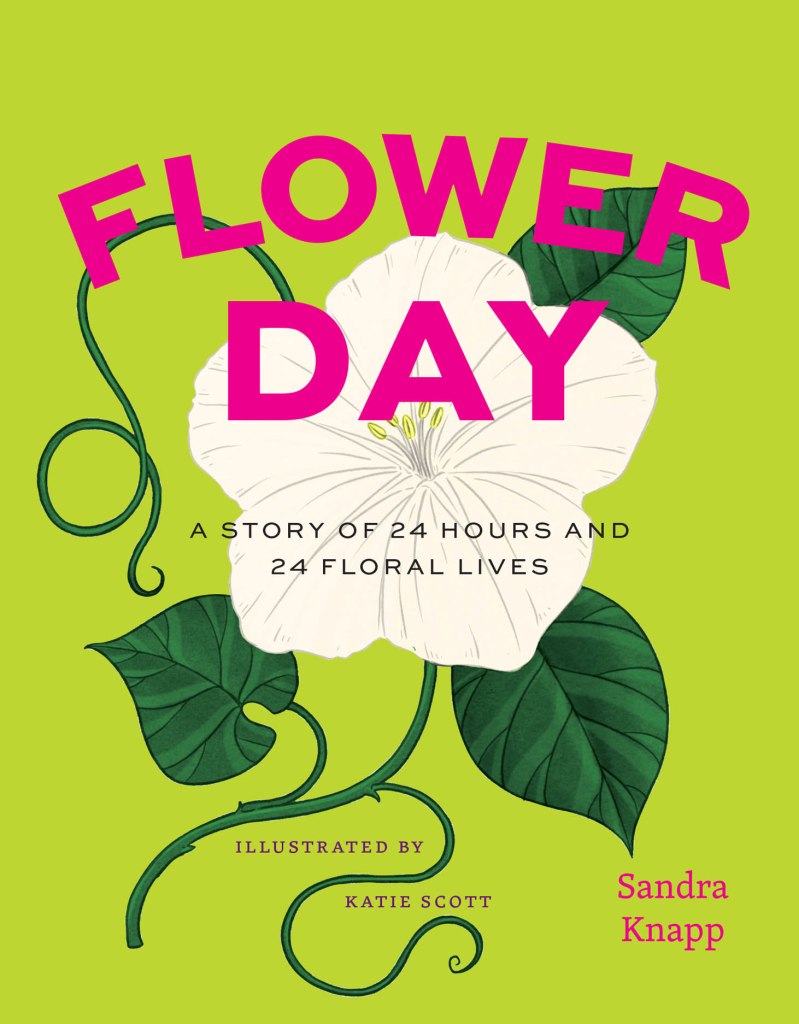
Flower day: A story of 24 hours and 24 floral lives, Sandra Knapp, illustrated by Katie Scott, 2025. The University of Chicago Press.
Famously, Swedish botanist (zoologist, mineralogist, and medical doctor…) Carl Linnaeus imagined a flower clock, a horologium florae*, in which the time of day was indicated by the opening and/or closing times of different flowers. Using 26 plants, he envisaged a clock that ran from 3 am (opening of Tragopogon pratensis) to 8 pm (closing of Hemerocallis fulva) (Kaushik Patowary). Sadly, Linnaeus’ clock didn’t actually exist, but, we can appreciate some of the art and science that went into creating that botanical construction in reading Flower day by Sandra Knapp [which book is here appraised – and which covers all 24 hours of a day].
Overview
In 24 mini-essays about plants, Flower day covers such topics as floral biology, pollination ecology, physiology, threats to plant’s existence, and ethnobotany. The text is – most pleasingly – a quite undemanding read that’s very well-written, and with some nice phrasing, e.g., “comprising grayish green stems that resemble a mass of snakes sliding over rocks and vegetation,” (p. 10 re queen of the night). In that way it manages to – fairly effortlessly [although anybody who writes will know how much hard work goes into making readability of text seem ‘effortless’!] – impart plenty of interesting plant – and plant-related – facts [Ed. – Mr Plant Cuttings learnt lots that was new to him**]. Which all makes for a most rewarding and satisfying reading and learning experience.
Flower day is also infused throughout with respect – both for the plants and the natural world, and the indigenous people who were often the first to discover a plant’s particular properties – e.g., the ancient Mesoamericans and the production of rubber in the case of American moonflower, the fibre uses of harakeke, or the compass point-related sequential opening of giant saguaro flowers – before scientists or other visitors ‘discovered’ it much later. That respect also extends to use of non-English common names in preference for English ones for some of the plants (e.g., harakeke, and uape jacana), and first place mention of the Māori name for New Zealand, Aotearoa***, before its English name in the entry for harakeke or New Zealand flax.
It’s always worth mentioning that US English spelling is used throughout the book. So there’s no need to make a fuss over ‘furor’ (Jade Joddle) (or neither go out of your way nor go off on one about traveler’s (Julia Merkus; Eoghan Ryan) tree [but which really should be traveller’s tree or traveller’s palm]).
The book’s 194 or so pages comprises a Preface, Plant entries, Epilogue, Further Reading, and an Index.
Preface
Provides a great summary of floral biology – with lots about flower structure (including a helpful diagram of a flower and names of its parts), male and female flowers, and such concepts as monoeicy (Cynthia Haynes) and dioecy (Cynthia Haynes) (all technical terms are well-explained in the text as they’re mentioned), pollination and rewards for pollinators, sexual and asexual reproduction. Many plant examples are mentioned in connection with these terms or concepts, usually (always?) chosen from amongst the 24 that are showcased in the book proper. The Preface also includes some quite sophisticated ideas such as German polymath Johann Wolfgang von Goethe (Nicholas Boyle)’s ‘Eureka moment’ (Christopher Dwyer) when he “first suggested that flowers were leaves for reproduction” (p. xx)****.
The Preface is personalised with mention of Knapp’s trips “collecting plants in the rainforests of the tropics” (p. xvi), which helps to establish the author’s credential as somebody who is suitable for writing this sort of book, and will know whereof she speaks. But, there is nothing here [or anywhere else in the book] to say that book is solely devoted to seed-bearing plants from the plant kingdom (which it is). [Ed. – But, maybe that’s not too surprising since the focus of Flower day is flowers?]
Plant entries
Each of the 24 entries is effectively a mini essay about the named plant. Each entry has a formulaic heading that provides: associated time of day [per Knapp]; common name used by Knapp [which is usually an English name]; scientific name [but not the authority]; and its native location in the world. A halftone pen-and-ink illustration of the plant accompanies the relevant text. The formulaic headings don’t include the plant family, nor is this consistently mentioned within the plant entries, which is a little disappointing as such information is quite interesting – and useful – in its own right.
On average, each entry is 6 pages long, ranging from 5.1 pages for Angraecum to 6.9 pages for harakeke. The text usually has quite a lot to say about the flower of the named plant and floral biology. Depending on the plant species the associated text will have an ethnobotanical, historical, physiological, ecological, or chemical ecology dimension, as well as the floral biological one. An important message from Knapp is on the plant conservation/forest stewardship of indigenous peoples – e.g. the relationship between sago palm and the Marind people of West Papua – and the consequences of climate change for plant diversity.
The illustrations
Are provided by Katie Scott, and they generally work for the smallish herbs featured. However, they don’t really do justice to the full stature of plants such as the giant saguaro, sago palm, or traveller’s tree. Maybe in those cases an additional silhouette of the entire plant would have helped to impress upon the reader the true size and majesty of those botanics. But, since the book’s focus is the flowers, let’s just accept that the illustrations do the job they are intended to and give the flowers of the named plants their ‘moment in the sun’ (Anna Matteo).
Epilogue
The book ends with a reflection on the importance not just of the plants but also of their pollinators, and the need to take more care of the natural world around us so we don’t upset these intricate relationships. For, even though “Plants are true survivors, though, and because many have mixed pollination strategies, they can often adapt. But we cannot rely on their capacity to absorb the wounds we inflict on the earth” (p. 157).
Further Reading
Is listed for the Preface and separately for each of the 24 plant entries [none provided for the Epilogue]. Primarily consisting of scientific articles – but some books – this section provides support for at least some [I haven’t checked all of them!] of the factual statements made in the relevant plant essay. Although it’s aways nicer to see explicit connections between facts and their sources, this is a pretty good attempt to provide the all-important evidence base for the book’s information. As far as up-to-dateness goes, 31 out of a total of 74 sources listed were published after 2009, including 10 in the 2020s. In terms of sufficiency, although five sources are shown for Antarctic hair-grass, the number is more usually three or four per plant entry; but with two for Angraecum, queen of the night, and moonflower [and the Preface], and only a single source for each of sunflower, and curly rock rose.
More sources needed
With so few sources listed for each ‘chapter’ it’s probably inevitable that some statements will be made that aren’t sourced. And that seems to be the case in several instances: e.g., re queen of the night, Knapp tells us, “By midnight the flowers are fully open and ready to receive visitors” (p. 13); re the Aboriginal use of flowers of east coast banksia to make a sweet energy drink, or, when fermented, an alcoholic version; re Antarctic hair grass, “Tillering increases with warming temperatures, and the Antarctic Peninsula and its western islands are warming faster than the continent itself; in fact, this region… (p. 87) … is thought to be the fastest warming area on Earth (p. 88)”; white campion (Silene latifolia) is amongst “the 6 percent of flowering plants that are dioecious” (p. 131). It is possible that some of the sources may be within the listed further reading for those plants, but if that’s the case it would be a great benefit to the reader if that is made explicit.
Index
Consisting of 9.5, two-columned pages, it goes from ‘Acacia spp. (wattles)’ to ‘Zahara do los Atunes, Spain’. An indication of the range of topics covered in the book will be gleaned from this selection of index entries: animals, anthers, bats, botany, cabbages, COVID-19, cross-pollination, Darwin, Charles; deserts, ecosystems, evolution: and plant genomes; florets, fruits; genetics; greenhouses; habitats; heliotropism; inflorescences; insects; iridescence; jasmine; lemurs; Linnaeus, Carolus; Malagasy people; Marvell, Andrew; monocarpy; moths; Namib desert; nicotine; O’Keefe, Georgia; ovules, and pollen; pesticides; petals; pollen; protandry; queen of the night; rainforest; Royal Botanic Gardens, Kew (London); saponins; seeds; sessile plants; stomata; superflower structure; tepals; tropane alkaloids; vegetables; weeds: and diversity, creation of; West Papua (Indonesia); and yerba del diablo (devil’s weed).
Although scientific names are listed in the index, the reader is referred to the common name***** used in the book for that plant’s page entries. Except in the case of scientific names of plants that aren’t in chapter names – e.g. Angraecum sesquipedale, Welwitschia, Gnetum, their occurrence(s) in the text are indicated under that entry. Where non-English vernacular names are included in chapter headings for plants (e.g., uape jacana for giant waterlily), that is the Index entry that indicates their occurrence within the text. In such cases, and as for those plants’ scientific names, their English name will refer you to the non-English name index entry.
So much for an overview of the book, why was Flower day written?
Purpose of book
Knapp tells us that “In this book, we tour the world in twenty-four hours, spending each hour with a different flower at a key moment in its day”. And “we travel together across time and to every continent” (p. xxi). The author’s aspiration is that “I hope you’ll take a moment to reflect on and be amazed by the power and beauty of plants, the stories they tell, and what they teach us about resilience and survival” (p. xxi). If that is the book’s purpose, then, having read Flower day, I think it has been achieved [as my evidence for this I draw your attention to footnote**].
How were the 24 selected?
Knapp is silent on that point. However, she does say that in choosing the plants we are “spending each hour with a different flower at a key moment in its day”. That assurance notwithstanding, it’s not always easy to discern what those key moments actually are. Nevertheless, we have 24 plants with interesting facts to be shared and/or stories to be told. So, I’m happy just to enjoy the selection that Knapp has made.
It’s not just flowers…
Despite being entitled Flower day, the book does feature a plant that doesn’t have flowers, the leafless ephedra (Ephedra foemina), which is a gymnosperm (T Delevoryas) (as opposed to the other 23 plants in the book that are angiosperms, i.e., true flower-bearing plants).
… but animals as well.
Throughout Flower day a great variety of pollinators covered, e.g. raspy crickets, hawk moths, sugar gliders, pygmy possum, honeyeaters, hoverflies, bee flies, lemurs, bats, and western white-winged dove, which gives Knapp the opportunity to underline the importance of animals to plants, and vice versa. A strong holistic ecological message permeates the book.
Although, there are no trees…
No proper trees are to be found in Flower day. Whilst sago palm (Metroxylon sagu) is included, it’s a monocot (Sandy Perry). And, despite its English common name, Knapp reminds us that the traveller’s tree (Ravenala madagascariensis) is not a tree but a giant herb, and is another monocot. Whilst these monocots have a tree-like appearance, they don’t produce proper ‘wood’ and therefore technically are not trees (Sandy Perry). Maybe trees proper are being left until Tree day by Meg Lowman [see There’s more where this came from…]? But, whether that’s by chance or by negotiation between the two authors – or an edict from the publisher – I don’t know.
Coverage of plant types
With only 24 plants to choose (from “328,565 known angiosperm species” (Steven P Bachman, 2024) – and maybe up to 369,400 (Rebecca Morelle)), selecting those few must have been quite the challenge for author Knapp. Nevertheless, she manages to include a pretty diverse group of plants that give an appreciation of the range of plant types within the seed-bearing members of the plant kingdom.
Accordingly, and in terms of stature, we go from the 2 cm tall Antarctic hair grass (Deschampsia antarctica) to towering plants such as Southeast Asia’s sago palm, and North America’s giant saguaro (Carnegiea gigantea) at 23 m tall.
Although plants included are primarily ones that ‘stand on their own two feet’, at least two epiphytes [plants that rely on support from taller, bigger neighbours] – queen of the night cactus (Selenicereus grandiflorus), and American moonflower (Ipomoea alba) are also featured. [Ed. – But, and somewhat surprisingly, the term ‘epiphyte’ is not mentioned by Knapp.]
Coverage of habitats
In terms of habitats, Flower day’s coverage ranges from the city-dwelling (‘urbanophyte’) [and cosmopolitan] dandelion (Taraxacum officinale) to denizens of the desert (giant saguaro cactus), from inhabitants of ponds and oxbow lakes (uape jacana or giant waterlily (Victoria amazonica), to a – very – hardy perennial of the Antarctic (Antarctic hair grass), to tropical rainforests (e.g. titan arum (Amorphophallus titanum)).
Taxonomic coverage
With over 400 flowering plant families to choose from [413 to 416 (Maarten JM Christenhusz & James W Byng, 2016) depending on source], at most 23 can be included in Flower day.
Having said that, in terms of taxonomic coverage, some plant families get much more attention than others. For example, composites, the Asteraceae, has four representatives, Jack-go-to-bed-at-noon (Tragopogon pratensis), sunflower (Helianthus annuus), dandelion (Taraxacum officinale), and chicory [Cichorium intybus); Solanaceae (the nightshade or potato family) has three species – coyote tobacco (Nicotiana attenuata), sacred datura (Datura wrightii), and night-blooming jessamine (Cestrum nocturnum) [Ed. – which is probably Knapp’s favourite plant family? As a research scientist Knapp “is best known as a specialist in the taxonomy, crop diversity, and ethnobotanic uses of the Solanaceae”, and declares herself to be “a specialist on the taxonomy of the nightshade family, Solanaceae”. If you can’t give a big shout-out to your favourite flowering plant family, in your own book…]; and Cactaceae has two (queen of the night (Selenicereus grandiflorus), and giant saguaro (Carnegiea gigantea).
Aside from a sole gymnosperm [see It’s not just flowers…], the collection is overwhelmingly of angiosperms (Martin Huldrych Zimmermann & Arthur Cronquist; Daniela Dutra Elliott & Paula Mejia Velasquez), i.e., flowering plants. And that’s as it should be since this is the only group to have proper flowers, and as befits the book’s title.
Within the book’s angiosperms, it’s primarily dicots that are showcased. Although four monocots are included: Antarctic hair grass; Angraecum (Angraecum cadetii); the traveller’s tree (Ravenala madagascariensis); and harakeke [Ed. – although also known as New Zealand flax (Phormium tenax), that index entry will refer you to the index entry for harakeke, the plant’s Māori name – Knapp is understandably keen to promote indigenous names of plants (as she also does for uape jacana, known in English as giant waterlily)].
Geographical diversity of plants
It is true that in this book we “travel … to every continent” (p. xxi)******; which are: North America, South America, Europe, Asia, Antarctica, and Australia (e.g., here, here, Diane Boudreau et al.) (which latter continent includes New Zealand, and is also known as Australasia, or Oceania).
However, the number of plant entries from each continent seems a little imbalanced because we have: two from Asia (sago palm from Southeast Asia, and Sumatra’s corpse flower); including the couple of entries for Madagascar – Angraecum and the traveller’s tree – along with curly rock rose (Cistus crispus), we have a total of 3 from Africa; two entries from Australia (Australia’s own east coast banksia (Banksia integrifolia) and New Zealand’s harakeke); three from Europe – chicory, Jack-go-to-bed-at-noon, the non-angiosperm leafless ephedra; one primarily from South America – the giant waterlily (Amazon basin) [two if Antarctic hair grass (Patagonia) is secondarily included]; and one from Antarctica – Antarctic hair grass [Ed. – which actually represents 50% of the flowering plant species from that continent (Bob Yirka)].
I’m not sure where the pair from the Caribbean (queen of the night, and night-blooming jessamine) fit in; presumably it’s North America since they are closer to that than South America. But, what about the two from ‘the Americas’ (American moonflower, and four-o’clock), is that North or South America or both North and South America? Are where does white campion – ‘from Eurasia’ – or ‘worldwide’ dandelion fit onto a continental categorisation?
However, and anyway, all of the above contrasts markedly with the six entries that are primarily from North America (coyote tobacco, sunflower, western blue flax, California poppy, sacred datura, and giant saguaro). Which number can be increased by including the two from ‘the Americas’ (American moonflower, and four-o’clock), and the trio that are – secondarily – described as ‘introduced to North America’ (chicory, Jack-go-to-bed-at-noon, and white campion). In other words, plant choice in Flower day is noticeably, and more than a little, North America-centric. I’m not saying that there’s anything wrong with that – and all seven continents are represented as declared in the Preface – but it does rather stand out.
Some comments on timeliness…
Appropriately enough the book begins its 24 hour sojourn at midnight, with the American moonflower. But, since we are told that the plant’s flowers opens at dusk, there’s no obvious reason why this plant should be the midnight example. Indeed, since we are told by Knapp in regards to queen of the night (the 1 am entry) “By midnight the flowers are fully open and ready to receive visitors” (p. 13), this plant would seem to be more appropriate for the midnight choice. However, what else could there be at midday but Jack-go-to-bed-at-noon (Tragopogon pratensis )? And is there a more time-appropriate exemplar for the 4 pm time slot than the 4 o’clock plant (Mirabilis jalapa), and whose flowers “open late in the afternoon” (p. 103)?
For the 4 am shift, Knapp has chosen chicory (Cichorium intybus), which was one of three plants chosen by Linnaeus in his imaginary floral clock for that hour (along with hawk’s beard, and bristly oxtongue). As fascinating as Linnaeus’ horologium florae is, Knapp only cites one reference for this information, Brian G Gardiner (1987)*. [Ed. – which limitation is probably a constraint imposed upon the book for issues of space.] Dandelion (Taraxacum officinale (George M Briggs)) is the 5 am representative, both here for Knapp, and – as one of several candidates – for Linnaeus (although then the plant was known as Leontodon Taraxacum).
There’s more where this came from…
If you liked Flower day, you will probably be interested to know that Knapp’s book will be joined by two more forthcoming botanical titles, Tree day by Meg Lowman, and Alison Pouliot’s Mushroom day, in the publisher [University of Chicago Press, UCP]’s Earth Day series]********. Promoted by UCP as “A new way to enjoy natural history, whether read in one afternoon or while up all night, these accessible, engaging books are a perfect way to spend a day”, I’m not sure I’d want to spend the whole day reading the books (Flower day can certainly be read easily in a couple of hours…), but am happy to endorse the notion of the books being “a new way to enjoy natural history”.
Summary
Overall, Sandra Knapp’s Flower day is a charming little book [it’s only 4.75 x 6 inches in size] that presents mini-essays on 24 plants from around the globe. Covering aspects such as floral biology, pollination ecology, physiology, threats to their existence, and ethnobotany, Flower day ensures that the reader will “be amazed by the power and beauty of plants, the stories they tell, and what they teach us about resilience and survival” (p. xxi).
* For more on Linnaeus’ floral clock, see here, here, Rick Anderson, Kaushik Patowary, here, here, Sam Wilde, Martin Fone, here, Maria Popova, Michael Tortorello, and here.
** Information that was new to me included: use of the term ‘cosexual’ (Sophia Huang) instead of the more-familiar ‘hermaphrodite’ (Kati) or ‘perfect’ (Cynthia Haynes) or ‘bisexual’ flower; that ‘one o’clocks’ was a common name in England for a plant of worldwide distribution; the fascinating insights into flowering time-switching behaviour of a North American member of the nightshade family that are related to herbivore attack; the identity of the plant that “holds the world record for southernmost distribution” (p. 85); the meaning of this, “But like that of Proust’s madeleine cakes, the unforgettable smell of our corpse flowers ensures that the memory remains” (p. 95) [which I’ve learnt refers to French writer Marcel Proust (George Duncan Painter), and the so-called Proust phenomenon (Patrick M Bray, 2013) or Proust effect (Angelique Chrisafis; Clare Finney) after his comments about madeleine cakes and memory in his book In search of lost time]; the important research by Gregor Mendel (Robert Olby) on a plant from the Americas, which gave him insights into fertilisation in flowering plants (Niko McCarty; Peter J van Dijk & TH Noel Ellis, 2022; Hui Zhang et al., 2022) – and Knapp’s words that displayed the less than gentlemanly role played by Carl Wilhelm von Nägeli in publicising this work (p. 107); the role of Captain Cook and the British authorities in attempts to create a flax industry on the Norfolk Island penal colony*******; the identity of a plant that has a sex chromosome system; that increased CO2 concentration associated with opening of flowers in a North American member of the nightshade family is perceived by pollinating moths; that the pollination droplets of a certain gymnosperm are produced with respect to a lunar cycle; how a selfie stick was used to get evidence of what’s pollinating the flowers of a tall desert-dwelling plant, and the compass point-related sequential opening of flowers of the same plant [which phenomenon, Knapp assures us, was known to Tohono O’odham people long before it was ‘discovered’ by scientists].
*** However, as I have learned, the official name of New Zealand – at the time of writing this post (19th May, 2025) – is New Zealand, until that is changed by legislation (Kathryn Armstrong; Eve Corlett).
**** For more on this concept, see here; here; George Quasha; Enrico Coen, 2001; and Marcelo Carnier Dornelas & Odair Dornelas, 2005.
***** Generally, where a plant is shown with two English common names, e.g., western blue flax or Lewis flax, and Jack-go-to-bed-at-noon or meadow salsify, it’s the first of each pair of indexed names that will give you the information about pages. However, for ‘titan arum or corpse flower’ [that is the order these common names are presented in the chapter heading], the index entry for the first of those names will direct you to corpse flower for the page numbers…
****** The seven continents that are above-water that is. I.e., this excludes the recently-recognised, but totally submarine, eighth continent of Zeelandia (Diane Boudreau et al.; Zaria Gorvett).
******* If St Helena can be considered a one-time ’penal colony’ – because it acted as a prison for deposed and exiled Emperor Napolean Bonaparte until his death there (Anna) – it is pertinent here to mention the New Zealand flax industry that was initiated on that small island in the Atlantic Ocean. For more on that, see here, here, Trevor W Hearl, and Serena Marner.
******** For completeness, I’m happy to advise that those plant-centred titles accompany already-published Marty Crump’s Frog Day, and Bird Day by Mark E Hauber.
REFERENCES
Steven P Bachman et al., 2024. Extinction risk predictions for the world’s flowering plants to support their conservation. New Phytologist 242(2): 797-808; https://doi.org/10.1111/nph.19592
Patrick M Bray, 2013. Forgetting the madeleine: Proust and the neurosciences. Prog Brain Res.205: 41-53; doi: 10.1016/B978-0-444-63273-9.00003-4
Maarten JM Christenhusz & James W Byng, 2016. The number of known plants species in the world and its annual increase. Phytotaxa 261(3): 201–217; http://dx.doi.org/10.11646/phytotaxa.261.3.1
Marcelo Carnier Dornelas & Odair Dornelas, 2005. From leaf to flower: revisiting Goethe’s concepts on the ¨metamorphosis¨ of plants. Braz. J. Plant Physiol. 17(4): 335-343; https://doi.org/10.1590/S1677-04202005000400001
Enrico Coen, 2001. Goethe and the ABC model of flower development. Comptes Rendus de l’Académie des Sciences – Series III – Sciences de la Vie 324(6): 523-530; https://doi.org/10.1016/S0764-4469(01)01321-X
Brian G Gardiner, 1987. Linnaeus’ floral clock. The Linnean 3(1): 26-29.
Peter J van Dijk & TH Noel Ellis, 2022. Mendel’s reaction to Darwin’s provisional hypothesis of pangenesis and the experiment that could not wait. Heredity (Edinb). 129(1): 12-16; doi: 10.1038/s41437-022-00546-w
Hui Zhang et al., 2022. Mendel’s controlled pollination experiments in Mirabilis jalapa confirmed his discovery of the gamete theory of inheritance in Pisum. Hereditas 159: 19; https://doi.org/10.1186/s41065-022-00232-1

 Plant Cuttings
Leave a reply to Delivering your daily dose of fungi – Plant Cuttings Cancel reply