
The Cambridge handbook of literature and plants edited by Bonnie Lander Johnson, 2025. Cambridge University Press.
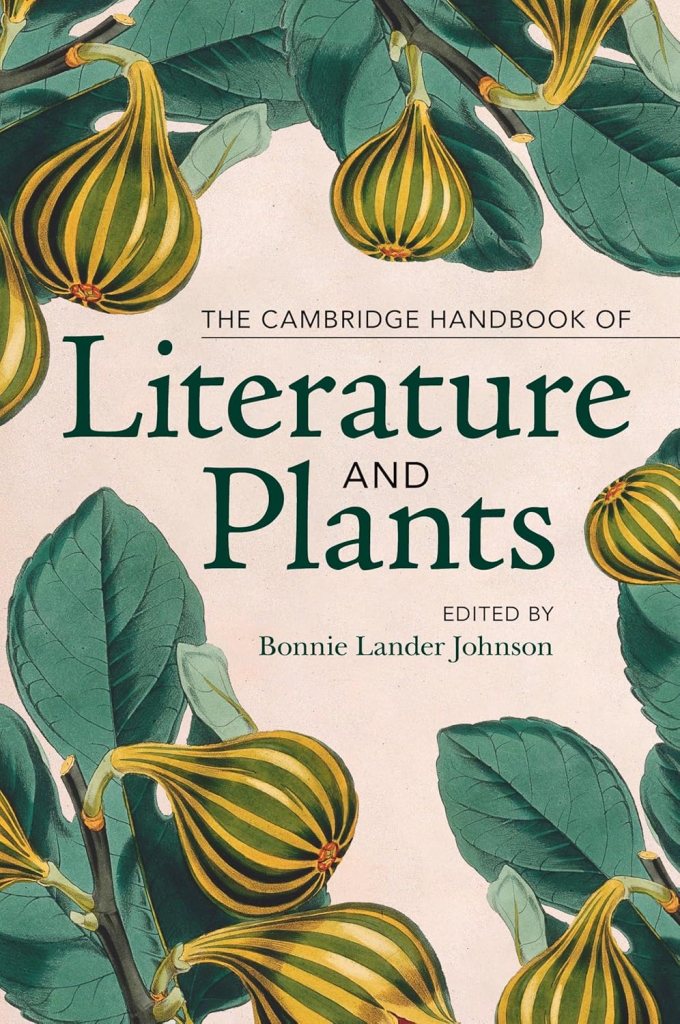
When I first heard of this title I assumed it was a collection – an anthology in the truest – literal etymological (Cristina Gusano) – sense of that word – of a selection of stories about plants. Which would have been a pleasant enough book to read. But, how wrong was I? Having acquired and examined The Cambridge handbook of literature and plants edited by Bonnie Lander Johnson [which tome – shortened to Literature and plants – is here appraised], I’m very happy to say that this book is so much more than that!
General observations
Literature and plants is 390 pages of erudite scholarship contributed by 19 specialists on topics as varied as: early Christian literature; herbals and gardening manuals; speculative fiction; early American plant writing; and Middle Eastern poetry. Each of the 19 chapters is very well written [but do see comments under Prepare to be challenged], and provides insights into how plants have been represented in text in manuscripts and novels, poetry, and in song in many of the planet’s cultures and literary traditions. The various scholarly contributions discuss how those botanical mentions should be interpreted, and how they contribute to the relationship between plants and people.
The editor’s declared aim of the book is that the text “speaks to the splendour of a literary tradition in which plant-writing has long allowed authors to ponder fundamental questions about the nature of life and death, the mystery of liveliness, and the relationship between the human and the nonhuman” (p. 3). This it does, and Literature and plants is full of fascinating accounts by experts in their field whose serious, sober, and scholarly musings provide a refreshingly different view of plants, and something of interest for everyone.
Sadly, though, Literature and plants contains very few illustrations. Notwithstanding the fact that the book’s focus is upon literature, some more pictures of plants would have helped break-up the large swathes of text. Of the five images that are included, all are in black-and-white, two are covers of magazines in the same chapter, and only one shows much in the way of plants proper – Fig. 4.1 featuring four herbs from John Gerard’s Herbal of 1597.
Choosing what to include in this handbook must have been a daunting task. It’s not clear how much is down to the personal preference of the contributing authors or by guidance from the editor, or maybe negotiation between them. But, a very good range of views and topics is covered in Literature and plants. That having been said, one can only imaging the tome getting bigger in time as more chapters are added to ensure an even more globally-encompassing coverage.
Finally, Literature and plants is not a book to read in a single setting; there’s far too much to digest in the book’s very diverse chapters. But, this book should inspire the botanically-minded to look at plants in a different way to the usual preoccupation with structure and function and utility of plants. In that regard Literature and plants is an important book.
Great variety and scope
Commentary in – and on – Literature and plants is provided by many different authors, from different backgrounds and perspectives. Consequently, you are exposed to a wide variety of different ways to think about plants in literature. For example: in her chapter on Chinese literature, Xiaofei Tian has a focus on one plant – the sacred Lotus; Giulia Pacini provides a very broad consideration of plants and writing in her chapter looking at French and francophone literature (although with a reminder of the importance of the rose in this tradition); and Lesley Wylie presents a tightly-focused essay looking at a handful of books – but each one in-depth – dealing with the plant literature of Latin America and the Caribbean. Although traditional written-word manuscripts and books are the mainstay of the literary outputs considered by each contributor, both poetry and song lyrics are also given a very good discussion – e.g., in the chapter on Chinese literature. And, John Charles Ryan’s contribution reminds us of the existence and importance of dendroglyphs on “ancient carved boab trees in Kimberley region of Western Australia” (p. 287) (and the fact that a tradition of plant writing dates back many thousands of years in Australia).
Wide global inclusivity
I’m not familiar enough with the phytoliterature of any region or genre to say what’s not included in this curated collection. But, I can say that what is included appears to represent an impressive overview of a great deal of plant-based writing from around the world. I suspect the widely-based geographical selections present in the book will be of similar eye-opening value to other readers wherever in the world they may be based*. In that respect this book does a great job of introducing geographically-dispersed readers to this important literary form. But, this book is not the end of the story. This book can only get bigger – and better – as more literary genres are included, and its geographical range is expanded – e.g., to Central and Northern Africa, The Levant, Central and Eastern Europe, Russia, Japan, Korea, and other Asian and far-Eastern cultures. With that expectation in mind, I very much look forward to expanded editions of this important work.
Prepare to be challenged
The text of Literature and plants is quite challenging in places – featuring many words that were ‘new’ to this reader, e.g.: aetion, efflorescence, elide, eschatology, immanent, exegetes, concupiscence, hylozoic, mythography, alterity, prelapsarian, ineradicable, Adamic knowledge, undergirds, actants, immensa turba, gnostic, emblematises, poeticisation, somatic congruences, Aristotelian nominalism, identarian, solidary, alterity, and such memorable phrasing as “Vegetal imagery constellates French and francophone literature…” (p. 233). Arguably, that is to be expected because it is written by scholars [and for an intelligent readership – whether academic or not] from disciplines whose literary styles are quite different to those of us from a scientific-paper-based writing tradition.
But, that’s no bad thing, it is good to be challenged and encouraged to ‘think outside of the box’, and venture beyond one’s comfort zone (Oliver Page). If you want to know more about plants, and the relationships between plants-and-people in particular, these forays into ‘difficult’; territory are necessary**. For those of us who are much more used to straightforward writing about plants and plants-and-people interactions, Literature and plants provides an opportunity to expand our horizons and gain a more nuanced appreciation of plants, and people.
Literature and plants looks at writing about plants. Plants, not as lifeforms in their own right and therefore worthy of study from that point of view, but as used in different – often metaphorical – ways to shine a light on human activities. Writing about plants – or, rather, using plants – may actually tell us more about many facets of the ‘human condition’ (Cait Caffrey) than plants, and more than writing just about people.
An indication of the botanical areas Literature and plants will take you into is given by the keywords for Susan McHugh’s similarly-titled Plants and Literature entry in the Oxford Research Encyclopedia of Literature (2021): botanical criticism, critical plant studies, ecocriticism, literary and cultural plant studies, phytocriticism, phytocentric criticism, phytographia, phytopoetics, plant thinking, and vegetal poetics. As I say, prepare to be challenged. And, if you approach the book in that way, you will be richly rewarded, and your botanical appreciation will be expanded.
A book of three parts
The approx. 375 pages of main text of Literature and plants is divided into three sections.
In Part I, “Historical periods”, roughly 2,000 years of plant literature are covered in six chapters that deal with: the ancient world [with a good mention of Vergil, and a reminder that there is much more concerning this ancient writer to be found in Vergil’s Green Thoughts: Plants, Humans, and the Divine by Rebecca Armstrong, this chapters author]; early Christian literature by Clare Lapraik Guest [which has the book’s record for number of Notes at 120, and which provides fascinating insights into how Early Christian literature should be read – and interpreted]; mediaeval England by Michael DJ Bintley [which considers varied representations of the physical form of trees in the literature of that period, and importantly reminds us 21st century readers of the problem of trying to understand the world of the Mediaeval peasant (or those of older, Ancient times)]; the botanical renaissance [which “focuses on the co-existence of myth and science in Renaissance botanical texts and the capacity of Renaissance literature to clarify the advantages and drawbacks of bestowing personhood on plants” (Todd Borlik)]; the 18th – 19th centuries [“The chapter also suggests that we should at least question that other familiar narrative of a newly discovered ‘Romantic’ transcendence: turning to moments of emotional engagement with plants both in earlier writing and in writing outside of the ‘Romantic’ tradition, helps us to recognise a much longer tradition of transcendent emotion of which the Romantics are only a part” (Stephen Bending)]; NB, I did say that this book will challenge you(!)]; and the 19th – 20th centuries [which chapter “traces the ways in which plants were revealed in new and sometimes unsettling forms in the literature, science and art of the fin de siècle and first decades of the twentieth century” (Claudia Tobin)].
Part II, “Anglophone literary forms”, ranges far and wide throughout the English language plant literary tradition. Amongst its 5 chapters are: contributions by Jessica Rosenberg on such ‘useful books’ as herbals and gardening manuals [which forms of plant writing “do not usually fall under the title of literature” (p. 131)]; Shakespeare’s plants [“More than any other dramatist, Shakespeare’s language was deeply invested in plants” (p. 149), with much more on this topic in chapter author’s Bonnie Lander Johnson’s book Botanical Culture and Popular Belief in Shakespeare’s England]; Metaphysical subjects and Cavalier objects in seventeenth-century plant lyrics [“Seventeenth-century Cavalier poetry … tends to focus on what the poet predictably wants from the material world, often based on analogies between plants and the desired objects, which are often young women. Metaphysical poetry of the same period … focuses instead, often by a plant metaphor, on what the poet is, fears to be, and wishes to be“ (Robert N Watson)]; speculative fiction [genres such as science fiction, fantasy, and horror] and the contemporary novel [with much praise for Richard Powers’ The Overstory, which book Timothy S Miller (the chapter’s author) describes as “‘The Great American Plant Novel’” (p. 205), and discussion of Semiosis by Sue Burke]; and “thinking and healing with grass in contemporary poetry” [which chapter “attends to the regular presence of grass in poetry of the twentieth and twenty-first centuries. From Walt Whitman and English war poetry to recent work by Oswald and Burnett…” (Holly Corfield Carr)].
Part III, “Global regions”, begins an exploration of plant literature from around the world, with chapters on: French and francophone sources by Giulia Pacini [with important reference to vegetation as a monstrous force in fin-de-siècle literature – which notion is greatly expanded upon in Monsters Under Glass: A Cultural History of Hothouse Flowers from 1850 to the Present by Jane Desmarais]; early American plant writing [“Early American literature in English – poetry, herbals, prose tracts, and instructional writing – was deeply engaged with the movement of indigenous and imported plant species as they flowed in and out of North America as rapidly as humans moved into the region from the rest of the globe” (Michael Ziser)]; Latin America and the Caribbean [“This chapter, organised chronologically from the colonial period to the present, focuses on key literary traditions and/or works from Latin America and the Caribbean that engage directly with plants, including sugar cane, the ceiba pentandra, and rubber” (Leslie Wylie)]; Australia [“Structured chronologically, the discussion begins with Indigenous Australian narratives of plants, arguably the world’s oldest literary representations of botanical life” (John Charles Ryan)]; Southern Africa [with focus on “ubiquitous plant presences in some of the literatures of southern Africa, essentially of South Africa and Zimbabwe” (Dan Wylie); China [“Focusing on the changing and expanding story of the lotus, this chapter suggests that the lotus is a plant of hybridity, a site of contested meanings, and that its botanical and literary lives are intricately intertwined with the social and cultural histories of China” (Xiaofei Tian)]; India [ “Trees and plants have been venerated for centuries in India as cosmic providers of life and energy. In the modern periods, these sentiments have dominated literary and cultural works” (Sourit Bhattacharya); and Middle Eastern poetry [which chapter “takes its lead from Islamic poetry, which was practiced for centuries in Arabic, Persian, Ottoman-Turkish, and Urdu, in a geography extending from the Middle East to South Asia” (Efe Khayyat)].
Whilst there is some scope for expanding the number and type of contributions to Parts I and II, Part III is arguably the section where one expects to see additional literature traditions added in future editions of this book.
Plus…
In addition to the Introduction and 19 chapters, Literature and plants also has 4.5 pages of ‘Select Bibliography’, which lists numerous books. Although at least some of the titles relate to items that are cited in chapter footnotes, there is nothing explicit to say what this collection relates to. Presumably, it is a list of additional, background(?), reading.
Finally, there is an Index, 4.5 pages of 2-columned entries, whose entries appear to be exclusively names of people. Exclusion of anything botanical – or subject-related – seems to be a very strange state of affairs in a book devoted to literature about plants. This reader sincerely hopes that this serious shortcoming will be remedied in a future edition of the book with entries for the different plants mentioned in the chapters. As a help to potential readers, some of the names indexed are: Austen, Jane; Bose, Jagadish Chandra; Chaucer, Geoffrey; Culpeper, Nicholas; Darwin, Charles; Donne, John; Eliot, TS; Flaubert, Gustave; Herbert, Frank; Herbert, George; Kimmerer, Robin Wall; Kinsella, John; Kipling, Rudyard; Le Guin, Ursula K; Linnaeus, Carl; Lovecraft, HP; Marvell, Andrew; Milton, John; Ovid; Pliny the Elder; Pope, Alexander; Powers, Richard; Proust, Marcel; Raleigh, Sir Walter; Rousseau, Jean-Jacques; Sackville-West, Vita; Sappho; Sartre, Jean-Paul; Shakespeare, William; Socrates; Spenser, Edmund; Theophrastus; Thomson, James; Thoreau, Henry David; Tolkien, JRR; Virgil; Wells, HG; Whitman, Walt; Wilde, Oscar; Woolf, Virginia; Wordsworth, William; Wyndham, John; and Zola, Emile. An eclectic mix if ever there was – and that’s just a sample of the full list – but which gives some idea of the scope of the text.
Is this book unique?
The publisher’s publicity blurb tells us “The first of its kind, this wide-ranging, accessible handbook covers literary engagement with plants in over two thousand years of writing from around the world” [here, and on page i of the book]. Although other books do consider the sort of material that is covered in Literature and plants – a very good example of this is the titles in Reaktion Books’ Botanical Series – I’m quite prepared to believe that this single tome is unique in its scope and ambition.
Something about sources…
Generally, Literature and plants seems to be suitably sourced [i.e. evidence-based] for the material it presents; in-text sources are indicated as super-scripted numbers, with a Notes section at the end of the chapter containing the relevant citation information.
But, sources cited are primarily for the numerous quotes from the literature that the contributors discuss. The interpretations of what those quotes mean or tell us about plants and the way they’ve been used in literature are largely the creation of the chapter’s author***. In that respect fairly minimal additional sources are needed.
However, where contributors aren’t talking personal interpretation but factual statements, there is need for more sources to be stated. For example, in Note 21 on page 87 we are told that Mark Griffiths’ claim that the 4th figure on the title page of John Gerard’s landmark herbal is William Shakespeare “has not found much support among Shakespeareans”. Such a bold assertion needs evidence; citing some of the sources where these dissenting views can be found would be most helpful. On p. 133 we are told that “As Fabrizio Baldassarri has suggested…”. Fair enough, but what is the source in which that statement has been stated? What is the evidence for saying that ”The nineteenth-century practice of gathering cuttings from Stratford-upon-Avon quickly became popular in America” (p. 151)? And, what is the source for the timing of Last Glacial Maximum (circa 20,000 years ago); and for the comment regarding use of native North American varieties of long-staple cotton? Adding the sources – or, at least, making them more explicit than they appear to be – can only boost the academic and scholarship credentials of Literature and plants.
Try before you buy…
Not sure if you want to commit to the book? If you’d like to examine the book before you part with your cash, and in the spirit of ‘try before you buy’ (Alexis Damen), summaries of all 19 chapters can be accessed and read here, as can the full text of the book’s Introduction.
How much..?
Talking of buying, a word about the book’s selling price. It’s £90 [US$120] for the hardback copy that I reviewed. Whilst that’s quite a lot of money for a single item, Literature and plants does introduce you to dozens – if not hundreds – of other books with plant-relevant themes that you might consider going on to read (and maybe purchase…). In that respect the book’s purchase price represents just a few pence per new book title that you discover. If you’re not swayed by that argument, then another strategy is to wait for the publisher to produce a paperback version of the book, which editions are usually a lot cheaper than the hardback ones (James; Jamie Rand).
Summary
The Cambridge handbook of literature and plants edited by Bonnie Lander Johnson is an important book. As its editor tells us, “The chapters in this volume explore some of the most abiding human concerns about plants: the extent to which we resemble them or they us; our use of plants to negotiate geo-political conflict; the ethical dimension of our plant sensibilities and the possible sensitive nature of plants; the moral dimension of our desire to engage aesthetically with plants; and the ways in which human–plant relations have been used to make and unmake national and ethnic identities” (p. 2). Literature and plants covers a lot of ground, and is a welcome addition to the plants-and-people genre.
* Important note: this reviewer is an English-speaking/-reading, UK-based commentator, which represents a fairly narrow literary and geographical base. From that rather restrictive perspective, Literature and plants has been very useful in reminding me (occasionally) or introducing me (more usually) to the wealth of phytoliterature that is to be found globally.
** In addition to being introduced to alternative views of the relevance/importance of plants to people by way of numerous interpretations of their mentions in literature, Literature and plants provided ‘new to me’ moments. For example I learnt: how long Adam and Eve actually spent in the Garden of Eden, according to Dante; that Infidelity was considered a cause of twin births by some contemporaries; an alternative notion of ‘rhizome’; and that The College of Physicians sought to discredit the plant knowledge of women and apothecaries.
*** Arguably, also a contributor’s personal view is this statement regarding Carl Linnaeus’ “natural method [of plant classification] which focused instead on the sexual characteristics of plants” (p. 236). One of the main facts about the plant classification system used by Linnaeus – based on the numbers and arrangement of sexual components in the flowers – is that it is artificial (Birgitta Bremer, 2007; Stefan Müller-Wille, 2007), and not natural. The book’s statement certainly needs a source for considering it to be a natural one.
REFERENCES
Birgitta Bremer, 2007. Linnaeus’ sexual system and flowering plant phylogeny. Nordic Journal of Botany 25: 5-6; https://doi.org/10.1111/j.0107-055X.2007.00098_12.x
Stefan Müller-Wille, 2007. The love of plants. Nature 446: 268; https://doi.org/10.1038/446268a

 Plant Cuttings
Leave a reply to What are gardens for..? – Plant Cuttings Cancel reply