
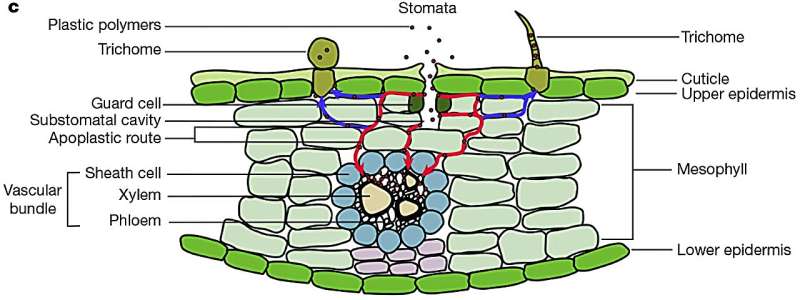
This image is from Figure 4 in the scientific article by Ye Li et al. (2025) and shows the movement of microplastics absorbed by the leaves through the stomata to vascular tissue (in red) and trichomes (in blue).
Stomata are wonderful biological innovations that are present within the epidermis that covers the aerial surfaces of plants (James W Clark et al., 2022). Essentially, stomata consist of a pair of cells that can expand to make a hole between them, or ‘deflate’ to close up that hole (Regina Bailey). The cells are called ‘guard cells’ and they effectively ‘guard’ the hole – which is technically the ‘stoma’ – that they create. In that way they exert some control over what materials pass through the opening, either to enter the plant or to leave it.
When closed – usually at night-time* or at other times when the plant may be experiencing water-stress (Emma Archbold; Melissa Ha) – they significantly reduce controllable water loss [‘transpiration’** (Melissa Petruzzello; Scott Trimble)] from aerial surfaces of plants. When open – during daylight hours for most plants* – they permit entry of CO2 used in photosynthesis (and permit egress of water vapour from the plant).
However, open stomata also allow ingress of other things that – unlike CO2 – aren’t so beneficial to the plant. For example, open stomata are an entry point for bacteria (Sheilagh Molloy, 2006; Junwen Wu & Yukun Liu, 2022) and fungi (David Moore et al.; Junwen Wu & Yukun Liu, 2022) which can infect the plant and markedly impair its growth and development, and maybe causing its death (Demetrio Marcianò et al., 2021). And, as if that’s not bad enough, now it seems that stomata are also a portal through which microplastics can enter a plant, which is the conclusion of Ye Li et al. (2025]).
But, before we consider Li et al. (2025)’s investigation a few words about plastics are appropriate, and necessary.
What are plastics?
Plastics is an ‘umbrella term’ that represents “a wide range of synthetic or semi-synthetic materials that use polymers as a main ingredient …”. Mostly “derived from fossil fuel-based chemicals like natural gas or petroleum”, and undoubtedly considered useful to humankind, plastics are rather detrimental to the living world more generally (Laura Parker).
What are microplastics?
“Mechanical abrasion, photochemical oxidation and biological degradation of larger plastic debris result in the formation of microplastics (MPs, 1 μm [micrometre] to 5 mm [millimetre] [in diameter])” (Liuwei Wang et al., 2021). In other words, large, visible-to-the-naked-eye bits of plastic are gradually broken down into much smaller – and more numerous – pieces of plastic. [Ed. – and, for good measure, even smaller bits of plastics are known as nanoplastics; “Mechanical abrasion, photochemical oxidation and biological degradation*** of larger plastic debris result in the formation of … nanoplastics (NPs, 1 nm [nanometre] to 1000 nm [which is equivalent to 1 μm])” (Liuwei Wang et al., 2021)].
Where are plastics found?
Since plastics were launched into the environment in the 1950s, they have been found everywhere on Earth (Laura Parker); on the land (Xiao Chang et al., 2022), in the sea (Bethany Clark et al., 2023), in rivers (William de Haan et al., 2023), lakes and reservoirs (Veronica Nava et al., 2023), and in the air (Janice Brahney et al., 2020). Plastics have been reported from the otherwise-largely-uninfluenced-by-humans-or-their-activities Arctic (Melanie Bergmann et al., 2022), and plastic bags have been recorded at the bottom of the deepest part of the ocean (Sarah Gibbens). And polluting plastic doesn’t just stay in one place. It travels around the globe, e.g., it moves from the ocean into the atmosphere (Isabel Goßmann et al., 2023). Plastic (pollution) is everywhere on the planet.
What are the effects of plastics on living things?
A Google Scholar search in mid-April 2025 [when this post was written] showed “About 11,700 results” “since 2025” using the search term “effect of plastic on animals”. That’s far too many items to consider here in any detail. However, in the interests of encouraging readers to take notice of this issue, the scientific publication by Alexander Nihart et al. (2025), entitled “Bioaccumulation of microplastics in decedent human brains”, has been interpreted for a lay audience by Max Kozlov with the not-alarming-at-all title “Our brain is full of microplastics: are they harming you?” From a plant perspective, the following two articles will provide readers with more information on how plastics impact flora, Fayuan Wang et al. (2022), and Enikő Mészáros et al. (2023).
Back to the stomata
With that as background and context, what did Ye Li et al. (2025) discover? Working with maize (Zea mays), they found that leaves of this plant can absorb airborne microplastics (MPs) directly from the atmosphere. Specifically, MPs of polyethylene terephthalate (PET) and polystyrene (PS) entered the leaves through open stomata.
Although the MPs appear to remain within the leaf – especially in such structures as epidermal trichomes, they were also detected in the vascular tissue, the long-distance transport pathway that extends throughout the plant (Kammy Algiers & Melissa Ha).
Of the two components of the vascular tissues – the xylem (Melissa Petruzzello), and the phloem (Erica Kosal) – the MPs were specifically associated with the phloem. And that’s a finding of particular concern because the phloem is the vascular component that transports [translocates] the products of photosynthesis – sugars in particular – throughout the plant. The direction in which the sugars move is determined by the strengths of so-called ‘sinks’; sugars move from the ‘sources’ of production – chiefly the photosynthetic leaves – to other parts of the plant without photosynthetic capability – ‘sinks’ – but which still have a need for sugars for respiration and as organic compounds for incorporation into biosynthetic pathways.
As Li et al. (2025) acknowledge MPs may enter the phloem translocation (Melissa Ha et al.) pathway – the sieve tubes – along with sugars and other compounds moved along that route. If this happens in practice, there is the possibility that stomatal-absorbed MPs could be transferred throughout the plant to – and maybe accumulate in – non-leaf parts such as developing fruit [the maize ‘ear’ in this instance], which is a major sink for photosynthate during its development. Since the ear of maize is harvested for consumption by humans and their domesticated animals, this poses a potential problem as a source of entry of MPs into the human body.
Apart from the maize that was investigated in detail during their study, Li et al. (2025) also found leaf accumulation of MPs in other plants – many of which are widely consumed by humans: Brassica oleracea var. botrytis [cauliflower]; Ipomoea aquatica [water spinach]; Apium graveolens [celery]; Brassica rapa var. chinensis [pak-choi]; Spinacia oleracea [spinach]; Lactuca sativa var. capitata [iceberg lettuce]; Brassica rapa var. glabra [Chinese cabbage]; Brassica oleracea var. capitata [cabbage]; Lactuca sativa var. ramosa [a type of lettuce]; Broussonetia papyrifera [paper mulberry]; Ailanthus altissima [tree of heaven]; Euonymus japonicus [Japanese spindle]; and Sophora japonica [Japanese pagoda tree].
These results suggest that this stomatal entry route for MPs may be quite a widespread phenomenon, and leads to a suitably cautious conclusion by Li et al. (2025): “Our results demonstrate that the absorption and accumulation of atmospheric MPs by plant leaves occur widely in the environment, and this should not be neglected when assessing the exposure of humans and other organisms to environmental MPs”. Sadly, although this plastic plant access route may only have been identified recently, it’s probably one that’s been used for a very long time. Or, plastic-loaded plants and their parts have probably been consumed by people all over the world for some considerable time. [Ed. – Something that’s been discovered hasn’t just become that thing upon its identification by people; it’s probably been a thing long before that recognition…]
Soil-borne plastic problems
Is it just airborne MPs that we have to worry about with plants? No. Ye Li et al. (2025)’s investigation adds to previous work on such plants as wheat (Triticum aestivum) and lettuce (Lactuca sativa) that has demonstrated uptake of plastics through their roots (e.g., Lianzhen Li et al., 2020; Xiao-Dong Sun et al., 2020; Yongming Luo et al., 2022]. So, MPs in the soil must also be considered a concern for plants and all organisms that feed on them – and presumably to the organisms that feed on the organisms that have consumed MP-containing plant material. In that way, arguably once in the environment MPs, have the capacity to be continually recycled throughout the food web. And, given the fact that MPs degrade very slowly (André Abreu & Maria Luiza Pedrotti) in the environment, this is a problem that will persist for a very long time.
Even if MP-contaminated parts aren’t eaten, presence of MPs in plants is a cause for concern because they can affect their growth and development. This may result in reduced yield and amount of harvestable material (e.g., Ruijie Zhu et al., 2025 – and commentary thereupon here, and by Denis Murphy). In that way there is less plant food to go around – even if that food that is produced isn’t MP-contaminated. One way or another, plastics are not one of humankind’s greatest inventions.
Plastic phytoremediation potential
But, maybe this phenomenon could be turned to the advantage of humankind? Since MPs are accumulated by plants, maybe those same plants could be used to absorb MPs from the air (and soil), so that other plants have less of a plastic burden to bear and are less harmful to other biota? This particular variant of ‘phytoremediation’ (Sigurdur Greipsson, 2011) is explored in the perspectives article by Wenke Yuan et al. (2024), with commentary on the proposal by Birgitte Svennevig. Which property may also be of value indoors within residential properties (Kushani Perera et al., 2024).
There’s more…
For more on the ‘stomata and plastics’ story, see Justin Jackson, Willie Peijnenburg, Mark Collins, Xinhua, here, here, here, Tudor Tarita, and Himanshu Nitnaware.
* The phenomenon of stomata being open during the day and closed at night may be considered the ‘normal’ state of affairs in land plants. However, there is a group of terrestrial plants that use an additional bit of biochemistry to effect photosynthesis. These so-called CAM plants open their stomata at night – which allows uptake of CO2 (and minimises water loss associated with daytime opening) – but are closed during the daylight hours. Photosynthesis still takes place in the daytime – using sunlight and the CO2 released within the plant from the stores that were made overnight.
** Stomata aren’t the only sites from which plants can lose water. Although largely bult from water-repelling waxes and fats, the cuticle (Laura González-Valenzuela et al., 2023) – which covers the external aerial surface of plants except where this water-proofing layer is breached by stomata – also allows the passage of water (Martijn Slot et al., 2021). In magnitude this so-called cuticular transpiration (Scott Trimble [https://cid-inc.com/blog/transpiration-in-plants-its-importance-and-applications/]) is much lower than that via the stomata, but is an example of uncontrolled water loss from plants.
*** A fascinating example of this is the digestive action of Antarctic krill that can turn MPs into NPs (Amanda Dawson et al., 2018).
REFERENCES
Melanie Bergmann et al., 2022.Plastic pollution in the Arctic. Nat Rev Earth Environ 3: 323–337; https://doi.org/10.1038/s43017-022-00279-8
Janice Brahney et al., 2020. Plastic rain in protected areas of the United States. Science 368: 1257-1260; doi: 10.1126/science.aaz5819
Xiao Chang et al., 2022. Microplastic pollution in soils, plants, and animals: A review of distributions, effects and potential mechanisms. Science of The Total Environment 850: 157857; https://doi.org/10.1016/j.scitotenv.2022.157857
Bethany Clark et al., 2023. Global assessment of marine plastic exposure risk for oceanic birds. Nat Commun 14: 3665; https://doi.org/10.1038/s41467-023-38900-z
James W Clark et al., 2022. The origin and evolution of stomata. Current Biology 32(11): R539-R553; https://doi.org/10.1016/j.cub.2022.04.040
Amanda Dawson et al., 2018. Turning microplastics into nanoplastics through digestive fragmentation by Antarctic krill. Nat Commun 9: 1001; https://doi.org/10.1038/s41467-018-03465-9
William P de Haan et al., 2023. The dark side of artificial greening: Plastic turfs as widespread pollutants of aquatic environments. Environmental Pollution 334: 122094; https://doi.org/10.1016/j.envpol.2023.122094
Laura González-Valenzuela et al., 2023. The plant cuticle. Current Biology 33(6): R210-R214; https://doi.org/10.1016/j.cub.2023.01.003
Isabel Goßmann et al., 2023. Occurrence and backtracking of microplastic mass loads including tire wear particles in northern Atlantic air. Nat Commun 14: 3707; https://doi.org/10.1038/s41467-023-39340-5
Sigurdur Greipsson, 2011. Phytoremediation. Nature Education Knowledge 3(10): 7.
Lianzhen Li et al., 2020. Effective uptake of submicrometre plastics by crop plants via a crack-entry mode. Nat Sustain 3: 929–937; https://doi.org/10.1038/s41893-020-0567-9
Ye Li et al., 2025. Leaf absorption contributes to accumulation of microplastics in plants. Nature (2025); https://doi.org/10.1038/s41586-025-08831-4
Yongming Luo et al., 2022. Quantitative tracing of uptake and transport of submicrometre plastics in crop plants using lanthanide chelates as a dual-functional tracer. Nat. Nanotechnol. 17: 424–431; https://doi.org/10.1038/s41565-021-01063-3
Demetrio Marcianò et al., 2021. The dark side of fungi: How they cause diseases in plants. Front. Young Minds 9: 560315; doi: 10.3389/frym.2021.560315
Enikő Mészáros et al., 2023. Impacts of plastics on plant development: Recent advances and future research directions. Plants (Basel) 12(18): 3282; doi: 10.3390/plants12183282
Veronica Nava et al., 2023. Plastic debris in lakes and reservoirs. Nature 619: 317–322; https://doi.org/10.1038/s41586-023-06168-4
Alexander J Nihart et al., 2025. Bioaccumulation of microplastics in decedent human brains. Nat Med 31: 1114–1119; https://doi.org/10.1038/s41591-024-03453-1
Kushani Perera et al., 2014. Evaluating the retention of airborne microplastics on plant leaf: Influence of leaf morphology. Environmental Pollution 346: 123673; https://doi.org/10.1016/j.envpol.2024.123673
Martijn Slot et al., 2021. Large differences in leaf cuticle conductance and its temperature response among 24 tropical tree species from across a rainfall gradient. New Phytologist 232(4): 1618-1631; https://doi.org/10.1111/nph.17626
Xiao-Dong Sun et al., 2020. Differentially charged nanoplastics demonstrate distinct accumulation in Arabidopsis thaliana. Nat. Nanotechnol. 15: 755–760; https://doi.org/10.1038/s41565-020-0707-4
Fayuan Wang et al., 2022. Micro(nano)plastics and terrestrial plants: Up-to-date knowledge on uptake, translocation, and phytotoxicity. Resources, Conservation and Recycling 185: 106503; https://doi.org/10.1016/j.resconrec.2022.106503
Liuwei Wang et al., 2021. Environmental fate, toxicity and risk management strategies of nanoplastics in the environment: Current status and future perspectives. Journal of Hazardous Materials 401: 123415; https://doi.org/10.1016/j.jhazmat.2020.123415
Junwen Wu & Yukun Liu, 2022. Stomata–pathogen interactions: over a century of research. Trends in Plant Science 27(10): 964-967; http://dx.doi.org/10.1016/j.tplants.2022.07.004
Wenke Yuan et al., 2024. The power of green: Harnessing phytoremediation to combat micro/nanoplastics. Eco-Environment & Health 3(3): 260-265; https://doi.org/10.1016/j.eehl.2024.04.001
Ruijie Zhu et al., 2025. A global estimate of multiecosystem photosynthesis losses under microplastic pollution. PNAS 122(11): e2423957122; https://doi.org/10.1073/pnas.2423957122


 Plant Cuttings
Leave a comment