
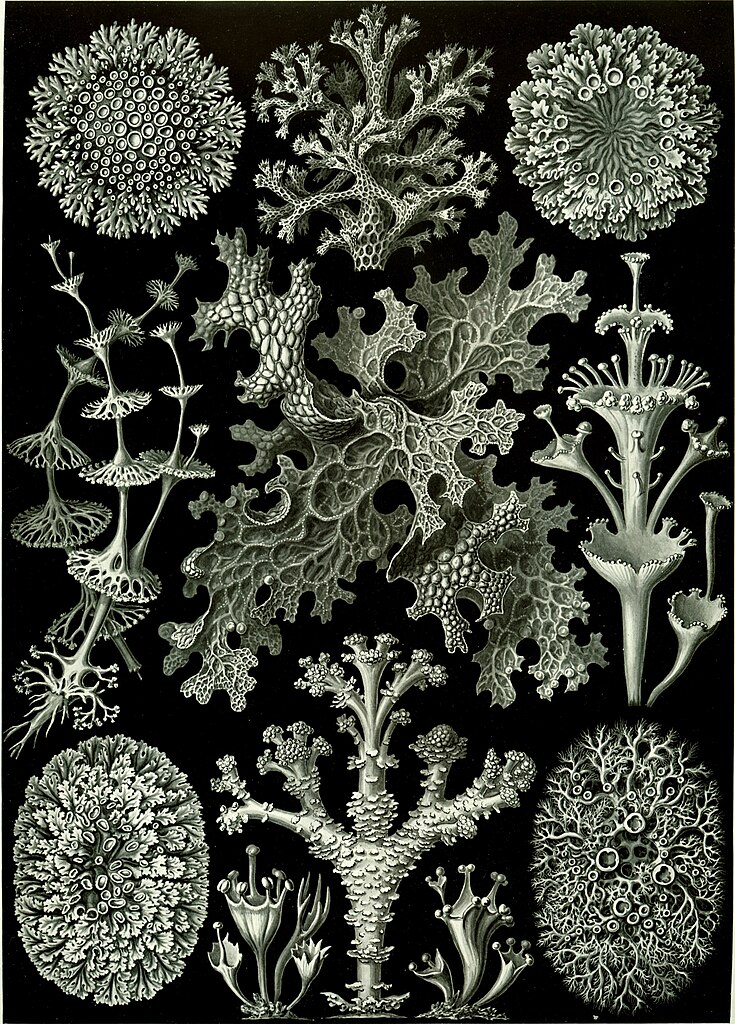
This image [https://en.wikipedia.org/wiki/File:Haeckel_Lichenes.jpg] is of plate 83: Lichenes from Kunstformen der Natur (1904) by Ernst Haeckel [https://en.wikipedia.org/wiki/Ernst_Haeckel] is in the public domain.
Answer: When it’s a phyllosymbium.
Although that word is a bit of a mouthful, it’s the name proposed by Che-Chih Chen et al. (2025). However, before we explore that tricky term we’d better provide some background. First,
What is a lichen?
Traditionally, a lichen is a mutually-beneficial relationship (Regina Bailey) between two partners, a fungus and a photosynthetic organism.
The fungal partner, known technically as the mycobiont (Rosmarie Honegger, 1998), provides the shape of, and structure to, the lichen. The photosynthetic partner, technically termed the photobiont, can be a cyanobacterium (which are bacteria) and/or a green alga*. The main defining physical nature of this partnership – whose dual-organism nature was determined in the second half of the 19th Century by Simon Schwendener (Rosmarie Honegger, 2000; ME Mitchell, 2002)** – is that the fungus envelops the photosynthetic partner that therefore resides within the fungal ‘casing’.
In terms of understanding how both organisms benefit from this arrangement, it has been likened to the relationship between a landlord and lodger. The fungus provides the physical structure that houses – i.e. supports and protects – the resident alga. In turn the algal tenant ‘pays rent’ to the fungal landlord in the form of energy-rich compounds created by its photosynthetic activities. This all seems understandable and nicely ordered and settled.
Upsetting the apple cart
So, what effect has the work of Che-Chih Chen et al. (2025) had on the world of lichenology? Basically, it ‘puts the cat amongst the pigeons’ and ‘upsets the apple cart’. Chen et al. (2025) have discovered a fungus-cyanobacterial association that turns on its head [Ed. – or, rather, turns inside out?] the notion of a lichen. Here the photobiont envelops the mycobiont.
The discovery, made within the cloud forests (Monica Evans; Dirk Nikolaus Karger et al., 2021) of Taiwan (John Copper), is neatly summarised in the discoverers’ own words: “We found an erect thallus resembling a lichen yet with an unexpected thallus structure composed of interwoven cyanobacterial filaments with numerous fungal hyphae inserted within individual cyanobacterial sheaths, contrasting with typical lichen structure [Mr P Cuttings’ emphasis]” (Chen et al. (2025).
Welcome to the phyllosymbium
Although described as a thallus, which usually means “The vegetative body of a plant that is not differentiated into organs such as stems and leaves”, the structure “displayed upright, pointy apices”, some of which extended up to 5 cm from the bases. Looking at the picture of this organism in the scientific paper, Figure 1A, it has the appearance of a very small green hedgehog or echidna (Anne Marie Musser). Or, because a botanical analogy is always preferable to a zoological one, a hornwort.
Further examination led the team to conclude that this entity represented a previously unknown form of cyanobacterium-fungus symbiotic association. Not only that, but the fungal component was identified as a previously undescribed species, Serendipita cyanobacteriicola***. And the blue-green alga represented not only a new species, but is also a new genus, and is named Symbiothallus taiwanensis***. Furthermore, both organisms “are distinct from known lichen-forming symbionts, uncovering a phylogenetically and morphologically unprecedented thallus-forming fungus-cyanobacterium symbiosis” (Chen et al., 2025). The uniqueness of these compound organisms is recognised by the team naming them ‘phyllosymbia’, which “underscore their unique symbiotic nature and leaf-like appearance”****.
What next?
Having recognised this cyanobacteria-fungal association, many questions remain to be asked, and answered – as Chen et al. (2025) acknowledge. One relates to the nature of any interaction between the bacterium and the fungus – what benefits might either partner receive from the association? Compared to a ‘normal’ – fungus on the outside – lichen, it seems unlikely that here the fungal partner can offer any physical protection to the cyanobacterium. But, Chen et al. (2025) wonder whether the fungus may “enhance stress resistance for the photosynthetic partner”. They even suggest that “the fungal hyphae may extend into the forest substrate and contribute to nutrient supply for cyanobacteria and the entire thallus”.
Aside from any contribution that the cyanobacterium might make to the fungus as a result of photosynthesis, Chen et al. (2025) demonstrate that the photobiont is also capable of nitrogen-fixation (N Rascio & N La Rocca, 2013). Although the detected activity was “similar to those of coexisting mosses but lower than those of cyanolichens (Frieda Henskens et al., 2012; Jouko Rikkinen, 2015)”*****, the atmospheric nitrogen fixed by the cyanobacterium “may function as one of the crucial exchange currencies in the symbiotic relationship between the cyanobacterium and the fungus”.
Finally [Ed. – for now. I’m sure we will hear more about this curious composite organism in future], although emphasis in this post – as in the scientific paper – is upon the two newly-named organisms – the fungus and the cyanobacterium – they are not the only organisms present in the phyllosymbium. Chen et al. (2025) recorded many more microbes that were associated with the structure. Quite what each – or any – of those may contribute to Serendipita cyanobacteriicola and/or Symbiothallus taiwanensis – and/or vice versa – remains to be examined; for example, Chen et al. (2025) “cannot exclude the possibility that other bacteria inhabiting the thalli played a secondary or equally important role in the observed nitrogen acquisition activity”. In this regard, the phyllosymbium appears similar to a ‘conventional’ lichen which, nowadays, tend to be viewed more as a community or ecosystem (e.g., David Hawksworth & Martin Grube, 2020, 2024; William Sanders, 2024) rather than simply as a bipartite (or tripartite (Frieda Henskens et al., 2012), or even multi-partite (David Hawksworth, 1988; Lourdes Morillas et al., 2022)) mutual****** symbiosis.
All in all this is a pretty impressive discovery that challenges what we thought we knew about myco- and photo-biont interactions (and extends the known range of cyanobacteria-‘plant’ symbioses (David Adams et al., 2006), and of interactions between fungi and other organisms)*******. As is fitting, the final words deserve to go to Chen et al. (2025): “Our finding sheds light on a unique form of symbiosis between fungi and cyanobacteria, opening up exciting avenues for future research”.
* Cyanobacteria used to be – and still are by those of us who are keen to increase the variety of photosynthetic organisms that botanists study – known as blue-green algae.
** This dual-nature interpretation was widely-believed to have been enthusiastically endorsed by Beatrix Potter (e.g., here, here, Gary Perlmutter, here, Sahastrarashmi, and Maria Popova). However, that view has been robustly challenged by an article on the web-site of the Linnean Society of London here. Today, Ms Potter is much better known for her charming tales about animals such as Peter Rabbit, Jemima Puddle-Duck, and Mrs Tiggy-Winkle than for her mycological researches.
As an interesting etymological footnote, recognition of the dual-organism, doubly-beneficial nature of this partnership led to the development of the term ‘symbiosis’ (Estelle Sia Yu Qi) by Albert Bernhard Frank, and that concept’s further expansion and popularisation by Heinrich Anton de Bary (WB McDougall, 1918).
As an additional ‘aside’, it should be noted that, whilst most lichens are considered to be a two-organism partnership – dual-partner organisms – of fungus and green alga, or fungus and cyanobacterium, known also as a bipartite lichen (Frieda Henskens et al., 2012), tripartite lichens – of fungus plus green alga plus cyanobacterium – also occur and account for 3-4% of all known lichens (Frieda Henskens et al., 2012).
*** For those who are intrigued by the meanings of scientific names, Chen et al. (2025) helpfully tells us that the fungus’ specific epithet “cyanobacteriicola,” referring to the cyanobacterial host; the cyanobacterium’s genus comes from “symbio (“symbiotic”) + –thallus (“thallus”), referring to the symbiotic association between a fungus and a thallus-forming cyanobacterium”, and the specific epithet ‘taiwanensis‘ relates to Taiwan, referring to the locality in which the organism was first discovered.
Whilst the names proposed seem sensible, I’m puzzled by Chen et al. (2025)’s statement that “In this study, the nomenclature of cyanobacterial and fungal species follows the International Code of Nomenclature for Algae, Fungi, and Plants (ICN)”. Whilst that seems entirely appropriate for the fungal component, it seems inappropriate for the naming of the bacterium. Although the end result may have been the same, surely the guidance for naming of cyanobacteria should be that from the International Committee on Systematics of Prokaryotes (ICSP) [https://www.the-icsp.org/], under its International Code of Nomenclature of Prokaryotes (Aharon Oren et al., 2023)?
UPDATE: Reading Michael Guiry (2024)’s article on 31st March 2025 I am much better informed about cyanobacterial nomenclature because he advises that “The provisions of this Code [the International Code of Nomenclature for algae, fungi, and plants] apply to all organisms traditionally treated as algae, fungi, or plants, whether fossil or non-fossil, including blue-green algae (Cyanobacteria)”. In other words, it is entirely appropriate to use the ICN to name both the fungus and the blue-green alga in the phyllosymbium. I must therefore acknowledge my formeer ignorance of this issue, and apologise to Chen et al. To deal with point I could have just deleted the second paragraph of the original footnote. However, I thought adding this update was a more honest way of dealing with this matter – and demonstrates how one can still learn new information.
**** And, because it is possible some of this blog’s readers may have heard of the term, the newly-identified relationship is not an example of a mycophycobiosis (e.g., Jan Kohlmeyer & Michael W Hawkes, 1983) because the enveloping ‘algal’ organism is not multicellular – and is not a true alga, so the prefix ‘phyco’ [as in ‘phycology’] does not apply (however much botanists would like to retain ‘ownership’ of their blue-green ALGAE!). [Ed. – Although, mycocyanobiosis might be appropriate..?].
***** Although Mr P Cuttings doesn’t know that much about biological nitrogen fixation [BNF] (Stephen Wagner, 2011; N Rascio & N La Rocca, 2013), he does recall that, for the process to take place, it requires an anaerobic environment (e.g., Jeremy Murray). In the legume BNF symbiosis (Robert Flynn et al.) this is achieved by encapsulating the bacteria within nodules and involvement of leghaemoglobin as an oxygen-capturing compound that regulates the amount of oxygen at sites of nitrogen-fixation to permit its operation (Stephen Wagner, 2011). The structure of typical cyanolichens – with the nitrogen-fixer enveloped by the fungus (Jouko Rikkinen, 2015) – has some physical similarities with the legume nodule, but that is apparently not present in the phyllosymbium. With the cyanobacterium to the outside of the fungus it is presumably in direct contact with the oxygen within the atmosphere, which would presumably reduce any nitrogen-fixing activity. Whether that ‘inside-out’ arrangement of photo- and myco-biont contributes to low BNF activity here seems worth investigating.
****** The long-held two-partner view of lichens was thrown into considerable disarray by the work of Toby Spribille et al. (2016), which showed that many lichens have an additional fungal ‘partner’ making – at a minimum, in several instances – a three-organism entity. Nowadays, the presence of many microbes in addition to the ‘usual suspects’ of algae, cyanobacteria, and fungi in lichens is widely recognised (e.g., Scott Bates et al., 2011; Maria Grimm et al., 2021).
******* It will also be interesting to see how this phyllosymbium relates to the ‘semilichens’ described in a preprint by Jan Vondrák et al. (2024).
REFERENCES
David Adams et al., 2006. Cyanobacterial-plant symbioses, pp. 331-363. In: M Dworkin et al. (eds), The Prokaryotes. Springer, New York, NY; https://doi.org/10.1007/0-387-30741-9_14
Scott T Bates et al., 2011. Bacterial communities associated with the lichen symbiosis. Appl Environ Microbiol. 77(4): 1309-1314; doi: 10.1128/AEM.02257-10
Che-Chih Chen et al., 2025. A thallus-forming N-fixing fungus-cyanobacterium symbiosis from subtropical forests. Sci. Adv. 11(7): eadt4093; doi: 10.1126/sciadv.adt4093
Maria Grimm et al., 2021. The lichens’ microbiota, still a mystery? Front Microbiol. 30(12): 623839; doi: 10.3389/fmicb.2021.623839
Michael Guiry, 2024. How many species of algae are there? A reprise. Four kingdoms, 14 phyla, 63 classes and still growing. Journal of Phycology 60(2): 214-228; https://doi.org/10.1111/jpy.13431
David L Hawksworth, 1988. The variety of fungal-algal symbioses, their evolutionary significance, and the nature of lichens. Botanical Journal of the Linnean Society 96(1): 3–20, https://doi.org/10.1111/j.1095-8339.1988.tb00623.x
David L Hawksworth & Martin Grube, 2020. Lichens redefined as complex ecosystems. New Phytologist 227(5): 1281-1283; https://doi.org/10.1111/nph.16630
David L Hawksworth & Martin Grube, 2024. Lichens redefined as complex ecosystems. New Phytologist 241(3): 972-973; https://doi.org/10.1111/nph.16630
Frieda Henskens et al., 2012. Cyanolichens can have both cyanobacteria and green algae in a common layer as major contributors to photosynthesis. Ann Bot. 110(3): 555-563; doi: 10.1093/aob/mcs108
Rosmarie Honegger, 1998. The lichen symbiosis – what is so spectacular about it? The Lichenologist 30(3): 193-212; https://doi.org/10.1006/lich.1998.0140
Rosmarie Honegger, 2000. Simon Schwendener (1829–1919) and the Dual Hypothesis of Lichens. The Bryologist 103(2): 307-313; https://doi.org/10.1639/0007-2745(2000)103%5B0307:SSATDH%5D2.0.CO;2
Dirk Nikolaus Karger et al., 2021. Limited protection and ongoing loss of tropical cloud forest biodiversity and ecosystems worldwide. Nat Ecol Evol 5: 854–862; https://doi.org/10.1038/s41559-021-01450-y
Jan Kohlmeyer & Michael W Hawkes, 1983. A suspected case of mycophycobiosis between Mycosphaerella apophylaeae (Ascomycetes) and Apophlaea spp. (Rhodophyta). Journal of Phycology 19(2): 257-260; https://doi.org/10.1111/j.0022-3646.1983.00257.x
WB McDougall, 1918. The classification of symbiotic phenomena. The Plant World 21(10): 250-256; https://www.jstor.org/stable/43477691
ME Mitchell, 2002. “Such a strange theory”: Anglophone attitudes to the discovery that lichens are composite organisms, 1871–1890. Huntia 11(2): 193-207.
Lourdes Morillas et al., 2022. Lichen as multipartner symbiotic relationships. Encyclopedia 2(3): 1421-1431; https://doi.org/10.3390/encyclopedia2030096
Aharon Oren et al., 2023. International Code of Nomenclature of Prokaryotes. Prokaryotic Code (2022 Revision). Int. J. Syst. Evol. Microbiol. 73: 005585; doi: 10.1099/ijsem.0.005585
N Rascio & N La Rocca, 2013. Biological nitrogen fixation. In: Reference Module in Earth Systems and Environmental Sciences, Elsevier; https://doi.org/10.1016/B978-0-12-409548-9.00685-0
Jouko Rikkinen, 2015. Cyanolichens. Biodivers Conserv 24: 973–993; https://doi.org/10.1007/s10531-015-0906-8
William B Sanders, 2024. The disadvantages of current proposals to redefine lichens. New Phytologist 241(3): 969-971; https://doi.org/10.1111/nph.16630
Toby Spribille et al., 2016. Basidiomycete yeasts in the cortex of ascomycete macrolichens. Science 353(6298): 488-492; doi: 10.1126/science.aaf8287
Jan Vondrák et al., 2024. Semilichen – an unjustly neglected symbiotic system between green biofilms and true lichens. bioRxiv 12(10): 626781; doi: https://doi.org/10.1101/2024.12.10.626781
Stephen C Wagner, 2011. Biological nitrogen fixation. Nature Education Knowledge 3(10): 15.


 Plant Cuttings
Leave a reply to The Week in Botany March 17, 2025 Cancel reply