
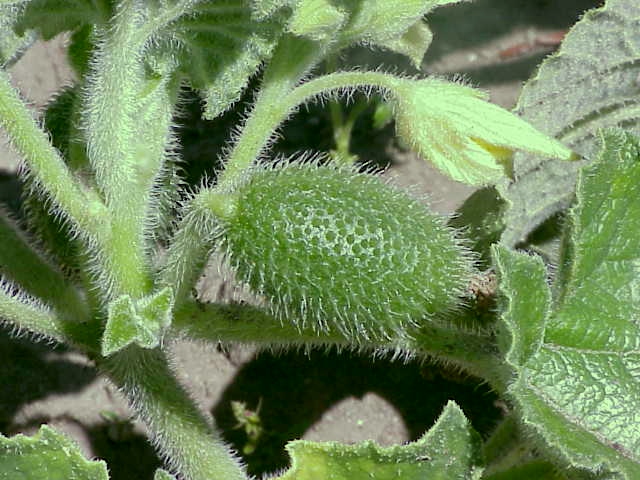
This image, captioned “A fruit of the squirting cucumber”, by Kurt Stueber, is used under under the Creative Commons Attribution-Share Alike 3.0 Unported license.
Watery background
Water – a chemical compound formed from two atoms of hydrogen [chemical symbol H] (William Lee Jolly) and one of oxygen [chemical symbol O] (Robert C Brasted), H2O – is one of the most fascinating molecules known to humankind, with many interesting – and unique – properties. But, you don’t have to take my – non-evidence-based – word for it; have a look at these sourced water statements inspired by Google’s AI Overview for the search term ‘what makes water so interesting’] [Ed. – NB, running this search on different occasions will return slightly different text and related sources]. Key points about water’s interesting properties include [AI overview’s text in italics]:
Polarity: Water molecules have a positive end (hydrogen) and a negative end (oxygen), which allows them to attract each other and other polar molecules (Paul Whitehead). For this reason water dissolves more substances than any other liquid and is known as the ‘universal solvent’ (Corinne Yee & Desiree Rozzi).
Hydrogen bonds: The strong attraction between water molecules due to their polarity creates hydrogen bonds, responsible for many of water’s unique properties (Paul Whitehead). “One water molecule can connect with another molecule via a hydrogen bond … between a hydrogen atom of one and an oxygen atom of the other”.
High surface tension: The “stickiness” of water molecules at the surface allows insects to walk on water. This phenomenon is due to hydrogen bonding between water molecules.
Cohesion: Water molecules strongly attract each other, allowing water to form droplets and resist breaking apart. This property is another consequence of the molecule’s capacity to hydrogen-bond.
Adhesion: Water molecules can also attract to other surfaces, like the walls of a container, and is the reason water “makes things “wet”” [Ed. – although water itself may not actually be wet…]
High specific heat: Water can absorb a large amount of heat before its temperature significantly changes, regulating temperatures on Earth. This very high specific heat capacity (and heats of vaporisation (Nandini Bapat) and fusion) – which is a consequence of hydrogen bonding – makes water a good coolant in the laboratory and elsewhere, but, more generally and importantly, buffers global temperature changes (Paul Whitehead).
Density anomaly: Ice (solid water) is less dense than liquid water, causing ice to float. “As water freezes, the molecules form a crystalline structure that spaces the molecules further apart than in liquid water. This means that ice is less dense than liquid water, which is why it floats“.
Water in (plant) biology
From a biological perspective, water is probably the most important chemical of all for living things (Hannah Bonville): Without it life – as we know it – would probably be impossible (Tia Ghose). From a plant point of view, water is not just the compound that makes life possible, it also participates in many phenomena that permit plants to exist on land or in an aquatic environment. For example,
As I understand it, surface tension is what allows leaves of aquatic plants – e.g., a water-lily – to remain on the surface of the water* facilitating its gaseous exchange with the atmosphere, and providing greater exposure to sunlight that will enhance its capacity to photosynthesise.
Both water’s cohesion (water-water attraction) and adhesion (water-walls of xylem vessels attraction) are important in the maintenance of a continuous column of water within plants that extends from the root/soil interface, throughout the plant, to the aerial surfaces from which water vapour is released into the atmosphere in the Cohesion-tension theory water movement within plants (Melissa Ha; Andrew McElrone et al., 2013).
The thermal buffering provided by the high specific heat of water means that aquatic environments experience less drastic changes in temperature than terrestrial habitats, which results in a more stable environment for the plants, animals, etc. living there – at least from a temperature point of view.
And, water’s ‘density anomaly’ means that it attains its maximum density at approx. 4 oC (Marisa Alviar-Agnew), which means that the water at the bottom of a lake will be no cooler than that, so living things won’t freeze. Put another way, “This property is important, as it keeps ponds, lakes, and oceans from freezing solid and allows life to continue to thrive under the icy surface”.
Water and plant movement
So much for activities that help to maintain the static, rooted-to-the-spot, stationary plant lifestyle. Water is also the ‘movement molecule’ that gives plants the capacity to move. Here I’m not thinking of cell expansion provided by water uptake into the vacuoles of cells with extensible walls that causes them to elongate and thereby contribute to increase in length, and therefore exhibit ‘movement’, of the growing plant part – e.g. phototropically-bending stems (Andrew Fife Hopkins-Galloway) in which they are embedded (George M Briggs). Rather, I have in mind actual movement – translocation from one place to another – without growth mediating the relocation. One way water can be a medium for plant movement is in transporting a whole plant or plant fragment, e.g. along a river, from one place to another, where it might settle and establish itself. Another, quite different kind of water-mediated movement is during the final – but majorly important – part of the life cycle of Ecballium elaterium.
The tale of the squirting cucumber
Better known in English as the squirting cucumber (Clare Kelly), water is used here to propel the seeds away from the parent plant to a new location. A more graphic phrasing of this behaviour is that “a stream of mucilaginous liquid” containing its seeds” issues forth from the ripe fruit during which phenomenon the seeds “are projected as far as 7–8 m (23–26 ft)”. [Ed. – this mechanism of seed dispersal is recognised in the plant’s generic name, Ecballium, “derived from the Greek verb ‘to expel, throw or cast out’” (Clare Kelly).
If the seed is fortunate to land in a place that’s suitable for its gemination, seedling establishment and growth into a mature plant, that’s a good outcome. Should said seed land in an unsuitable place, then it’s bad news for the seed. But, presumably, good news for animals that might eat the seed and receive sustenance and nourishment therefrom. Well, although the existence of this explosively expulsive seed propulsion phenomenon has been known for a long time (since at least the days of Pliny the Elder (Rupendra Brahambhatt), approx. 2000 years ago), it was not clear how this remarkable feat was achieved. However, Finn Box et al. (2024), have done their bit in – as stated in their straightforwardly-titled scientific paper – “Uncovering the mechanical secrets of the squirting cucumber”.
What did Box et al. (2024) uncover? In an approach that combined several techniques – experiments, high-speed videography, and advanced mathematical modelling – the team discovered that the plant exhibits “an unusual decrease in fruit volume prior to ejection which stiffens the stem and orients the fruit to an improved angle for dispersal” Box et al. (2024). In some more detail, Box et al. (2024) “uncover key mechanical interactions between the fruit and stem both prior to and during seed ejection, including the unique feature that fluid is redistributed from fruit to stem prior to ejection…”**.
Not only did they employ computer modelling to investigate the ballistic seed release mechanism, they also used it to predict the spread of new plants starting from a single original plant. In that way they showed how “the coordination of mechanical events prior to and during seed ejection contributes to dispersal success in Ecballium” (Box et al., 2024). Overall, their investigation shows “how well-suited Ecballium is for efficient dispersal”. [Ed. – In reporting this work, Mr P Cuttings is acutely aware of his own lack of expertise in physics and mathematics that have here helped Box et al. (2024) to probe this biological phenomenon, and is extremely grateful for those who can do so – or of research teams that bring together individuals with the necessary complementary skills and expertise.]
Find out more
Unsurprisingly, Box et al. (2024)’s research was widely covered in the science communication media. Accordingly, for more on this work (some with videos), see here, here, here, Rachael Funnell, Derek Moulton, Paul Simons, Mindy Weisberger, Daniel Graham, Carolyn Wilke, Laura Baisas, Michael Banks, Rupendra Brahambhatt, and Sascha Pare.
What’s in a name..?
The technical suffix relating to methods of seed dispersal is -chory***. In nature, examples of seed-dispersal by water – hydrochory – are known, e.g., water-lily (Judy Kilpatrick). As are plants that use a ballistic – ‘explosive’ – method of seed release – e.g., Himalayan balsam and Chinese witch-hazel (Simon Poppinga et al., 2019), which phenomenon is known as ballistochory (Jim McCormac). The conundrum with squirting cucumber using water to explosively release its seeds is whether this event should be considered hydrochory, or ballistochory? Or, whether it should be categorised as a hybrid ‘hydroballistochory’? [Ed. – or is it a type of ‘diplochory’ (Regina Bailey)?]
* Or is that down to buoyancy of the leaves as a result of their air-filled spaces, the aerenchyma (Raymond Ritchie, 2012; Gisele Catian & Edna Scremin-Dias, 2015; Emily Bonnett)..?
** Should any readers like even more details, the ‘Companion Mathematica notebook and experimental datasets’ for the scientific paper are available to peruse here.
*** For more on seed dispersal more generally, the text of HN Ridley’s 1930 book, The dispersal of plants throughout the world is freely-available at the Internet Archive, here.
REFERENCES
Finn Box et al., 2024. Uncovering the mechanical secrets of the squirting cucumber. Proceedings of the National Academy of Sciences of the United States of America 121(50): Article e2410420121; https://doi.org/10.1073/pnas.2410420121
Gisele Catian & Edna Scremin-Dias, 2015. Phenotypic variations in leaf anatomy of Nymphaea gardneriana (Nymphaeaceae) demonstrate its adaptive plasticity. The Journal of the Torrey Botanical Society 142(1): 18-26; https://doi.org/10.3159/TORREY-D-14-00038.1
Andrew McElrone et al., 2013. Water uptake and transport in vascular plants. Nature Education Knowledge 4(5): 6.
Simon Poppinga et al., 2019. A seed flying like a bullet: ballistic seed dispersal in Chinese witch-hazel (Hamamelis mollis OLIV., Hamamelidaceae). JR Soc Interface 16(157): 20190327; doi: 10.1098/rsif.2019.0327
Raymond J Ritchie, 2012. Photosynthesis in the blue water lily (Nymphaea caerulea Saligny) using pulse amplitude modulation fluorometry. International Journal of Plant Sciences 173(2): 124–136. 2012; https://doi.org/10.1086/663168


Leave a Reply