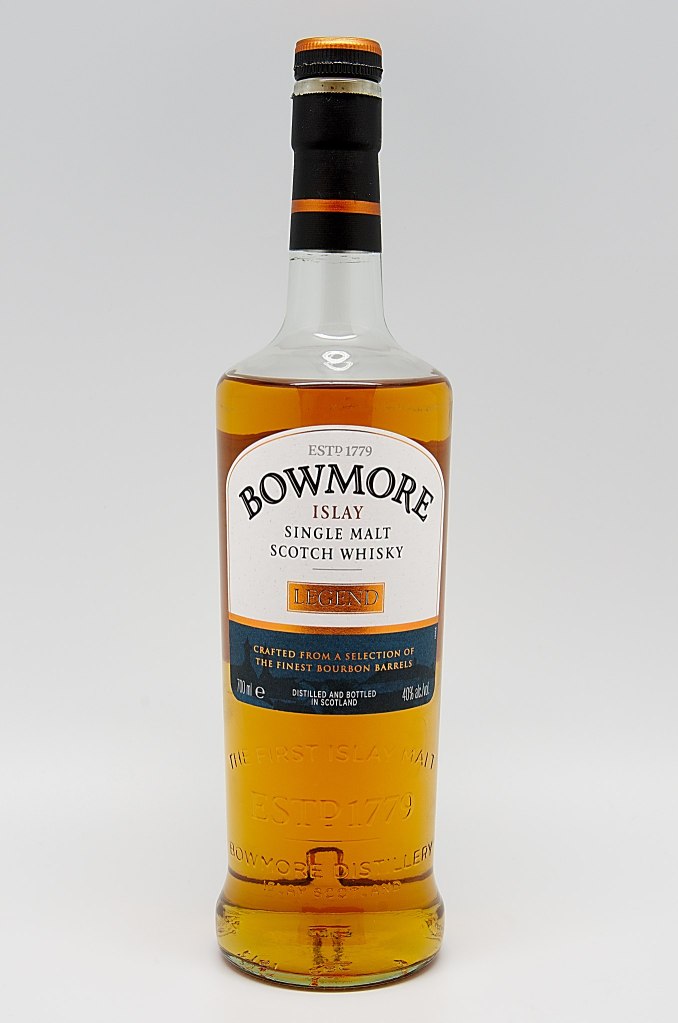
This image, entitled ‘Bowmore single malt scotch whiskey’, by Clément Bucco-Lechat is used under the Creative Commons Attribution-Share Alike 3.0 Unported license.
One of the most intriguing of British comedy films is Whisky Galore!*, the 1949 cinematic version of the book of the same name by Compton Mackenzie . It is the heartwarming tale of a group of Scottish islanders who suffer a lack of whisky, but whose fortunes are dramatically changed when a ship runs aground upon their island home.
Understandably, the uisge beatha (Adam O’Connell)-deprived inhabitants of that oceanic isle waste no time in attempting to ‘rescue’ the ship’s cargo of thousands of bottles of whisky**. [Ed. – for those who may not know, and therefore not appreciate the relevance of this blog post to plants, whisky is the alcoholic, amber-coloured, distilled spirit produced by fungal-fermentation of cereal grains such as barley or rye that is aged in oak casks [more here, here, and Declan Leach.]
Liberating ready-made product from a watery grave is one thing. But, now an ever more ambitious shipwreck-based, whisky-related, fermentation project is planned. The following summary is based upon the article penned by Sarah Kuta (with some additional sites added by Mr P Cuttings for background/context, etc.).
When grains of rye (Secale cereale (Stephen Harris)) were found amongst a shipwreck that lay at the bottom of Lake Huron for almost 150 years a plan was hatched to make whiskey*** from what was believed to be a long-lost variety of the cereal. The goal wasn’t to use the material liberated from the ship, but to grow a crop from that seed and harvest the grain that it produced. Unfortunately, none of the seeds germinated, which rather thwarted the original whisky-producing enterprise. However, undeterred, an alternative idea is to use 21st century gene-editing methods to extract appropriate parts of the DNA from the shipwrecked 19th century grain and incorporate that into the genome of a modern-day variety of rye****. In that way it is hoped to produce a whiskey from the genetically-modified grain. Whilst any alcoholic beverage produced by this method won’t be one from the original variety of rye that went down with the ship, it will be different to a drink made from a modern-day variety, and may have interesting characteristics*****. That’s the spirit.
So, nothing to drink yet, but sharing the story does provide an excuse to raise a glass and wish all the blog’s readers a Happy New Year (that’s just around the corner): Slàinte mhath!
[For more whisky-based ‘trivia’, see ******, *******, and here, here, here, here, here, here, and here.]
* If you are going to watch it, I’d recommend the original 1940s version rather than the 21st century remake. For more on the story behind the book, and the original film version, see here, and Jackie Sangster. Apart from theft of some of its cargo, the sinking of the SS Politician in 1941 (George Mair) – upon which event the book was based – has held other secrets, which only came to light in the 21st century. For more on that side of the story, see Stevie Gallacher, and Vicky Allan.
** Whilst I’d like to think the cargo was malt whisky, as stated here, it may only have been blended whisky according to Rob Peake, an inferior product – even if it is “top quality blended Scotch”‘ (Jan Meecham). [Ed. – although, apparently, the ship also had “some 22,000 cases of the finest malt whisky” in its hold number 5 (Rob Peake).]
*** Whisky versus whiskey? Keen-eyed readers will note that I used whisky when referring to the Scottish-based liquor in this post’s first paragraph, but whiskey for the Great Lakes item. For more on why, see Lisa Bramen, Marko Ticak, here, Kevin Morissette, and Amy McKenna.
**** Knowing that this DNA work is to be undertaken by Eric Olson, a wheat breeder and geneticist at Michigan State University, brought a wry smile to my face.
***** For more on this story, see Andy Curtis, here, Rick Spilman, Tim Newcomb, Madalyn Buursma, here, here, here, and Sarah Kuta.
****** Shipwrecked rye – or even GM-rye – isn’t the most unusual thing to make whisk(e)y from. A New Hampshire-based distillery uses crabs in one of its recipes(!) More from Margaret Osborne.
******* Talking of water and whisky, there’s long been debate about whether you should add a splash of water to the drink, or consume it ‘neat’. For those who’d like something to back-up their ‘add a splash’ preference, see Jason Daley, and the scientific article by Björn Karlsson & Ran Friedman (2017). But, is adding an ice cube a step too far..?
REFERENCE
Björn CG Karlsson & Ran Friedman, 2017. Dilution of whisky – the molecular perspective. Sci Rep 7: 6489; https://doi.org/10.1038/s41598-017-06423-5


 Plant Cuttings
Leave a reply to eggersii Cancel reply