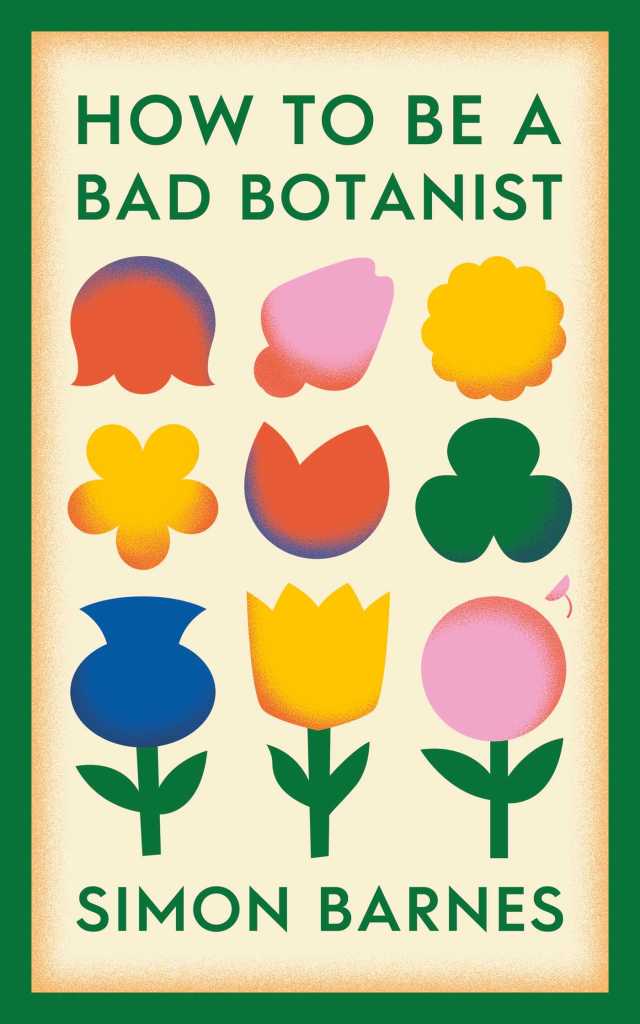
How to be a bad botanist by Simon Barnes, 2024. Simon & Schuster.
We’ve had The big, bad book of botany by Michael Largo. We’ve also had Amy Stewart’s The drunken botanist. And, if you cross those two books, as in a plant hybridisation experiment, you might well get How to be a bad botanist by Simon Barnes [which tome is here appraised]. Let me say, right at the start of this post, Barnes’ book is brilliant. Brilliant, but flawed…
What’s wrong with the book?
Let’s get the flaws out of the way, because I really do want to focus on the good points about the book – and they are many.
NO sources: How to be a bad botanist contains a myriad of facts and factual statements about plants (and other topics), which is good to see. However, no sources are stated for any of them. There’s not even a suggestion of ‘further reading’ which might have given some clues to the sources of the information presented. Whilst that may not be a major problem to the overall thrust of Barnes’ book [that anybody can become botanically aware and appreciative of plants], it is problematic for those who are rightly sceptical and like to be reassured that the information shared by the author is evidence-based, and that one may therefore be able to pass on those facts to others, with confidence in their provenance.
And there are several statements of fact for which one would like to know the evidence, e.g.: on clover, “One leaf in 5,000 bears four leaflets. Some have even more: there’s a record of fifty-six” (p. 18); “…the deadly fart of a beaded lacewing larva that can kill six termites with one blast, …” (p. 45); “The field poppy contains rhoeadine, which is a mild sedative” (p. 91); regarding the dynamite tree, Hura crepitans, “It can release seeds at a speed that’s been calculated at 160 mph, for distances that have been claimed at more than 100 yards” (p. 107); “It [hedge bindweed] has a massive and complex root system: 9 metres deep is no problem, and growth three times deeper has been claimed” (p. 122); and p. 241: “Linnaeus … believed that the Venus flytrap was not eating the insects but sheltering them from the rain” (p. 241).
The importance of evidence and using credible sources to support statements of fact is surely known to Barnes from his years as a journalist writing for The Times (Mark Avery). But, whereas the withholding of one’s sources may be a long-standing and cherished tradition for journalists (Ronan Brady, Rebecca Young) it isn’t appropriate for books that present factual statements about the science of botany. Although Barnes offers special thanks to Sara Oldfield for “casting an expert eye over this book and saving me from countless howlers” (p. 277), that is no substitute for providing sources in the book that can be checked by the reader.
Barnes tells us that he undertook research for the book from this statement, “It seems obvious that parasitic plants are wicked, and when I started to research this chapter [Mr P Cuttings’ emphasis]” (p. 234). And I have no doubt that research was undertaken; it’s just such a pity that the reader doesn’t get the fullest benefit of Barnes’ scholarship by knowing the details of the sources consulted for his numerous facts.
Imprecise and erroneous statements: absence of sources notwithstanding, How to be a bad botanist does contains some statements that need to be challenged. For example: “After fertilisation has taken place – the pollen shifted from one plant to another…” (p. 81). The clear implication of this statement is that pollination is synonymous with fertilisation; it isn’t. Although the two terms are related – under the broad topic of reproductive biology of plants – pollination and fertilisation are two different processes [more here, here, here, here, Heather Broccard-Bell, Daniela Dutra Elliott & Paula Mejia Velasquez]. In fairness it should be added that Barnes does realise this and gets it right elsewhere in the book [but I forget which page that’s on – if only there was an index to help me find it…].
Whilst Barnes understands the importance of photosynthesis, and plants’ role in that process, statements such as, “Plants are the only living things that can eat light” (p. 26), and “Plants, in short, are the only living things that can exploit and store the energy of the sun” (p. 27) completely ignores the major photosynthetic contribution made by algae, and cyanobacteria (James Moroney & Ruby Ynalvez; Ralph Lewin & Robert Anderson).
A statement that not only cries out for a source, but also contradicts what I thought I knew is this, “When does an introduced plant become a neophyte? The cut- off date usually agreed on is 1494, the year of the first voyage of Columbus” (p. 133). Is 1494 really the year of Columbus’ first voyage [presumably to the Americas rather than his first ever foray at sea]? Wasn’t it in 1492 that Columbus “sailed the ocean blue” (Emma Baldwin)?
Finally, the author’s views on the wood-wide web (Katie Field & Emily Magkourilou, Melanie Jones et al.), summed-up in the phrase, “The trees really can talk to each other” (p. 248), should rightly ring alarm bells for any purist on this topic. Allied to that is Barnes’ stated fact that “When one tree in a forest is attacked, it informs the other trees and they all set about making poison” (p. 248), which really does need a source.
No Index: Whilst the absence of an index is not the worst crime in the world, it is annoying – as a reader, and as a reviewer – if you ever wanted to refer back to a particular statement, etc. that you hadn’t made a note of (with page number(s)) elsewhere, or marked in the pages of the book. And I think that underlines the fact that How to be a bad botanist is a book that one would like to refer back to on several occasions; it’s not just a read once and forget about it tome. If it had an index, I’d like to think it would include entries such as: acorn; biopiracy; cypress, Leyland; Darwin, Charles; Epic of Gilgamesh; flowers; giant hogweed; grafting; hazel; Hiroshima; ID guides; juniper; Kew Gardens; light; monkshood; Mendel, Gregor; Nootka cypress; Orford Ness; photosynthesis; poppy; Question, The; ragwort, common; Sitka spruce; thistle; Ulysses; virgin birth; water mint; xylem; yellow rattle; and Zen. Which gives some idea of the range of topics covered by this book.
Right, having now got that off my chest, let’s concentrate on the book’s good points…
What’s right with it?
Lots. For example:
Barnes’ book will make you a better botanist: I can’t imagine that anybody would actually want to be a bad botanist. But, How to be a bad botanist isn’t really about that. Rather, it attempts to show that anybody can take an interest in the plants around them, learn to identify a few and find out a bit more about them – whether it’s their structure, medicinal value, folklore, or other uses. In that way, and armed with that information, that will give a better appreciation of flora; you’ll be a botanist. At this stage you won’t be a very good botanist, like those revered types who can identify all of the plants in an area, but you’ll know a few – and that will hopefully inspire to want to know more. So, whilst you won’t yet be a very good – nor even a good – botanist, you’ll be a ‘bad’ botanist. And, as a start, that’s not bad. Not bad, at all. And that is where Barnes’ book begins with his own botanical ‘epiphany’ on a wind-swept shingle beach in Norfolk looking at a yellow-horned poppy, growing where he imagined nothing should be able to survive.
With that ‘lightbulb moment’ (Candace Osmond), Barnes realised that plants were incredible survivors. And not just that, but they are the lifeform upon which all others depend, not just for their survival but for their very existence. Plants were all around. And this insight encouraged him to want to know more about them, to be able to identify them, and know something of their stories. Having begun to delve into the plants’ stories, Barnes began to realise that he knew more about plants than he thought*. Arguably, we ALL do. But, what we often fail to appreciate is their importance. Sharing his own realisation of this fact, and his enthusiasm for plants, is what drives the book.
There is nothing like the zeal of a recent convert to a cause to promote it to others. And, in How to be a bad botanist, Barnes has much of the zealot whose enthusiasm for plants borders upon botanical evangelising. And, why not? Plants are truly amazing lifeforms and the more people who appreciate that and look out for – and after – them, the better. In its way, Barnes’ book does a great deal to help tackle the affliction known as plant blindness (Jon Moses), or plant awareness disparity [PAD (Kathryn Parsley, 2020)], and increase the public’s botanical literacy. [Ed. – always good to see a phytoevangelist ‘phyting’ the good fight…]
There are plentiful pen portraits of plants: An – the most ? – important thread upon which the rest of the book hangs is Barnes’ own development to becoming a bad botanist that unfolds over the course of a year. That tale is told as he discovers the plants** (and their stories…) that reside in an ‘entangled bank’ near his home. That aspect of the book is covered in a year of seasonal forays along the bank in six (of the book’s 25) chapters. Barnes documents his floristic encounters as delightful ‘pen portraits’, short accounts of the plants’ descriptions and their natural settings, with oftentimes some folklore or information about their usefulness, as well as moments of whimsy and other useful commentary. Other plants not present in the bank are also treated in this way in other chapters. Altogether, the book contains 97 of these mini-essays, covering such plants as: fen orchid; cedar of Lebanon; sycamore; fleabane; oak; foxglove; and greater celandine [and only angiosperms and gymnosperms]. Amongst those entries are several ‘duplicates’ – for species such as cow parsley (pp. 17, 54), daisy (pp. 19, 60), dandelion (pp. 19, 39), and bluebell (pp. 20, 61). Even then, though, Barnes finds different things to say about the plant on each occasion.
It’s nicely phrased…: Having read other books by this author (specifically, The green planet, and The history of the world in 100 plants), I know he has a great writing style that is highly-readable. How to be a bad botanist continues that tradition with some memorable lines such as: regarding snowdrops, “sometimes apparently taking on the snow in a whiteness competition” (p. 16); “We may not love nettles [of the stinging variety] but nettles love us. They are the great camp followers of humanity” (p. 56); “A name is not a label but a portal – walk through it and your understanding grows: of the individual, of the ecosystem it inhabits, of the world we all share” (p. 70); and “Outcrossing brings vitality to any gene pool: call that Lady Chatterley Syndrome – she preferred to mate with the gamekeeper rather than members of her own inbred class” (p. 196). But, my absolute favourite – NB rude language alert!: has to be: “The language of flowers is a complex and occasionally contradictory means of communication, but no one has any doubt that a red rose says love, rosemary says remembrance and leylandii says fuck off” (p. 216) [NB, on several occasions, How to be a bad botanist uses language that’s not usually found in a non-fiction botanical text…].
… and nicely illustrated: The words about plants are accompanied by beautiful black-and-white illustration from the hand of Cindy Lee Wright. Although the drawings don’t adorn many pages, and don’t represent all of the plants that Barnes highlights in the book, their presence at the beginning of each chapter is always a delight for the eye of the beholder.
And it’s informative: I learnt (subject to checking their veracity for myself…) a lot of new things from Barnes’ book, e.g.: the bramble terms primocane, and floricane; the existence of an Oxygen Catastrophe; that the common daisy is also called ‘woundwort’ (and why that is the case…); that the definition of a tree in the 1990 UK Town and Country Planning Act is “anything that one would normally call a tree is a tree”; that the plural of auroch is aurochsen; the concept of a ‘structural parasite’; and found out the identity of the plant known as the Robin Hood of parasites (which may just be what Barnes has christened it***…).
You get practical advice to improve your botanical knowledge: inspired by his new-found botanical knowledge, Barnes is keen to pass on his tips and recommendations so that readers may aspire to develop their own plant identification prowess – and so become a ‘bad’ botanist for themselves. Much of that information is contained in Chap. 7 What’s in a name, which is devoted to words about books, apps – and wall-charts – for plant identification [ID]. Along with some rather disparaging comments about certain plant ID books and their appropriateness for beginning botanists, Barnes does recommend some books that he’s found particularly helpful****. Acknowledging that books aren’t the only sources of plant ID help, he reminds us that “There are also apps for smartphones that will do a very great deal of the legwork for you. Or have a damn good shot at it anyway” (p. 76).
It is also a good botany primer: Although Barnes’ book will not be a substitute for a more formal textbook on botany, it will serve as a great introduction to the subject [or/and as a nice, easy-reading tome to read alongside]. True, How to be a bad botanist doesn’t cover every aspect of the plant science. But, it does give a pretty good introduction to many aspects of plant biology, e.g.: plant structure, ecology, reproductive biology, domestication, seed dispersal, photosynthesis, parasitic plants, poisonous plants, and plant evolution. Although aspects of those topics are scattered throughout the book’s 25 chapters, they are particularly covered in such chapters as: How to Eat the Sun [a nod in the direction of Oliver Morton’s book, Eating the sun..?]; What Do You Mean, Flower?; What’s in a Name?; Seed Dispersal; What Do You Mean, Tree?; How Plants Began; The Vampire Plants; and Sex and Passion.
This is a many-faceted book: How to be a bad botanist isn’t the most straightforward book to categorise. It is in parts a nature diary, one man’s odyssey towards botanical enlightenment, philosophical musings on nature, and botanical ‘textbook’. So, even if you aren’t particularly interested in becoming a – bad/better/good – botanist, there is plenty to interest the casual reader.
The book’s take-home message
In the words of the author, “And it always begins with plants. Without plants we would not be. Without plants, no Bach no Joyce no Shakespeare no Bashō [I’m guessing that this is a reference to Matsuo Bashō, “arguably the greatest figure in the history of Japanese literature and the master of the haiku” no Darwin no Newton no Einstein no lion no tiger no cat no dog no porpoise no blue whale no crane no egret no bee no ant no butterfly no me no you” (p. 8). Plants.Are.Important(!)
Summary
Despite its absence of sources, How to be a bad botanist by Simon Barnes is an excellent book. But, it’s more than that, it’s the botanical evangelist’s handbook. It therefore deserves to be read by all who have any interest in plants – whether seasoned – ‘good’ or ‘very good’ – botanists – or those whose botanical journey is just beginning – ‘bad’ botanists, or – and especially – those who don’t think that they have an interest in plants. It should do a lot to improve the reader’s botanical literacy, and dispel the blight that is plant blindness amongst the public. There’s a big present-giving celebration just round the corner, why not put Barnes’ brilliant botanical book on the list – to give, or to receive?
* Barnes’ botanical credentials are not mentioned in the book, but, having previously written two factual books about plants – The green planet, and The history of the world in 100 plants – they are already well-established. Acknowledging that botany as a subject is much bigger than the just the ‘field botany’ that How to be a bad botanist emphasises, Barnes is not a bad botanist.
** By way of a point of information, scientific names [and he uses this particular phrase, rather than Latin names] are not always provided for the plants mentioned in book (e.g. the plant pen portraits are all headed with the plant’s common English name). But, they are included on several occasions. I would have liked them to have been used for all of the 97 plants that are specifically ‘showcased’ – if only to ensure that the correct plant can be looked-up in an ID book by interested readers to be assured that they and Barnes are talking about the same thing.
*** I had thought this phrase was invented by Barnes. However, after a bit of internet checking it appears not to be the case. Although the moniker ‘Robin Hood parasite’ has been applied to the oomycete (William Fry & Niklaus Grünwald, 2020) Hyaloperonospora arabidopsis that infects Arabidopsis thaliana (Lucie Salvaudon et al., 2008), that seems unlikely to be Barnes’ source. It’s more likely that he has borrowed the phrase from Malcolm Press (1998), who applied it to several root hemiparasites in nutrient-poor habitats, i.e. in the sense used by Barnes. But, without a source stated in the book, that can only be conjecture; he may have conjured up the term independently.
**** The genuine thrill of being able to identify an ‘unknown’ plant using an ID book is not one to be under-rated. As witness Barnes’ own thoughts on having identified yellow archangel with the help of such a resource: “And it was a bit of a breakthrough. I had seen, observed, noticed, researched and named a wildflower … I had established a personal relationship with the plant: it was now part of my brain, part of my thinking, part of the way I see the world. I had been walking this lane for five years, and all the while I had been entertaining archangels unawares. Now I always see them. It was a moment of confirmation: I had finally made it. Now I really was a bad botanist” (p. 66).
REFERENCES
William E Fry & Niklaus J Grünwald, 2010. Introduction to Oomycetes. The Plant Health Instructor 10; doi: 10.1094/PHI-I-2010-1207-01
Kathryn M Parsley, 2020. Plant awareness disparity: A case for renaming plant blindness. Plants, People, Planet 2(6): 598-601; https://doi.org/10.1002/ppp3.10153
Malcolm C Press, 1998. Dracula or Robin Hood? A functional role for root hemiparasites in nutrient poor ecosystems. Oikos 82(3): 609-611; https://doi.org/10.2307/3546383
Lucie Salvaudon et al., 2008. Arabidopsis thaliana and the Robin Hood parasite: a chivalrous oomycete that steals fitness from fecund hosts and benefits the poorest one? Biol Lett. 4(5): 526-529; doi: 10.1098/rsbl.2008.0332


 Plant Cuttings
Leave a reply to What’s in a name? The case of Barnes’ stolon – Plant Cuttings Cancel reply