
This item concludes Mr P Cuttings’ consideration of some of the more unusual uses of wood – in the past, the present, and here in the future. Along with his look at different wood types, this quartet of posts [surely, not a woody pun..?] makes September 2024 officially ‘wood month’ on the Plant Cuttings site.
Japanese wooden satellite…
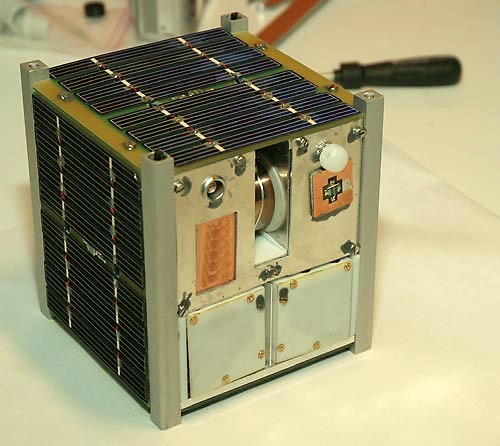
This image of Ncube-2, a Norwegian CubeSat by Bjørn Pedersen, NTNU is used under the Creative Commons Attribution 1.0 Generic license.
Something else that’s ‘out of sight’ is this item [a poorly-disguised reference to the transparent wood item above…] is news that “Japan just built the world’s first wooden satellite and it’s a pretty big deal” (Mihai Andrei). Although it’s only the external housing of the satellite that’s made of wood (Tibi Puiu) – specifically magnolia (Tim Hornyak, Passant Rabie), it’s a good start towards making construction of these objects more sustainable, and reducing the amount of ‘space junk’ (Jonathan O’Callaghan) that surrounds our planet (Mihai Andrei). [Ed – and if, in future, the satellite’s circuitry and electronics can be wood-based – see ‘Woodenising the silicon age…‘ – then that will be even more environmentally-desirable.]
Named LignoSat (Elizabeth Beattie, Josh Dinner, Samantha Mathewson, Jessica Speed), the satellite [which is technically known as a ‘cubesat’ because of its box-like shape] is due to be sent to the International Space Station (ISS) on a SpaceX rocket (Alison Eldridge) from the Kennedy Space Center in the USA in September 2024. If that launch date is after this blog item is published, then it qualifies for a future wood-use: Fingers’ crossed. [Update – I’ve not found any news that Lignosat has yet been launched – as at 16.50 GMT on 27th September 2024…]
In addition to the scicomm articles included as links above, there is a really useful audio and video item about LignoSat by Chris Pattison.
The future of wood is black, super-black…

This image, entitled “Super 3 Myanmar”, by loganliam is used under the Creative Commons Attribution-Share Alike 4.0 International license.
Finally, in this wood round-up, no sooner than we’ve finished looking at wood that’s been made transparent, and by way of a counter to that item, we have a team at The University of British Columbia [UBC] in Canada, who’ve done the opposite (Lou Bosshart).
When UBC researchers Prof. Philip Evans and PhD student Kenny Cheng used high-energy plasma [https://en.wikipedia.org/wiki/Plasma_(physics); https://www.psfc.mit.edu/vision/what_is_plasma; https://plasmaexperience.engr.wisc.edu/the-science/what-is-a-plasma/] (specifically, oxygen glow-discharge plasma (Michael Kelley & Simeon Potter, Kenneth Cheng et al., 2024a)) in an attempt to make wood (of Tilia americana L.*, basswood) more water-repellant, actually succeeded in turning the surface extremely black. So black in fact that the material absorbed almost all – more than 99%(!) – of the visible light that was shone upon it (Lou Bosshart). A newly-discovered material needs a name, and this one has been duly “Trademarked (Andrew Rapacke) [a move that presumably anticipates commercialisation potential of the material?] Nxylon (“niks-uh-lon”), the material takes its name from Nyx, the Greek goddess of the night, and xylon, which is the Greek word for wood” (Ben Coxwith)**.
In what is an excellent example of serendipity [which I once saw defined as “digging for earthworms and finding gold”], the research team may well ‘have struck gold’ (Juan Cabrera) with this discovery because they intend to launch a startup (Rebecca Baldridge & Benjamin Curry), Nxylon Corporation of Canada, to exploit this material commercially. One trusts that such plans are well-advanced – and legally protected – because, having published their methodology in the scientific press – Kenneth J. Cheng et al. (2024b) – their findings are available for all to see. Amongst which viewers of the work may be budding entrepreneurs who may seek to capitalise upon the business opportunities of this innovation for themselves, at the expense of BUC and the Nxylon team.
And the potential for this novel woodform is quite impressive. Cheng et al. (2024b) envisage its application in: “optical instruments and thermal imaging; aerospace and defense; radiation shields; solar absorbers including space sails; automotive (anti-glare surfaces); art and design; architectural features; and consumer goods”. One particular use that has caught Mr Cuttings’ eye is replacement of naturally black – but endangered-in-the-wild – woods (such as ebony and rosewood) by this new wood that can be made from non-endangered basswood, “which is abundant in North America and can be grown in plantations”. As a ‘proof-of-principle’, in press photos, the UBC team are wearing watches whose faces have Nxylon in place of expensive and rare ebony or rosewood. And another proposal is for Nxylon to be used in jewellery as a replacement for the black gemstone onyx. Whilst such substitutions maybe not be desirable or acceptable to the connoisseurs of such matters, it would have the highly-desirable benefit of being more tree biodiversity-friendly, and environmentally-sustainable.
Plus, as Cheng et al. (2024b) also state, woods other than basswood might be suitable for ‘super-blackening’, such as other Tilia species, yellow buckeye (Aesculus flava Sol.*) and balsam poplar (Populus balsamifera L.*). In addition to balsa (Ochroma pyramidale (Cav. ex Lam.) Urb.*) – which had previously been similarly ‘super-blackened’ by Bin Zhao et al. (2023) [and whose earlier work is acknowledged by Cheng et al. (2024b)] using a different methodology to basswood [which thereby distinguishes Cheng et al‘s work from Zhao et al’s] . And, if the methodology could be scaled-up to produce bigger pieces of Nxylon, it may be used as nonreflective ceiling and wall tiles. Once you start thinking about this material, the potential applications are seemingly endless.
For more on this fascinating story, see here, here, here, here (and references therein), Nelson Bennett, Ben Coxwith, David Nield, and Eric Ralls.
* I feel compelled to say how refreshing it is to see proper scientific names used in scientific papers that aren’t primarily biological: Well done, Cheng et al. (2024b). And not only the binomials in this case, but the Authorities too! This is much appreciated! You don’t always get that important level of information (e.g. lack of binomial in the ‘self-irrigating’ radish paper considered in a previous post on this site).
** Despite Coxwith’s guide to pronunciation, nxylon is a difficult word to say. That, and maybe the thought that the new word didn’t really do proper justice to Greek goddess’ Nyx’s name [being reduced to just the ‘N’], led one commentator – ‘jug’ – to wonder why the neologism (Adam Zeidan) nyxylon wasn’t chosen instead. In fact, looking at the pronunciation guide, it appears better suited to how to say nyxylon, rather than nxylon [whose pronunciation to Mr Cuttings seems to be “en-sy-lon”, rather than “niks-uh-lon”…]. Which makes Mr Cuttings wonder if nyxylon was the word intended by the UBC team [and would seem to be a better combination of Nyx and xylon], and that nxylon may be a ‘typo’..? Maybe. But in their scientific article (Cheng et al., 2024b), it is clearly stated that: “We called this material Nxylon, a neologism created from Nyx (Greek goddess of the night) and xylon (Greek for wood materials)” [Introduction, p. 2]. Which is a bit of a pity because the Scrabble (Criss Cross, Robby Findler) score that nyxylon would generate is rather large (as mused by ‘Y_Y’, should that word ever be acceptable for that word game).
REFERENCES
Kenneth J. Cheng et al., 2024a. Differential Etching of Rays at Wood Surfaces Exposed to an Oxygen Glow Discharge Plasma. Materials 2024, 17(2): 521; https://doi.org/10.3390/ma17020521
Kenneth J. Cheng et al., 2024b. Super-Black Material Created by Plasma Etching Wood. Advanced Sustainable Systems Early View Online Version of Record before inclusion in an issue: 2400184; https://doi.org/10.1002/adsu.202400184
Satish Kumar, 1994. Chemical Modification of Wood. Wood and Fiber Science 26(2): 270-280.
Michael H. Ramage et al., 2017. The wood from the trees: The use of timber in construction. Renewable and Sustainable Energy Reviews 68(1): 2017: 333-359; https://doi.org/10.1016/j.rser.2016.09.107
Bin Zhao et al., 2023. Wood-based superblack. Nat Commun 14, 7875; https://doi.org/10.1038/s41467-023-43594-4
Tags: science communication, wood, wood uses, botany, plant science, trees, super-black wood, basswood (Tilia americana), wood technology, LignoSat, cubesat, SpaceX, magnolia, balsa, ebony, rosewood, Nxylon, oxygen glow-discharge plasma, xylon, Nyx (Greek goddess of the night), neologism, plasma, superblack,


 Plant Cuttings


Leave a reply to eggersii Cancel reply