
Following a look at some ancient uses of wood in a previous post, we turn now to present-day uses. Since there are so many modern-day uses of wood* [as there are, no doubt, ancient uses – we’re just waiting for them to be unearthed] it’s not possible to cover them all here. However, two that have come to my notice recently are worth a mention.
Wood that isn’t there…
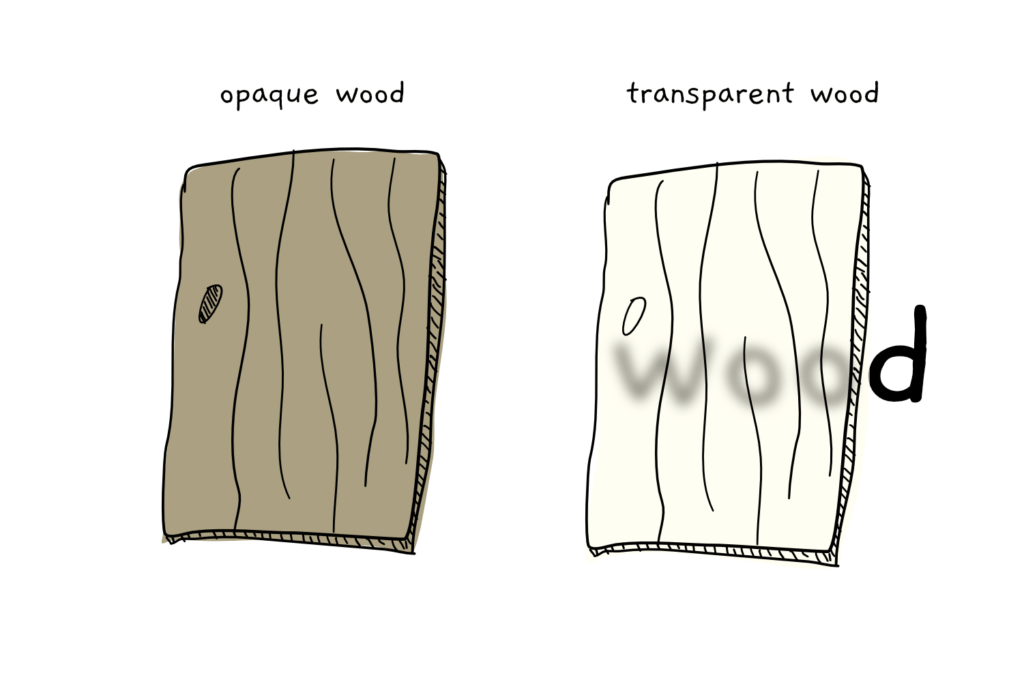
Image borrowed from Tegan’s article “It’s time we talked about see-through wood” on the Plants and Pipettes blog.
Well, not exactly, but ‘as good as’. First, some context.
We are told that an atom is nearly all empty space (Frank Close, 2009; Trevor English), 99.9999999999996% empty in the case of a hydrogen atom. Since all known objects are composed of atoms (e.g., here, here, here, Daisy Dobrijevic & Tim Sharp, Keith Welch, and Richard Feynman et al.), that means that the vast majority of any thing is empty space**. Shouldn’t that therefore mean that objects are more or less transparent, and we should be able to see through them? No. And why that is so is elegantly explained by Robert Matthews** thus: “While atoms are indeed mostly empty space, the void is filled with the electromagnetic fields generated by the electrons within the atom. These affect light waves as they move through materials, preventing them from passing straight through unimpeded. Switching to radiation of shorter wavelength, like X-rays or gamma rays, allows even relatively dense materials to become transparent”***. So, whilst solid objects aren’t – usually! [read on…] – see-through, it is still an appealing notion: Welcome to the world of transparent wood(!)
Summarising the words of Thabisile Brightwell Jele et al. (2023) from their review on engineered transparent wood composites, natural – straight from the tree, unprocessed in any way – wood is non-transparent (due to its low optical transmittance). But, if coloured material(s) in the wood that prevent/inhibit transparency, e.g. the chromophores of lignin (Ellen McCrady), are modified or eliminated, and a suitable polymer (Sid Perkins) is infiltrated into the now-processed wood [to give it added strength and stability], a high degree of transparency of the wood is achieved.
The resulting material is known as engineered transparent wood (ETW), and “may serve as a sustainable replacement for glass which is environmentally unfriendly in its manufacture and application” (Thabisile Brightwell Jele et al., 2023). Technically, ETW “exhibits excellent optical properties (transmittance > 80%), high haze (Leah Pandiscia) (haze > 70%), thermal insulation (thermal conductivity less than 0.23Wm−1 K−1), unique hierarchical structure, good loadbearing performance with tough failure behaviour (no shattering) and ductility” (Thabisile Brightwell Jele et al., 2023). All of which, we are told, by Thabisile Brightwell Jele et al. (2023), means that ETW is potentially useful in such applications as solar cells (Steve Joseph Fonash & S Ashok), screens, windows, and luminescent and decorative materials.
Which list of applications is not bad for a material whose production was almost completely overlooked. As explained by Jude Coleman: “Thirty years ago, a botanist in Germany had a simple wish: to see the inner workings of woody plants without dissecting them. By bleaching away the pigments in plant cells, Siegfried Fink managed to create transparent wood, and he published his technique in a niche wood technology journal. The 1992 paper remained (Siegfried Fink, 1992) the last word on see-through wood for more than a decade, until a researcher named Lars Berglund stumbled across it”****.
For more information, including scicomm items, about transparent wood, see here, here, here, here, here, here, Jude Coleman, Jude Colman [yes, two different articles by the same writer], Steve Eichhorn; Hongli Zhu et al., 2016; Yuanyuan Li et al., 2017, 2018a, 2018b, 2018c; Chao Jia et al., 2019; V Karl’a, 2019; Ruiyu Mi et al., 2020; Alberto Mariani & Giulio Malucelli, 2022; Thabisile Brightwell Jele et al., 2023; Shuaiming He et al., 2023; Pratick Samanta et al., 2023; Priya Bisht & Krishna Pandey, 2024; and Kayleigh Harrison. And not forgetting the informative and comprehensible introduction to transparent wood – and its history – from Joram & Tegan’s Plants and Pipettes blog (and references therein). [It should be evident from the high number of additional sources cited above that Mr P Cuttings found this topic fascinating. [Ed. – err, clearly(!)]]
Woodenising the silicon age…

This image, entitled “The Apple Desktop Bus implemented in an Early Microchip PIC chip in a Macintosh SE” by Binarysequence, is used under the Creative Commons Attribution-Share Alike 3.0 Unported license.
As entities largely built from carbon-containing organic compounds (Melvin Usselman & Carl Noller), human beings are a carbon-based lifeform (Courtney White). However, we might rightly – and more correctly? – nowadays be reclassified as a silicon-dependent***** one given society’s ever-increasing reliance on silicon-microchip-based technology (Abiola Ayodele) that seems to control every aspect of our everyday lives******.
Well, the gauntlet has well-and-truly been thrown down (Elizabeth Harrison) in the battle between carbon and silicon. In a development that might be interpreted as us organics attempting to reclaim the silicon-dominated world, we have this attention-grabbing headline, “Electronics made of wood and paper” (Michael Allen). In an EU-funded project known as HyPELignum, Dr Valerio Beni (of RISE (the Research Institutes of Sweden)) is exploring ways to make consumer electronics with wood-based materials (Michael Allen).
Recognising that the life cycles of current electronics are unsustainable, and, in addition to the energy and raw materials needed for their production, the gadgets result in mountains of waste once they get discarded, Beni et al. aim to develop two types of wooden circuit board, one made of thin layers of wood (a bit like plywood), and the other constructed from cellulose fibres extracted from wood and wood waste [more here] (Michael Allen). Which noble aspiration sounds quite laudable. Furthermore, the circuits are printed – rather than etched as at present – onto the wooden boards using conductive metal inks developed by the project, which contain cellulose and bio-based plastics produced from wood (Michael Allen). With funding for the 4-year project not due to end until September 2026, this news item is arguable one for future uses of wood rather than present-day ones. However, two that are definitely a little way off are wood-uses considered in the next – futuristic – post…
* For more ways in which wood – and wood products – can be used, see here, here, here, here, here, here, here, Terry Connors, Shanta Urmila Mou, George Thomas Tsoumis, Michael Ramage et al., 2017, and Tommy Fowler.
** “After studying physics at Oxford, Robert [Matthews] became a science writer. He’s visiting professor in science at Aston University”. More about Prof. Matthews here, here, here, here, and here.
*** As to the question of why solid objects – which are composed of individually ‘empty’ atoms – are solid, there are good explanations by Roger Barlow (Research Professor and Director of the International Institute for Accelerator Applications, University of Huddersfield), and Giedrius Pakalka & Alius Noreika. And also explain why wood that you cannot see – ETW – will still hurt you should you be hit by it. In which case, although you may not see the wood, but you might well see stars (Hannah Ashworth, James Roland, John Staughton).
**** If this scenario sounds familiar, it’s probably because you are thinking of the ground-breaking discoveries about inheritance that were made by a 19th century pea-plant-experimenting monk, whose researches weren’t ‘discovered’ until the 20th century (e.g. here, here, here, RA Fisher (1936), TM Cox (1999), and Ilona Miko (2008)). Proving that history – in the case of genetics and transparent wood, at least – does repeat itself (Clint Pumphrey & Melanie Radzicki McManus, Stephen Drew).
***** I’ve just discovered that this notion has a sort of precedent where microprocessors have been viewed as a silicon-based lifeform – having been mentioned on the Wikipedia “Carbon-based life” page [https://en.wikipedia.org/wiki/Carbon-based_life] And, Duane Ager & William Pope [https://www.the-ies.org/analysis/does-silicon-based-life-exist] have discussed the possibility of silicon-based life – in which an organism has silicon-based molecules instead of carbon compounds.
****** And there is surely an argument for classifying the present day as the Silicocene. By which I mean the current stage of Earth’s history or geological epoch, or event (Philip Gibbard et al., 2022). The Silicocene is therefore akin to the Anthropocene (Eric Ellis, Sarah Kaplan) [and not “Silicocene (C5H5)2Si, a highly symmetric sandwich compound” (Timothy Lee & Julia Rice, 1989)].
REFERENCES
Priya Bisht & Krishna K. Pandey, 2024. Optical and mechanical properties of multilayered transparent wood. Materials Today Communications 38: 107871; https://doi.org/10.1016/j.mtcomm.2023.107871
Thabisile Brightwell Jele et al., 2023. Engineered transparent wood composites: a review. Cellulose 30: 5447–5471; https://doi.org/10.1007/s10570-023-05239-z
Frank Close, 2009. How empty is an atom?, pp. 23-40. In: Nothing: A Very Short Introduction, Very Short Introductions (Oxford, 2009; online edn, Oxford Academic, 24 Sept. 2013); https://doi.org/10.1093/actrade/9780199225866.003.0002, accessed 27 August, 2024.
TM Cox, 1999. Mendel and his legacy. QJM: An International Journal of Medicine 92(4): 183–186; https://doi.org/10.1093/qjmed/92.4.183
Siegfried Fink, 1992. Transparent wood—a new approach in the functional study of wood structure. Holzforschung 46: 403–408; doi:10.1515/hfsg.1992.46.5.403
RA Fisher, 1936. Has Mendel’s work been rediscovered? Annals of Science 1(2): 115–137; https://doi.org/10.1080/00033793600200111
Philip Gibbard et al., 2022. The Anthropocene as an Event, not an Epoch. Journal of Quaternary Science 37(3): 395-399; doi: 10.1002/jqs.3416
V Karl’a , 2019. Update on Research on Transparent Wood. IOP Conf. Ser.: Mater. Sci. Eng. 566: 012015; doi: 10.1088/1757-899X/566/1/012015
Satish Kumar, 1994. Chemical Modification of Wood. Wood and Fiber Science 26(2): 270-280
Alberto Mariani & Giulio Malucelli, 2022. Transparent Wood-Based Materials: Current State-of-the-Art and Future Perspectives. Materials 2022, 15, 9069; https://doi.org/10.3390/ma15249069
Ilona Miko, 2008. Gregor Mendel and the principles of inheritance. Nature Education 1(1): 134
Michael H. Ramage et al., 2017. The wood from the trees: The use of timber in construction. Renewable and Sustainable Energy Reviews 68(1): 333-359; https://doi.org/10.1016/j.rser.2016.09.107
Pratick Samanta et al., 2023. Coloration and Fire Retardancy of Transparent Wood Composites by Metal Ions. ACS Appl. Mater. Interfaces 2023, 15, 50: 58850–58860; 10.1021/acsami.3c13585
Shuaiming He et al., 2023. Engineered Wood: Sustainable Technologies and Applications. Annual Review of Materials Research 53: 195-223; https://doi.org/10.1146/annurev-matsci-010622-105440
Chao Jia et al., 2019. Clear Wood toward High-Performance Building Materials. ACS Nano 13(9): 9993–10001; https://doi.org/10.1021/acsnano.9b00089
Yuanyuan Li et al., 2017. Luminescent Transparent Wood. Advanced Optical Materials 5(1): 1600834; https://doi.org/10.1002/adom.201600834
Yuanyuan Li et al., 2018a. Transparent wood for functional and structural applications. Phil. Trans. R. Soc. A. 37620170182; http://doi.org/10.1098/rsta.2017.0182
Yuanyuan Li et al., 2018b. Towards centimeter thick transparent wood through interface manipulation. J. Mater. Chem. A 6: 1094-1101; https://doi.org/10.1039/C7TA09973H
Yuanyuan Li et al., 2018c. Optically Transparent Wood: Recent Progress, Opportunities, and Challenges. Advanced Optical Materials 6(14): 1800059; https://doi.org/10.1002/adom.201800059
Ruiyu Mi et al., 2020. Scalable aesthetic transparent wood for energy efficient buildings. Nat Commun 11: 3836; https://doi.org/10.1038/s41467-020-17513-w
Hongli Zhu et al., 2016. Wood-Derived Materials for Green Electronics, Biological Devices, and Energy Applications. Chem. Rev. 116(16): 9305–9374; https://doi.org/10.1021/acs.chemrev.6b00225


Leave a comment