

This image of 16 wood samples by Anonimski is made available under the Creative Commons CC0 1.0 Universal Public Domain Dedication.
Julius Caesar’s spikes
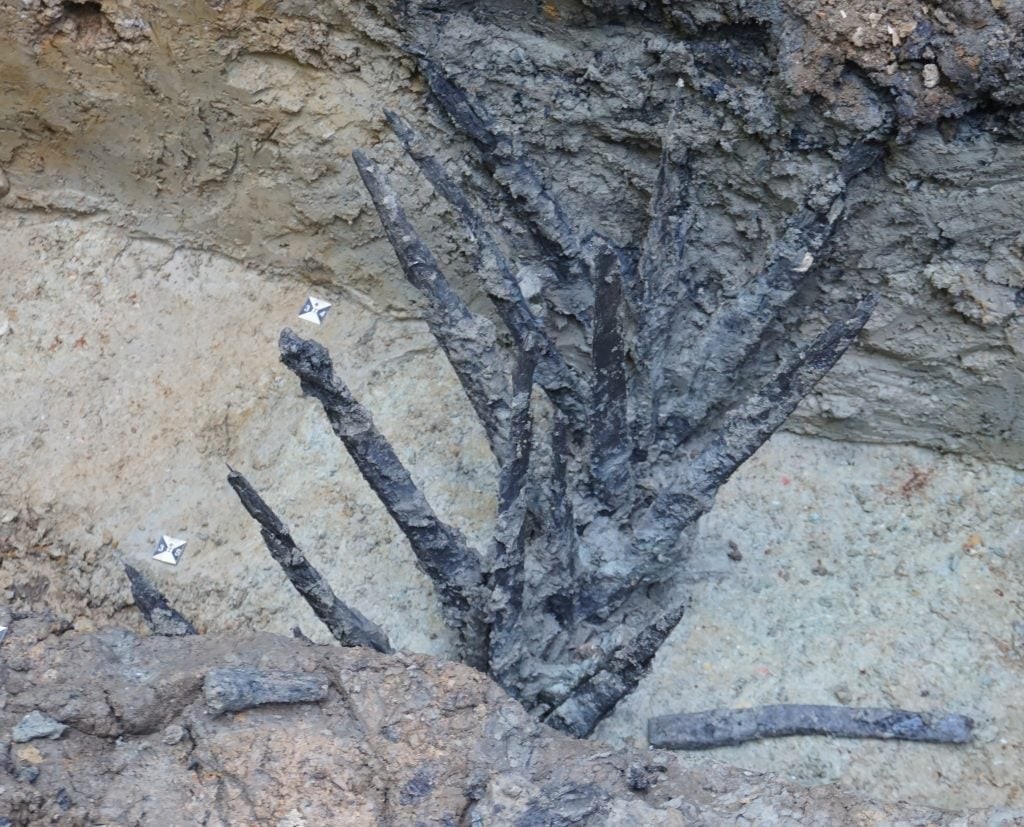
This image, entitled “The ancient Romans erected a fence topped with these wooden spikes in a [sic.] effort to defend a silver mining operation that ultimately ran dry”, is by Frederic Auth, has been borrowed by the article by Sarah Cascone.
Often when reading ancient texts one has to take what’s written ‘with a pinch of salt’ (Gina Rancaño). Especially if it’s written in an old language that has to be not only translated, but also – usually – interpreted, so that it can be understood by modern-day readers. Often, without physical evidence of what was being described, credibility of those old writers is understandably questioned. That was arguably the case when Julius Caesar (Arnold Joseph Toynbee) wrote about small, sharpened wooden stakes (or spikes) used to line the fences of his camps during his military campaign in Gaul, the Gallic Wars (Christopher Parker). Although likened – somewhat unconvincingly per the picture above – to ”an ancient Roman version of barbed wire” (Christopher Parker, for almost 2000 years we have had no evidence that such an adornment ever existed. So, fanciful and credibly effective as a deterrent as it sounds, was this military innovation real?
Apparently, yes. Working in Bad Ems in Rhineland-Palatinate, Germany (Sarah Cascone), archaeologists have discovered “well-preserved sharpened wooden stakes used to deter attacks from enemies at an ancient Roman military camp from the first century CE” (Karen Ho). Although not found in ‘Gaul’ – modern-day central France (Kristina Killgrove)** – their existence in a site in Germany validates the written statement of that war-faring general, statesman (Arnold Joseph Toynbee), dictator, and leader of ancient Rome.
For information on how this defensive installation might have worked, “Caesar wrote about the fortifications he set up in the Battle of Alesia in France in 52 B.C. He wanted his camp to be defended by as few soldiers as possible, so he cut down very thick branches, sharpened them to a point, and sank them into trenches, fastening them firmly at the bottom and covering the ditch with willow branches and twigs. “Whoever entered within them were likely to impale themselves on very sharp stakes,” Caesar wrote”” (quoted in Kristina Killgrove)**. [Ed. – This is one example where the ‘stakes are not raised’, but definitely lowered (into the ground). Although getting safely across them will still be something of a gamble; you would be taking your life in your hands…]
For those keen to see the wooden spikes with their own eyes, they are apparently now located at the Römisch-Germanisches Zentralmuseum in Mainz (Christopher Parker). For more on this story – including its connection to a silver mine, see here, Sarah Cascone, Karen Ho, Kristina Killgrove, and Christopher Parker.
Seahenges and mammoth-hunting

This image, entitled “Seahenge, a henge made from split oak found at Holme-next-the-sea in Norfolk, around 2050 BC. It is here displayed at the British Museum as part of their World of Stonehenge exhibition”, by -JvL-, is used under the Creative Commons Attribution 2.0 Generic license.
Other past uses of wood that are not covered in any detail here, but which have recently come to light and are nonetheless noteworthy, include the discovery of a ‘seahenge’, a 4,000 years-old circle of split oak stumps on England’s east coast (Tom Metcalfe; David Nance, 2024), and new insights into mammoth-hunting – which involved driving the beasts onto spears (stone-headed, but wooden-shafted…) fixed in the ground, rather than thrown, and which research “suggests that the spear as a system functioned similar to a hollow-point bullet”(!). Which discovery has more than a passing resemblance to the story above regarding Caesar’s combatant-impaling spikes.
* For more ways in which wood – and wood products – can be used, see here, here, here, here, here, here, here, Terry Connors, Shanta Urmila Mou, George Thomas Tsoumis, Michael Ramage et al., 2017, and Tommy Fowler.
** Whilst researching this item, my attention was caught – quite understandably! – by a ‘related story’ entitled “Smooth wooden phallus found at a Roman fort was likely a sex toy” in Kristina Killgrove’s article (which was entitled “Ancient Roman ‘spike defenses’ made famous by Julius Caesar found in Germany”). Being a non-judgemental, but diligent investigator, I felt duty-bound to follow-up that related story. I did, and found more information in the ‘signposted’ news item by Jennifer Nalewicki. Without delving too deeply into all the ins-and-outs of that piece, it is about a wooden object found during excavations at the site of the Roman fort of Vindolanda (David Ross) near Hadrian’s Wall in England.
For more on this story, see here, and Mark Brown, and the scientific article about the object’s re-interpretation as a “large, disembodied phallus” (i.e., a dildo (Nicole Schmidt & Amy Gopal)) by Rob Collins & Rob Sands (2023). The object of interest was carved from young ash (Fraxinus excelsior L. (Robin Harford)) – which is a hardwood – and is 160mm [approx. 6 inches] long.
Maybe this past use of wood, should be relocated to the present-day uses section [see next post] because 21st century individuals interested in this phenomenon can buy their own versions on ebay, and apparently “The Dildo market is undergoing a transformative phase of growth” in 2024. Whether the research by Collins & Sand (2023) has anything to do with that ‘uptick‘ in interest is not something I can tell you. [Ed. – and research for this item has seriously compromised my internet search history! I do hope readers will be impressed by the lengths I go to on their behalf…]
REFERENCES
Rob Collins & Rob Sands, 2023. Touch wood: luck, protection, power or pleasure? A wooden phallus from Vindolanda Roman fort. Antiquity 97(392): 419-435; https://doi.org/10.15184/aqy.2023.11
David A Nance, 2014. Holme I (Seahenge) and Holme II: ritual responses to climate change in Early Bronze Age Britain. GeoJournal 89, 88; https://doi.org/10.1007/s10708-024-11088-5
Michael H. Ramage et al., 2017. The wood from the trees: The use of timber in construction. Renewable and Sustainable Energy Reviews 68(1): 333-359; https://doi.org/10.1016/j.rser.2016.09.107
Tags: science communication, wood, wood uses, seahenge, mammoth, Julius Caesar, spiked defences, botany, plant science, trees, Gallic Wars, Hadrian’s Wall, Vindolanda, dildo, wooden phallus, ebay, archaeology, Holmes-next-the-sea, Romans, sex toy, ash, Fraxinus excelsior, hardwood,


 Plant Cuttings


Leave a reply to Intriguing uses of wood: present… – Plant Cuttings Cancel reply