
The beauty of the flower: The art and science of botanical illustration by Stephen A Harris, 2023. Reaktion Books.
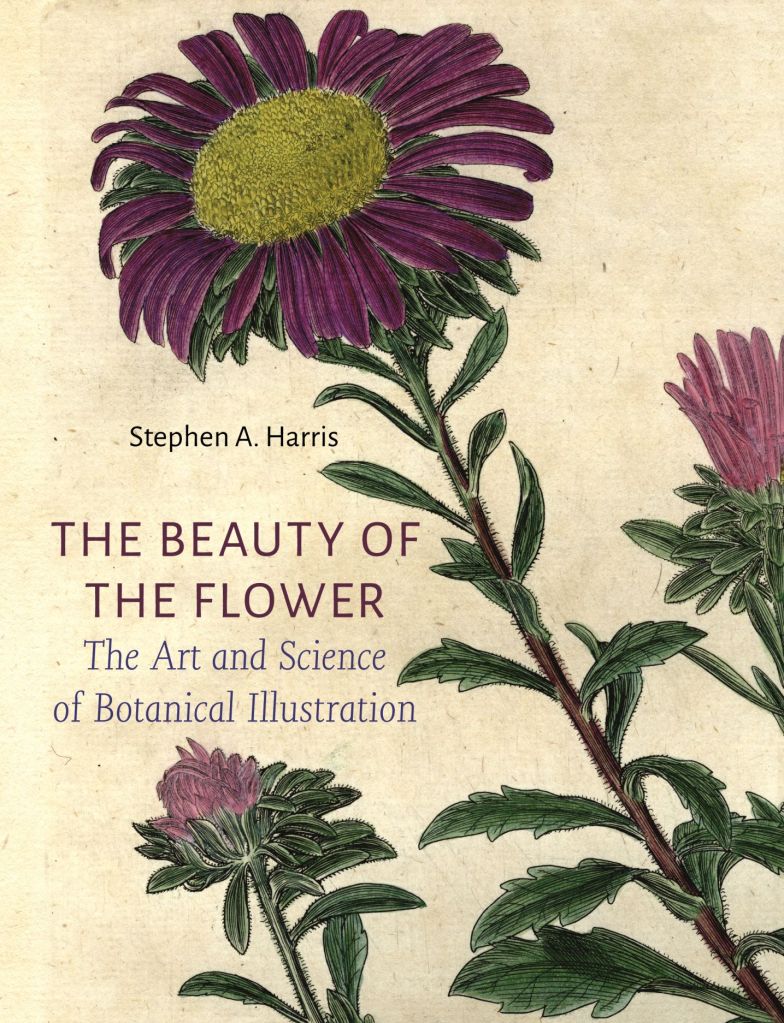
It seems entirely appropriate that The beauty of the flower by Stephen Harris [which book is here appraised] should be written by the Curator of a herbarium. Why? A herbarium is a collection of dried, flattened plants (Diana Horton) – and which, as a consequence, are essentially two-dimensional. This publication is effectively a paean to portraits of plants – not just their flowers – that are represented in art as 2-dimensional images. But, showcasing plenty of plant pictures is a rather small part of the book’s purpose. The true relevance and importance of The beauty of flowers comes from its sub-title, The art and science of botanical illustration.
Overview
The main text of The beauty of the flower occupies approx. 270 pages and is spread across a Preface and nine chapters. As anybody familiar with Harris’ other books (e.g. Sunflowers, and Roots to seeds) will expect, the writing is excellent – and highly readable (which is helped by breaking-up the narrative into short sub-headed sections). Harris is a wordsmith par excellence who writes with knowledge, wit, and passion. The beauty of the flower – apart from being an extremely erudite and comprehensive account of its subject matter – has all the feel of a labour of love.
A few of the book’s more notable and quotable phrases will give some indication of Harris’ writing style: “As costs waxed, interest waned” (p. 63); “Illustrations must be treated with the same degree of scepticism that one reserves for written and spoken words – a task that is made more difficult with visually stunning images” (p. 78); “Yet within the velvet glove of discovery was hidden an iron fist of social, political and economic opportunism; chillies, potatoes and tomatoes transformed our diets, but tobacco, cocoa and sugar enslaved us” (p. 107); “Redouté is best known as a recorder of royal and imperial gardens, a role that was interrupted temporarily by the decapitation of Marie Antoinette in 1793” (p. 149); “George Gardner winnowed grains of truth from the chaff of myth” (p. 210); and “Botanical illustrators convert three-dimensional plants into two-dimensional images, which – with the skilful use of shade, perspective and, perhaps, ‘taste’ – become three-dimensional illusions” (p. 274). This is beautiful prose.
Narrative is important, as are illustrations for such a visual subject – and there’s pretty much one on every page. However, I’m not entirely sure how many images are included. The UK publisher’s site states it contains “157 illustrations, 76 in colour”, whereas the University of Chicago Press site tells us there are “80 color plates and 64 halftones”. Poor arithmetic? Or an indication of differences between UK and US versions of the book [which I’ve seen previously with Dorling Kindersley’s Flora, and The science of plants]? Whichever interpretation is correct, the numerous illustrations supplement and enliven the text, and demonstrate – graphically – what Harris is talking about in his narrative.
Although flowering plants are the main subjects of the book’s botanical illustrations, several gymnosperms are also featured, as are, amongst others, the green alga, Struvea plumosa [whose scientific name is Indexed (as is the publication it appears in), but it is not included in the Plant List], Ceramium echionotum, a red seaweed [whose scientific name is in the Index, but not in the Plant List]; diatoms [included in the Index], and Pleurotus fimbriatus, a fungus. And it’s not just the flowers (although they do feature a lot) that are illustrated. We have several images of the whole organism e.g. Socotran dragon’s-blood tree, a plant fossil from the Coal Measures, pitchers of Nepenthes northiana, a stone pine cone, a collection of fern frond forms, apples from six apple cultivars, pollen grains, transverse sections of aerial roots, a collection of microscopic algae, and landscapes.
The beauty of the flower is a fascinating, factual, phytological exploration of the art and science of botanical illustration. It is a beautiful book, that’s very well-researched and referenced (with a few reservations [see Some insufficiency of stated sources…]…).
Comments on the book’s main sections
Preface: Although this section is very short – approx. two pages – it packs a great punch with many quotable passages that underline the relevance and importance of botanical illustration, “the discipline of creating technically accurate depictions of plants” (p. 8), which “is art with a scientific purpose: to record, display and convey scientific data about plants” (p. 8). But, it’s not all about looking nice, “An effective botanical illustration need not be aesthetically pleasing, but it must be accurate” (p. 8) [something generations of instructors have no doubt told their students when they attempt to make drawings of microscope images]. And let us not forget, “Interpretations of an image may change over time but, as accurately observed and recorded data, botanical illustrations are timeless scientific records” (p. 8). Additionally, the preface also tells us the aims of the book, which are to explore: interchanges between science and art through botanical illustration since the mid-fifteenth century; the way botanical illustration has been used to communicate scientific information about plants; and how views of botanical imagery have changed.
Chapter 1: Plant and Page* focuses on scientific botanical illustration as a collaboration, emphasizing the methods used by illustrators and printers to present scientific data and ideas. It is a fascinating, scene-setting chapter with informative sub-headings, such as: What is botanical illustration?; Why draw plants?; Who draws plants?; Where are plants drawn?; Making illustrations; Reproducing illustrations [which gives important information about the techniques used to transfer the artist’s original illustration to the printed version]; Nature printing; and Adding colour.
Chapter 2: Themes and trends “focuses on recurrent themes in botanical illustration from the roots of Western science in the Near East and the Mediterranean to the present day. Is the illustration of a specific individual plant or is it an ideal, distilling features from many individuals? Does an illustrator work solely from nature or incorporate prior knowledge, and if the latter, how much? Are illustrations for elite or popular publications? What is the interplay between illustration and text when the work is published?” (p. 50). Accordingly, this chapter covers a lot of topics which are relevant to the way in which we should interpret botanical illustrations if they are to have more value than just as nice artworks to look at. What I wasn’t expecting was to learn that Lutheran theologian German Hans Weiditz the Younger’s book Herbarum vivae icones (Life-like plant pictures) – one of several “sixteenth-century books that transformed the scientific portrayal of plants” (p. 54) – appeared in the Vatican’s Index librorum prohibitorum (Index of Prohibited Books) (Joseph Hilgers)(!). Who knew botanical pictures could be so controversial?
Chapter 3: Science and illustration summarises botanical history [from scientific botany’s beginnings in Western Europe with Theophrastus], focusing on illustrations in the presentation of key observations in naming and classification, physiology and experimentation, and evolution and genetics. In doing so it underlines “the influential role of botanical illustration in the history of botany” (p. 82). Amongst its other virtues, this is a great chapter regarding the philosophy of naming and classifying plants, with thoughtful comments on the value of common names and scientific names. It also includes an important account of early microscopy and problems of rendering the invisible visible in illustrations. This chapter also includes this important assertion, regarding the traditional association of botanic gardens and herbaria, “It has been said that ‘a collection of living and dried plants should always go together’: living plants generate initial botanical enthusiasm plus the means to understand details of plant structure, while dead plants give access to species that are impossible to grow all year round” (p. 89). Which is relevant to current concerns – and considerable debate – over the proposed geographical separation of the great herbarium at Kew from the botanical gardens themselves**.
Chapter 4: Blood and treasure: Although botanical illustrations may be viewed in cosy libraries or drawing rooms in urban or rural settings in Europe, this chapter reminds us that much of the subject matter for those artworks came from far afield. Appropriately, this chapters gives abundant insights into botanising abroad, in places such as Amazonia, Socotra, and New Zealand. Or, as explained by Harris, “Through a global tour, starting in the eastern Mediterranean, this chapter shows how the work of European botanical collectors has been complemented by illustrators in order to record patterns of global plant diversity. In the nineteenth century such patterns eventually led to the development of two ideas – Humboldtian biogeography and Darwinian evolution – that became fundamental concepts in modern biology” (p. 109).
Chapter 5: Garden and grove, as a nice contrast to Chapter 4, concerns itself with illustrators who rely for their subjects on cultivated landscapes, and “focuses on the function of botanical illustrations in recording, advertising and selling plants to Western gardeners” (p. 143).
Chapter 6: Inside and out “focuses on the ways in which botanical illustrators have worked with naturalists to present the new worlds made visible through magnification using simple hand lenses or the compound microscope” (p. 177). As one who has used a range of microscopes to study the inner workings of plants, this was my favourite chapter. It is also an important one in making the point that botanical doesn’t just mean land plants. Traditionally, botanists also studied fungi, and Harris gives us approx. 6 pages devoted to fungi [classified by Linnaeus under the category ‘Chaos’ I was interested to learn]. Why? Because “Coloured illustrations have been at the heart of cataloguing fungal diversity, and providing the means to identify species, for centuries. Moreover, the interpretation of illustrations has played an important part in developing the understanding of the fundamental roles of fungi in the processes that maintain life on Earth” (p. 200).
Chapter 7: Habit and habitat: Although ‘habit’ doesn’t appear to be defined in the book, this chapter seeks to highlight “the role of botanical illustrators in documenting the habits of plants in natural landscapes, and myths about them, from the poles to the equator and from sea level to beyond the treeline” (p. 208). The perspective here is almost exclusively a European one, the tales told are primarily about Europeans, and their contribution. But, Harris does make an important observation about the contribution of indigenous knowledge to this narrative, “Like the Rafflesia, Welwitsch’s and Baines’s plant was known to indigenous people, since both plants had common names, but nineteenth-century attitudes considered such people inappropriate as either witnesses or holders of knowledge about the plants with which they lived” (p. 215). Somewhat surprisingly, although Albrecht Dürer’s Das groβe Rasenstück [whose umlaut has disappeared, and its ‘ss’ has been substituted for the ‘β’ in the version in the Index] (The great piece of turf) is discussed by Harris, who recognises it as “one of the first representations of plants within a naturalistic ecological context“ (p. 222), we don’t have an accompanying picture. Although it may be considered such a famous image that interested readers can find it on the internet, surely it deserves its place in the book?
Chapter 8: Observe and test considers the evidential role of botanical artworks in informing our understanding of plants and botanical science more broadly, as neatly summed-up by Harris: “Data gathered by botanical illustrators, through their accurate observations, facilitate the generation and testing of scientific hypotheses” (p. 228). Usefully, there is a great explanation of the notion of ‘falsifiability’ regarding hypotheses, “By the mid-twentieth century objective testing of hypothesis-driven science had crystallized in the concept of ‘falsifiability’: that is, a theory is accepted until hypotheses arising from it are rejected through an interactive process of observation, hypothesis, experimentation, evaluation and retesting” (p. 228).
Chapter 9: Sweat and tears is concerned with the use of illustrations for education and the dispersal of ideas about plant sciences. Appropriately, therefore it mentions ‘plant blindness’ (Sarah Jose et al., Plants, People, Planet 1: 169–172, 2019; https://doi.org/10.1002/ppp3.51). Indeed, those are the first two words of the first sentence of the chapter. The emphasis of this chapter is accordingly on educating the public, with a consideration of such illustrated publications as floras, wallcharts, and botanical textbooks.
Appendix: Plant names occupies approx. 4 two-columned pages, and lists plants mentioned in the text in alphabetical order of their common names [although predominantly English, there is also at least one each of Maori, German, Chinese, and French common names]. Alongside their common names are the plant’s scientific name and the name of the family to which it belongs. Reflecting the bias of plants covered in the book, this listing is primarily of angiosperms [plants with flowers]. However, it also includes several gymnosperms, two fungi, and two ferns.
The References catalogue almost 750 numbered items. Occupying approx. 31 two-columned pages, it is very impressive – at first sight. Listed by Preface and Chapter order the numbers relate to the super-scripted numbers within the text. In several instances, a single note number refers to multiple sources (e.g. Note No. 10 (on p. 284) lists 9 items); in many – 72 per a search of the pdf copy of the book – cases a source for a Note No is shown as ‘ibid.’ (Lindsay Kramer; Eoghan Ryan), i.e. referring to the same source as the preceding Note number. Whilst it is therefore difficult to say quite how many unique sources are stated for statements made in the book, it is a lot, which is a great testament to the evident scholarship that has gone into the book. As far as I can tell, almost all of the Notes are supported by sources (although in many cases you need to do a bit of work to track down the full citation details because they are only provided on the first mention of a source, thereafter mentions are highly abbreviated). But, Note number 5 on p. 191 stands out because there is no source for the fascinating information about ‘Neptune balls’. See also comments under Some insufficiency of stated sources…
Further reading names three ‘general texts on botanical illustration’ (but omits mention of their publishers), and gives URLs for – and some commentary on – four ‘Botanical illustration websites’.
The Index occupies approx. eight 3-columned pages and has entries from Actinotinus sinensis to Yates, Thomas. It is replete with names of people [botanists, illustrators, engravers, patrons, publishers] – linked to the names of their publications where appropriate, and names of plants [some scientific names, but mainly English common names].
Some insufficiency of stated sources…
I draw readers’ attention to two issues in connection with sufficiency of sources for statements stated in The beauty of the flower. The first relates to finding specific cited information within a declared source; the second concerns the need for more sources to be supplied generally.
Specifically, and sometimes, where a source is stated, it’s not always easy to locate the actual statement in the cited text. A good example is this statement by Harris, “Johann Moldenhawer showed the plant’s entire structure to be made from them [cells]” (p. 183). At the end of the paragraph that contains that statement, the source cited is Francis Hallé’s In praise of plants. I couldn’t find the Moldenhawer information in that book. However, the source Harris cites for a later unrelated statement, AG Morton’s History of botanical science, does provide the ‘Moldenhawer information’ – on p. 369. Does that indicate a ‘mix-up’ re sources for the Moldenhawer statement? [Interestingly, Harris makes the same statement re Moldenhawer and a plant’s cellular nature on p. 101 of the book, where he cites his own translation of Moldenhawer’s Beitrage zur Anatomie der Pflanzen.]
Another specific example is my inability to find the text in Hallé’s book that is the source for Harris’ statement that “Simplistically, plant cells are like boxes, made from different densities of cardboard, containing water-filled balloons. The denser the cardboard or the more water in the balloon, the more rigid the box. Reduce the amount of water in the balloon and the flexibility of the box increases; that is, the plant begins to wilt, deforming its shape. The way in which a plant deforms is a consequence of how cells are arranged in its body, how they are packed together and how their walls are thickened” (p. 183). If it’s in Hallé’s In praise of plants, it would greatly assist the reader to have the page(s) specified in the source. In some places, Harris does provide page numbers in cited books for statements made. It would be much appreciated if that had been done [in a future version of this book?] for all such sources.
More generally, the first paragraph on p. 49 provides many examples of plants and their mythological connections. However, no sources are supplied for any of those statements. On p. 83 Harris tells us that “Mandrake is native to the Mediterranean, where it has been used for millennia as an effective anaesthetic”. I’d like to know more about this, but no source is shown. And, apparently, “until the nineteenth century European tea drinkers did not realize that black and green tea came from the same plant” (p. 154). Whilst I’m happy to believe that statement, a source to support the statement is really necessary. The statement on p. 193 that “microscopical identification of pollen grains is routine in areas as diverse as air-quality assessment, forensics and the reconstruction of ancient habitats and climates”, would benefit from citing some sources. I won’t list every example of this sort of thing; suffice it to say there are several example throughout the book where the diligence for stating sources applied elsewhere is not matched.
Otherwise, Harris appears to have done an exemplary job in citing sources.
Final words (from the author)
Having read Harris’ appraisal of botanical illustrations, the reader should be in no doubt about the author’s view, not only of their importance, but also their continued relevance into the 21st century***. However, lest any doubts remain, the book’s final paragraph should dispel them: “Education encourages one to see. Illustration forces one to observe and record, to interpret the unfamiliar in terms of the familiar. However, we must learn to read illustrations if they are to serve the objective research and educational purposes of both creator and viewer. Knowledge derived from illustrations may challenge accepted ideas, stretching the imagination. Illustrations disperse practical information about the cultivation, harvest and use of plants. Moreover, evidence supporting essential botanical ideas, which are fundamental for the solution of today’s global problems, may be effectively presented in illustrations” (p. 277).
Summary
To a large extent we probably take high-quality botanical illustrations for granted nowadays. Harris’ book tells us why we shouldn’t do so as it comprehensively documents the trials, tribulations, and travails over hundreds of years that have perfected the craft – which is a combination of art and science – to produce the representations we cherish and admire. All things considered, The beauty of the flower: The art of botanical illustration by Stephen Harris is a great book. It is insightful, comprehensive, very well-written, and abundantly-illustrated. ‘Tis a job that’s very well done, Dr Harris!
* An arithmetical puzzle is not something you’d expect in a book devoted to an artistic subject, but the following is something that just didn’t look right to Mr P Cuttings in ‘sceptical book-appraiser’ mode. On p. 42 Harris tells us that: “John Sibthorp and James Edward Smith’s folio-sized Flora Graeca (1806–40; print run 25 copies) contained 966 hand-coloured copperplate engravings; that is to say, 28,980 plates had to be hand-coloured”. However, if you do the math(s), 966 x 25 comes to 24,150, a difference of 4,830. Since the missing 4,830 is exactly 5 x 966, there appear to be five copies of the book unaccounted for. Having got us in a quandary over that conundrum, Harris tells us, on p. 75, that “only thirty copies were printed”. A revised print run of 30 copies gets us back to the 28,980 plates mentioned on p. 42. Mystery solved – eventually.
** The proposal to relocate Kew’s herbarium away from its existing location at the site of the gardens is a divisive issue. We don’t have the space, etc. here to give that controversial suggestion proper consideration. But, for those of you interested in this issue, more information can be found here, here, here, here, here, and in the articles by Robin McKie, Sarah Knapton, and Danya Bazaraa.
*** A good demonstration of the 21st century relevance of botanical illustrations is to be found in the article entitled ‘Sixteenth-century tomatoes in Europe: who saw them, what they looked like, and where they came from’ by Tinde van Andel et al. 2022 (PeerJ 10:e12790 https://doi.org/10.7717/peerj.12790 [https://peerj.com/articles/12790/]).

 Plant Cuttings
Leave a reply to 50 world-changing plants – Plant Cuttings Cancel reply