
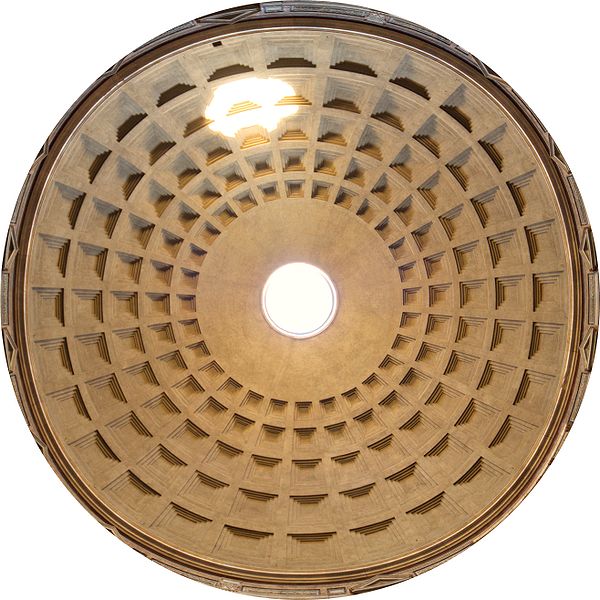
This image of the complete cupola of the Pantheon in Rome by Matthias Kabel is provided under the Creative Commons Attribution-Share Alike 3.0 Unported license.
There is an old joke that goes something like this:
Customer: Waiter, my coffee tastes like mud.
Waiter: Well, it was ground just a few minutes ago…*
That probably doesn’t work for everybody [anyone..?], and does rather rely upon the way the word ‘ground’ is pronounced. The humour [which in this instance is known as a play on words or a pun] is in the fact that roasted coffee ‘beans’ have to be ground to make coffee, the drink. Ground is also a word for the surface of the Earth that we stand upon. That outer solid covering to our planet can be made of a variety of still-solid-but-somewhat-softer substances such as soil, clay, or … mud. Although the transition from solid ground to less-solid mud is suggestive of an improvement, a drink that tastes like mud is still not a nice one. [Hmm, no longer funny when you have to explain it, is it..?]
I imagine that few readers will disagree that the above is one of the most bizarre starting points for a Plant Cuttings item. But, humour was used to try and lighten the load of a topic that is no laughing matter, attempts to increase the strength of concrete so that buildings don’t collapse and fall on people. Concrete is “an engineering material that simulates the properties of rock and is … a blend of aggregates, normally natural sand and gravel or crushed rock … bound together by a hydraulic binder e.g. Portland Cement and activated by water to form a dense semi homogenous mass”. Widely-used in construction, “Concrete is the second-most-used substance in the world after water … Its usage worldwide, ton for ton, is twice that of steel, wood, plastics, and aluminium combined”.
Notwithstanding its long history of use for building (James Mitchell Crow) – and the fact that some concrete structures have stood the test of time, e.g. the ceiling of the Pantheon, which is almost 2000 years old (Hilary Clarke) – it can still be improved, to make buildings that are safer, and longer-lasting.
One of the latest attempts to improve concrete is by addition of organic material to the otherwise inorganic ingredients. And here we pick up the opening reference to coffee because Rajeev Roychand et al. (Journal of Cleaner Production 419, 2023, 138205; https://doi.org/10.1016/j.jclepro.2023.138205) show that the strength of concrete can be substantially improved if coffee grounds are incorporated into the mix**.
However, that remarkable outcome isn’t achieved by simply stirring in the coffee ‘waste’. Indeed, use of unprocessed spent coffee grounds (SCG)*** interferes with the chemistry that takes place during the formation of concrete and impairs the strength of the material. But, if those grounds are pyrolysed at 350 C, and exchanged for 15% of the usual mixture’s sand, an improvement of approx. 30% in the compressive strength of the concrete was the result****.
Subjecting SCG to such high temperatures leads to the formation of what is termed biochar (Stefanie Spears)*****, a lightweight residue similar to charcoal (Donna Lu). The team – from the School of Engineering at RMIT University (Melbourne, Victoria, Australia) – estimate that all of the 75,000 tonnes of waste coffee grounds produced in Australia****** could be utilised in structural concrete in this way. If that was done, it would be the opposite of what’s called a ‘double-whammy’, i.e. a positive double-whammy (Nick Thompson). Not only would the coffee-derived biochar make stronger concrete, but also diversion of SCG from the landfill sites (Craig Freudenrich & Patrick Kiger) – into which it is currently dumped – prevents the release of methane into the atmosphere (Roychand et al., 2023) that accompanies its breakdown, and which has consequences for global warming. [But, the carbon footprint of the energy-requiring pyrolysis stage need to be considered to see the actual saving in this regard] And there’s a third benefit of use of SCG, the reduced need for sand in concrete manufacture, the extraction of which material has environmental impacts (Roychand et al., 2023). [The elephant in the room here is the fact that concrete manufacture is a major producer of CO2 (James Mitchell Crow), one of the most important contributors to global warming…]
As interesting as this work is it does come to something when, the next time you’re buying concrete, you have to specify full-strength or decaffeinated*******.
* For more ‘Waiter, waiter’ jokes, see here.
** The benefits of this addition of solid material to concrete contrasts markedly with the consequences of inclusion of gas bubbles, as is the case for reinforced autoclaved aerated concrete (RAAC) (Sabrina Weiss). Created in the 1930s, RAAC was used widely in the UK, Europe, Asia and North America in post-World War II reconstruction (Jonathan O’Callaghan). Although the concrete was reinforced with steel bars, these can erode over time leaving a material that can “fail catastrophically and suddenly” (Jonathan O’Callaghan). Because the lifetime of many RAAC-constructed buildings in the UK – between 30 and 50 years (Sabrina Weiss) – has now passed, they are “liable to collapse with little or no notice” (Ryan Hogg).
Which is why, and just a few days before the new school year began in September 2023, more than 150 schools, colleges, and nurseries in England were ordered to close parts of their buildings due to the looming threat of collapse (Sabrina Weiss). The problem is not confined to schools in the UK: other public buildings such as theatres, housing blocks and council buildings have RAAC concerns (Sabrina Weiss). And, the major international airports of Heathrow and Gatwick are not immune to the problem (Ryan Hogg).
Although a major cause of concern in the UK in 2023, RAAC-related issues will undoubtedly be uncovered in other countries in due course (Jonathan O’Callaghan). Which is why work such as that of Roychand et al. (2023) is of great importance. Although their coffee biochar-based innovation is clearly too late to solve the problem of RAAC, it may be part of the solution for replacing, or reconstructing, those buildings so that they are safer for the people that use them.
*** Before anybody thought to add them to concrete, spent coffee grounds have been used as a method to stop slugs and snails from feasting upon plants in the garden. For more on that, see here, Robert Pavlis, Natascha, and Trudi Bialic.
**** Interestingly, Roychand et al. (2023)’s substitution of coffee-based biochar for silica-rich sand has some similarities to earlier work of Ali Akhtar & Ajit K. Sarmah (Journal of Cleaner Production 196: 411-423, 2018; https://doi.org/10.1016/j.jclepro.2018.06.044), who used biochar produced from rice husks (which are rich in silica).
Although Akhtar & Sarmah worked with recycled aggregate concrete (RAC, which is not to be confused with RAAC), the rice-husk-enhanced mix led to improvements in the compressive and splitting tensile strengths of the concrete created. Both of these studies are great testament to the continuing capacity of plant resources to help solve humankind’s problems.
For some sort of completeness, another addition to concrete – which involves ‘incarceration’ of a living organism within the concrete rather than incorporation of a dead waste product – that’s worth mentioning is use of the fungus Trichoderma reesi to heal cracks that might form.
***** If this term sounds familiar to some readers, it may have been in connection with the unexpectedly-high soil fertility in parts of the Amazon and the subject of dark-earth soils (Kate Evans), known as terra preta.
****** I don’t know how much spent coffee grounds are produced by other countries, but news that China has recently discovered a thirst for coffee (Casey Hall & Marcelo Teixeira) presumably adds substantially to the stock of coffee grounds that await exploitation by enterprising creators of concrete.
******* As a final thought about coffee, and another item to add to its increasing number of uses, I leave you with news that it was used as a hand-cleanser before it became a popular drink. For more on that, read the ambiguously-worded article “Before drinking coffee, people washed their hands with it” by Nawal Nasrallah.


Leave a Reply