
Orchid by Dan Torre, 2023. Reaktion Books.
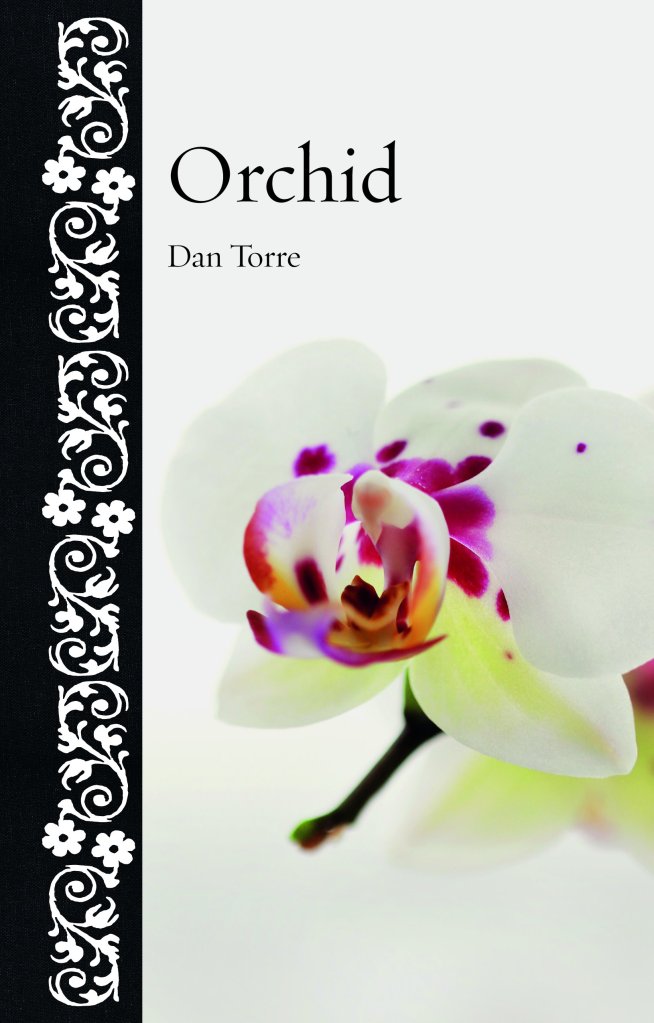
What have carnivorous plants, cacti, and orchids got in common? All three are subjects of books by Dan Torre. Having reviewed Carnivorous plants some time ago [which title is now out in paperback], I was looking forward to appraising Orchid by Dan Torre [which is done here]. Spoiler alert: I was NOT disappointed.
What’s included
The main text of Orchid – approx. 216 pages – is divided into an Introduction and seven Chapters [see Section summaries]. Material at the end of the book primarily comprises:
The Timeline (five pages). Unusually, not starting with appearance of orchid family in the geological record, but with the cultivation of orchid plants during the Han Dynasty in China, between 206 BCE and 220 CE (Tanya Trusler). And ending in 2016 and the discovery of “the most recent species of Australian underground orchid, Rhizanthella speciosa” (p. 229) (Mark Clements).
A listing of References (approx. 11 pages and 288 entries in total) provides citation details for sources included in-text as super-scripted numbers, and includes a good mix of scientific articles, books, and web resources (with URLs and dates of access). [Unfortunately the URL provided re Reference No. 52 on p. 240 won’t get you to the intriguingly-entitled item ‘Beaver butts emit goo used for vanilla flavoring’ by Mollie Bloudoff-Indelicato(!)]*.
Further Reading lists 10 books – all of which have already been cited amongst the References.
A page of URLs for Associations and Websites relevant to orchids highlights 13 items, including Akatsuka Orchid Gardens on Hawai’i, Orchid Conservation Alliance, and Société Française d’Ochidophile.
And approx. 5.25 pages of a 2-columned Index, from ‘abstract communication’ to ‘zygomorphic see bilateral symmetry’. NB, orchid genera and species names are not separately listed here, but are grouped together – alphabetically – under the ‘orchid species’ entry.
In addition to the words, and providing a very high ratio of text to pictures, Orchid is abundantly illustrated, with 127 illustrations, of which 111 are in colour (according to the book’s back cover (and its on-line catalogue entry)).
Section summaries
Introduction
This provides an intriguing summary of what makes orchids unique amongst flowering plants, and sets the scene for the chapters that follow. Torre reminds us that thousands of orchid species already known to science, and still more are ‘discovered’ each year, for example, in the book’s publication year, we have news offive new species of Thrixspermum from Thailand (Nopparut Toolmal et al., Phytotaxa 601: 223-262, 2023; 10.11646/phytotaxa.601.3.3), Trichoglottis quadriga from the Central Highlands of Sri Lanka, and Myoxanthus anancusiensis from the inter-Andean Valley of Huancavelica in Peru.
Chapter 1 Understanding orchids
Highlights the harshness of the life of epiphytic orchids, with an opportunity to draw out parallels between them and succulents [and therefore a nod in the direction of the author’s book Cactus]. It also introduces us to the cucumber orchid, the tiny Bulbophyllum minutissimum that reaches a height of only 1 cm, and Grammatophyllum speciosum, which can grow to several metres in diameter. And – as may not be too surprising – this chapter also shares lots of information about orchid flowers. All told this is quite a biological chapter [which is not a complaint, merely an observation] – and Torre is not afraid to use the technical terms that abound in orchid floral biology/structures, e.g. page 27’s stipe, column, pollinia, viscidia, and pollinarium.
Chapter 2 The secret life of orchids
With sub-headings such as: Orchid choreographies; Orchid deception (featuring Food, Enemy, Brood-site, and Sexual deceptions); Pitfall orchids (and an opportunity to remind readers of Torre’s Carnivorous plants book); Mobile orchids; Living underground; and Ant orchids, this is a most impressive essay on orchid biology and ecology. This chapter challenges our preconceived notions of what a flowering plants should be – and do (and even introduces us to the notion that orchids engage in abstraction, and the existence of a suspected orchid carnivore from Venezuela).
Chapter 3 Discovering orchids
Right at the start, Torre acknowledges that indigenous people have known about, and used [e.g. eating their tubers], orchids for thousands of years, and therefore discovered these plants long before science laid claim to the first discovery of named species. Thereafter, this chapter looks at different types of ‘discoveries’, e.g. orchidmania once Europeans discovered orchids in the tropics and brought them back to England and Europe, the often outrageous activities of orchid ‘hunters’, and early scientific discoveries – most notably those described in Charles Darwin’s The Various Contrivances by Which Orchids Are Fertilised by Insects**.
Chapter 4 Picturing orchids
Representing a marked shift from the preceding, more plant-focused, chapters, this chapter begins the book’s look at the people dimensions of orchids. Accordingly, and noting that “A significant reason why we are attracted to orchids is that we often see things within their floral forms” (p. 98), we are treated to tales – and pictures – of the monkey face orchid, flying duck orchid, and holy ghost orchid [Somewhat disappointingly, Torre doesn’t mention the swaddled babies orchid]. There then follow introductions to orchids in European art and Christian symbolism, Traditional Asian art with its focus more on fragrance, delicate beauty of flowers, and wispy grass-like leaves, and an orchid flower sign language. This chapter also covers botanical illustration – which is essential to support the scientific study of orchids. The rest of the chapter looks at more artistic interpretations such as sculpted glass orchids by the Blaschkas, and orchid designs in jewellery, and in ceramics. This round-up of orchids in visual art concludes with mention of modern art and artists such as Odilon Redon, Martin Johnson Heade, Marianne North, Max Beckmann, Georgia O’Keefe, Madeline von Foerster, Debora Moore, and Marc Quinn.
Chapter 5 Pop culture orchids
The plants-and-people side of orchids is further developed in this chapter with considerations of orchids in literature and language. Accordingly, Torre dwells at length on the notion that orchids possessing decidedly dark and deadly characteristics [apparently due in no small part to Darwin’s work on these plants] in works of fiction, e.g. HG Wells’ The flowering of the strange orchid, and John Collier’s Green thoughts. Amongst other literary mentions are Black Orchid, a female superhero, and Rex Stout’s orchid-obsessed private detective Nero Wolfe. We also learn of monocled British Statesman, Joseph Chamberlain who sported an orchid on his lapel, the British musical comedy The Orchid; and boxer Georges Carpentier, nicknamed ‘The orchid man’ in America. Torre also looks at the role of orchids in advertising where ‘orchid’ was used as term meaning ‘best’ or ‘gold standard’, as exemplified in peas marketed by the Green Giant company being promoted as “The Orchid of the Pea Family” (p. 167) [a right old botanical conundrum if ever there was…].
Chapter 6 Consuming orchids
Opening with “Humans have been consuming orchids for thousands of years [in no small measure encouraged by suggestions that the tubers had aphrodisiac qualities] – and we continue to do so on a considerable scale” (p. 171), Torre treats us to a potted history of human consumption of orchids. Which, he is at pains to say, is not just use of vanilla as flavouring, but maybe extends as far back as 60,000 years with consumption of the tubers of terrestrial orchids by the indigenous peoples of Australian. Nevertheless, Torre does have quite a lot to say about vanilla, as befits the fact that “Vanilla is by far the most widely cultivated and widely consumed orchid” (p. 185) [and does cover the discovery of hand-pollination of the vanilla flowers by Edmond Albius]. But, he also has a lot to say about the range of products that come under the umbrella of the term ‘salep’ (a name for dried tubers of terrestrial orchid, and the powder therefrom, and beverage and foods made from the powder), with origins in the Ottoman Empire. You can’t deal with consumption without mention of use of orchids in traditional – and modern, contemporary – medicine, which Torre does. And, bringing this side of human exploitation of orchids right up-to-date, the chapter ends with use of the vasculature system of an orchid trialled as the basis of a tissue scaffold for growing human cells to repair damaged skin or muscle(!).
Chapter 7 Orchid conservation
Having been treated to the wonders of orchids in the preceding chapters, this last chapter has a rather sobering opening sentence: “Despite the general pervasiveness of orchids, many species are severely threatened in the wild. In large measure, this is a result of sustained human activity” (p. 209). Sadly, the popularity of orchids has led to their destruction, decimation, and demise in the wild. And, despite internationally-agreed and -adopted ‘regulations’ such as CITES, Illegal orchid trading persists, as does destruction of their habitats. Which is not only bad for the orchids, it’s also bad news for their pollinators and life-sustaining fungal partners. But, it’s not all doom-and-gloom for orchids, some species are doing very well as can be seen with the designation of some orchids as ‘weeds’, even becoming invasive in some parts of the world. And Torre is not without an appropriate mention of global climate change noting that it is assisting spread of some orchid species. A suitably cautionary note upon which to end the book.
Sufficiency of sources? Almost…
Generally, Orchid is well referenced throughout [and you know I like to see that!]. But, more references are needed in several places. For example, Torre tells us that approx. 8% of Earth’s flowering plant species are orchids, and that there are roughly 28,000 species of orchid. Both these facts are presented in the Introduction, without stating the statements’ source(s). Since they’re initially stated in the book’s introductory, scene-setting section I’d be prepared to accept absence of sources there – as long as they are suitably sourced when mentioned in a subsequent chapter. Unfortunately, although both facts are repeated in Chapter 1, they are not sourced there either. It would also be good to have evidence for the statement that there are over 100,000 recognised orchid hybrids, that a dozen species are able to survive above the Arctic Circle, and in respect of the information about the floral biology of hammer orchids on pages 47-49.
Overview
Orchid is very well-written, with great attention to detail. Indeed, with its inclusion of so many matters of botanical minutiae and relevance, you’d be forgiven for thinking the author was a professional plant biologist. I’m not aware that’s the case. In fact, Dan Torre is a Senior Lecturer in Design at RMIT University (formerly the Royal Melbourne Institute of Technology) in Australia. Whilst this is not the expected background for an author of such a botanical text, Torre writes as one who is clearly an enthusiast for his subject – and a great advocate for orchids generally. Orchid has several similarities – in terms of style and content – with the author’s previous Reaktion Books Botanical title Carnivorous plants. And,why not? If you’ve got a formula that works, use it. And there’s no doubting that Torre has an engaging style that makes reading Orchid not only a pleasure, but a rather entertaining and informative one as well. And it’s not without some nice phrasing, e.g. “Although it is possible that this news article was a true account of the discovery of yet another rare epiphytic orchid to be growing from the top of a human skull, it is much more probable that it was the work of a wily publicist’s skulduggery” (p. 78). All-in-all, Orchid is another great addition to Reaktion Books’ plants-and-people-themed Botanical series.
Summary
Orchid by Dan Torre is a wonderful collection of orchid miscellanea. It’s a very well-written, abundantly illustrated, fact-filled foray into the weird and wonderful world of the orchid family. Executed with impressive breadth and depth of knowledge, and respect and sensitivity for the ancient cultural associations between people and the plants, this is a wonderful book, and a most welcome addition to the plants-and-people literature.
* I can’t just leave you dangling wondering what on Earth this stuff is. So, for more on the vanilla-like flavouring, better known as castoreum, see articles by George Burdock (International Journal of Toxicology 26(1): 51-55, 2007; doi: 10.1080/10915810601120145); Jessica Taylor Price; and Sarah Lohman.
** In respect of that book, Torre mentions Darwin’s ‘pencil test’ that demonstrated reorientation of pollinia to a position that promotes pollination, and elsewhere in Orchid discusses the importance of this reconfiguration. But – just to prove that there’ still more to discover about orchids – Micaela Lanzino et al. (AoB PLANTS 15, October 2023, plad054; https://doi.org/10.1093/aobpla/plad054%5D) report that such reconfiguration is not necessary in certain Serapias species. And, yes, Torre does recount the famous story about Darwin and Angraecum sesquipedale (Joyce Newman). And, interestingly, considering the venerable naturalist was so far ahead of the game in many other ways biologically, Darwin was not a supporter of the notion of pseudocopulation in orchids [which term which was not known in Darwin’s time, having been first used in print in Tarlton Rayment’s 1935 book A cluster of bees].

 Plant Cuttings
Leave a reply to Moss and lichen: A deep dive into cryptogams – Plant Cuttings Cancel reply