
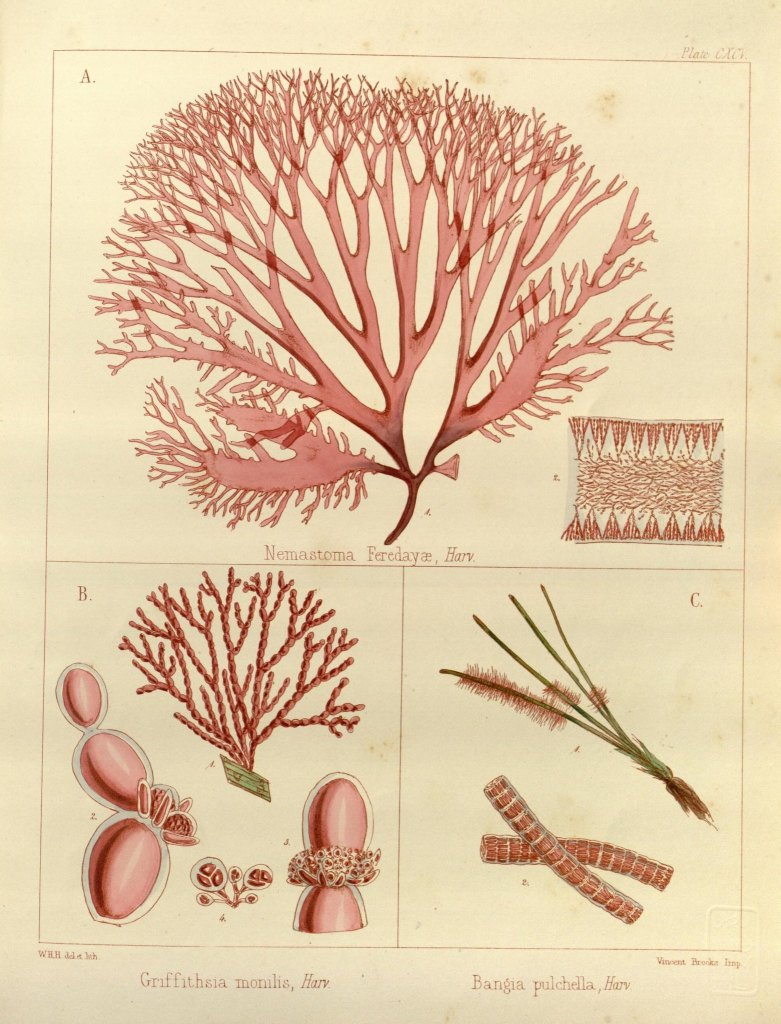
The image – of red seaweed, including Griffithsia monilis at B (bottom left panel) – is of plate CXCV from The botany of the Antarctic voyage of HM discovery ships Erebus and Terror in the Years 1839-1843, and is in the public domain [https://www.flickr.com/photos/biodivlibrary/33072114276].
Evolution is a wonderful thing: It’s created the bewildering variety of living forms with which we share the planet [and neither this blog’s writer nor its readers would be here without it!]. Having been in action since life first appeared on Earth hundreds of millions of years ago (Michael Marshall) you might be forgiven for thinking it should by now have created creatures perfectly adapted to their environment. But, that’s not necessarily the case: evolution is not perfect, it’s about selection not perfection, creating organisms, processes, etc. that are ‘good enough’ (Judy Lehmberg; Alvin Powell]). However, good enough for nature is not always good enough for people. Take for example land plants and photosynthesis.
A long-standing conundrum in plant biology is the difficulty that the enzyme RubisCO [Ribulose-1,5-bisphosphate carboxylase/oxygenase] has in distinguishing between CO2 and O2. When RubisCO – the main enzyme involved in incorporating CO2 into organic compounds in photosynthesis – uses CO2, the result is sugar production by the plant, i.e. photosynthesis. When it uses oxygen, the process is termed photorespiration, which is generally seen as a wasteful bit of biochemistry (Chris Somerville, Plant Physiol. 125(1): 20–24, 2001; doi: 10.1104/pp.125.1.20; Berkley Walker et al., Annu. Rev. Plant Biol. 67:107–29, 2016; 10.1146/annurev-arplant-043015-111709) that diverts resources away from plant growth-promoting, life-sustaining photosynthetic production of sugars. Why this substrate-discriminatory dilemma should persist is a bit of a mystery – and will probably remain so until we figure out what photorespiration is for. But, mysterious or not, it’s a situation that humans would like to change.
Why? Because – one way or another – people depend upon plants for food (Donald Larson; Stephanie Renfrow). Either directly for staples such as bread, or indirectly via products from animals that ultimately are dependent upon plants for their food. With increasing human population on the planet (Hannah Ritchie et al.; Anthony Cilluffo & Neil G. Ruiz) there is some urgency to provide the food that is needed to feed those hungry mouths. One way to do that is to boost the efficiency of photosynthesis in plants upon which we depend. We can’t wait for evolution to do that, because clearly it hasn’t done so already and it’s had millions of years to get it right [from our human perspective!].
Some plants have overcome some of the inefficiency of RubisCO by use of reactions – so-called carbon-concentrating mechanisms [CCMs] (John Raven et al., Journal of Experimental Botany 68: 3701–3716, 2017; https://doi.org/10.1093/jxb/erx110) – that increase the concentration of CO2 within photosynthetic plant tissues to values significantly above ambient atmospheric values. This CO2-enrichment tips the enzymic balance in favour of photosynthesis, and away from photorespiration. One group of carbon dioxide-concentrating plants – that include the important crop plant maize (Sophie Young) – are the C4 plants (Jon Keeley & Philip Rundel, Int. J. Plant Sci. 164(3 Suppl.): S55–S77, 2003; https://doi.org/10.1086/374192; Katherine Meacham-Hensold).
Compared to so-called C3 plants – that only have RubisCO as a carbon-capturing mechanism – C4 plants have greater photosynthetic efficiency – and therefore productivity (Andrea Bräutigam & Udo Gowik, Journal of Experimental Botany 67: 2953–2962, 2016; https://doi.org/10.1093/jxb/erw056). Not too surprisingly, an attractive – and active – research area involves attempts to engineer C4 photosynthesis into C3 plants – such as rice – to boost their photosynthetic efficiency (Mara L. Schuler et al., The Plant Journal 87: 51-65, 2016; https://doi.org/10.1111/tpj.13155; Sophie Young). We’re not there yet with that approach (Hongchang Cui (2021), Front. Plant Sci. 12:715391; doi: 10.3389/fpls.2021.715391).
An alternative – and additional – avenue of enquiry is to ‘improve’ C3 plants with a more efficient form of RubisCO (Jitender Singh et al., Plant Biotechnology Journal 12: 1217–1230, 2014; doi: 10.1111/pbi.12246; Zhen Guo Oh et al., Journal of Experimental Botany 74: 520–542, 2023; https://doi.org/10.1093/jxb/erac349; Matteo Gionfriddo et al., FEBS Lett. 597: 1679-1680, 2023; https://doi.org/10.1002/1873-3468.14678) that will undergo photosynthesis at the expense of photorespiration. An important step along that road has been reported by Yo Zhou et al. (Nature Plants 9: 978–986, 2023; https://doi.org/10.1038/s41477-023-01436-7) in a study entitled “Grafting Rhodobacter sphaeroides with red algae Rubisco to accelerate catalysis and plant growth”. Acknowledging that such scientific article titles are hard-to-decipher for a more generalist audience, let’s try and unravel what the group did, and provide the necessary background to appreciate what they’ve achieved.
First off, not all RubisCOs are created equal, in nature there are several versions of this enzyme (F Robert Tabita et al., Journal of Experimental Botany 59: 1515–1524, 2008; https://doi.org/10.1093/jxb/erm361; Zhen Guo Oh et al., Journal of Experimental Botany 74: 520–542, 2023; https://doi.org/10.1093/jxb/erac349). One variant, that’s 30% more efficient at fixing carbon than RubisCO in other organisms – including terrestrial crops, is found in the red alga Griffithsia monilis (Krisy Gashler]), a type of seaweed. Understandably, the enhanced photosynthetic capability of this alga’s enzyme makes it a highly desirable one to ‘swap’ for relatively inefficient crop plants’ RubisCO. With the wonders of genetic ‘manipulation’ (Mike Smith) nowadays you might think it relatively straightforward to exchange the normal, but poorly-performing, RubisCO gene for the red algal variant and get the enzyme made and working in the crop plants.
Unfortunately, there’s a bit more to successful plant genetic modification [GM] (Theresa Phillips) than that. Merely making the new RubisCO protein is not enough, it has to be folded correctly once synthesised to assemble the correct 3-D shape for the enzyme to work. That important task is performed by molecules known as ‘chaperones’ (Manajit Hayer-Hartl, Protein Science 26: 2324-2333, 2017; https://doi.org/10.1002/pro.3309) whose identity in Griffithsia are unknown (Krisy Gashler). Unless they are identified – and also introduced into the crop plant you want to improve – you might make the algal enzyme but it won’t work because it won’t fold correctly. [Nobody said GM is straightforward(!)].
So, direct transformation of crop plants with the red algal RubisCO gene was not feasible. But, the research group were aware that RubisCO from the bacterium Rhodobacter sphaeroides could be made in tobacco (Laura Gunn et al., PNAS 117: 25890-25896, 2020; https://doi.org/10.1073/pnas.2011641117), and that enzyme didn’t need any special chaperones to fold correctly in a land plant (Krisy Gashler). Unfortunately, the bacterial enzyme isn’t that efficient and won’t achieve the desired goal of boosting photosynthesis in crop plants. But, the bacterial Rubisco is structurally similar to that of the red alga (Krisy Gashler). What Zhou et al. (2023) did – and is the main thrust of their article – was to examine the physical structure of the red algal enzyme. Doing so they identified several regions that were different to those in the bacterial RubisCO (and which presumably related to the higher carbon-fixing efficiency of the algal enzyme). Altering the bacterial enzyme in ways suggested by the structural differences they identified, Zhou et al. (2023) created an improved version of the bacterium’s RubisCO that was more like the red algal variant. This enhanced enzyme had a 22% increased carboxylation efficiency, and an improved ability to distinguish between CO2 and O2 (which reduces photorespiration). Finally, when engineered into tobacco (Nicotiana tabacum) (Marianne Jennifer Datiles & Pedro Acevedo-Rodríguez; Stephen Harris)*, it doubled photosynthesis and plant growth.
Which sounds fantastic**, and bears repeating, and emphasising: tobacco photosynthesis and growth was doubled. In fact it’s the sort of scientific breakthrough that should be shouted from the rooftops. Except there’ve been no rooftop declarations. And that’s because – as is so often the case – the devil is in the detail (Daniel McLeod). In this instance it’s that the improvement was “compared to tobacco grown with unaltered bacterial Rubisco”. As Laura Gunn, one of the research team, states, “We’re not at the point where we’re outperforming wild-type [(Tarquin Holmes, Stud Hist Philos Biol Biomed Sci. 63: 15-27, 2017; doi: 10.1016/j.shpsc.2017.03.006)] [i.e. not-genetically-modified] tobacco, but we’re on the right trajectory” (quoted by Kristy Gashler). But, the potential of this approach is significant because, as Gunn continues, “we only need fairly modest improvements to Rubisco performance, because even a very small increase over a whole growing season can lead to massive changes in plant growth and yield…”. So, overall, this is promising work.
Another challenge for plant photosynthesis – and therefore for those who depend upon this process for their food [which is practically every person on the planet and their domesticated animals] is that presented by climate change (Renee Cho; Imma Perfetto). In that regard, it’s noteworthy that Laura Gunn [assistant professor at Cornell University] received a major Department of Energy (DOE) Early Career Award (Krisy Gashler) to study the ancient RubisCO from photosynthetic organisms that thrived during the Miocene Epoch, when Earth was warmer and carbon dioxide concentrations were higher (Krisy Gashler). Building upon work by another team at Cornell University [Myat Lin et al. (Sci. Adv.8,eabm6871(2022); doi: 10.1126/sciadv.abm6871) [for more, see Krishna Ramanujan]], Gunn’s goal is to see if such ancient forms of RubisCO could be resurrected and integrated into modern plants, to help them cope with the miocenic conditions being created by present-day climate change. A worthy ambition.
* Why tobacco? Is tobacco an important food crop for humans? No. But it’s what’s called a model species (Ute Krämer (2015) eLife 4:e06100; https://doi.org/10.7554/eLife.06100; Juniper Kiss), experimentation with which plants paves the way for more profitable exploitation of those that are.
** Not exactly rooftops, but this achievement was lauded in headlines such as “Red algae proteins grafted into tobacco double plant growth” [here, and here [https://news.cornell.edu/stories/2023/07/red-algae-proteins-grafted-tobacco-double-plant-growth?utm_source=substack&utm_medium=email]], and “Red Algae Protein Doub Boosts Tobacco Growth”, which give a rather false impression of what’s actually been achieved. And the first of those over-hyped proclamations is from the science news press, no less an outlet than PhysOrg [https://phys.org/]. Hmmm, a little ‘naughty’..? Hopefully, this blog item’s title of “Can seaweed boost tobacco photosynthesis?” avoids that criticism.
However, there is a way that seaweed can definitely boost crop photosynthesis/yield/productivity. And that’s to use it as a fertiliser (Alys Fowler; Darcy Larum) and applying it directly to the soil in which the crop plants are growing. This nutrient boost should increase crop growth and therefore productivity – the old-fashioned way, without any of that there highfalutin, newfangled, hi-tech, Genetic Malarkey. There. GM sorted. [Ed. – A little mischievous, Mr C. I do hope there won’t be ‘letters’…]

 Plant Cuttings
Leave a reply to Algae, lichens and bryophytes all together – Plant Cuttings Cancel reply