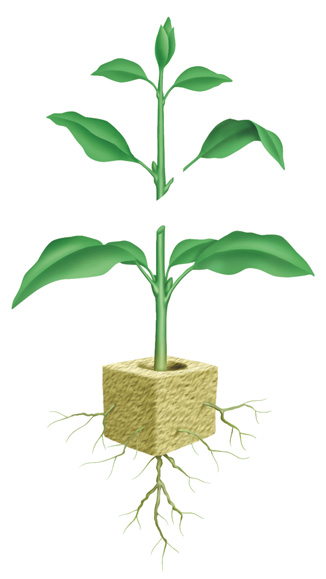
Schematic showing a plant cutting by Hydrob. File is licensed under the Creative Commons Attribution-Share Alike 3.0 Unported license.
From October 2023 my writings about plants, and books about plants, have a new home at Plant Cuttings. That site is dedicated to all those who find fascination in plants, whether die-hard plant-lovers or those who are simply plant-curious. Even as the site develops – it’s very much a work in progress(!) – blog items will appear there, contributing to the site’s goal of “reducing plant blindness*, one post at a time…”. For those of you unfamiliar with my writing – or as a reminder to those that are, there follows a little more about what this site hopes to achieve, and its owner.
About the Plant Cuttings site
The simple aim of Plant Cuttings is to provide a home for my writings and musings about plants, and plants-and-people. Although that may be considered something of a vanity project, the site does have a nobler and more serious ambition – to share my enthusiasm for all things ‘planty’ with a wider audience with the objective of improving the public’s appreciation of plants and therefore their ‘botanical literacy’ (Claire Hemingway et al., Science 331: 1535-1536, 2011; doi: 10.1126/science.1196979). Why?
Because there is a widely-held belief that people are insufficiently aware of the importance of plants, to the extent that they may not even see them in the environment. That phenomenon has been called ‘plant blindness’ (Mary Jo DiLonardo)*. In trying to combat that short-sighted approach, which prevents a fuller appreciation of all of the living things with which we share our planet, posts on this site will try to showcase how interesting and important plants are. After all, at the end of the day, when all’s said and done, and lest we forget, plants – and other photosynthetic organisms such as diatoms and cyanobacteria – are what keeps almost every other living thing on Earth alive because of the food they create and the oxygen they produce.
I firmly believe that the more we know about plants, the more we’ll appreciate them. And the more they’re appreciated, the better we’ll look after them. And that will ultimately be to the greater benefit of the planet and all who live here. Plants play – and have played – a huge part in our existence on Earth; if we want to continue to live here, and have a future on this planet, we’ve got to look after the plants.
In that regard it is hoped that one audience for the site will be those who don’t know that much about plants but are keen to find out more. The site’s second intended readership is those who already know quite a bit about plants but are interested in finding out even more. And, if any of the items posted here are of value to those who are doing their own bit to educate others in the awesomeness of plants, then that’s a bonus.
Trying to write material – particularly about sometimes scientific subjects – that will appeal to both audiences is a challenge. Whilst I’ve tried to assume a general level of understanding of plant biology – which is itself difficult to define – I include numerous links within the posts to more information about particular topics to provide useful background. With a mix of assumed knowledge and appropriate within-text information, I hope I’ve got the balance right in my attempts at science communication (‘scicomm’). In terms of style, I try to write in a way that is informative, but is also educational and entertaining. I trust that the writing will be engaging and understandable.
The site will feature two main categories of blog items, Plant Cuttings, and book appraisals.
Plant Cuttings are intended to provide information about an aspect of botany that I think is worth sharing with a wider audience. The catalyst for each post may be an article from a scientific journal, something from a newspaper, a TV programme, or a book I was reading. Or, they may simply be plucked out of the air as Edward Elgar did in composing his music (e.g., here).
Regardless of the topic tackled, the most important feature of a Plant Cutting is that it should be evidence-based, with sources stated for statements made. It’s important to acknowledge, and credit, the sources of information used in one’s writing, to avoid a charge of plagiarism. I believe it’s also important to provide sources so that the reader can check on what’s been written – and get more information about the subject.
Sometimes, it may look like too many sources have been supplied to support a statement made. That ‘duplication’ is usually to ensure that at least one of the sources can be accessed by interested readers – sites do occasionally disappear from the internet. Plus, different sources often add something extra to the story.
Usually the topic that triggered the post will be related to other topics within the blog item – either directly or more tangentially. Those links help to underline the interconnectedness of plants and the stories they have to tell.
Because these posts work hardest at promoting the ‘plants are really important’ message, the site has been named after them. For those already fascinated by plants, I hope these posts will further fuel that fascination. For those readers who aren’t yet fascinated by plants, I hope that the posts will convert that curiosity to fascination.
[For those of you who followed my posts on Botany One, I encourage you to subscribe to Plant Cuttings to be alerted to new items at their new site.]
Book appraisals are my reviews of books with a plant connection [although plant is widely interpreted to include fungi (organisms traditionally studied by botanists), and photosynthetic organisms such as algae]. The appraisals are intended to be honest assessments of the books’ strengths and weaknesses. By way of a ‘spoiler alert’**, one theme you’ll soon identify is mention of the need for fact-based books to provide more evidence to support statement made. Where such posts seem to be a little on the long side that’s usually because there’s a lot to say about the particular book. I hope the appraisals will be useful to potential readers.
[For those of you who followed my posts on Botany One, I encourage you to subscribe to Plant Cuttings to be alerted to new items at their new site.]
A bit about me
My name is Nigel Chaffey***. I am a Botanist, and fascinated by plants – as wonderful organisms in their own right – and how they interact with people. I tried to convey that wonder and enthusiasm to students during my time as Senior Lecturer in Botany at Bath Spa University (Bath, near Bristol, UK). In trying to spread that message beyond the university’s campus I contributed the monthly Plant Cuttings column to the Annals of Botany, an international plant science journal.
Until September 2023, my Cuttingsesque items – and appraisals of books with a plant focus – were also shared with a plant-curious audience at Botany One, the web log for the Annals of Botany Company [for my items at that site, see here]. In all those different roles my main goal has been to inform others about plants, and plant-people interactions, and thereby improve humankind’s botanical literacy.
Now, as a rather grandly-titled ‘freelance plant science communicator’, I’m hoping to reach a wider audience with my own web site, Plant Cuttings****.
In the spirit of trying to reach even more people, I’m happy to be contacted to discuss potential writing – or talking – projects and opportunities. Please use the Contact page for that purpose.
* Yes, I am aware that moves are now afoot to get plant blindness rebadged as ‘plant awareness disparity’ (e.g. see here) – and which is catchier as the acronym PAD. However, until such time as the term PAD is more prevalent in the public’s mind – but acknowledging its perceived deficiencies – I’m sticking with plant blindness for now.
** I also like to try and enhance appreciation for the English language, particularly when it comes to use of idioms. Which is why I insert links to demystify phrases or unusual words in my posts. That is not intended to be patronising; it’s just that I find English almost as fascinating as plants and am keen to share that interest with others. As hyper-links you can easily ignore them in your reading of the posts.
*** In the past, owing to the strangeness of internet searches, I have been known as Mr Plant Cuttings. That title is one I’ve been happy to use, and occasionally appears in my blog items. But, to remove any doubts, Nigel Chaffey = Mr Plant Cuttings.
**** I’m not as adept at IT as I’d like to be. Developing this site is therefore going to be quite a steep learning curve, both for me and for the readers(!). My goal is to keep things nice and simple on the basis that the content is more important than any fancy ‘packaging’. I do hope you’ll bear with me as I try to get things ‘right’ on this site…


Leave a Reply