Nature’s apothecary by Margaret Willes, 2026. Bodleian Library Publishing.
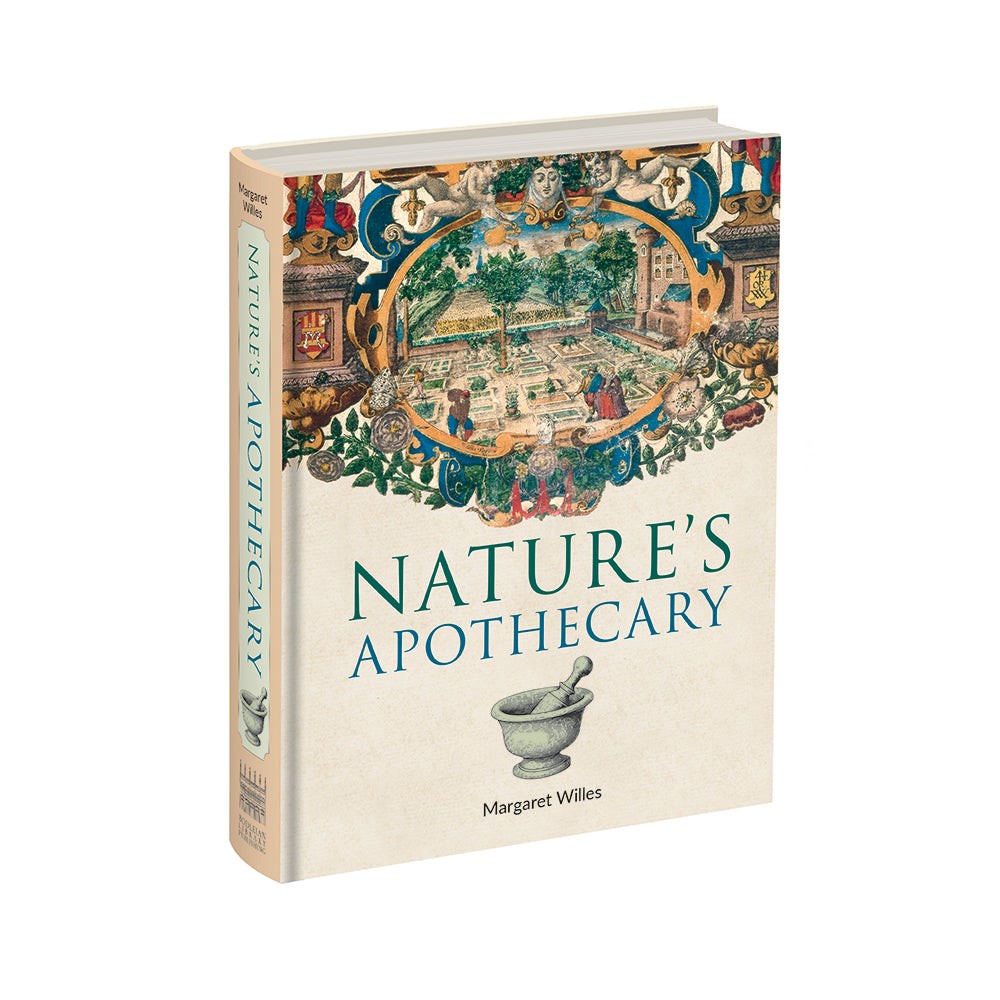
The title of Nature’s Apothecary by Margaret Willes [which book is here appraised] is a play on words, a pun (Sam Evans; Dario Villirilli). The word apothecary* is a term applied to a person who made and sold medicines, i.e., “a professional who formulates and dispenses medicinal substances” (Kiah Stone) “made from herbs, natural ingredients and other medicinal substances” (Asti Mary). Or, in other words, “fascinating druggists who meticulously mixed herbs and minerals, adding a dash of animal fat here and a bit of earwax there, all with the intent of curing common ailments” (quoted from here. So far, so good.
But, as Willes also tells us on page 1 in her book, “the term ‘apothecary’ comes from the Greek for storehouse”. Acknowledging those two meanings, she skilfully weaves both into her book. Accordingly, in the Introduction, Willes provides an account of the history of ‘apothecarism’ and the role of the apothecary in wider society. But, in the larger part of the book, The plants, she examines the role played by 100 plants in that story. And it is those plants – growing in the garden, or specialist greenhouses, etc. – which represent the botanical ‘store’ housed within nature that represents the nature’s apothecary of the book’s title.
What the book is about…
It’s always good to know this. And Willes not only tells us this, she does so in the 1st paragraph of the first page: “In this book I have taken a hundred examples of plants to show the vital role they have played in medicine, and indeed in daily life, from medieval times right through to the present” (p. 1). And, in that regard – this reviewer is very pleased to say – Nature’s apothecary ‘does exactly what it says on the tin’.
… and what the book is
Nature’s apothecary is very well written, with some memorable phrasing (such as, “Another proposal he [John Gerard] made was to the Barber-Surgeons of London that a garden should be kept for the cultivation and study of medicinal plants at East Smithfield, but this also never bore fruit” (p. 17)), which makes it a joy to read. It’s also full of fascinating facts about the people and the plants – lots of which were new to me** (always a sign of a good book), which brought me much pleasure (but also some pain [see Sources???, and foot note **]).
Accompanying the text are dozens of illustrations, generally occupying between a half and a whole page. There seems to be one on almost every other page of the Introduction, and each of the 100 plant entries has a picture. But, rather than use accurately-represented drawings or photographs, Willes has opted to use images from the herbals that provide the phytomedicinal information in the book. In that way the – frequent – imperfect rendering of the illustrations mirrors the – often – imprecise nature of the traditional herbal medicinal value of the depicted plants. And the majority of those pictures are from the hand-coloured version of Gerard’s The Herball, or Generall Historie of Plantes of 1597.
Two books in one…
Nature’s apothecary is a book of two halves – the Introduction, and The plants. Although unequal in length – 50 pages, and 200 pages, respectively – they tell two important, and complementary, stories.
After appropriate historical scene-setting (with good mention of Theophrastus, Dioscorides, Pliny the Elder, Galen, and Paracelsus), the Introduction provides a very full essay placing the English/British herbal tradition in context, from its beginnings to the present day. Accordingly, we get good mentions of the likes of such notable historic writers and practitioners as John Gerard, Nicolas Culpeper, and William Turner – with intriguing biographical insights for each of them. As laid-out, Willes’ Introduction delivers a very good account of the history of the English herbal, and its practitioners. Although a subject with a male-dominated history, Willes makes suitable mention of female botanists – such as Elizabeth Blackwell who produced a beautifully illustrated two-volume A Curious Herbal to settle her husband’s debts and secure his release from prison – to ensure that their role and contribution to development of the subject is not overlooked. But, because of its length, this part of the book would probably benefit from use of sub-headings to help the reader navigate the review, which is roughly in chronological order. Nevertheless, in its existing form it is a great promoter of the value of herbalism (several of which ancient or traditional folkloric plant uses are ‘vindicated’ by modern day scientific medicine – as frequently mentioned by Willes in appropriate plant entries).
The plants section showcases 100 botanics, in alphabetical order of common name, from ‘alecost’ to ‘yew’. Each entry is just 2 pages – a mix of text and an illustration. Plants covered are primarily angiosperms, but with a single pteridophyte (maidenhair fern), and two gymnosperms (juniper, and yew). Each plant entry starts with an English common name (although most of these are probably familiar ones, sundew is included as ‘rosa solis’ (Henriette Kress; Elaine Leong) (Drosera rotundifolia) – which is why this plant is listed under ‘R’ and not ‘S’…), followed by the plant’s scientific binomial.
After some botanical description of the plants, and depending on the plant, we may get information about the mythology associated with the plant, or the etymology of its name, or other sundry matters. In all cases we are given information about its medicinal usage – usually its ‘traditional use’ (with abundant quotes from old herbals/herbalists), but often with some more modern insights into its pharmaceutical value in the 21st century. Along the way we have plenty of interesting information**; there’s something for everyone, and something of interest – sometimes more than one thing – on every page. Nature’s apothecary is a fascinating collection of phytological and pharmaceutical facts, with a very good mix of plants-and-people.
Book’s botanical scope
Although Willes’ book has a declared emphasis on British herbalism – for the showcased plants, she has “put them in their British context” (p. 1) – that doesn’t mean that Nature’s apothecary is just about British native plants. Several exotics are covered – e.g., cinnamon (Cinnamomum), cloves (Syzygium aromaticum), ginger (Zingiber officinale), nutmeg and mace (Myristica fragrans), and tobacco (Nicotiana tabacum). This demonstrates the ingenuity of workers with plants in assimilating imported botanics, and the important influence on the British herbal flora of species from far-flung, foreign lands (such as The Spice Islands (the present-day Moluccas in Indonesia)). Somewhat sadly, it also reminds us of how much botanical bounty Britain/England gained from its voyages of discovery/colonialism/exploitation, and politically-promoted, prolific plundering of the planet’s plant resources [Ed. – a sort of empire-expanding botanical kleptomania..?] from the 15th century onwards [Ed. – and which policies of plant-pilfering were also profitably practised and promulgated by other European powers of the time..].
Although I’ve not – so far – found a list of the 100 plants otherwhere than in the book, I’m happy to devote a little space here to naming a few of ‘the 100’: almond, blessed thistle, chervil, deadly nightshade, English oak, fig, groundsel, houseleek, liquorice, madder, nettle (stinging variety), orpine, pomegranate, quince, rosemary, saffron, tansy, vervain, walnut, and yarrow.
Other parts of the book that support these two main sections are:
Notes, approx. 3 pages, containing 95 ‘Notes’ (29 for the Introduction). Cross-checking quite a few of these numbered items to their in-text numbers shows that they primarily appear to be sources for quoted text in the book. Several of those sources are also listed amongst the Further Reading section.
Further Reading, approx. 1.5 pages encompassing three categories: Primary printed sources; Primary manuscript sources (which two lists include Gerard’s The Herball, Nicholas Culpeper’s The English Physician, Sarah Jinner’s An Almanac or Prognostications for the year [1658–], and The Complete Receipt Book of Ladie Elynor Fetiplace); and Secondary sources (which includes two of Willes’ own books, plus The Englishman’s Flora by Geoffrey Grigson, and Henry Oakley [sic.]’s Modern Medicines from Plants).
Presented without comment by Willes, the primary sources appear to relate to items that are mentioned in-text (principally in the Introduction), six of which are sources for numbered Notes. Although a couple of the secondary sources are cited as sources for Notes, the purpose of the remainder is unclear. They may indeed be further reading for those interested in knowing more about the book’s subject matter, or – as I suspect for some of the publications – sources that provided at least some of the information in the book but whose sources are uncited [see Sources???, and footnote **].
Index
This is approx. 3.75 two-columned pages, from ‘aconite’ to ‘yew’. The Index doesn’t include any scientific names (even though Willes provides them for each of the 100 showcased plants). Although the listing is principally plants, people, and places, the Index also includes a few other entries such as: chicken-in-the-woods, and puffball (fungi are mentioned in passing, but not included amongst the book’s 100 plants); doctrine of signatures (an essential guide to the medicinal value of plants back in the day, and mentioned in connection with Paracelsus in the Introduction); galls (in connection with manufacture of oak-ink); green sickness (hypochromic anaemia, “a disease peculiar to virgins, who would be cured if they got married and became pregnant” (p. 192)); King’s Evil (or scrofula, “a tubercular swelling of the lymph glands” (p. 116)); piccadill (a type of ‘ruff’ that emerged at the court of James I…); Quacks Act (“an Act was passed in 1543 allowing those experienced in the nature of herbs, roots and waters to practise them as a gesture of Christian charity” (p. 29), but which – not surprisingly, caused an outcry amongst those with vested interests in not opening their profession to those “having no more perseverance, reason, or knowledge in this art than has a goose” (p. 29)); and sympathy, theory of (Marieke Hendriksen; Lauren K McCormick) (apparently, “Taking the theory of sympathetic medicine, she [St Hildegard of Bingen] suggested that physicians should use the part of the root [of mandrake] that corresponded to the affected part of the human body” (p. 154), which sounds like the doctrine of signatures (Bradley C Bennett; Allaire Diamond) by another name…).
Sources???
Information provided in Nature’s apothecary is of two main types: quotations from publications, and facts about the plants, people, herbal practices, etc.. For the quotations Willes is very good at telling us the sources, and this is indicated by super-scripted numbers in-text, which numbers relate to the Notes gathered together in that separate section.
However, the second category of information is generally very poorly sourced – if at all. Examples of this omission are: “Sheep’s dung, for example, is particularly rich in potassium, vital for many healing processes” (p. 36); “Spiders’ webs contain natural antiseptic and vitamin K, which helps in the process of clotting blood and repair” (p. 48); “Extracts of deadly nightshade and related plants are still important drugs in conventional medicine, particularly as a stomach sedative. And, echoing its traditional use by beautiful ladies, in opthalmology [sic.], where low doses of belladonna stop the contraction of the pupil, so enlarging it and increasing eye brightness” (p. 99); “Although the lovely flowers [of borage, Borago officinalis] have traditionally been added as decoration to alcoholic drinks, the UK Food Standards Agency now advises against this because of the presence of toxins” (p. 65); and “Dr Stewart Johnson of the City of London Migraine Clinic decided to undertake a survey of some 270 feverfew-takers” (p. 115). [Ed. – footnote ** lists further examples of this practice.]
As botanically-knowledgeable as the author undoubtedly is – after all, she has written several books on related topics: Pick of the Bunch: The Story of Twelve Treasured Flowers; A Shakespearean Botanical; and The Domestic Herbal: Plants for the Home in the Seventeenth Century – I doubt that she has generated first-hand all of the factual statements about plants that appear in Nature’s apothecary. Not to provide the reader with the sources in these instances undermines the scholarship that is so clearly evident in the rest of the book with the numerous quotations that are appropriately stated and cited.
Summary
Nature’s apothecary by Margaret Willes contains a wealth of information about traditional medicines and herbalism (with a British perspective), and of 100 herbal plants. Well-written, profusely illustrated, and informative, it is a valuable addition to the literature of the plants-and-people genre.
* If apothecary is considered a rather outdated word, it’s closest equivalent today is probably pharmacist (Asti Mary). However, most modern-day pharmacists don’t make and mix their own medicinal potions. Instead, they tend just to provide ready-made remedies and pharmaceutical products [made by others] to their customers. Arguably, the closest we get today to the apothecary of old is probably therefore the herbalists, “herbal medicine practitioners who work with plant-based ingredients and traditional herbal preparations” (Asti Mary).
Notwithstanding its antiquity, apothecary is still applied to individuals in the 21st century, who may be members of organisations such as The Society of Apothecaries, that “derives its membership from the medical and pharmacy professions”. The source of which membership helps to place the term apothecary in the context of the development of the various medical specialisms, “Apothecaries were a branch of the tripartite medical system of apothecary-surgeon-physician which arose in Europe in the early-modern period” (quoted from here).
** A few of the facts in Nature’s apothecary that were new to me are: Alecost (Tanacetum balsamica), also known as “‘bible leaf’, indicates that it was interleaved in bibles and other books to disperse the smell of mildew” (p. 53); the similarity of the common name of basil (Ocimum basilicum) to “the word ‘basilisk’ [(Janine Ungvarsky; George R Zug)] has led to a belief that the plant was an antidote to that reptile’s venom” (p. 56); “During the Second World War the latter [coltsfoot rock from coltsfoot, Tussilago farfara] might be obtained from the chemist, counting as a cough sweet and therefore not subject to rationing” (p. 83); and “This popularity [sandwiches of leaves of dandelion, Taraxacum species] is making a comeback” (p. 97). Unfortunately, in none of those cases were any sources supplied by Willes. All of these are facts I’d consider using in my own writings about plants. But, without sources supplied I would either have to refrain from doing so, or invest considerable time in tracking-down suitable sources.
 Plant Cuttings
Leave a comment