
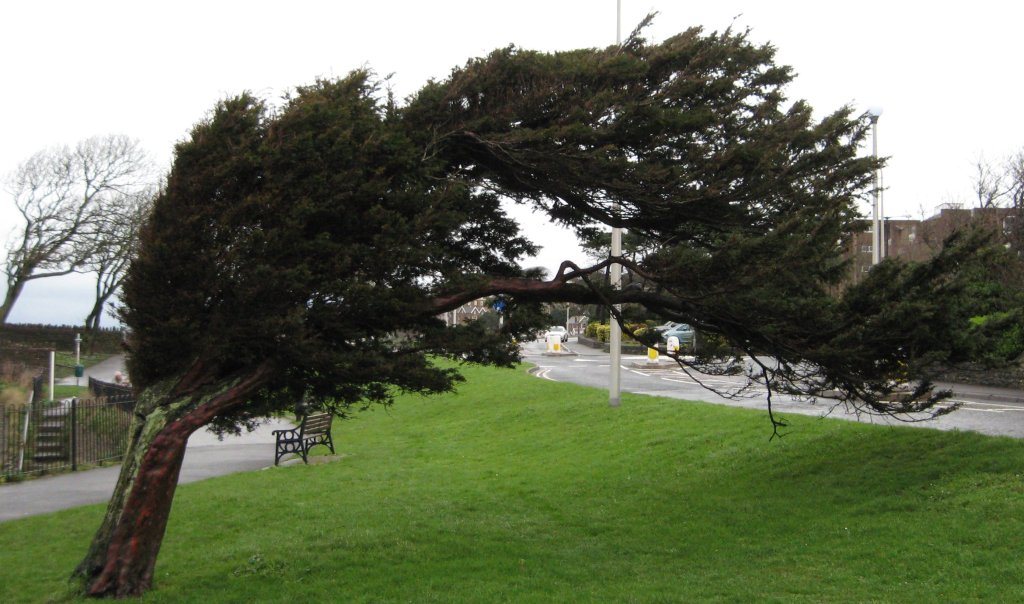
Plants have equivalents of many of our human senses. The sense of ‘touch’ is dramatically illustrated here in the phenomenon of thigmomorphogenesis whereby the growth form of this yew tree has been ‘sculpted’ by the touch of the prevailing westerly wind.
This chapter explores some of the plant parallels with the five main human senses. Plants are masters of the sedentary lifestyle and expert at being in-tune with their environment. Indeed, being able to do so is a matter of life or death for a plant.
From our human perspective five main senses – means of perception – are generally recognised: hearing, sight, touch, smell, and taste (Carl Pfaffmann, 2012). What about plants? They may not have obvious analogues of our ears, eyes, fingers and toes, noses or tongues – or brains to interpret these sensations and determine how the organism should respond – but do they have similar senses? Are they able to detect these sensations and respond in an appropriate way consistent with them being sensitive to those factors? As organisms that are generally fixed in position it would certainly be beneficial for them to have similar sensory capabilities in order to better cope with what the environment throws at them.
Plants can see
Light is one of the most important factors in the life of plants; it has roles both as a source of energy and as a modifier of behaviour. Perception of light is akin to the human sense of sight. Apart from its essential role as a supply of energy for photosynthesis, the quality and quantity of ‘light’ – both visible wavelengths, and those beyond the PAR range of 400 – 700 nm – have profound effects on many aspects of plant biology. Bluntly put, the ability of plants to detect – and to respond appropriately to – light is essential to their survival; it is very much a matter of life-or-death. Generally, light is detected by various photoreceptors, which are numerous, and increasing in number as more aspects of plant photobiology are studied.
For example, a rather basic property of plants is that they tend to grow ‘towards the light’. This tropism (“a phenomenon indicating the growth or turning movement of an organism, usually a plant, in response to an environmental stimulus” (Randy Moore) – specifically, phototropism (Melissa Ha et al.; Regina Bailey) – is largely down to the ability of the appropriately named pigment phototropin, a blue light-receptor (David Goodsell, 2015), to detect the direction of a light source. By appropriate re-adjustment of growth the illuminated organ grows towards the light source. The overall appearance of a plant – its morphology – is the result of several such intimate interactions between the plant and its environment.
And one environmental cue that plays a large part in this is light – in particular the ratio of different wavelengths of the visible/near-visible spectrum, primarily red and far-red. Detection of which is largely down to the diverse group of photoreceptors known as phytochromes (Peter Quail, 2010). This suite of developmental changes is known as photomorphogenesis (Peter von Sengbusch; Shagun Khand; James Shinkle, 2008) and is instrumental in such phenomena as the lengthening of internodes when seedlings are grown under low light. To visualise this think of the sprouting of potatoes long-forgotten about and kept in a darkened cupboard for several weeks. Associated with the long internodes – an ‘attempt’ by the plant to reach sufficient light to enable it to photosynthesise and survive before it runs out of stored reserves – is a whole suite of other changes to its ‘normal’ appearance. This is graphically demonstrated in the colour images of cress plants grown either with or without light for five days here, for Arabidopsis seedlings by Jules Bernstein, and for runner beans by Michael W Clayton, and less dramatically in black-and-white drawings for several other species by Augustine Dawson Selby (1906).
The adaptive benefits of that behaviour are clear – a plant can’t move to a better lit area, it must grow towards one if it can, or attempt to outgrow a neighbouring plant that may be shading it (Keera A Franklin & James R Shinkle, 2009). For plants to flower at the ‘right time’ they must be able to detect – amongst other factors – light quality (e.g., the wavelengths – and ratios thereof – present) and duration (the ‘photoperiod’) (Israel Ausín et al., 2005).
Regarding light quality, the photoreceptors phytochrome and cryptochrome, are involved in detecting red/far-red, and blue/UV wavelengths, respectively, both of which have a role in the plant’s ‘decision’ to flower. Finally, the opening of stomata is promoted in the early morning by the blue-enriched light which is perceived by a phototropin (David Goodsell, 2015). Open stomata permit a more ready uptake of atmospheric CO2 for P/S, which in turn permits the plant to make better use of the fuller range of PAR wavelengths available in sunlight a little later in the day. Many more examples could have been used, but clearly plants can ‘see’. Indeed, should a plant become ‘blind’ it is unlikely to survive; the sense of ‘sight’ is essential to its continued existence; “For plants, the sensing of light in the environment is as important as vision is for animals” (Harry Smith, 2000, p. 585).
Plants can smell
Here I include perception by the plant of volatile or gaseous chemicals. This olfactory capacity is exemplified in many facets of plant biology, and is involved in some of the most basic, life-sustaining activities such as germination, coping with herbivory, and disseminating the next generation.
Many plants require smoke to permit germination of their seeds (Thomas Landis, 2000), and so-called ‘smoke-water’ – water to which smoke from combustion of wood and other plant materials has been added (Janice Coons et al., 2014; Nidhi Pandey et al., 2015) – can encourage germination in other instances (Nicholas Peterson et al., 2025). [Ed. – keen-eyed readers will no doubt wonder if detection of, and response to, smoke dissolved in water is more akin to a sense of taste than one of smell. Agreed, but, since it is compounds within the smoke alone that initiate the response, it is a legitimate example of the sense of smell in plants. Furthermore, smoke and its compounds when in contact with the plant may well be dissolved in the film of water that may persist on leaves and other aerial surfaces, and within the cytoplasm inside plant cells…]
Smoke – itself often the product of combustion of plant material in the natural environment – contains many compounds, including 3-methyl-2Hfuro[2,3-c]pyran-2-one (Gavin Flematti et al., 2004), a butenolide. Now known as karrikinolide, it is just one of a family of naturally-occurring compounds called karrikins (Mark Waters & David Nelson, 2023; Qilin Deng et al., 2025) that have potency in breaking dormancy of seeds of many species adapted to environments that regularly experience fire and smoke (Sheila DS Chiwocha et al., 2009). This intimate interaction between fire, smoke and plant ecology is a major feature of several regions of the world where fires are a natural part of the ecosystem – e.g., South Africa, Australia, South America (David Nelson et al., 2012).
Many plants are affected directly by herbivores that eat parts of – or even entire – plants (Dana Blumenthal & David Augustine, 2009). This is an age-old battle and over geological time plants have developed a wide array of defences in order to resist those usually unwanted attentions (Michael Wink, 2016; André Kessler, 2017; Jose Sánchez-Serrano, 2017). One of the most intriguing aspects of this struggle for survival is the plant’s production of HIPVs [herbivore-induced plant volatiles]. Released by an attacked plant, these volatile organic compounds – such as methyl jasmonate (Richard Karban et al., 2000) and GLVs [Green Leaf Volatiles – Juergen Engelberth et al., 2004] – are detected by another plant that is currently not under herbivore attack (C Kost & M Heil, 2006; Martin Heil & Richard Karban, 2009), or leaves of the attacked plant that are not currently directly attacked (Martin Heil & Rosa Adame-Álvarez, 2010). In any event the ability to detect air-borne chemical signals sounds remarkably like ‘smell’.
And extending this notion further still other HIPVs are detected by predators of the herbivores who then attack those herbivores and effectively come to the aid of the herbivore-attacked plants (Marcel Dicke, 2009; Andrea Clavijo McCormick et al., 2012) in a tritrophic interaction (Martin Heil, 2008). And microbial attack may invoke a similar aerial signalling mechanism (Hwe-Su Yi et al., 2009; P Saraí Girón-Calva et al., 2012).
Interestingly, workers such as Ian Baldwin et al. (2006) and Martin Heil (2009) liken such plant-plant chemical interaction to eavesdropping where the un-attacked plant is listening-in on the conversation that the attacked plant is having with the outside world. If so, then this phenomenon may be considered as an example of plants having a sense of hearing.
Ethylene is one of the so-styled classical plant hormones (Hans Kende & Jan Zeevaart, 1997) that affect several facets of plant growth and development (William Gray, 2004; Ann Marie VanDerZanden; Ross H McKenzie; Ercan Çatak & Ali Atalay, 2020). Often called the ‘ripening hormone’ (Caren Chang et al., 2013), it is this aspect of ethylene’s activities that are relevant to the notion of plant smell. Although production of ethylene is a part of the normal ripening process of fruits of many species, as a gas it diffuses away from the originating plant. This diffused ethylene can be detected by nearby plants whose own fruits will then begin to ripen under its influence (Joe Schwarcz; Jolene Pappas)…]. [Ed. – this phenomenon is believed to be the origin of the phrase ‘one bad apple spoils the whole barrel’. Ethylene released during ripening (‘spoiling’) of one apple can bring about the ripening of others nearby (Athanasios Theologis, 1992)…] In turn, ripe fruit are taken and eaten by animals that often do not eat the seeds they contain but instead distribute them along with fertilising faeces some distance from the parent plant where they may establish as a new individual to perpetuate the species. Plants are masters at delegating a variety of such ‘translocation/propagation activities’ to animals who thereby assist the colonising ambitions of the plant.
Plants can taste
Daniel Chamovitz (2012a) makes the point that smell and taste are so intimately interconnected that they should be considered together and his review of plant senses accordingly only considers ‘smell’, which he defines as the plant’s ability “to perceive odor or scent through stimuli” (p. 29); he consequently only reviews four plant senses. However, I would argue that the ability of plants to detect chemicals other than scents or odours or volatiles (consider above under ‘smell’) in the environment – e.g., detection of small amounts of vitamin B12 by a diatom so that levels of a vitamin B12 carrier protein are increased within its cell wall thereby permitting better scavenging of this essential nutrient (Erin Bertrand et al., 2012) – is akin to a taste-like capability and we can legitimately consider plants to have an equivalents of that human sense, too.
In a terrestrial plant context much of the contact between plant and non-gaseous chemicals takes place below ground, and is consequently out-of-sight, and therefore largely beyond our appreciation. But chemical communication between plant and microbes is involved in the correct establishment of N-fixing nodules and mycorrhiza, with the plant recognising and responding appropriately to microbe-produced NOD factors, and Myc factors (Paola Bonfante & Natalia Requena, 2011; Fabienne Maillet et al., 2011; Tania Ho-Plágaro & José Manuel García-Garrido, 2022). Interestingly, both NOD and Myc factors are examples of the same category of bioactive molecules, lipochitooligosaccharides (Fabienne Maillet et al., 2011).
In a less benign way the ability of one plant to detect the chemical signals released by another is crucial to the lifestyle of some parasitic plants (James H Westwood; Jay Sullivan; Alex Twyford, 2018; Min-Yao Jhu & Neelima R Sinha, 2022). Whilst most plants are autotrophs (satisfying their energy requirements by photosynthesis), many gain an extra hand in the nutrient acquisition stakes via N-fixing nodules or mycorrhizal association or carnivory. Approx. 1% of flowering plant species are parasitic on other plants, to one degree or another (A James S McDonald & Dominic B Standing, 2003) and largely rely on the food production efforts of other plants for their own sustenance. The genus Striga – which contains obligate parasites that “have a greater impact on humans worldwide than any other parasitic plant, because their hosts are subsistence crops grown widely in Africa and Asia” (Daniel L Nickrent & Lytton J Musselman, 2004, p. 7) – has been much studied and engages in a number of ‘chemical communication events’ with its hosts, such as sorghum or maize. For example, seeds of Striga germinate in response to appropriate ‘signals’ – strigolactones (Xiaonan Xie et al., 2010; Koichi Yoneyama et al., 2010; Christine Beveridge, 2014) – from the host’s root, which not only indicate the type of host but also its distance from the seed (Nickrent & Musselman, 2004). After germination, the root of the Striga ‘seedling’ grows towards the root of the host plant. After contact it develops a haustorium that effects penetration of the host root and eventually results in continuity between the vascular tissues of both plants (Nickrent & Musselman, 2004). Thus, the parasite can abstract the materials it needs from the host. Indeed, it does it so effectively that Striga spp. are thought to cause damage of tens of billions of dollars in lost crop yields (Yuichiro Tsuchiya & Peter McCourt Tsuchiya, 2009) on two-thirds of the arable land in Africa that they infest.
Keeping with a plants-harming-other-plants theme, we have the phenomenon of allelopathy (RJ Willis, 1985; Harsh Pal Bais et al., 2004), which is defined as “the beneficial or harmful effects of one plant on another plant, both crop and weed species, by the release of chemicals from plant parts by leaching, root exudation, volatilization, residue decomposition and other processes in both natural and agricultural systems” (James J Ferguson et al., 2016]). Although this concept has been treated with a certain amount of scepticism in the past (RJ Willis, 1985), there is now sufficient evidence that allelopathy is taken seriously (Tiffany Weir et al., 2004), and is an active research area in the field of chemical ecology with potential implications in farming (Marianne Kruse et al., 2000).
On a slightly less exotic level – but one which is nevertheless just as vital to plant life – plant roots are not only instrumental in the uptake of essential nutrients – e.g., nitrates and phosphates – from the soil, but also respond in ways that tend to maximise their uptake when such minerals are in short supply. For example, levels of phosphate transporters – membrane-located molecules involved in uptake of phosphate from the soil – are enhanced by low external levels of phosphate (E Remy et al., 2012). A similar behaviour is seen in respect of nitrate transporters under conditions of low N supply (Takatoshi Kiba et al., 2012). Again, it is not too far-fetched to consider this ‘chemosensing’ to be the plant equivalent of taste. Interestingly, conditions of both N and P deficiency stimulate the production and release of strigolactones in sorghum (Xiaonan Xie et al., 2010). Although strigolactone is implicated in parasitic plant attack (e.g., Striga above), it is also important in facilitating mycorrhizal association (Kohki Akiyama & Hideo Hayashi, 2006; Catarina Cardoso et al., 2011), which – once established – would help the host exploit a greater soil volume and maybe overcome those nutrient deficiencies.
Plants can feel/touch
Many examples of touch-related growth and development phenomena are known in plants. For instance in thigmotropism (Mahak Jalan), plant parts – such as tendrils – twist around adjacent plants or upright supports upon contact (Janet Braam, 2005). The tactile stimulus results in differential growth (as with tropisms generally (Randy Moore, 2023)) whereby cells of the tendril on the other side of the support elongate more than those on the surface directly touching the support (Regina Bailey). The end result is that the tendril-owning plant gets extra support and is held a little nearer the sunlight or away from shading neighbouring plants.
Another phenomenon is that of thigmonasty (Peter von Sengbusch; Jan Emming). [Ed. – ‘nasties’ are phenomena that occur in response to a stimulus, but whose direction of movement is independent of the position of the stimulus (Jane F Hill, 2023; Douglas Wilkin & Barbar Akre), unlike the directional growth that occurs with ‘tropisms’ Douglas Wilkin & Barbar Akre)]. Famous examples of this nastic phenomenon include the touch-induced dropping of the leaves and leaflets of Mimosa (the aptly-named sensitive plant) (Braam, 2005), the insect touch-induced closure of the fly-trap at the end of modified leaves of Dionaea muscipula (Venus flytrap), and the incarceration of aquatic organisms by the underwater traps of another carnivorous plant Utricularia (Janet Braam, 2005).
A further example of touch-related phenomena is that of thigmomorphogenesis (MJ Jaffe, 1973; Danilo D Fernando, 2023), whereby the development of a plant is determined by mechanical stimuli (e.g., touch, rainfall, wind – Fig. 5) (Braam, 2005; E Wassim Chehab et al., 2009). The classic example of this phenomenon is the wind-shaping or wind-sculpting of trees (Marion Robertson) as considered on Chapter 4.
There is much still to be learned about plants and touch, and a fascinating observation is the role played by touch in neighbour detection by plants. Although the suite of changes that result in plants growing and developing so as to avoid shade – e.g., that caused by neighbouring plants – is light-dependent and based on phytochrome, Mieke de Wit et al. (2012) show that the touching of leaf tips is important, and acts at an even earlier stage than the involvement of phytochrome.
Plants can hear (maybe…)
This is probably the least understood – or understudied – of the ‘standard senses’ in plants. In large part that may be due to the claims that plants do respond to certain kinds of music, but usually on the basis of results from ‘insufficiently controlled’ experiments, and which is well summarised by Daniel Chamovitz (2012a) (who even concluded that plants have no need of a hearing sense, and were to all intents and purposes deaf). Nevertheless, that is unlikely to stop groups of workers occasionally testing plants for any aural responsiveness and it is hard to predict what advances in experimental technology may uncover in future. [Ed. – for insights into Chamovitz’ thoughts on plants’ five senses, the 2012 version of his book was succinctly summarised – albeit without sources stated – in an article in New Scientist. Although published as a four page single piece, somewhat bizarrely, each sense is indexed as a separate publication. The sources for that series are Chamovitz (2012c, d, e, f, g, h). And, for a longer item about plant’s sense of smell, extracted from his book, see Chamovitz (2012i)].
But, Chamovitz’s conclusion relates to 2012 (or, rather some time before that year given the time it takes to complete writing a book and the finished product seeing the light of – publication – day). Matters have moved on since that date.
A case in point is the considerable media interest in research published in late 2012 by Monica Gagliano et al. (2012) (and no doubt only known to the readers of the scientific paper – and Chamovitz’s book – after publication of Chamovitz’s 2012 book). Gagliano et al. (2012) report that plants might be using sound to communicate The aim of that study was specifically to look for evidence of means of communication in plants – alternatives to chemicals, contact or light – by testing whether any interaction between plants still occurs when all communication based on recognised means has been blocked. Investigating an allelopathy (James J Ferguson et al., 2016) between Capsicum annuum (chilli pepper) and Foeniculum vulgare (fennel), Monica Gagliano et al. (2012) showed not only that seeds of the former germinated more slowly in the presence of the fennel, but also that chilli seed actually germinated faster when sealed off from the fennel. The group suggest that sound may be involved as a means of communication between the sealed off plant/seed and that the accelerated germination may be in anticipation of receipt of fennel-derived chemicals that will slow their growth. The idea of anticipation is probably a difficult one for most of us to accept, but the notion of some as-yet-undiscovered communication mechanism is deemed worth pursuing by those who’ve openly commented upon the work (e.g., Michael Marshall, 2012).
On the back of such work, Monica Gagliano et al. (2012) firmly believe that the whole subject of ‘plant bioacoustics’ is ripe for further investigation. Commenting on that work, Chamovitz (2012b) muses, “As this field of research was often littered with pseudoscience, it will be interesting to hear if plant auditory prowess can match their visual, olfactory or tactile sensitivities” [Ed. – Chamovitz clearly hinting there that plants do exhibit equivalents of four of the five human senses].
In the last few months of 2012, with Chamovitz (2012) postulating in print the existence of four out of five traditional senses in plants, and Gagliano (2012) hypothesising “ that it would be particularly advantageous for plants to learn about the surrounding environment using sound, as acoustic signals propagate rapidly and with minimal energetic or fitness costs”, the scene was set for a “systematic exploration of the functional, ecological, and evolutionary significance of sound in the life of plants” (Gagliano, 2012).
And we didn’t have to wait too long. Accordingly, what follows is a brief consideration of two examples – both published post-2012 – of work on ‘plant acoustics’, which may encourage you to rethink your own views of whether plants can hear – or not.
Plants can ‘hear’ the very hungry caterpillar
Heidi Appel & Reginald Cocroft (2014) demonstrated that the vibrations caused by insect feeding can elicit chemical defences in Arabidopsis thaliana (L.). In assessing the suite of human-like senses plants have, vibrations set up within the plant by physical presence of the herbivore – the larva of the cabbage white butterfly (Pieris rapae) – might be viewed as the plant exhibiting a sense of touch. However, the same responses were elicited within the plant in response to recordings of the caterpillar’s leaf-chewing activity. In which instance, it is the sound waves that the plant is responding to, not the insect’s touch. Which is a phenomenon we can interpret as a sense of hearing. In attempts to ‘fine-tune’ the plant response, Appel & Cockcroft (2014) showed that the defence response was not elicited by vibrations caused by playback of ‘insect song’ or wind. Since that initial report, other changes have been detected in plants challenged with the recordings of herbivory (e.g., Mélanie Body et al., 2019). And it has even been shown that recordings of plant-chewing by several different insect species elicits the same effects in the test plant that appears favoured for this work, Arabidopsis (Alexis Kollasch et al., 2020). Whilst this implies that plants might not be able to distinguish one herbivore from another, they might not need to; the defence response to insect herbivores generally may be enough to be the same in all cases.
In trying to relate function to plant structure, Shaobao Liu et al. (2017) have discovered that trichomes on the leaf surface of Arabidopsis respond to sound within the frequency range of the sounds of feeding caterpillars. This finding encourages them to wonder whether these epidermal hairs might act as ‘mechanical antennae’.
[Ed. – for an interview with Heidi Appel about the original work, see here. For scicomm articles about this discovery, see Emma Weissmann, Molly Michelson, Garry Rogers, and here]
Plants hear water in the ground
Although we don’t have the space to go into in-depth analysis of the subject here, I’m happy to add to the discussion of plant senses by alerting readers to Monica Gagliano et al. (2017)’s study of plant roots (and its supporting video here).
In a report somewhat controversially entitled “Tuned in: plant roots use sound to locate water”, Gagliano et al. (2017) propose that roots of Pisum sativum (garden pea) were able to locate a water source by sensing the vibrations generated by water moving inside pipes. Since this happened in the absence of substrate moisture, it would appear to rule out involvement of the plant roots’ hydrotropism response. Interestingly, when presented with both moisture and acoustic cues, the roots preferentially responded to the moisture in the soil over acoustic vibrations. This behaviour is interpreted as indicating that roots use acoustic gradients broadly to detect water sources at a distance, but exploit moisture gradients to home-in on a specific source. [Ed. – for some scicomm comment on this work, see here]
This is an intriguing bit of plant behaviour that apparently using two senses – hearing and taste [of the water] – in the battle to acquire that most precious of resources. But, although this seems to work well in single plant experiments, how might it work in the mixed-species environment outside in the wide world? Are there differences in water-hearing abilities between plant species which might give the ‘more-acute-of-hearing’ the edge when it comes to detecting and reaching water sources before competing species? Fascinating work, and which highlights a more general concern about sound in the natural environment as the authors also argue for more research into the role of sound in biology and ecology more generally. In particular, they raise concerns about the contribution that noise pollution might make to organisms’ – plants and animals – ability to respond appropriately to their surrounding ‘soundscape’.
[Ed – as an excellent example of a scientist happy to change their mind when further evidence presents itself, the post-2012 report of Gagliano et al. (2017) was one of the factors that led Daniel Chamovitz to revise his opinion on plant’s sense of hearing. Accordingly, in the 2017 version of What a plant knows, which is updated and expanded compared from the 2012 first edition, he now states, “I now need to reevaluate my position; plants may indeed respond to acoustic signals” (p. 112). Or, in advertising parlance this version “includes new revelations including the long-awaited discovery that plants hear!“. Which is a good example of the scientific method in practice.]
Plants and soil microbes…
Finally [Ed. – for now. I’m sure we’ll, err, hear more about this in future…], Hafiza Komal Naeem et al. (2026) review work that has been accumulating over the decades which investigates the influence of sound on plant growth, stress responses, and microbial activity. As a result they propose a conceptual model that links acoustic stimuli to root function and processes that take place in the rhizosphere (the region around the root with which it interacts). They go further and suggest that sound vibrations act primarily as mechanical cues which are perceived by plant tissues and trigger calcium and hormonal signalling that modulate root architecture, metabolism, and exudation patterns. Aside from giving further insights into plant biology, Naeem et al. (2026) suggest that “Understanding these pathways may support the development of sound-based strategies as low-impact tools for improving plant–soil–microbe interactions in sustainable agriculture”. [Ed. – remember, you heard it here first…]
Finally – and, surely, on much firmer foundations is the subject of buzz pollination.
What’s the buzz about insect pollination?
Have you ever wondered what might be happening when bees make a buzzing sound around flowers? In some cases they are probably engaged in the phenomenon known as buzz pollination. This term describes behaviour “in which bees use vibrations to extract pollen from flowers, incidentally fertilising them” (David J Pritchard & Mario Vallejo-Marín, 2020). [Ed. – do note use of the term ‘incidentally’ here, which makes the point that any pollination of the flowers is secondary – arguably, entirely accidental – to the bee’s primary goal of extracting collecting pollen for its own – primarily, nutritional – purposes…]
On the face of it sound waves – transmitted through the air and which are audible – are detected by the plant whose ‘response’ is to release pollen from its anthers. Which sounds like a pretty clear-cut sense of hearing on behalf of the plant. Unfortunately, when you look into the details of the phenomenon the reality is a little different. The noise made by the bee is a result of what are known as ‘non-flight vibrations’ (Mario Vallejo-Marin & Avery Russell, 2024). That is because the bee is not flying during this behaviour but is actually grasping the anther and engaged in vigorous muscular contractions (that create the ‘buzz’). [Ed. – interestingly, these ‘floral buzzes’ are just one of a suite of several buzzes that bees can make by muscular activity (Mario Vallejo-Marín, 2022). Buzzy little things, bees…] In that way the vibrations caused by the bee are transmitted directly to the anther. It’s that vibration – transmitted though plant tissues – that the plant is reacting to. Not the sound waves from the buzzing via the air.
Which is to say, buzz pollination is actually an example of a plant’s sense of touch, not hearing. Hopefully, that account has now made proper sense of this phenomenon. Whilst explanations of buzz pollination are readily found by searching the internet, not all of them make it clear that it is a result of physical connection between the bee and the plant. Those that do include Wikipedia, Koppert Canada; and Fenella Saunders. For a graphic that illustrates the process, see the freely-available review article by Mario Vallejo-Marín (2009). As an added dimension to this phenomenon – and underlining physical contact between bee species and the plant – Charlie Woodrow et al. (2024) demonstrate that periodic biting of the anthers by at least one species of buzz-pollinating bee can increase the efficiency of vibration-induced pollen release in some plant species. [Ed – for more on this phenomenon, known as ‘bee kisses’, see Stephen Buchmann & Mark Jankauski, 2024, and the scicomm article by Fenella Saunders. For a video of Woodrow et al. (2204)’s work see here]
So, are plant sensitive?
This short survey shows that plants are clearly ‘sensitive’ – in that they are able to sense their surroundings [“capable of being stimulated or excited by external agents”]. Or, rather, they are able to display responses to environmental signals that are akin to the five human senses of touch, sight, hearing, smell, and taste. Whilst that makes plants ‘sensible’, it does not – necessarily – demonstrate that plants are sentient, as in “wise, judicious, sensible, or intelligent” [Ed. – although that will be touched upon in the next chapter]
Conclusion
This chapter has explored some of the plant parallels with the five main human senses, and found many similarities. Plants are masters of the sedentary lifestyle and expert at being in-tune with their environment. Plants are sensitive; they have versions of at least 4 of our own 5 senses. Plants are like us, but different.


Leave a comment