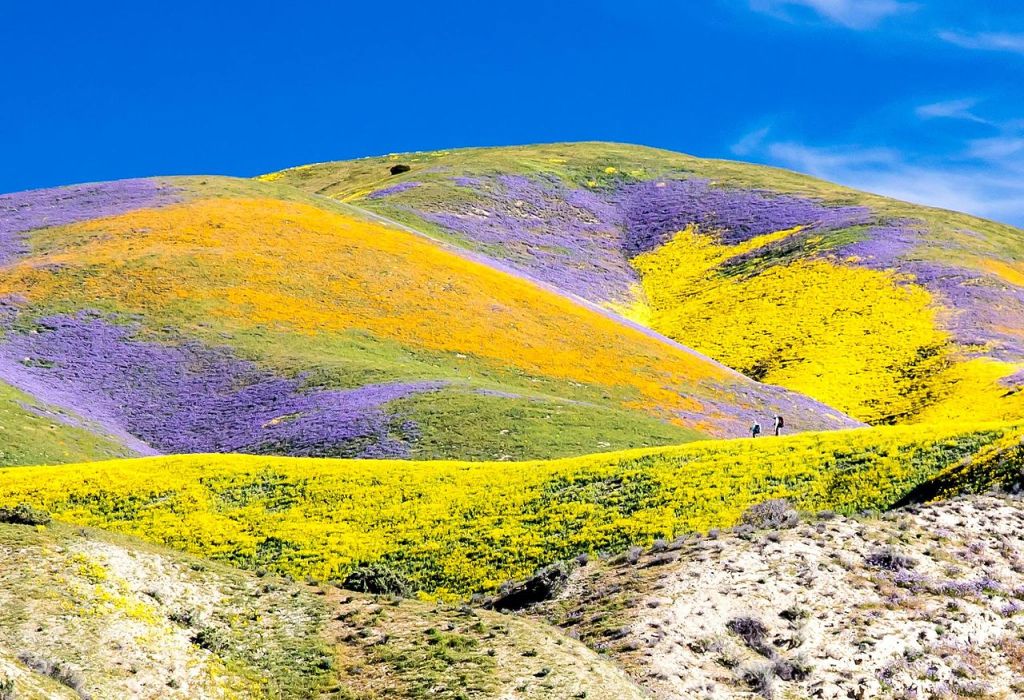
This image, entitled “Superbloom at Carrizo Plain National Monument, 2017”, by Bob Wick (a Bureau of Land Management employee) is in the public domain in the United States.
A desert bloom (Mischa Dijkstra; Nicole Saffie) (and, especially a ‘superbloom’ (Jules Bernstein)) – when seeds that may have lain dormant in the soil for many years germinate, burst into life and carpet the desert floor with flowers – is one of nature’s most spectacular sights [Ed. – and experiencing one ought to be on every botanist’s ‘bucket list’]. But, for all their technicolor grandeur and spectacularity, desert blooms are not only ephemeral, they are are also not guaranteed to occur predictably every year (Mark Dimmitt; Corina Godoy).
So, although less colourful than desert blooms can be – but more predictable, perennial and permanent – it’s probably enough just to get a desert to ‘green-up’ (or ‘regreen’ (Chris Reij & Robert Winterbottom)) and become revegetated, especially when that helps the planet – and people. And that is the claim that’s being made for a desert re-vegetation project assessed by Salma Noor et al. (2026)*.
Noor et al. (2026) evaluate the results of 40 years’ worth of a tree-planting initiative in the Taklamakan Desert (Guy S Allito et al.; Chris Carpenter)**, “one of the largest deserts and sand seas in the world and plays a critical role in the global aerosol (eolian dust) system***” (Hongbo Zheng et al., 2023).
As part of China’s ‘Three-North Shelterbelt Forest Program (TNSP)’ (Qiang Wang et al., 2014), the Taklamakan Desert has been encircled by a wooded plantation amongst which are plants such as “poplar trees, tamarisk shrubs, and drought-resistant grasses” (Sajida Sikandar). [Ed. – for lovers of ‘trivia’, this ‘green belt’ is 3,046 kilometres (or 1,892 miles) long (Tom Hale)] Launched in 1978 (Sajida Sikandar), the TNSP, alternatively known as ‘the Great Green Wall’ (Matthew D Turner et al., 2023), is an ambitious programme aimed at environmental protection on a big scale. Amongst the aims of the TNSP are increasing forest coverage to combat desertification in the program area, and improving the overall situation of serious wind-sand hazards and soil erosion. Arguably, those two goals have been achieved by construction of this living ‘wind-break’ around the Taklamakan Desert, which is a good outcome.
However, this massive ‘hedge’ [Ed. – because ‘veg on an edge is a hedge…’ (source: Anon.] has handed humanity another important outcome. As a result of its photosynthetic activity – during which carbon dioxide (CO2) is removed from the atmosphere – the hedge has caused a reduction in the CO2 concentration in that desert region. Although small – approx. 3 ppm (parts per million) (Noor et al., 2026) – this is being hailed as a significant vote of confidence in the afforestation scheme* that has turned the Taklamakan Desert into a carbon-sink.
In removing some of that greenhouse gas (Michael E Mann) from the atmosphere, this CO2-removal, or ‘carbon-drawdown’ by the hedge is ‘doing its bit’ in helping to mitigate the climate change and global warming (Michael E Mann) that result from excess concentration of CO2 and other GHGs (Marc Lallanilla & Tiffany Means) in the atmosphere from human activities.
As encouraging as Noor et al. (2026)’s findings are, it’s not a complete answer to all of our climate change concerns. [Ed. – although forest management more broadly is one of the factors that have contributed to the recent reduction in China’s emissions (Ben Turner; Mengyu Zhang; Mengyu Zhang et al., 2026)] However, “It serves as a proof-of-concept for low-tech carbon solutions and demonstrates that, with long-term planning, even the most inhospitable landscapes can contribute to environmental restoration.” (quoted from here).
But, who needs vegetation, anyway..?
Interestingly, estimates by Fan Yang et al. (2025) show that unvegetated Taklamakan Desert can act as a CO2-sink. It is to be hoped that regreening parts of this otherwise arid expanse will only help to boost that capability, and not adversely affect it. Why the caution? Because such large-scale tree-planting is not without its dangers, and may have unintended – and undesirable – consequences [see Carbon cycle vs water cycle…]. Plus, in view of the Taklamakan Desert’s contribution to the phytonutrionally-important global dust cycle***, it may be unwise to completely cover its surface – or that of any desert – with plants****.
Carbon cycle vs water cycle…
Although afforestation projects, such as that in the Taklamakan Desert, may help with controlling aspects of human intervention in the global carbon cycle, they can impact upon the planet’s hydrological – or water – cycle. For example, there are reports of unintended alterations to the water cycle from such enthusiastic afforestation attempts (e.g., Sascha Pare; Everett Sloane). Rather than just stop any and all afforestation work, “the lesson is not that tree planting is a mistake, but that scale and placement matter” (Everett Sloane). As always, more research – and appropriate use of its results – is required.
From China’s Taklamakan to an Indian hedge…
Always keen to identify plant connections in a plant cutting, we now go from a ‘hedge’ that may help to unite humanity in its battle against climate change, to one that was much more contentious ‘back in the day’ (Patricia T O’Conner & Stewart Kellerman). [Ed. – there really is an argument for renaming this blog ‘plant connections’…]
The Great Hedge of India (Roy Moxham) has been described as “one of the most egregious historical structures built in the name of colonial profit” (Cliff Southcombe & Marianne Hood). Also known as the “Indian Salt Hedge” (Supriya Ambwani), it formed part of the Inland Customs Line established by the British during their occupation of India in the 19th century. The Customs Line was “established in 1823 to enforce a very high tax on salt levied in the eastern third of British India, an area … in which there is very little natural salt” (Roy Moxham), and effectively cut the country in two. Although The Customs Line extended for over 2,500 miles, the vegetated portion had “grown to more than 1,100 miles long” by 1878 (Sarah Laskow). And the hedge was not only very long, this awesome tangle of vegetation was also quite substantial, being, in parts, “12 feet tall and 14 feet across” (Sarah Laskow), which made it “an impenetrable thicket”, “utterly impassable to man or beast” (Kamala Thiagarajan).
Not only was the great hedge substantial and dense, the plants used to construct this botanical wall were quite formidable because “almost every description of locally indigenous thorny shrubs” (Kamala Thiagarajan) was apparently used. In particular, “It was built with prickly pear (Opuntia ficus-indica), clusters of thorny acacias (Vachellia nilotica) and the thorny Indian plum tree (Ziziphus mauritiana)” (Kamala Thiagarajan). The plants appear to have been carefully chosen by Allan Octavian Hume (Jacqueline Banerjee), the commissioner of Inland Customs between 1867-70, “who was also a botanist*****” (Akshay Chavan).
Space does not permit a deeper look at this hedge, but interested readers can find out more – including an assessment of how well this worked – in the fascinating articles by Akshay Chavan, Kamala Thiagarajan, Marlon K Screnker, Sarah Laskow, Kaushik Patowary, and Sharmila Ganesan Ram.
… and home again to one’s backyard…
And, if its hedge-contention you crave, we must mention ‘leylandii’, Leyland cypress (Cupressus × leylandii). Leylandii is an evergreen, coniferous gymnosperm (Christopher J Earle) that is often planted as a hedging tree to provide privacy and mark the boundary of one person’s property, i.e., a hedge on the edge.
However, because of its fast-growing nature (Gaina Kapoor), leylandii is often cited as the reason for border disputes between neighbours (Leo Hickman) – and is probably responsible for a murder (Rhodri Clark). This ‘scourge of suburbia’ [source: Anon.] is certainly a source of contention between otherwise reasonable, good-natured, peace-loving individuals******.
Hedges can push people to – or even tip them over – the edge. Plant – and choose your plant – wisely.
* For more on the Taklamakan story, see Sascha Pare, Sajida Sikandar, Jules Bernstein, Ben Aris, Sheetal Kumari, Tom Hale, Mihai Andrei, here, here, here, here, and here.
** Having read that “The Taklamakan Desert is roughly the size of Germany, spanning approximately 337,000 square kilometres” (quoted from here), Mr P Cuttings is understandably concerned that this is the beginning of the end for use of ‘Wales’ as a unit of size (Ben Frampton).
*** For those of you intrigued by the notion of a ‘global dust cycle’, and because this post has elsewhere given a ‘name-check’ and/or ‘shout-out’ for the hydrological and carbon cycles, to find out more about this Earth-wide, dusty aerosol, circular phenomenon, see Yaping Shao et al. (2011), Nicholas J Middleton (2017), Jasper F Kok et al. (2021, 2023), here, and here.
**** Another initiative that aims to turn dust into soil – and which might therefore impact upon the global dust cycle – has been investigated in another of China’s great sandy expanses, the Tengger Desert. The Tengger Desert is “home to the Shapotou Desert Experimental Research Station, which focuses on stabilizing sand dunes through the use of microbial mats and vegetation” (Bill Kte’pi). As part of attempts to arrest expansion of this desert, the sandy surface has been ‘inoculated’ with a mix of cyanobacteria and organic matter (Songqiang Deng et al., 2020). This combination of nutrient and microbes provides the ingredients – apart from water – necessary for a biologic alcrust (Bettina Weber et al., 2022; Ferran Garcia-Pichel, 2023) to form over the surface of the desert – once supplied with water.
This induced biological crust formation is one of the first processes in development of a soil that can support other plant life and help to stabilise the otherwise shifting sands. It may therefore pave the way for afforestation of this desert along the lines demonstrated above for the Taklamakan Desert. One of the exciting outcomes of this work is that it can reduce soil formation time from several years naturally to between 10 and 16 months (Benedikt Schlotmann).
For scicomm perspectives on this work, see Mihai Andrei, Alif Ilham Fajriadi, Benedikt Schlotmann, Mrigakshi Dixit, Báo Tuổi Trẻ, here, here, here, and here.
***** Although it appears that his interests in botany didn’t appear until he had returned to England, post-1894 (Aman Kumar), when he founded the South London Botanical Institute (SLBI), an institution for the popularization of botany, in 1910. Had his botanical credentials been established whilst he was involved with the Great Hedge of India one might – and quite rightly – have asked if that was really a good use of his botanical knowledge.
****** For more on leylandii and the law (mainly in the UK), see here, here, and here. For advice on boundary disputes more generally, in Ireland, see here.
REFERENCES
Songqiang Deng et al., 2020. Biological soil crust succession in deserts through a 59-year-long case study in China: How induced biological soil crust strategy accelerates desertification reversal from decades to years. Soil Biology and Biochemistry 141: 107665; https://doi.org/10.1016/j.soilbio.2019.107665
Ferran Garcia-Pichel, 2023. The microbiology of biological soil crusts. Annual Review Microbiology 77: 149-171; https://doi.org/10.1146/annurev-micro-032521-015202
Jasper F Kok et al., 2021. Contribution of the world’s main dust source regions to the global cycle of desert dust. Atmos. Chem. Phys. 21: 8169–8193; https://doi.org/10.5194/acp-21-8169-2021
Jasper F Kok et al., 2023. Mineral dust aerosol impacts on global climate and climate change. Nat Rev Earth Environ 4: 71–86; https://doi.org/10.1038/s43017-022-00379-5
Nicholas J Middleton, 2017. Desert dust hazards: A global review. Aeolian Research 24: 53-63; https://doi.org/10.1016/j.aeolia.2016.12.001
Salma Noor et al., 2026. Human-induced biospheric carbon sink: Impact from the Taklamakan Afforestation Project. PNAS 123(4): e2523388123; https://doi.org/10.1073/pnas.2523388123
Yaping Shao et al., 2011. Dust cycle: An emerging core theme in Earth system science. Aeolian Research 2(4): 181-204; https://doi.org/10.1016/j.aeolia.2011.02.001
Matthew D Turner et al., 2023. Great Green Walls: Hype, myth, and science. Annual Review Environment and Resources 48: 263-287; https://doi.org/10.1146/annurev-environ-112321-111102
Qiang Wang et al., 2014. The Three-North Shelterbelt Program and dynamic changes in vegetation cover. Journal of Resources and Ecology 5(1): 53-59; https://doi.org/10.5814/j.issn.1674-764x.2014.01.006
Bettina Weber et al., 2022. What is a biocrust? A refined, contemporary definition for a broadening research community. Biol Rev Camb Philos Soc 97(5): 1768-1785; doi: 10.1111/brv.12862
Fan Yang et al., 2025. Carbon sequestration in the desert. Carbonsphere 1: 9510003; https://doi.org/10.26599/CS.2025.9510003
Mengyu Zhang et al., 2026. Enhanced forest management rather than afforestation has dominated China’s carbon sink over recent decades. Commun Earth Environ 7: 153; https://doi.org/10.1038/s43247-025-03176-2
Hongbo Zheng et al., 2023. Birth of the Taklamakan Desert: When and how? STEM Education 3(1): 57-69; doi: 10.3934/steme.2023005


Leave a comment