Essential plant biology, by Alison M Smith, J Allan Downie, Nicholas Harberd, Jonathan DG Jones, Lars Østergaard, Robert Sablowski & Colwyn M Thomas, 2026. CRC Press.
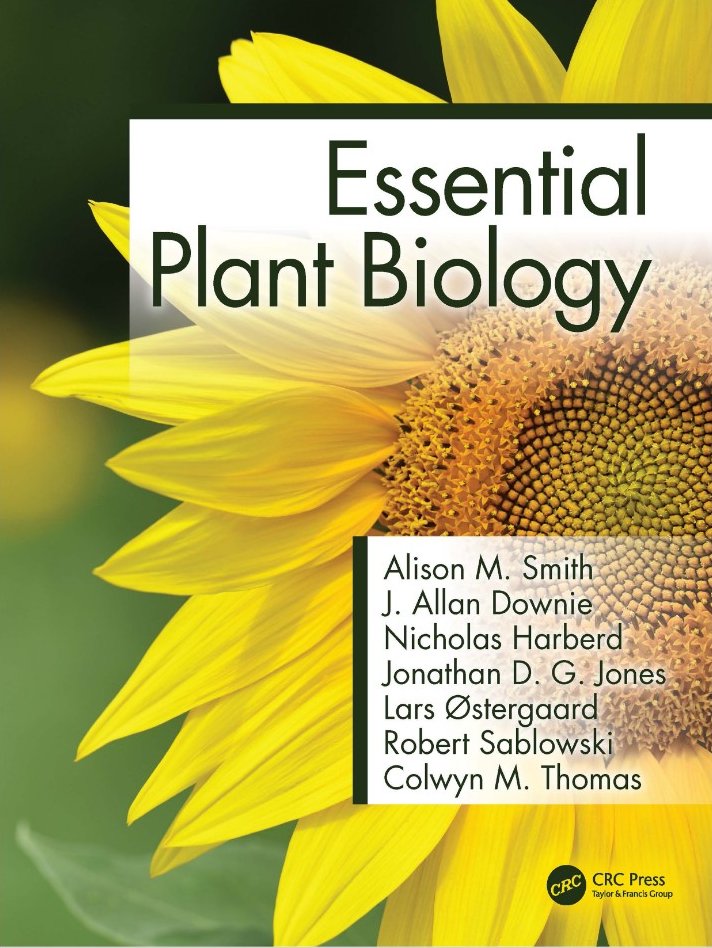
What constitutes essential plant biological knowledge in the 21st century? Alison Smith et al. seem to have the answer in their book Essential plant biology, which is here reviewed.
So, what is essential when it comes to plant biology?
Probably the most important change to acknowledge from the late 1970s when I was taught plant biology as an undergraduate is the impact of molecular biology on the subject. Although genes existed in living organisms (and had been working there for a very long time), we didn’t know that much about the details of how they worked in plants in the ‘70s. And molecular genetics certainly wasn’t taught to botany undergraduates. That situation changed dramatically towards the end of the 20th century, and its importance to an understanding of how plants work has only increased into the 21st. Accordingly, that aspect of plant biology looms large in Essential plant biology. And its essentiality to modern-day biology – not just of plants – is underlined by Smith et al. in occupying the 2nd and 3rd chapters of their book, which sets the scene for an appreciation of the molecular biology of the rest of the tome. [Ed. – as a ‘traditionalist’ when it comes to plant biology, it was nice for Mr Cuttings to see that chapter 1 was devoted to origins of the land flora – evolution and diversity of the plant kingdom].
In the book’s own words, “Starting with the evolutionary history of plants, the book addresses the dynamic nature and regulation of plant genomes, the conversion of products of photosynthesis into the vast diversity of molecules that comprise the plant body, and the nature and coordination of growth, development, and reproduction of the plant”. And that is a good summary of what Essential plant biology does: its approx. 552 pages of main text deliver a pretty comprehensive introduction to our understanding of plant biology in the 21st century (although the authors acknowledge that it is only an ‘overview’ (Preface, p. ix)).
The book’s organisation and content
Essential plant biology is divided into six parts: PART I, the origins of plants, their evolutionary diversification, and the nature and magnitude of their impact on the planet over the last 3.5 billion years; PART II, the nature of plant genomes, and how genomes and the mechanisms that regulate gene expression give today’s diversity of plant species; PART III, photosynthesis, and the means by which the primary products of assimilation and nutrients from the soil are converted into the multitude of molecules that are assembled to form the plant body; PART IV, how the plant body develops, grows, and reproduces; PART V, how plants sense and respond to changes in their environment; and PART VI, the importance and future of human interactions with plants*. That sextet is further sub-divided into 18 Chapters, the bulk of which are in the Parts that deal with: Metabolism; Growth and development; and Interactions with the environment. The layout of those chapters is pleasingly uniform throughout the book: after a statement of learning objectives, the text is broken down into sections with informative sub-headings (that summarise the contents of each sub-section), and concludes with a pretty full summary of the chapter. Finally, readers are referred to “interactive self-test questions” (e.g., p. 163) that test understanding of chapter content (and give the answers)**, and “further reading suggestions”, both of which should be found on-line here.
The book’s essential emphasis…
Although the proportions of text in Essential plant biology devoted to different aspects of plant biology differ from some of my standard ‘go-to’ textbooks such as Raven Biology of plants by Ray Evert & Susan Eichhorn (8th edition, 2013), and James Mauseth’s Botany (sixth edition, 2017]) – both of which have more-in-depth information about plant anatomy and morphology, and cover biology of all groups within the Plant Kingdom, and algae (and fungi in the case of Evert & Eichhorn) – Essential plant biology has much more emphasis upon the molecular side of botany than those other tomes.
In that regard, in Essential plant biology, we get a lot – and I mean a lot(!) – of biochemistry and the molecular genetic basis of plant physiology and development. And that emphasis is appropriate to the modern-day pre-occupations of plant scientists. In many respects the anatomy and physiology of plants is well-established, it’s trying to understand how that growth, differentiation and function is regulated and controlled that is the current challenge. In that respect Essential plant biology is an important companion to more traditional botanical textbooks such as Evert & Eichhorn’s, and Mauseth’s. To some extent, the authors of Essential plant biology acknowledge that in advising its readers “We focus mainly on the biology of multicellular land plants – readers are recommended to seek additional information on photosynthetic organisms in the oceans, responsible for about half of the photosynthetic carbon dioxide assimilation on the planet” (Preface, p. ix). And its implicit when one learns that “We wrote this book to provide a new generation of plant scientists with an appreciation of the wealth and breadth of radically new knowledge and technologies in plant biology” (Preface, p. ix).
Comparisons with other textbooks
Essential plant biology has many similarities – e.g., multiple authors, and greater emphasis on biochemistry and the molecular aspects of plant biology – with Lincoln Taiz et al’s Plant physiology and development (2023) [Ed. – for Mr Cuttings’ appraisal of that tome, see here].
But, the botany textbook with which it shares most in common is the 2010 publication, Plant biology by Alison Smith et al.. That book was co-authored by several of the team that wrote Essential plant biology, specifically, Alison Smith, Nicholas Harberd, Jonathan Jones, and Robert Sablowski. In the Acknowledgements to Essential plant biology we are told that, “We are grateful to George Coupland , Liam Dolan …, and Cathie Martin …, co-authors on our previous book Plant Biology (2010). This new book [i.e., Essential plant biology] draws heavily on their prior contributions”. With 15 years or so between the publication dates of the two tomes, one expects Essential plant biology to include much more of the recent advances in plant biology.
You can get a very good idea of the ‘debt’ owed by Essential plant biology to Plant biology by comparing the first chapters of both books (downloadable under the ‘preview pdf’ option at the book’s publisher’s sites, for Essential plant biology, and here for Plant biology. Looking through both full copies of the books it is easy to think of Essential plant biology as being the second – revised – edition of Plant biology. [Ed. – but, two of the really useful features of Plant biology – inclusion within the book of a Glossary (28 pages’ worth) and lists of further reading – were not incorporated into Essential plant biology]
Intended audience?
Every book is published with a particular readership in mind. According to the publisher’s site, Essential plant biology has been “Carefully designed for, and written at, a level accessible to all undergraduate biologists who have a grounding in the fundamentals of molecular biology and biochemistry”. That appears to be the case: Essential plant biology is very ‘molecular’. Potential readers should be therefore be advised that quite a high level of biochemical prior knowledge is required to get the best out of Essential plant biology. As is also the case for molecular biology – although chapters 2 and 3 will help provide some of the necessary context and underpinning for that side of things. Essential plant biology is not a plant biology textbook for those students with no prior knowledge of molecular biology or biochemistry, for whom a more traditional botany text would be more appropriate.
Another aspiration of the book is to be “a valuable resource for postgraduates in plant research” (quoted from the publisher’s site). Given its molecular emphasis, that appears entirely reasonable. As does the notion that “For lecturers, the breadth of coverage and clear organization facilitate the teaching of both complete courses in plant science and more focused topics in plant biology” (quoted from the publisher’s site). Although other topics not addressed in Essential plant biology – such as the biology of plant groups beyond primarily angiosperms – would be needed for a more comprehensive course on plant biology.
Sources?
The main purpose of a textbook – its raison d’être if you like – is to be the text that provides the facts for a particular subject. In that role the textbook becomes the fount of knowledge for whatever subject it may be, plant biology in this case. Readers – e.g., students taking a plant biology course – are therefore entitled to believe what is stated in the book, that its words are ‘gospel’ and that all facts stated are true. But, we also would like our students to think for themselves and maybe be just a little sceptical. In that regard we would want to give them additional information so they could make their own minds up about a particular fact or statement. In order to do that they need access to the sources used by the authors who wrote the text wherein the statements are made. Do readers of Essential plant biology have that opportunity? Maybe. We are told that Further Reading exists for chapters in the book. The trouble is that such material is not to be found within the book itself. Instead, it had been placed on-line, here.
My understanding is that the site that holds this further reading is not password-protected, and should be freely-accessible by anybody. Although that site was not available throughout the time I was drafting this review, I am pleased to say that it was available at 10.12 am on Friday 20th February, the day that this post is published. [Ed. – fortunately, Mr P Cuttings spotted this before pre post publication deadline, and amended his review – hopefully removing his more critical comments about lack of availability of this resource for soem time after availability of the book]
Not having the time to scrutinise every item of further reading available on-line I can offer a few general comments. Items listed are a good mix of books and scientific articles. It was interesting to see five Wikipedia pages listed for Chapter 1. Although one wouldn’t like to see such sources cited in a student’s work, they are extremely useful starting points for a student’s own reading around a subject – when one would expect them to refer to the sources cited for statements made in the Wikipedia articles. It was also interesting to compare sources listed for Essential plant biology compared to those for Plant biology by Alison Smith et al. (2010) – which book is drawn heavily upon for Essential plant biology – and is available here. In that regard it was somewhat surprising to see only eight items listed for Chapter 2 Genomes in Essential plant biology compared to nearly 50 for the chapter of the same name and number in Plant biology. But, one thing that does stand out is the publication dates for further reading for essential plant biology; the great majority appear to be dated post-2010, the publication date for Plant biology. Which means that a great deal of effort has gone into providing up-to-date sources for statements made in Essential plant biology. All-in-all, sources stated for Essential plant biology should go some way to providing the necessary evidence to substantiate statements made within the text***. But, whether readers will be able to relate a specific source to a particular statement is not known. BUT…
… Although removal of sources to an on-line depository saves space in the physical book, what about situations when readers have no internet access? How, then, can they be (re-)assured of the veracity of what they have read? Surely, there is an argument for including – at least some of – those sources within the book itself. And what about the glossary? That has also been removed to the publisher’s site, or ‘the cloud’ (Cody Slingerland). This reviewer, for one, thinks that inclusion of the glossary within the body of the book would be a greater benefit to, and provide a greater service for, the readers.
How up-to-date is it?
Not being an expert in all aspects of plant biology – and therefore able to determine factual ‘up-to-dateness’ just from reading the text – it is hard to assess this aspect of Essential plant biology without sight of the sources used (which are unavailable as I pen this review). However, there was one telling indication in the book: Mention of the ‘nitroplast’. It’s almost a ‘throwaway’ two-sentence comment on page 491, in a section dealing with nitrogen-fixing symbioses. The nitroplast is a newly-recognised nitrogen-fixing organelle identified in a marine alga. I knew about this because I had intended to blog about it when the news broke in 2024. Not knowing what the on-line resource for the book might have to say about this, if you are interested in finding out more I’m happy to point you in the direction of the scicomm article by Jess Cockerill, and the relevant scientific papers by Tyler H Coale et al. (2024), and Francisco M Cornejo-Castillo et al. (2024). Finding that in Essential plant biology leads me to conclude that the book is – likely to be – very up-to-date [Ed. – and see comments under Sources?].
It’s not all in the book…
Throughout the book, there are signposts to ‘online material’, which “provides additional details, related concepts or broader perspectives, background history or methodology, or relevance to food, health, industry, or agriculture” (Preface, p. x). Online Material for each chapter includes a Reading List, providing reviews of and background to specific or general topics addressed in the chapter. Online resources also include an extensive Glossary, “covering words and terms highlighted in bold in the book that may be unfamiliar to newcomers to plant biology” (Preface, p. x). I’ve written about the wisdom of this approach above [see Sources?].
To help the instructor, slides of the book’s figures have been created for use in lectures, etc. Available as both pdf and ppt formats, they are accessible at the Instructor Resources Download Hub. To access that resource it is necessary to register as a qualified instructor [Ed. – which Mr P Cuttings isn’t, so can’t comment on that resource]
Having read material in a textbook it’s always useful to try and assess what has been learned – both for the benefit of the instructor, and instructee. To help with that chapters in Essential plant biology are accompanied by “Questions for Students: Up to 10 online multiple choice questions on topics presented in the chapter, designed to allow students to evaluate their understanding of the material. Some are straightforward; others may prompt further study of the text” [Preface, p. x]. These questions are available on the Instructor and Student Resources Website.
It’s not just about the words
The text of the book is important. Visually, Essential plant biology is also a very attractive looking book, being abundantly illustrated with graphics from Nigel Orme (who does indeed “turn science into art”), and adorned with figures and graphs from published plant biological research. Given the large number of biochemical pathways and molecular biological interactions that are covered in the book, such graphics are essential. Importantly, for some of those graphics, the source publication is stated, which gives readers an opportunity to examine the source of such displays – if unable to access further reading that’s only available on-line.
Essential, but maybe missing some important information?
In providing their overview of essential plant biology, a few important omissions appear to have been made.
First, in connection with water relations, there is no mention of matric potential. Matric potential is important in understanding the relationship between soil-held water and ability of plants to abstract it from the soil. It is essential to an appreciation of water uptake by geminating seeds. That omission is surprising (although it also appears absent from Plant biology (2010)). [Ed. – there’s no mention of gravity potential, either. Although that is usually ignored when dealing with shortish plants such as arabidopsis and maize, or horizontal branches, it has to be taken account of when considering water movement to the tops of tall plants such as ‘giant coastal redwoods’…].
Second, although the phenomenon by which oxygen-generating photosynthetic organisms oxygenated the atmosphere was written about in Chapter 1, I was surprised not to see specific or explicit mention of GOE – the Great Oxygenation Event (GOE, or Great Oxidation Event) (Kartik Aiyer) in the book. At the very least, flagging-up that term here in the book would help readers explore that particular topic further, elsewhere.
And third, CRISPR technology. This gene-editing technique is mentioned in the book, but only in the Index, where readers are referred to an on-line source for more information about it (which can be found under Chapter 2 Genomes). Having looked at the on-line information about that technique [foiund in “OM2.2 METHODS FOR INVESTIGATING GENE FUNCTION IN PLANTS”, within the ‘reverse genetics’ section], what I read didn’t really give me that much information about the technology. As a student I think I’d need a little more background than what is provided. The omission of CRISPR from the book seems a little odd – especially for those readers not able to access the internet.
However, one nice touch, that was appreciated by this reviewer, was seeing plant hormones called plant hormones. This is much preferred to having to read about ‘plant growth regulators’ – not least because some of those compounds – or some of their multiple roles at least – don’t actually regulate growth as such. And it’s good to see nickel included as an essential nutrient (Kennedy Appah) – for so long it has been excluded from lists of essential plant nutrients.
Summary
Essential plant biology, by Alison Smith et al., is an impressive tome. As a textbook it provides a very good – and up-to-date – overview of the present-day understanding of how plants work in the first quarter of the 21st century. With its emphasis on the molecular side of plant biology, Essential plant biology will not replace more traditional botany textbooks with their more organismal focus, but it does provide additional valuable and important insights into how plants work.
Amongst the book’s final words are these, “Humans are at a tipping point in their capacity to deliver crops to meet challenges. The knowledge, skills, and creativity of the next generation of plant biologists will be essential for success in that endeavor” (p. 551). One trusts that the information in Essential plant biology will contribute to that – provided we retain the capacity to provide botanical education to our students (e.g., Sebastian Stroud et al., 2022).
* In respect of Fig. 17.1, “The Fertile Crescent” on p. 512, the publisher might like to check that the spelling of the name of the country that sits between Georgia and Armenia on its western border and the Caspian Sea to the east. I know it in UK and US English as Azerbaijan, but is shown there as ‘Azabaijan’.
** Although you get feedback on your succcess (or otherwise), it looks like you only take the test (many questions in which are of the multiple choice variety) for each chapter once [Ed. – but using a different browser Mr P Cuttings was able to take an already-taken test again…].
Whilst I have not found the time to go through all of the questions, I do have a query about Question 9 in the quiz for Chapter 1 Origins, “Question 9 (Choose one or more) Which of the following statements about monocots, eudicots, and basal angiosperms are NOT true?” The site tells us that the correct answers are: “Option 3: Euicots [sic.] have two cotyledons whereas monocots have one; Option 5: Eudicots floral organs usually occur in multiples of four or five whereas monocot floral organs usually occur in multiples of three; and Option 7: Almost half of the calories consumed by humans come from monocot crops”. I don’t know if it’s me misunderstanding the instruction, but those three options all look like true statements to me, so how can they be correct answers to the question posed, which asks us to identify statements that are not true? [Ed. – and, yes, Mr P Cuttings is inviting replies from readers to this question]
*** For example, statements that do need their sources to be stated include: “Plants had colonized the land by about 470 million years ago” (p. 4); “Today there are about 400,000 species of seed plants” (p. 21); “Each year, plants assimilate approximately 100 billion metric tons of carbon, about 15% of the total CO2 from the atmosphere” (p. 91); “About 260 Tg (260 million metric tons) of reactive nitrogen**** enter the global nitrogen cycle**** each year due to the action of bacterial nitrogenase**** enzyme” (p. 490). Although sources for such facts may exist within the book’s listed further reading on-line, it might prove challenging to tie-up specific sources to particular statements.
**** These words and terms are emboldened here because that’s how they are shown in-text. Such emboldened items – found throughout the text of the book – are those that should be found in the on-line glossary [per Preface, p. x].
REFERENCES
Tyler H Coale et al., 2024. Nitrogen-fixing organelle in a marine alga. Science 384(6692): 217-222; doi: 10.1126/science.adk1075
Francisco M Cornejo-Castillo et al., 2024. Metabolic trade-offs constrain the cell size ratio in a nitrogen-fixing symbiosis. Cell 187(7): 1762-1768.e9; doi: 10.1016/j.cell.2024.02.016
Sebastian Stroud et al., 2022. The botanical education extinction and the fall of plant awareness. Ecology and Evolution 12: e9019; https://doi.org/10.1002/ece3.9019

 Plant Cuttings
Leave a comment